18 August 2014

Francine McKenzie, Québec city

'ICI VÉCUT
Francine
MCKENZIE
(1937–1988)
SOCIOLOGUE, GRANDE HUMANISTE ET PRÉSIDENTE
DU CONSEIL DU STATUT DE LA FEMME DE 1984 À 1988'

Narcisse-Henri-Édouard Faucher de Saint-Maurice, Québec city

'ICI VÉCUT
Narcisse-Henri-Édouard
FAUCHER
DE SAINT-MAURICE
(1844–1897)
ÉCRIVAIN ET JOURNALISTE AU JOURNAL DE QUÉBEC ET AU CANADIEN,
IL EST RECONNU COMME L'UN DES LITTÉRATEURS CANADIENS-FRANÇAIS
LES PLUS FÉCONDS DU XIX SIÈCLE

17 August 2014

Pamphile Le May in Québec city

'ICI VÉCUT
Pamphile
LE MAY
(1837–1918)
POÈTE, ROMANCIER, ET PREMIER CONSERVATEUR DE
LA BIBLIOTHÈQUE DE L'ASSEMBLÉE NATIONALE DU QUÉBEC'

Le May's most noted works are Le Pèlerin de Sainte-Anne (c. 1877), Picounoc le maudit (c. 1878), and Les Contes vrais (c. 1899) , and he also translated works by William Kiby and Henry Wadsworth Longfellow. He was the friend of writers  Louis Fréchette, Napoléon Legendre et Adolphe Poisson.

Gabrielle Roy in Québec city

'ICI VÉCUT
LES TRENTE DERNIÈRES ANNÉES DE SA VIE
Gabrielle
ROY
(1909–1983)
ROMANCIÈRE, LAURÉATE DE NOMBREUX PRIX DONT LE
PRIX FEMINA EN 1947 POUR BONHEUR D'OCCASION ET LE
PRIX DAVID EN 1969 POUR L'ENSEMBLE DE SON ŒUVRE'

Gabrielle Roy was born between two and three thousand miles from Québec, in Saint-Boniface, Winnipeg, Manitoba, although she went with her husband to Québec in 1952, where she spent her final thirty years.


Below is my link to Gabrielle Roy's most noted book:

–––––––––––––––––––––––––––––––––––
Gabrielle Roy: Bonheur d'occasion

15 August 2014

Anne Hébert in Québec city

'ICI VÉCUT
Anne
HÉBERT
(1916–2000)
'POÈTE ET ROMANCIÈRE, LAURÉATE DE NOMBREUX PRIX DONT LE FEMINA EN 1982
POUR LES FOUS DE BASSAN, LE PRIX DU GOUVERNEUR GÉNÉRAL EN 1992
POUR L'ENFANT CHARGÉ DE SONGES ET LE PRIX GILLES-CORBEIL
EN 1990 POUR L'ENSEMBLE DE SON OEUVRE'


My other Hébert posts:

–––––––––––––––––––––––––––––––––––
Anne Hébert in Paris
Anne Hébert: Les Fous de Bassan

Alain Grandbois in Québec city

'ICI VÉCUT
Alain
GRANDBOIS
(1900–1975)
'ÉCRIVAIN ET POÈTE, PRIX DAVID EN 1970
POUR L'ENSEMBLE DE SON OEUVRE'

Grandbois wrote poetry, short stories, essays and biographically and autobiographically inspired works.

H. P. Lovecraft in Québec city

'ICI SÉJOURNA
Howard-Phillips
LOVECRAFT
(1890–1937)
'CÉLÈBRE AUTEUR AMÉRICAINE DE LITTÉRATURE FANTASTIQUE,
IL A ÉCRIT UN TEXTE REMARQUABLE SUR QUÉBEC, ÉVOQUANT
NOTAMMENT SON 'PARFUM DE DOUCE ANTIQUITÉ,
DE QUIÉTUDE ET D'ÉTERNITÉ...'

The text perhaps refers to 'A Description of the Town of Quebec' in the essay collection To Quebec and the Stars (1976).

Louis-Alexandre Bélisle in Québec city

'ICI VÉCUT
Louis-Alexandre
BÉLISLE
(1902–1985)
'AUTEUR DU DICTIONNAIRE DE LA LANGUE FRANÇAISE
COMMUNÉMENT APPELÉ – DICTIONNAIRE BÉLISLE'

Bélisle's dictionary was one of the first to take account of the French language in Québec.

Adrienne Choquette in Québec city

'ICI VÉCUT
Adrienne
CHOQUETTE
(19151973)
'JOURNALISTE ET ROMANCIÈRE, PRIX DAVID EN 1954
POUR SON ROMAN LA NUIT NE DORT PAS'

Choquette – who was born in Shawinigan and studied in Trois-Rivières – wrote articles for a large number of organs, including Harvey's Le Jour. Contrary to what is mentioned on the plaque above, La Nuit ne dort pas is not a novel but a collection of short stories.

On the other side of the door is a plaque dedicated to Jean-Charles Bonenfant, a journalist, librarian and professor of Law at l'Univerisité Laval.

Jean-Charles Harvey in Québec city

'ICI VÉCUT
PENDANT QU'IL RÉDIGEAIT LES DEMI-CIVILISÉS
Jean-Charles
HARVEY
(18911967)
JOURNALISTE ET ÉCRIVAIN'

Harvey's novel Les Demi-civilisés (1934) was attacked by the clergy, particularly by Cardinal Villeneuve, and led to his dismissal from the daily Le Soleil. He established the weekly Le Jour in 1937, which continued for over eight years.

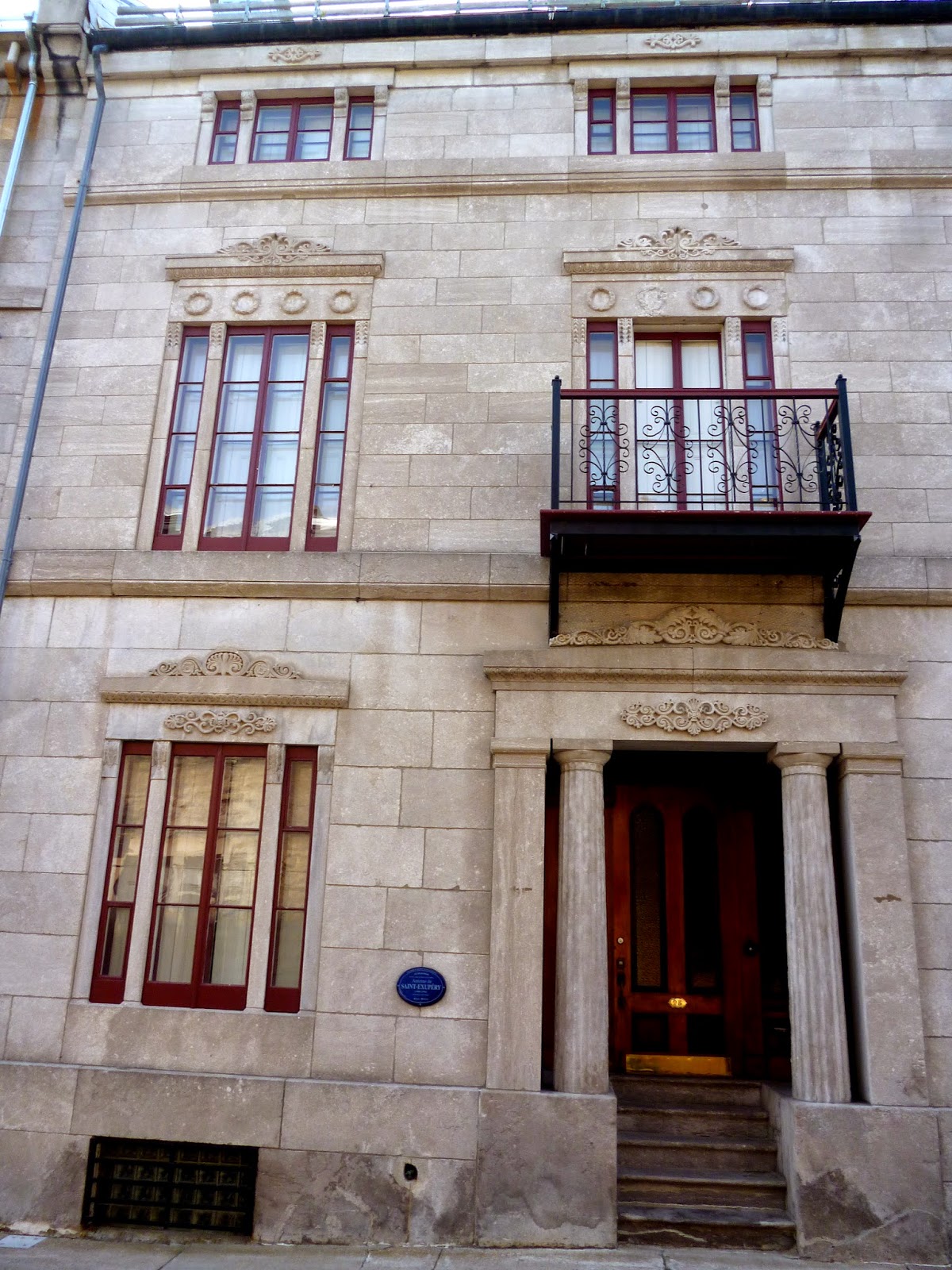
Antoine de Saint-Exupéry in Québec city

'Je me souviens' ('I remember') is the province of Québec's motto, and I believe that all number plates bear it. Clearly, this motto is the inspiration behind the title of the series of commemorative plaques 'Les Gens de Québec se souviennent' ('The People of Québec Remember') in Québec city, and I'll be posting a number of the ones that caught my interest. A few are a little blurred because of the distance I had to shoot them from.

This one is on 25 de la rue Sainte-Geneviève and records Saint-Exupéry's stay. Inevitably, Le Petit Prince is mentioned, although it's unfortunate that this is his only book mentioned:

'ICI SÉJOURNA
EN 1942, DANS LA FAMILLE DE KONINCK,
Antoine de
SAINT-EXUPÉRY
(1900–1944)
AUTEUR DU PETIT PRINCE'


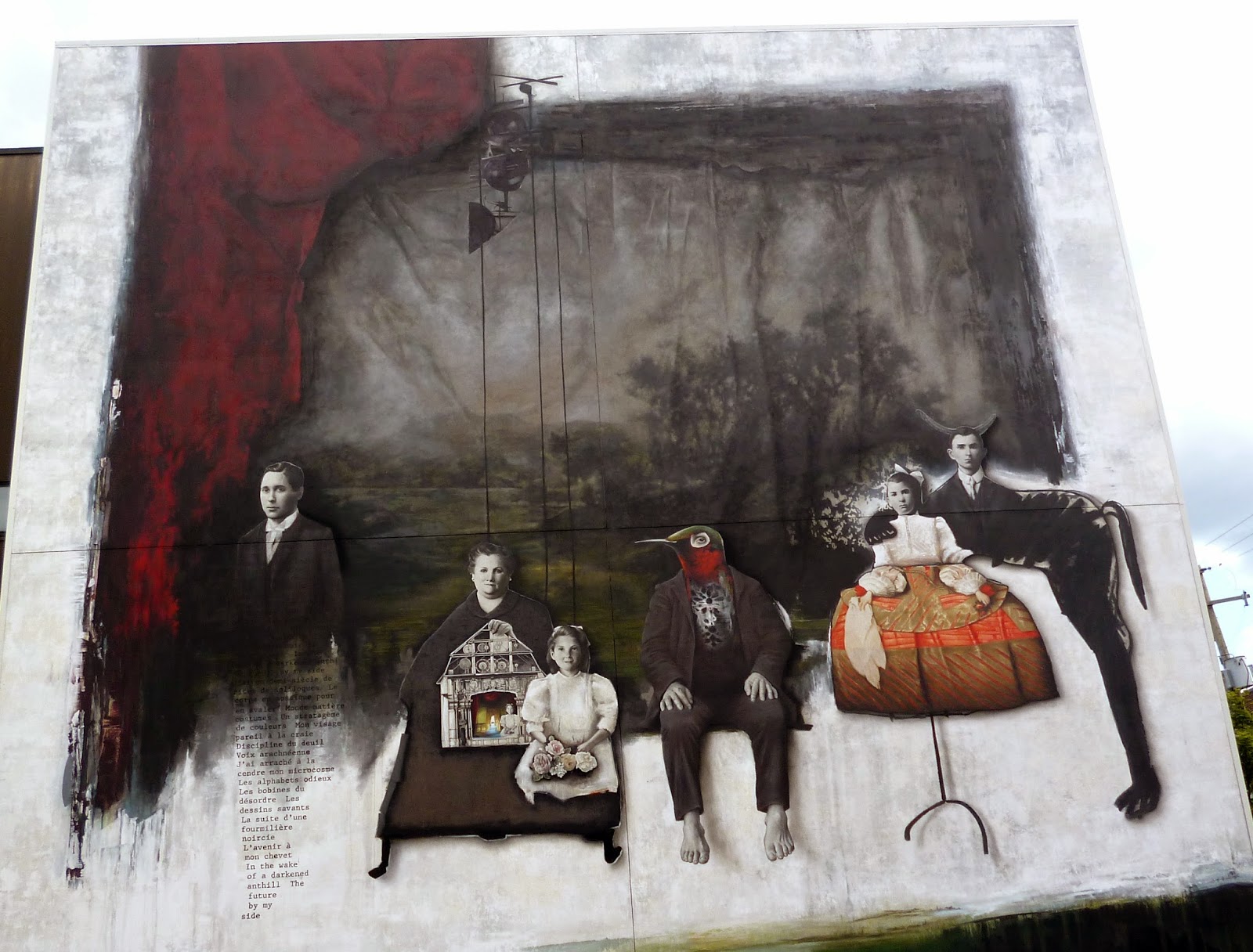
Félix Leclerc in Québec

I couldn't resist taking a shot of this shoe shop sign in Québec city, named after one of Félix Leclerc's most famous songs: 'Moi, mes souliers'. Leclerc died in 1988 in Saint-Pierre-de-l'Île-d'Orléans, where his ashes were scattered and where, in the local cemetery, a memorial stone was erected, where lovers of his songs leave their old shoes.

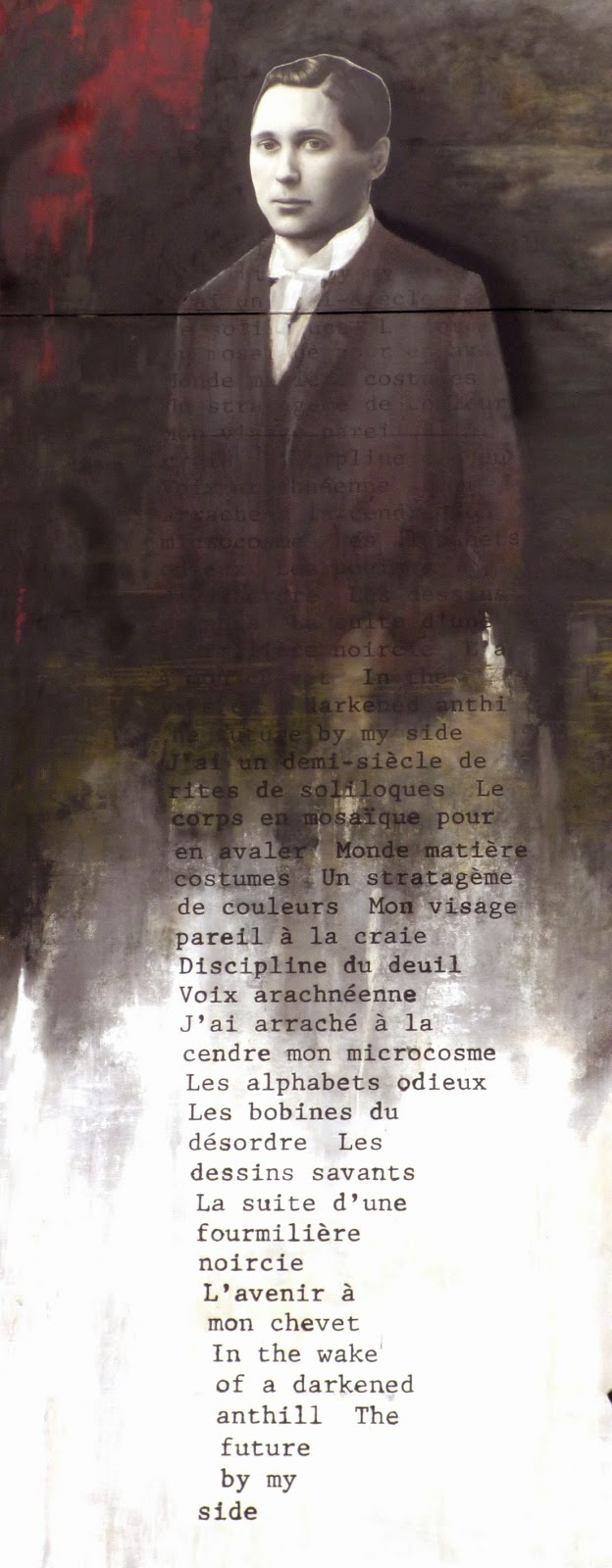
A representation of Leclerc on a huge mural, La Fresque des Québécois, in Vieux-Québec. A link below is to a rather strange clip of Leclerc singing the song, plus another to a former post I made on Leclerc:

–––––––––––––––––––––––––––––––––––
Félix Leclerc: 'Moi, mes souliers'
Félix Leclerc in Plateau-Mont-Royal

Québec and Bilingualism

The province of Québec is of course essentially French-speaking, although in the most populous – particularly tourist-infested – areas such as Montréal and Québec city there is a tendency for many of the inhabitants to speak both English and French, sometimes as a mixture, other times switching between the two languages apparently at random. I took this shot on the Grande Allée in Québec city, but far away from all the cameras firing away at the Citadelle and Château Frontenac. 'Fuck la police' is the bilingual message here, although I can't find the same expression anywhere online. The unilingual 'Nique la police' is common enough though, followed by 'Nique les keufs': 'flics' now sounds outdated.

14 August 2014

Les Conteurs, Plateau-Mont-Royal, Montréal, Québec

Les Conteurs, a mural by Richard Morin, was completed in 2011 and is another example of the MU project. It was part of the celebrations of the fiftieth anniversary of L'École nationale de théâtre of Canada. It was MU's most ambitious undertaking.


Octave Crémazie, Plateau-Mont-Royal, Montréal, Québec


The statue of the poet Octave Crémazie (1826–79) impressively stands at the entrance to the square Saint-Louis, where it was originally unveiled in 1906 at the instigation of Louis Fréchette.

Robert Burns in downtown Montréal, Québec


The statue of Robert Burns in square Dorchester, downtown Montréal, is by G. A. Lawson and one of several replicas: the original is in Ayr, with other replicas in Melbourne, Winnipeg, Vancouver and Detroit. This statue was unveiled in 1930 and commemorates the influence of the Scottish on the growth of Montréal.

'ROBERT BURNS
1759 – 1796

"IT'S COMIN' YET FOR A' THAT
THAT MAN TO MAN THE WORLD O'ER
SHALL BRITHERS BE FOR A' THAT"

A representation from 'Tam O'Shanter'.

A representation from 'The Cotter's Saturday Night'.

A representation from 'To a Mountain Daisy'.

13 August 2014

Portuguese writers in the Plateau-Mont-Royal, Montréal, Québec

In 2009 twelve public benches were installed in the quartier portugais on the boulevard Saint-Laurent to acknowledge the fifty years of the presence of the Portuguese community in Montréal.

Each bench is inscribed with a quotation by a Portuguese writer and is decorated with ceramic tiles (or azulejos) by four Montréal artists of Portuguese origin.

Unfortunately, several of the benches have suffered from graffiti attacks. Below I show all of the benches, although I only mention the writers to whom the benches are dedicated and don't give the quotations.

Logically, the starting point for the benches is parc du Portugal, a small park where there are many tiles, such as in the example of this fountain. From here southwards the benches feature on both sides of the boulevard Saint-Laurent, although the sequence below is in no particular order.

Miguel Torga.

Natália Correia.

José Saramago.

Eça de Queirós.

Luis de Camões.

Père António Vieira.

Dom Dinan.

Fernando Pessoa.

Gil Vicente.

Manuel Maria Barbosa du Bocage.

Antero de Quental.

António Lobo Antunes.