18 July 2013

Samuel Bamford in Stockport

The above sculpture of the poet Samuel Bamford is on a BHS wall in central Stockport. It was unveiled in 1978 and is part of a much larger series of reliefs. 

Below is a link to a much longer Bamford post:

–––––––––––––––––––––––––––––––––––
Samuel Bamford in Middleton

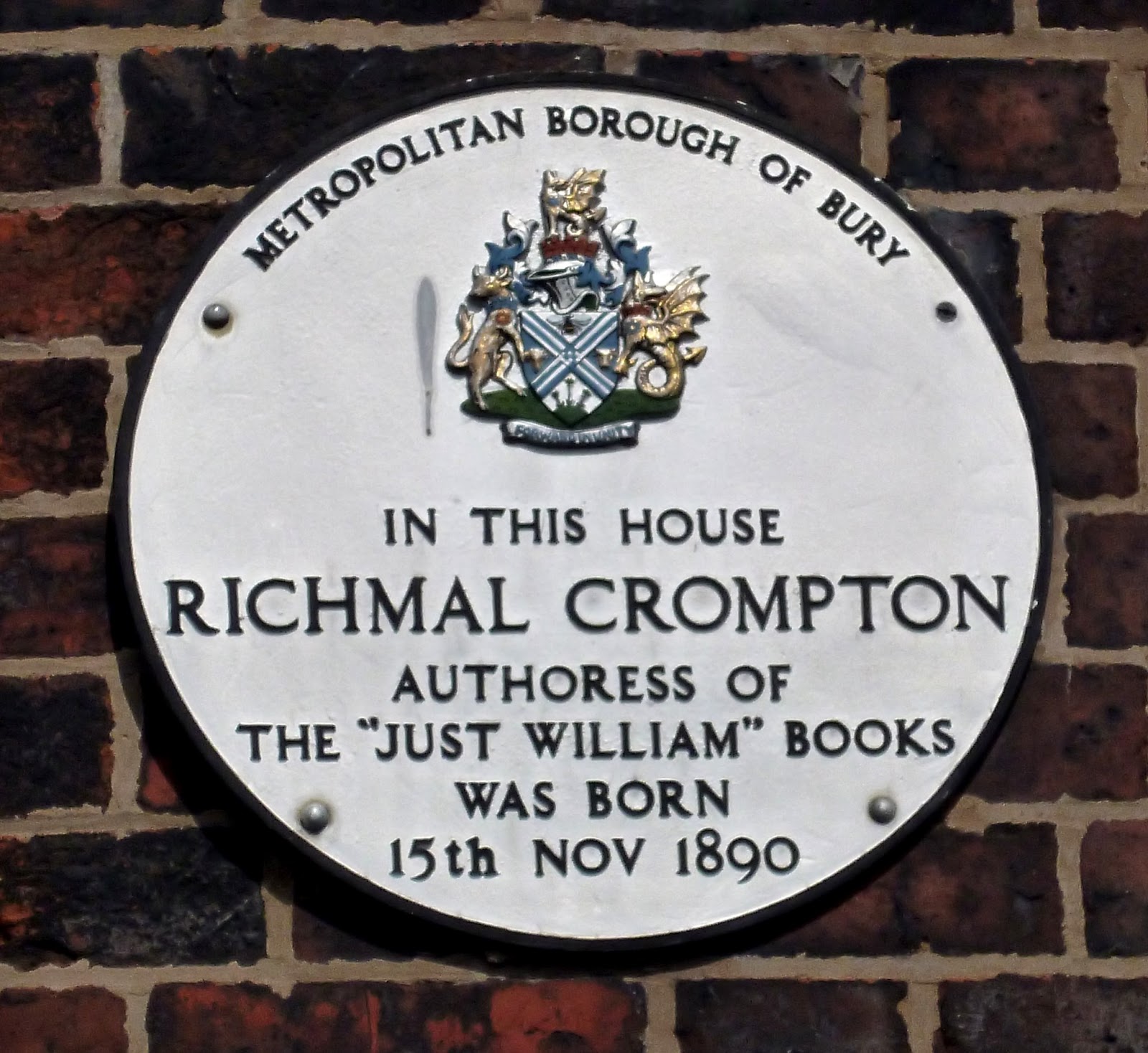
Richmal Crompton in Bury

The corner of Hampson Mill Lane and Manchester Road, near Hollins Vale, Bury.

'IN THIS HOUSE
RICHMAL CROMPTON
AUTHORESS OF
THE "JUST WILLIAM" BOOKS
WAS BORN
15th NOV 1890'
 
'Authoress'? I don't know when the sign was erected, but the expression must surely have been embarrassingly condescending even at the time.
 
I believe this plaque began life blue, but the sun has apparently blanched it. Richmal Crompton published about forty children's novels about William Brown, but although she published a similar number of adult books, it was the William books that sold more. She died in Chiselhurst in 1969.

Ron Silliman in Bury

'Poetry has been Bury, Bury good to me.'

Part of the Irwell Sculpture Trail, this neon sign at Bury Interchange shows a line from American poet Ron Silliman's 'Northern Soul'.

John Horsefield in Prestwich: Artisan Naturalists #1

In St Mary's churchyard, Prestwich stands the table tomb of the handloom weaver and amateur botanist (or artisan naturalist) John Horsefield, after whom the daffodil Narcissus Horsfieldii is named.

 'In Memory of
JOHN HORSEFIELD
OF WHITEFIELD, BOTANIST;
who died March 6th, 1854, in the
69th Year of his age.'

'Ye, who behold God's works in Nature's ways,
And find in Flowers mute anthems to His praise:
Who read the volume of eternal love,
In seeds of earth as in the stars above:
Here read a name whose fame shall long endure,
One of poor birth, but Gifted although poor:
God – unlike man – the humblest spirit lifts.
Nor asks his wealth before He sends His gifts!
Where'er Botanic science could be learn'd.
New links disclosed – new species yet discern'd
Where'er by wood or lane, or heath or hill.
God oped the book that taught Botanic skill.
There HORSEFIELD's foot from dawn to eve was seen
To learn – to teach – to be what he has been.
An honour to the soil that gave him birth:
A mind of truth – a heart instinct with worth:
Oh, may that spirit, for whose loss we grieve,
Our GOD accept – our Saviour, LORD, receive.'


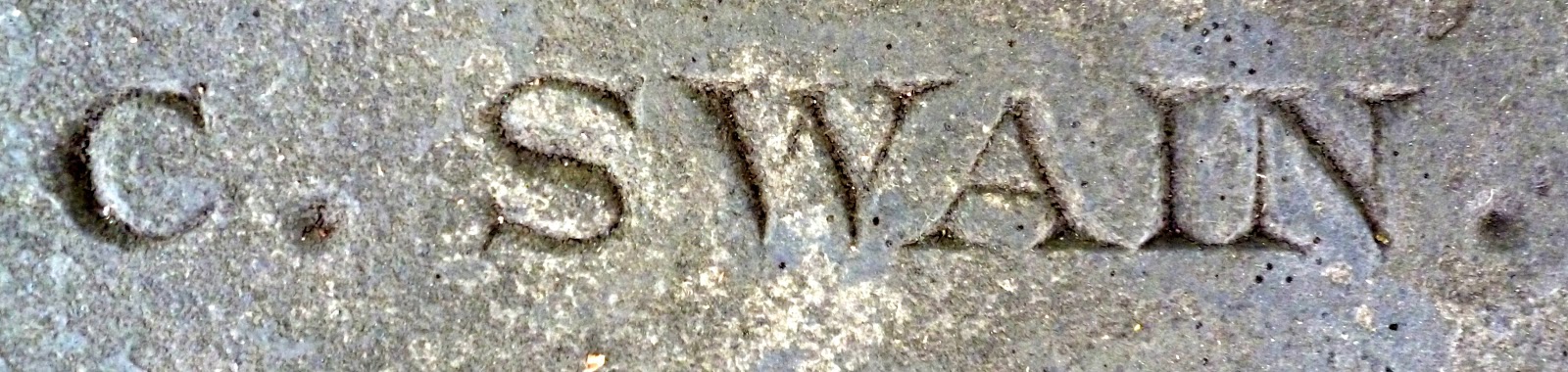
The verse is by the poet Charles Swain (1801–1874), and the grave has been given Grade II listed status.

Included at the top of the gravestone is an engraved representation of Tigridia conchiflora, a lily first hybridised by Waterfield.
 
–––––––––––––––––––––––––––––––––––
James Percival in Prestwich: Artisan Naturalists #2
Richard Buxton in Prestwich: Artisan Naturalists #3

17 July 2013

Kersal Moor and Chartism

 
'Kersal Moor
 
This Moor was the site of
the first Manchester Racecourse
(c 1687–1846) and the great
Chartist rallies of 1838 and 1839,
when over 30,000 workers met to
demand the right to vote and
the reform of Parliament.'

 
The wooden sculptures are attractive too.

James Crossley and Eleanora Atherton: St Luke's, Kersal Moor #5

'In Loving Memory
of
JAMES CROSSLEY,
PRESIDENT OF THE CHETHAM SOCIETY,
F.S.A.
BORN AT THE MOUNT, HALIFAX;
MARCH 31ST 1800
DIED AT STOCKS HOUSE, CHEETHAM;
AUGUST 1ST 1883.'
 
James Crossley (who has been called 'Manchester's Dr Johnson') was an author and bibliophile, and also a solicitor and a business partner of Thomas Ainsworth, the son of the novelist William Harrison Ainsworth who was a lifelong friend.
 
Crossley established the Chetham Society in 1843 to edit and publish works of local history, and many titles were published. He was responsible for the publication of a very successful hoax: Fragment on Mummies, which was said to be by Sir Thomas Browne.
 
I learned about the existence of this grave (and the other below that I've made posts on) from an online publication on St Paul's Churchyard, which I link here. This publication also mentions that he asked to be buried as closely as possible to Eleanora Atherton, and his wish was granted.

Eleanora Atherton (1782–1870) was a philanthropist who lived in Manchester and is thought to have given about £100,000 to charity between 1838 and 1870. She supported the work of the Chetham Society, including the donation of the library of one of her ancestors, the philosopher and poet John Byrom.

Below are links to other posts in the series:
 
–––––––––––––––––––––––––––––––––––
Edwin Waugh: St Paul's, Kersal Moor #1
Samuel Oldham Lees: St Paul's, Kersal Moor #2
Robert Angus Smith: St Paul's, Kersal Moor #3
William Edward Armytage Axon: St Paul's, Kersal Moor #4

16 July 2013

William Edward Armytage Axon: St Paul's, Kersal Moor #4

The dates of William Edward Armytage Axon (1846–1913) are only just visible on his gravestone, although he is also mentioned here in relation to his wife Jane (née Woods) (1843–89) and his granddaughter Helen Josephine. Here too his third daughter Katharine is buried.

Axon was born in Chorlton-on-Medlock, Manchester, the son of the soon-to-be bankrupt clothing manufacturer Edward Armytage and his fifteen-year-old servant Lydia Whitehead. He was brought up in poverty by the Axon family. Although his education was very limited, William Axon had a great aptitude for education, he spent some years at Manchester Free Library, and in the mid-seventies started working for the Manchester Guardian, where he remained until retiring in 1905.

His many published works include Exotica [poems], 1876; Illustrating Lancashire Dialect (1876); Life of Oliver Cromwell (1877); The Good and Evil of Tobacco (1877); The Annals of Manchester (1886); The Ancoats Skylark, and other verses, original and translated (1894); Echoes of Old Lancashire (1897); and William Harrison Ainsworth: A Memoir (1902).

–––––––––––––––––––––––––––––––––––
Edwin Waugh: St Paul's, Kersal Moor #1
Samuel Oldham Lees: St Paul's, Kersal Moor #2
Robert Angus Smith: St Paul's, Kersal Moor #3
James Crossley and Eleanora Atherton: St Luke's, Kersal Moor #5

Robert Angus Smith: St Paul's, Kersal Moor #3

A very impressive polished granite gravestone. Scottish-born applied chemist and environmental scientist Robert Angus Smith (1817–1884) has been dubbed 'The Father of Acid Rain'. In 1843 he became the chemist Lyon Playfair's assistant at the Manchester Royal Institution, and later stayed in Manchester as a consulting analytical chemist. His most noted publications are Disinfectants and Disinfection (1869) and Air and Rain: the Beginnings of a Chemical Climatology (1872).

Below are links to other posts in the series:

–––––––––––––––––––––––––––––––––––
Edwin Waugh: St Paul's, Kersal Moor #1
Samuel Oldham Lees: St Paul's, Kersal Moor #2
William Edward Armytage Axon: St Paul's, Kersal Moor #4
James Crossley and Eleanora Atherton: St Luke's, Kersal Moor #5

Samuel Oldham Lees: St Paul's, Kersal Moor #2

'IN LOVING MEMORY OF
SAMUEL OLDHAM LEES
OF CALDER BANK, DAVYHULME
DIED AT SALT LAKE CITY, UTAH, DECR 8TH 1879,
AGED 47 YEARS, WAS INTERRED HERE JANY 3RD 1880.'

Although Samuel Oldham Lees's grave is here, it's his daughter who is of interest. Edith Ellis (1861–1916), or Edith Lees, hated her cruel father and distrusted men in general. She became a lesbian. However, in 1883 she joined the Fellowship of the New Life, where she met Havelock Ellis, whom she later married. The marriage was unusual though: they probably never had sex, lived separately some of the time, and Edith continued with lesbian affairs.
 
In 1898 Edith published the novel Seaweed: A Cornish Idyll, which Jo-Ann Wallace suggests may have inspired D. H. Lawrence's Lady Chatterley's Lover,* and which (published by 'Dr. Roland de Villiers') was accidentally suppressed at the same time as Havelock Ellis's Sexual Inversion (1897). There is a link below to Seaweed, along with links to other posts in the series.
 
* 'The Very First Lady Chatterley? Mrs. Havelock Ellis’s Seaweed', by Jo-Ann Wallace, English Literature in Transition, 18801920 Volume 51, Number 2, 2008.
 
–––––––––––––––––––––––––––––––––––
Edwin Waugh: St Paul's, Kersal Moor #1
Robert Angus Smith: St Paul's, Kersal Moor #3
William Edward Armytage Axon: St Paul's, Kersal Moor #4
James Crossley and Eleanora Atherton: St Luke's, Kersal Moor #5
Edith Ellis's Seaweed: A Cornish Idyll (1898)

15 July 2013

Edwin Waugh: St Paul's, Kersal Moor #1

Saint Paul's churchyard, Moor Lane, Kersal Moor, Salford.
 
The grave of Edwin Waugh (1817–1890) – pronounced 'Woff' – the dialect poet who was born in Rochdale and was the son of a maker of shoes. His poem "Come Whoam to Thi Childer an' Me" (1856) greatly impressed Andrea Burdett-Coutts with its emphasis on temperance and marital fidelity, although the alcoholic wife-deserter Waugh was obviously no exemplar of the ideals of the poem.
 
EDWIN WAUGH
'BORN 29TH JANUARY 1817
DIED 30TH APRIL 1890'
 
The following paragraphs are included in the Wikipedia entry for Kersal Moor:
 
'In 1876 the Lancashire dialect poet and songwriter Edwin Waugh moved from his Manchester home to Kersal Moor for the "fresher air". Waugh's early life was spent in Rochdale and although he worked in Manchester he yearned for the moors he remembered from his youth. He wrote the following poem about Kersal Moor:

Kersal Moor

Sweet falls the blackbird's evening song,
in Kersal's poised dell;
But the skylarks trill makes the dewdrops thrill,
In the bonny heather;
Wild and free
Wild and free
Where the moorland breezes blow.


Oft have I roved you craggy steeps,
Where the tinkling moorland rills,
Sing all day long their low sweet song,
To the lonely listening hills;
And croon at night
In the pale moonlight


While mountain breezes blow.

As his health declined, Waugh moved to the seaside town of New Brighton. On his death in 1890, his body was brought back to be buried in the graveyard of St. Paul's Church, on the edge of the moorland he loved so well.

...Oh lay me down in moorland ground,
And make it my last bed,
With the heathery wilderness around,
And the bonny lark o'erhead:
Let fern and ling around me cling,
And green moss o'er me creep;
And the sweet wild mountain breezes sing,
 
Above my slumbers deep. – from The Moorland Breeze, Edwin Waugh (1889)'

–––––––––––––––––––––––––––––––––––
Samuel Oldham Lees: St Paul's, Kersal Moor #2
Robert Angus Smith: St Paul's, Kersal Moor #3
William Edward Armytage Axon: St Paul's, Kersal Moor #4
James Crossley and Eleanora Atherton: St Luke's, Kersal Moor #5

11 July 2013

Armand Salacrou: Boulevard Durand (1960)

Armand Salacrou's dramatisation of the last years of Le Havre anarchist Jules Durand (1880–1926) had a particular poignancy for him, as he too is from Le Havre and although only ten years old at the time, lived opposite the prison when the unfortunate Durand affair broke out. Boulevard Durand is a powerful, heartfelt indictment of the frame-up of Durand by the authorities.

Durand was Secretary of the union of coal heavers on the docks in Le Havre in the summer of 1910 when a strike for better conditions was called. One evening there was a drunken argument in which a scab, Louis Dongé (whose name Salacrou changed to Capron in consideration for his daughters), was killed. Although the militantly teetotal Durand had nothing to do with this, his company bosses thought this an excellent opportunity to incriminate him, and after a farcical trial in which Durand was accused of complicity in the murder, three of the real killers were imprisoned but Durand sentenced to be beheaded in a public place in Rouen.

Durand had a nervous breakdown from which he never recovered. The photos on the cover of the book above graphically portray the damage: the one on the left shows a young, healthy-looking thirty-year-old with quite chubby cheeks, whereas the one on the right shows a sick-looking, haggard old man: only two years had elapsed between the taking of the photos.

Durand was declared innocent in 1918, although he died insane in Sotteville-lès-Rouen lunatic asylum. In 1956 boulevard Durand in Le Havre was named after him, hence the title of the book.

I was particularly struck by what Julia (Durand's partner) says in Salacrou's play:

'[O]n n'a pas le droit d'amener les hommes affamés à voler, et leur reprocher leur vol; de leur vender de l'alcool et les traiter d'ivrognes'. (My translation: 'No one has the right to force starving men to steal and then reproach them for theft. Nor to sell them alcohol and call them drunkards.')

This reminds me of Sasha's thoughts about her boss in Jean Rhys's novel Good Morning, Midnight: 'Let’s say that you have this mystical right to cut my legs off. But the right to ridicule me afterwards because I am a cripple – no, that I think you haven’t got.'

Barbara Pym: Some Tame Gazelle (1950)

My second Barbara Pym novel is in fact her first published, although it took many more years in the making, being begun sixteen years previously in 1934, when she was still at Oxford University. Several of her characters contain elements of people she knew at Oxford, and the main two characters, the confirmed fiftysomething spinsters Belinda and Harriet Bede, are a kind of premonition of Barbara and her sister Harriet's life together: they also lived in a village and were deeply steeped in social rituals revolving around the parish church.

As for some of the other inspirations:

– Archdeacon Henry Hoccleve is inspired by Henry Harvey. Pym met Harvey at Oxford and never forgot him: Belinda had 'loved the Archdeacon when she was twenty and [never] found anyone to replace him since'. The narrator adds 'with the years [Belinda's] passion had mellowed into a comfortable feeling, more like the cosiness of a winter evening by the fire than the uncertain rapture of a spring morning'. She admires his wife Agatha, and seems to prefer this marriage from a distance, by proxy.

– Radmila May notes that John Akenside, who died in a riot in Prague but is only mentioned in relation to Count Bianco, was inspired by her father John Barnicot, who incidentally wasn't killed in Prague, but had a Balkan connection as Akenside does, and whose physical description tallies.

– Count Bianco was inspired by Robert Weiss: May comments that Weiss was famous for unrequited love, and never forgave Pym for the description of Bianco repeatedly asking Harriet to marry him.

Pym's spinster sisters want not to get married far more than they want to get married, although there is something – which is surely deliberate, as if Pym is laughing at herself – ridiculous (partly because paradoxical) in their situation, in their being jealous about men they can't have and don't want. The whole thing seems to be a game that the women win (or at least don't lose), and usually, I think, the men are seen in a more ridiculous light than the women: Nathaniel Mold is upset by Harriet turning him down and resorts to drink; Bishop Theodore Grote is eager to be married, although he seems not too concerned to whom; and Henry delights in talking over people's heads and repeatedly quotes the same lines from Edward Young, as if he were a young schoolboy scoring points in a test of knowledge.

Literary quotations seem to be a prominent feature of Pym's novels, and they are often used to make an important generalising principal. In yet another humorous observation on spinsterhood, the narrator, speaking through Harriet and Belinda's thoughts, concludes:

'[W]ho would change a comfortable life of spinsterhood in a country parish, which always had its pale curate to be cherished, for the unknown trials of matrimony?'
 
Harriet remembers her sister

'saying something about people preferring to bear those ills they had, rather than flying to others that they knew not of'.

This, of course, is a slight misquotation from one of Hamlet's soliloquies, and is most apt: a more prosaic, proverbial rendering would be 'better the devil you know than the devil you don't.'

One of the oddest paragraphs, and one in which the virtual life of the sisters is again highlighted, is when Agatha is leaving for a holiday abroad on her own and the sisters take up 'their posts' at the window well before she is due to leave. They are obviously not only 'very confirmed spinsters', as Harriet later remarks, but confirmed curtain twitchers who love watching people come and go, and Agatha's leaving is something they have 'looked forward to [...] with an almost childish excitement'. Things of interest to them are the emotions shown on the occasion, what Agatha is wearing, how much luggage she has, etc. Self-parody this certainly is, although aren't such actions bound to evoke pity in the reader rather than amusement? Isn't it taking the proxy world of Belinda and Harriet (and by extension Barbara and Hilary) a little too far? Just a thought.

9 July 2013

James M. Cain: The Postman Always Rings Twice (1934)

The 1927 murder of Albert Snyder by his wife Ruth and her lover Henry Judd, as a result of which both were convicted and executed, is a clear influence on James M. Cain's Double Indemnity (1943). It was also a minor influence behind Cain's earlier The Postman Also Rings Twice, which was banned in Boston due to the sex and violence in it.

The Postman Always Rings Twice is narrated by Frank Chambers, an itinerant who finds little difficulty insinuating his way into the the Papadakises' lives: Nick the Greek runs a rural Californian diner and needs a worker, and his american wife Cora needs another life.

Cora is a femme fatale and the 24-year-old Frank – who tells his story in a rather paradoxical mixture of slangy casualness and doomladen nerviness – is soon (disturbingly) falling for her smell, and it's obvious he doesn't mean perfume: he gives her a literal lovebite that draws a deal of blood from her lip – before taking her off to bed.

The murder of Frank is inevitable, although many events in this short novel are by no means predictable. But then, for me it's not the plot so much that's striking, but the way this tale – almost eighty years old – has a thoroughly modern feel to it. I think it's because there's so much suggestion and no compromising euphemistic elements.

Northern Voices 14: Summer / Autumn 2013

I discovered Northern Voices last week in a newsagents in Ashton-under-Lyne market: a radical biannual magazine published in Burnley, Lancashire, dealing essentially with northern issues.

The main article is by John Walker, the former editor of the Rochdale Radical Press, the first paper to reveal the scandal about the child abuser and self-advertiser Cyril Smith (1928 – 2010) way back in 1979. This was known about, but ignored, by all the press (apart from Private Eye), by the police (who held a dossier on him), and of course by the Establishment: well, he was a major political public figure, what did truth and justice matter as long as the fact that he was such a monster could be concealed? We really need radical papers because they have the guts to expose corruption, because they're not tied to any political party.

Another article in this issue's Northern Voices is the not-too-serious 'Six o' the Best: Northern Artists' by Christopher Draper, which after reluctantly rejecting Northumberland's Ashington Group member George Blessed, Liverpool-born Walter Crane, Leeds artist George Walker and Chester-based Louise Rayner, lists (in ascending order and in a slight parody of celebrity lists) the final six:

6. Isabella Jobling (née Thompson) 1851–1926, painter associated with the Staithes Group.

5. Thomas Bewick (1753–1828), wood engraver born in Northumberland.


4. David Hockney (b. 1937) from Bradford.

3. Atkinson Grimshaw (1836–93), born in Leeds.

2. William Etty (1787–1849), born in York.

1. L. S. Lowry, from Salford, who ended his days in Mottram.

There's also a long review of a book I wasn't aware of: David Goodway's Anarchist Seeds Beneath the Snow (Liverpool University Press, 2006; rev. 2012).

Great stuff, but what I can't understand is the apparent self-censorship, as in a cartoon with a balloon saying 'Willy – you're a sexist Anti-Semite, you f**king disgrace!' Yes, 'f**king', just like the red tops: really radical. So why can't an organ of the free press say 'fucking'? What are they frightened of: loss of advertising revenue, loss of readers, loss of sales outlets? Surely not, as they would no longer be 'free'.

8 July 2013

Barbara Pym: Excellent Women (1952)

Barbara Pym's Excellent Women depicts a world that revolves around spinsters, Anglo-Catholic rituals, anthropologists, church jumble sales, correct behaviour, suitable dress, bathroom sharing, and above all tea. As the above sentence may suggest, externally this is a world that has in some respects gone or is disappearing, one in which the church was all-important as a social focus and moral compass, when people had a 'Christian' name as opposed to a first or forename, when pubs were called 'public houses', when people frequently popped in to visit acquaintances and friends without prior arrangement – before the ubiquity of the telephone as a nervous tic, before the cultural anaesthesia of television.
 
Mildred Lathbury, a thirtyish spinster who works part time for the Society for the Care of Gentlewomen, is the protagonist and narrator. Her non-working life is wrapped up in church acivities, although the arrival of the anthropologist Helena Napier and her husband Rockingham, neither of whom are churchgoers and both of whom are very extroverted, soon bring a little colour to Mildred's existence. But perhaps this isn't what she really needs.

Mildred doesn't seem romantically interested in Father Julian Malory, nor in a man with whom she occasionally has lunch: William Caldicote, the priggish brother of her friend Dora. In fact she seems more interested in Rocky, who is of course unavailable because married. And here we perhaps have the crux of the issue: that Mildred may think about marriage from afar, but really isn't interested in it becoming a reality. Like Lolly Willowes in the first half of Sylvia Townsend Warner's novel of the same name, Mildred prefers to live life by proxy. As William tells her:

'We, my dear Mildred, are the observers of life.' In fact they do socially (or maybe more exactly, virtually) what Helena and her colleague Everard Bone do professionally.

Mildred herself says:

'I must not allow myself to have feelings, but must only observe the effects of other people's. [...] [P]erhaps I really enjoyed other people's lives more than my own.'
  
Mildred tells Dora – also a spinster – that there's no one she wants to marry, and Dora replies that she doesn't know anyone either 'at the moment', an expression that the narrator quietly picks up on and considers:
 
'It was a kind of fiction that we had always kept up, this not knowing anyone at the moment that we wanted to marry, as if there had been in the past and would be in the future.'

There certainly are moments of strong drama in the novel, such as Helena walking out on Rocky, or the young widow Alegra breaking off her engagement to Julian, but usually the actions are far more subtle, very understated, although at the same time sometimes apparently minor things (such as a teapot) carry great weight. When for instance Mildred asks Miss Stratham if they need a cup of tea, she interprets the effect of her question on her involving pain, puzzlement, distress, almost anger:

'It was the kind of question that starts a landslide in the mind.'

Such a sentence – evidently self-parody – comforted me in the knowledge that Mildred was capable of laughing at herself to such a degree: this is almost absurdist territory. And I can see why Anne Tyler identifies with Pym's work, saying that she 'reminds us of the heartbreaking silliness of everyday life'. I can't wait to read more Pym novels.

4 July 2013

Timothy Conigrave: Holding the Man (1995)

The expression 'holding the man' is from Australian football, and although it certainly relates to John Caleo's enthusiasm for football, it relates far more to John and the narrator Tim Conigraves's gay relationship described in this autobiographical work set in Australia.

Holding the Man details Tim's school years from the early sixties, through the swiftly developing awareness of his homosexuality in his early teenage when, after a few gay experiments with others, he finds love and happiness with John. This is very much the story of a fifteen-year-old relationship which survives the insults of homophobic school 'friends' and peers as well as the embarrassment, disgust, incomprehension and religious hypocrisy of the parents.

The book is divided into three parts: 'A Head Full of Boys', which takes the reader up to the time when Tim and John leave school; 'Out in the World', the shortest section, in which the two lovers temporarily separate and they – particularly Tim – experiment with other male partners until they come together again and discover the terrifying reality of AIDS which is beginning to bring havoc to the gay community; and 'Soft Targets' charts their diagnosis as HIV-positive, the rapid decline in their health, and John's death after which the mourning Tim awaits his own premature demise.

Holding the Man isn't afraid to detail the joys of gay sex and nor is it squeamish about clinical detail of the disintegration of the body through AIDS-related illnesses. It is at times painful to read, but often moving and powerful in its description.

3 July 2013

Joseph Sidebotham and Haughton, Denton


Medland Taylor's St Anne's Church, St Anne's Drive, Haughton, Denton, which in 2003 was upgraded to Grade I status.

E. Joseph Sidebotham (1824–1885) financed the construction. Sidebotham was born at Apethorn House in Hyde and his father managed Gibraltar Mill in Gee Cross. Joseph Sidebotham was a noted early amateur photographer.

For many years he was a partner in Strines Printing, a calico printing company in New Mills. In the 1850s he contributed a number of articles and photos to the firm's newspaper, Strines Journal, which was run by manager Joel Wainwright, who later wrote Memories of Marple: Pictorial and Descriptive Reminiscences of a Lifetime in Marple, Leisure Hours on the Banks of the Goyt, the Tame (1899).

Sidebottom died at his home – Erlesdene, in Bowdon – and was buried in Bowdon Cemetery.

By the chancel wall outside. James Nasmyth Sidebotham (1864–1904) was one of Joseph's sons and, with his brother Joseph Watson, was the owner of the Hyde and Haughton Colliery Company. As a result of an underground explosion at the colliery on 18 January 1889, twenty-three miners were killed. The verdict of the inquest was that the incident was accidental.

2 July 2013

Frank Hampson in Audenshaw

488 Audenshaw Road, Audenshaw.

'FRANK HAMPSON
1918–1985
 
Born at this house, Frank Hampson is famous
for creating the world renowned cartoon strip
science fiction character Dan Dare: Pilot of the Future,
whose world he invented, wrote about and drew.
 
Dan Dare appeared in the Eagle magazine,
launched on 14th April 1950.
 
Frank died in Epsom, where he had resided
for many years drawing Dan Dare and
other creations.
 
Unveiled on 2nd November 2001
by Peter Hampson.'

Hampson's family moved to Southport a few months after his birth. He married Dorothy in 1944 and won a Southport poster competition advertising the town.

Marcus Morris, a local vicar, wanted someone to illustrate a monthly Christian magazine he intended to publish, and had deep concerns about the influence of American horror comics on British youth. Morris set Hampson on full time, and the Eagle was created in Hampson's council house in Southport and published by Hulton's in 1950.

Jane Rogers: Mr Wroe's Virgins (1991)

As I mentioned in my slightly earlier post about John Wroe's former gatehouse in Ashton-under-Lyne, Mr Wroe's Virgins is a fictional recreation of the events after members of Wroe's Christian Israelite flock have granted him the seven virgins he's asked for.

The story consists of a multiple narrative told from the point of view of four of the women (who incidentally are not all virgins):

– The saintly Joanna, the 'head' sister who initially believes implicitly in the genuineness of Wroe's preachings, even to the point of sexually giving herself to him under the illusion that she will be bestowing a holy child on the community.

– The cynical and sexually supercharged Leah, who already has a child by a casual relationship, but who (with the collusion of Wroe) introduces her son Thomas into the church as an unknown mother's abandoned baby.

– The highly intelligent and socially conscious atheist Hannah, who first sees Wroe as an unwitting charlatan, but comes to view him in a far more negative light on discovering the damage he's done to Joanna.

– The disturbed Martha, who has suffered extreme abuse at the hands of her father and until the end sees Wroe as a kind of (non-religious) saviour.

The remaining three women – the handicapped Dinah (who dies), and the sisters Rachel and Rebekah – only have minor parts in the story, briefly being mentioned in passing by the narrators.

The women act as servants-cum-slaves to Wroe, although they are free anytime to go back to the parents or relatives who have already rejected them, or to test their own survival skills in the harsh economic climate outside.

In the end it is Leah who swiftly brings about the demise of the community: sexually rejected by Wroe, she falsely accuses him of rape. And although the internal enquiry finds its leader not guilty, the tale has quickly leaked through to the citizens of Ashton, who only narrowly escape meting out the 'justice' of the mob.

An intelligent and very imaginative construction.


Below is a link to another post I made about John Wroe:

–––––––––––––––––––––––––––––––––––
John Wroe in Ashton-under-Lyne

John Wroe in Ashton-under-Lyne

This building in Park Square, off Mossley Road, was threatened with demolition in 2003 but was given a Grade II listing because of its historical interest.

'PROPHET JOHN WROE
(1782–1863)
 
Founded the Christian Israelite Church and declared that
Ashton-under-Lyne would be the new Jerusalem.
Four gatehouses were built of which this building
was one. Later banished for alleged indecent
behaviour, he went to Australia where
the Christian Israelite Church
still survives today.'

Wroe was born in Bradford the son of a woolcomber and it was during an illness that he had visions which led to him establishing the Christian Israelite Church. He conducted baptisms in the River Medlock. The Sanctuary was built in Ashton-under-Lyne in 1825, and later became the Scala cinema. The gatehouse here became Ashton's cholera hospital, and later the Odd Whim pub.

In 1830 Wroe asked members of his flock for seven virgins, two of whom were to accuse him of indecent behaviour. Although acquitted, this spelled the end of his church in Ashton. In the novel Mr Wroe's Virgins, Jane Rogers  gives a fictional account of the virgins' story.
 
Below are links to John Wroe's three-part autobiography, plus a link to my review of the novel:

–––––––––––––––––––––––––––––––––––
Private Communications, Given to John Wroe, Vol. I (1845)

Private Communications, Given to John Wroe, Vol. II (1846)
Private Communications, Given to John Wroe, Vol. III (1853)
Jane Rogers: Mr Wroe's Virgins (1991)

26 June 2013

Lydia Becker in Chadderton

The existing structure of Foxdenton Hall dates back to the end of the 17th century, and Ernest Hannibal Becker (1771–1852) was a German immigrant who rented the hall at the beginning of the 19th century. His son Hannibal Leigh Becker (1803–1877) was Lydia's father, and she was the eldest of fifteen children.

'The family home of
LYDIA ERNESTINE BECKER
 1827–1890
 Suffragist, campaigner and political lobbyist,
founder of the National Society
for Women's Suffrage
 
Women gained the full vote
in 1928'

This wooden sculpture is at the side of the hall.
 
'AESOP'S FABLES

The Fox and the Heron.

A Fox invited a Heron to dinner and served thin soup on a flat plate. The Heron with it's long beak could not eat and went hungry while the Fox ate all the food.

The Heron then invited the Fox to dinner. The Heron served the food in a tall thin jar into which it could fit it's long beak, but the Fox could not reach. Thus was the Fox served right for it's meaness.'
 
Er... I've noticed many other signs that we're probably losing the distinction between possession and omission with 'it(')s', and can't help thinking that GBS was perhaps right in advocating the complete abolition of the apostrophe.

Foxdenton Hall is in a rather idyllic setting, and apparently this is the first sighting of a Canada gosling here for many years.

Below is a link to an article on Lydia Becker on Manchester's Radical History website:
–––––––––––––––––––––––––––––––––––
Manchester's Radical History: Lydia Becker

Sylvia Townsend Warner: Lolly Willowes (1926)

This is a far from conventional spinster novel: it is deeply subversive, it screams anti-convention. Towards the end of the book the narrator suggests that protagonist Laura Willowes' nephew Titus is a 'proxy wooer', marrying Pandora when in fact the 'real match' is between Pandora and Lady Place, Titus's inherited home.

The word 'proxy' goes a long way towards an understanding of this work, because the unmarried Laura lives much of her life through others: after the death of her mother she's housekeeper to her father, and then after he dies it's taken for granted that she can probably have no life of her own (although she's still under thirty) and she goes to London to live with her brother Harry, his wife Caroline and her two nieces, one of whom accidentally causes the re-branding of Laura to 'Lolly'.

Early in her stay in London Harry and Caroline had nevertheless hoped to find a match for her among Harry's acquaintances in the legal profession, although Laura didn't tell them that she thinks '[t]heir jaws [are] like so many mouse-traps, baited with commonplaces'. However, they are surprised that she gets on well with Mr Arbuthnot, although marriage is far removed from Laura's ideas: she merely finds Mr Arbuthnot a little more human than the others because of his stammer. And then, after Mr Arbuthnot refers to February as a dangerous month Laura agrees, adding:

'If you are a were-wolf, and very likely you may be, for lots of people are without knowing, February, of all months, is the month when you are most likely to go out on a dark windy night and worry sheep.'

This is England in 1902 and we are in prim and proper upper-middle-class society, so the effect of such a frivolous – and slightly crazy – remark can be imagined. Some years later, in her late forties, Laura disturbs the family universe by deciding to leave her brother and family to live in the hamlet of Great Mop – a fictional creation, of course – in the Chilterns. There, in spite of the unwelcome and confused Titus briefly joining her, she finds a physical and a mental room of her own. A world of her own, in fact, because she makes a pact with the devil and becomes a witch:

'One doesn't become a witch to run round being harmful, or to run round being helpful either, a district visitor on a broomstick. It's to escape all that – to have a life of one's own, not to have an existence doled out to you by others, charitable refuse of their thoughts, so many ounces of stale bread of life a day'.

This was Sylvia Townsend Warner's first novel, and it clearly heralded a fresh new voice in interwar fiction. It's not difficult either to see the demonic symbolism, that essential coding of difference, as a prototype of the coding used by other homosexual writers such as Rhys Davies, John Hampson, or Frank Sargeson.

24 June 2013

James Dronsfield in Hollinwood

(Photo courtesy of Sophia Burgess.)

In the graveyard of St Margaret's Church, Chapel Road, Hollinwood:

'In Loving Memory
Of
JAMES DRONSFIELD
BORN AT HOLLINWOOD JAN 21ST 1826
DIED AT OLDHAM JUNE 24TH
1896.
HE EARNED THE ESTEEM OF HIS FRIENDS
BY HIS MANLY VIRTUES AND AS AN
AUTHOR UNDER THE NAME OF
JERRY LICHENMOSS
WAS WELL KNOWN FOR HIS SKETCHES
OF HUMBLE AND BY-GONE LANCASHIRE
LIFE.'
James Dronsfield was a friend of Samuel Bamford and Benjamin Brierley. His wife Ann (1823–95) is also buried here, as is his son Bamford William (1859–61), his first name being after his friend.
Dronfield's works were published posthumously as Ouselwood: or, A gathering of old chums, and other stories (Oldham: John Albinson, [1921]).
He attended Ben Brierley's funeral but died shortly before finishing editing Brierley's works. Below are links to these editions, and a link to a likeness of Dronsfield by George Henry Wimpenny:

–––––––––––––––––––––––––––––––––––
Ab-o'th'-Yate Sketches and other short stories: Volume I
Ab-o'th'-Yate Sketches and other short stories: Volume II
Ab-o'th'-Yate Sketches and other short stories: Volume III
James Dronsfield (Jerry Lichenmoss)

21 June 2013

Ron Rash: Serena (2008)

Ron Rash's Serena comes with many snippets from reviews, the Guardian's mentioning the author in the same breath as Cormac McCarthy and Charles Frazier, and I think Frazier is particularly significant as he is writing about the same geographical area. This powerful book certainly has an atmosphere of myth, or possibly, as one reviewer pointed out, of Shakespearian tragedy. Except that Serena is not a tragic figure – she's a psychopath.

And by proxy, she's a violent serial killer too, and the book begins where it ends: with an act of revenge, only the revenge at the beginning is turned against its unfortunate would-be perpetrator. To clarify: this is in the late 1920s in the North Carolina mountains, and Pemberton the logging company owner (whose forename is virtually never spoken, even by his wife) returns from a journey to Boston with his new wife Serena, who automatically expects her trophy husband to despatch the knife-toting, vengeful father Harmon, whose (as yet unnamed) daughter is visibly pregnant – by Pemberton, as everyone knows. So Harmon cuts Pemberton's arm a little and Pemberton slits Harmon's belly deeply and his intestines fall out: job done, time to show the wife her spartan new home.

Serena and Pemberton are a match made in hell, and the logging company proceeds to ride roughshod over anyone who stands in their way, cares nothing for its workers (well, this is the Depression and labor is cheap), and their only interest is in money and power, along with frequent 'coupling' with each other, as the narrator insists on calling it. If the merciless nature of the environment won't kill the men then (if they don't worship at the altar of Serena) then Serena knows a man who will kill them, and when she can't with impunity get Pemberton to kill for her, she'll get her henchman Galloway to do the job instead.

One of the minor characters in the book is a representation of Horace Kephart, who was the prime mover in the establishing of the Great Smoky Mountains National Park, and although he's the 'natural' enemy of the mass tree-felling Serena and husband, the novel of course doesn't  distort history and have him killed off by Galloway.

A strong symbol of Serena's power is the eagle she trains to kill rattle snakes, and even a dragon: the violent language is firmly rooted in the real, and this helps the reader to maintain that suspension of disbelief. And it's the eagle that hovers over the narrative drive, creating a fear in the reader that the bird will somehow destroy two of the few sympathetic characters in the novel: Rachel Harmon and her young child. This fear grows as Serena learns that she can't have a child and she seeks to have Rachel and the child killed.

Rash does suspense well, and as Pemberton reveals his tragic 'flaw' – his humanity, because he sees to it that Rachel gets enough money to escape to Seattle with their child, who conveniently looks like his double – Serena finds out and (via Galloway, of course) packs Pemberton off on an everlasting day trip with rat poison sandwiches; his death is made even more painful by a chance encounter with a deadly poisonous snake.

The story has another sting in its tail: forty-five years later (in a coincidence the reader just has to put up with in his or her honorable lust for revenge) Rachel happens to read about the timber baroness Serena, the 75-year-old Amazon who has been making financial killings in the Amazon for decades. This of course is the cue for Rachel's son to hop on a train to Sao Paulo (which, it perhaps goes without saying, mirrors Pemberton's train ride from Boston at the beginning), where he descends and swiftly slits Serena's bodyguard's throat and drives into her belly the knife that killed his grandfather. In a final poignant touch, Ron Rash leaves us with the image of the knife fast inside the still-standing Serena. Only she's now dead.

The movie adaptation, with Jennifer Lawrence and Bradley Cooper as the Pembertons and directed by Susanne Bier, is due for release at the end of September 2013.

My post on Horace Kephart and his grave:


–––––––––––––––––––––––––––––––––––
Horace Kephart and Bryson City, North Carolina

Anthony Beckles Willson: Mr Pope & Others at Cross Deep, Twickenham in the 18th Century (1996)

I've already mentioned Anthony Beckles Willson in the Pope's Grotto post linked below, and indeed some of my information on the grotto and house came from this book. But the scope of this publication is much broader, detailing the people who lived in Cross Deep (formerly also the name of this area just outside Twickenham) before, during, and after Pope lived here between 1719 and his death in 1744.
 
This is a very well illustrated work, and it has to be so because of the often very confusing changing nature of the properties over time. Pope's Grotto is on the site of the present school Radnor House. One of Pope's neighbours was John Robartes (1686–1757), 4th Earl of Radnor, whose property (now long gone) was also called Radnor House. Robertes also owned a Cold Bath, or Bath House, near the River Thames, part of which has been moved to Radnor Gardens adjoining the present day Radnor House. Robertes was one of the witnesses to Pope's will in December 1943.
 
Pope erected a large memorial in the form of an obelisk at the bottom of his garden to commemorate his mother, with whom he had lived and who died in 1733. It survived Baroness Howe's ravages and now stands in the grounds of Penn House, Amersham, Bucks, after sailing by coal barge to Gopsall Park in Leicestershire, where it had spent several decades and is a kind of Howe family heirloom.
 
This large, impressive, informative and engrossing work is self-published and occasionally betrays minor flaws that more assiduous proofreading would have unearthed: for instance, both Robert Shirley and Selina Finch are given two separate ages when they married, and there are a number of rather eccentric uses of the comma: mere quibbles – this is still a fascinating book.
 
–––––––––––––––––––––––––––––––––––
Alexander Pope's Grotto in Twickenham
Alexander Pope in Stanton Harcourt, Oxfordshire
Alexander Pope in Chiswick

17 June 2013

Terry Dibble in Bayswater, New Zealand

 
'TERRY DIBBLE
May the hungry be fed and the
well fed have a hunger for justice'
 
Relaxing near our hotel in Bayswater on our final day in New Zealand before the long haul flights back to the UK, we were reading books on this bench when it occurred to me that Terry Dibble might be worth Googling. He was.
  
The bench in Quinton Park a short distance from the Baywater–Auckland ferry is relatively new: Father Dibble, a fervent campaigner for social justice, died in Auckland at the age of 78 in 2011. In 1981 he played an active part in the anti-Springbok tour, being one of the invaders of the pitch in Hamilton; he was a staunch supporter of independence in East Timor; and he spent a lifetime working for the recognition of Māori rights.

And this, in the distance, is the view of Auckland Harbour Bridge from Terry Dibble's memorial bench in Quinton Park, Baywater.