10 June 2013

Robinson Crusoe and Friday in Tooting

Norfolk House, Trevelyan Road, Tooting.
 
I noted this some weeks ago, and just had to see it for myself. The blog Faded London, in a post which was also picked up by London Remembers, finds a fascinating 'ghost door' in Trevelyan Road, Tooting, with two faces on the capitals that surely must represent Robinson Crusoe and Friday. Why are they there though, and why 'Norfolk House'? Clive Yelf of Faded London then did some research and found out not only that Daniel Defoe's A Tour Through the Whole Island of  Great Britain mentions that the author was impressed by King's Lynn, but that St Nicholas Chapel in Kings Lynn actually has a tombstone of a Robinson Cruso.* Of course, whatever this tells us it still doesn't tell us what the figures are doing in Tooting, although in a comment to the post a Divine Mrs M says that there's long been a rumour that Defoe once lived in Tooting, and she also reveals that there's a Selkirk Road in Tooting. That of course may be a coincidence, but...
 
*Tour was published between 1724 and 1727: several years after Robinson Crusoe (1719), but then I don't know how long the research took him.
 
–––––––––––––––––––––––––––––––––––
Faded London

Eel Pie Island, Twickenham

I remember many years ago bumping into my former English school teacher Stan Middo, a man more formally known to others as the writer Stanley Middleton (1919–2009), and him asking me how things were on Eel Pie Island. I'd never been to Eel Pie Island and had never mentioned the place to Stan before, but he obviously quite rightly assumed that I'd understand that he was using the expression generically: Eel Pie Island had been associated with the hippie ethos, and I had for some time been espousing hippie ideals.
 
Until last weekend, though, I'd never set foot on Eel Pie Island, although a casual opportunity to do so (which I hadn't taken advantage of when I went to Horace Walpole's Strawberry Hill House last year) emerged when I re-visited Twickenham to see the opening of Alexander Pope's Grotto as one of the Twickenham Festival attractions. And although the hippie trappings may have long gone, there nevertheless remains a certain zaniness, even hints of anti-authoritarianism on the island.
 
'ANY PERSON OMITTING TO SHUT
AND FASTEN THIS GATE AFTER
USING IT, IS LIABLE TO A PENALTY
OF FORTY SHILLINGS'
 
'THE CORNISH RIVIERA
ENGLAND'S NATIONAL HEALTH & PLEASURE RESORT'
 
'NO
UNDER-
STANDING
ANY
TIME'
 
'WRONG
DAY
GO BACK'
 
'LOVESHACK'
 
'NOTICE
 
THANK YOU
FOR NOTICING THIS
NEW NOTICE
 
YOUR NOTICING IT
HAS BEEN NOTED
 
AND WILL BE REPORTED TO THE AUTHORITIES'
 
There isn't much of it as you soon come to a kind of wall beyond which you can't go, but I found Eel Pie Island – to which positively no motor vehicle is allowed and access is only by boat or footbridge – quite refreshing.

East Sheen and Richmond Cemeteries #3: George Julian Harney

George Julian Harney (1817–79) was a journalist and Chartist leader radicalised in his youth as a result of being imprisoned on three occasions for selling the unstamped Poor Mans' Guardian.

He became a Chartist leader and the editor of Feargus O'Connor's Northern Star and persuaded both Karl Marx and Friedrich Engels to write articles for the paper.

He emigrated to the USA in 1863, working as a clerk in Massachusetts for fourteen years. He returned to England after his retirement.
 
Harney died in Richmond and his wife Mary (née Cameron) erected this (vandalised?) monument, which calls him 'The last of the Chartist leaders' and remembers 'many years of happy wedded life'.

My other posts on graves in East Sheen and Richmond cemeteries are linked below:

–––––––––––––––––––––––––––––––––––
Montague Summers
Mary Elizabeth Braddon

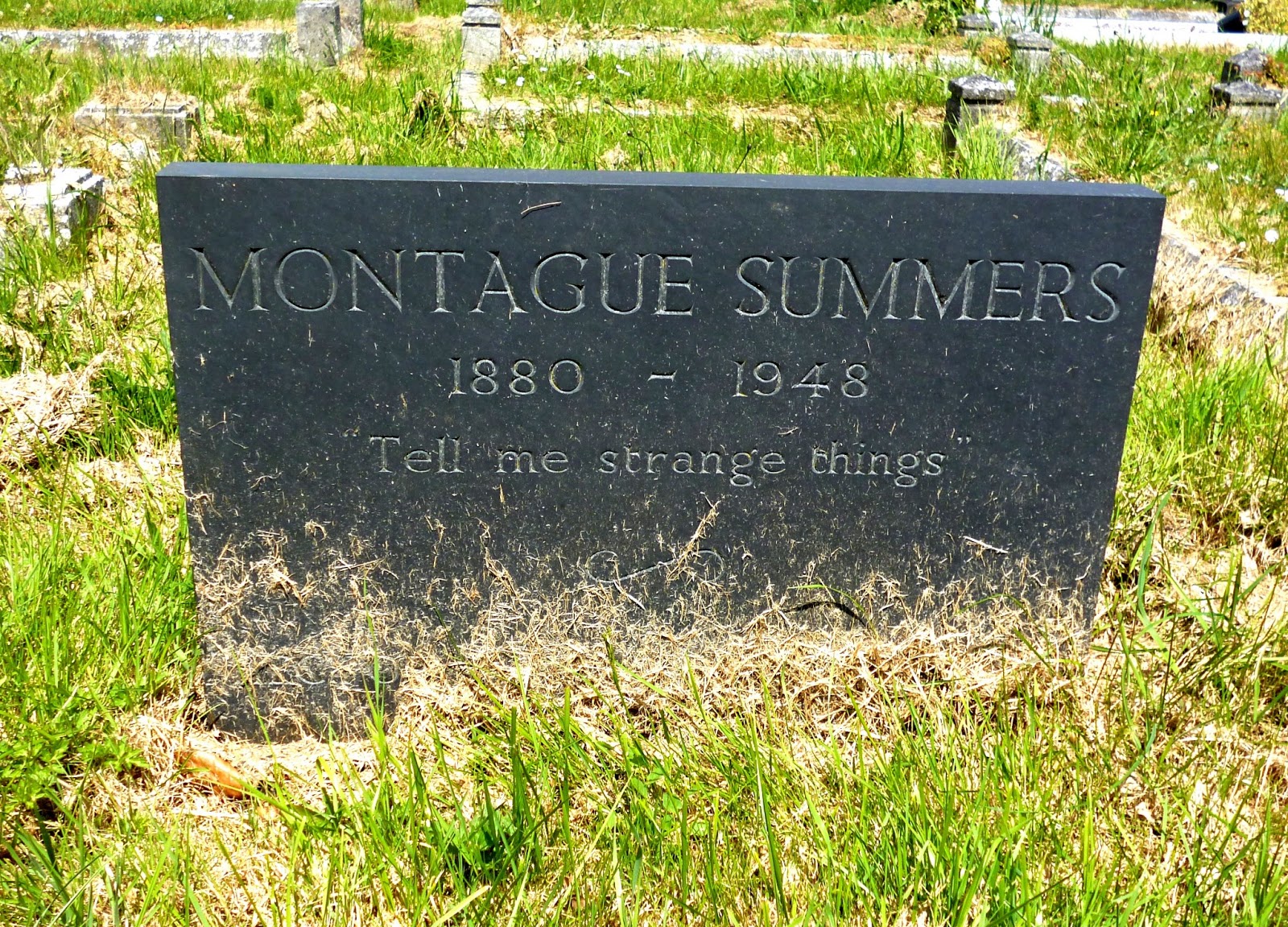
East Sheen and Richmond Cemeteries #2: Montague Summers

'MONTAGUE SUMMERS
1880–1948
"Tell me strange things"'
 
The rather odd epitaph 'Tell me strange things' is a quotation from Montague Summers, who certainly had a great hunger for strange things. It's also the half-title of Brocard Sewell's tribute to the man, which was published by the Aylesford Press in 1991.

Summers was a Roman Catholic convert who began calling himself the Reverend Alphonsus Joseph-Mary Augustus Montague Summers, although his credentials are very dubious.
 
He is best known as a writer, and edited works by 17th century playwrights such as Aphra Behn, William Congreve and John Dryden. He is also noted for his work on Jane Austen's 'Northanger Horrid Novels', which many people thought were an invention of Austen's narrator in Northanger Abbey.

But above all he is remembered for his work on the occult, particularly relating to vampires, witches and warlocks, and his first book in this field was The History of Witchcraft and Demonology (1926).

My other posts on graves in East Sheen and Richmond cemeteries are linked below:

–––––––––––––––––––––––––––––––––––
George Julian Harney
Mary Elizabeth Braddon

East Sheen and Richmond Cemeteries #1: Mary Elizabeth Braddon

Mary Elizabeth Braddon (1835–1915) was a writer of sensation novels and wrote over eighty of them. She is most noted for Lady Audley's Secret (1862), one of her earliest works. She lived in Lichfield House, Sheen Road, Richmond, with publisher John Maxwell, whom she married on the death of his mentally ill wife in 1874. Several roads in Richmond are named after characters in Braddon's books.
 
Her son William Babington Maxwell (1866–1938) was also a novelist.


My other posts on graves in East Sheen and Richmond cemeteries are linked below:

–––––––––––––––––––––––––––––––––––
George Julian Harney
Montague Summers

6 June 2013

Constance de Salm: Vingt-quatre heures d’une femme sensible ou Une grande leçon (1824; repr. 2007)

Constance de Salm (1767-1845), who was born Constance de Théis, wrote poetry and plays and came to be known as the 'Boileau des femmes.' She was an influential figure in intellectual and political spheres and her salon – one of the most frequented in Paris – was noted for such guests as Alexandre Dumas fils and Stendhal.*

In 1824 Salm anonymously published her first and only novel, the epistolary Vingt-quatre heures d’une femme sensible ou Une grande leçon ('A Sensitive Woman's Twenty-four Hours: or, an Important Lesson'), which was rescued from oblivion several years ago by Claude Schopp, incidentally an expert on Dumas.

Salm – who wrote Vingt-quatre heures a number of years before it was published – was something of a proto-feminist who disliked sentimentalism and subservient women, and wrote this novella as a reply to reproaches she had received about her work being too serious and philosophical. She wanted to paint a complete picture of what it is to be a woman, or show the heart of a woman, at the same time as giving women a lesson, showing them to what point they can be driven by the passing 'disorder' that is love.

The work consists of forty-six letters, almost all of which are written by the narrator to the man she loves, during one night and angst-ridden day in which she reveals her jealous torments after seeing her lover leave a concert on the arm of another woman: madame de B.... The fact that her lover doesn't come to her later that night triggers off the series of letters by this increasingly desperate and even (in her later stages) deranged woman.

In the course of twenty-four hours the narrator not only writes the letters (some of which are very short) but fruitlessly visits her lover's house and has to be taken back home unconscious: her lover has left for the country with madame de B...; she later learns that her lover is marrying madame de B... and prepares to kill herself. However, through a twist in the story she is saved by her lover's letters informing her that madame de B... is clandestinely marrying his uncle – a man whose earlier intention was to marry the narrator – and that her lover's main desire is to marry her.

This short novel is written in a very powerful language and is in fact much better than my unfortunately very reductive summary of it might sound.

*Salm was previously married to Jean-Baptiste Pipelet, whom she divorced in 1799, and a 'Mme Constance Pipelet' appears in Stendhal's autobiographical work, the unfinished Vie de Henry Brulard (1890).

5 June 2013

Edmund White: The Flâneur: A Stroll through the Paradoxes of Paris (2001)

These are Edmund White's impressions of Paris after living there for sixteen years, and as we might expect they're pretty idiosyncratic, with the emphasis on the gay, flamboyant nature of the city.
White divides this into six chapters, beginning with a general account (which encompasses a large – and fascinating – digression about Colette) of the flâneur, that essentially non-tourist Paris-oriented stroller; from there he shifts his focus to multicultural Paris, to Jewish Paris, to a few rather obscure museums, to gay Paris, then to French royalty past and (unrecognised) present.

The main point is that White concentrates on the obscure, and it is really refreshing to read an account about Paris without a single mention, for instance, of the Eiffel Tower or the Moulin Rouge. So, unsurprisingly, a number of things interested me here that I'll be investigating presently, such as the marché du livre near the Parc Georges Brassens, along with the gay writers Tony Duvert and Yves Navarre.

Occasionally, White forgets his target reader and unnecessarily reminds us, for example, that August Strindberg was a Swedish playwright. (Really?). He also seems a little overwhelmed by power and money, hence all the pages on the Musée Camondo (but nothing, alas, on the wonderful little Parc Monceau at the side of it), and (yawn) the fate of the French royal family. Twice in a few pages he says he doesn't understand the French distinction between royalist and monarchist: nor do I, but then who cares anyway?

Through all this, The Flâneur is well worth reading because it digs far deeper into Paris than the usual guidebook (which this obviously isn't, and was never intended to be), and in several ways it approaches the city from an outsider's point of view.

4 June 2013

Robert Coover: Noir (2010)

Robert Coover's Noir is another genre spoof work in the same vein as his pornography spoof novella Spanking the Maid, although as its title suggests this is a spoof of the detective novel, with an obvious allusion to Raymond Chandler's Philip Marlowe: the detective in question is Philip M. Noir.

Noir is a seedy ex-alcoholic private dick (and of course there are plays on that word) who still lapses into drinking binges, particularly when his new client slams a large amount of money on the table for him to search for Mister Big, a mystery man she believes has killed her husband. She's still wearing widow's weeds and Noir doesn't even get a glimpse of her face, although he's mightily impressed by her legs.

The novel, which is considerably longer than the to-get-down-to-the-point Spanking the Maid, unfolds (if that's the right word for a book that leaves so many questions unanswered) through a series of flashbacks, dream sequences and unreliable characters, in which there are many dead bodies and several painful coshes on the head for Noir. The unnamed woman with the lovely legs who supplied Noir's money is murdered and then her body disappears, but Noir still continues his search for Mister Big, encouraged by sexual fantasies of the woman.

Noir endures many dangerous encounters, but throughout the novel the principal constant is the loyalty and intelligence of his secretary Blanche, who picks him up when he's down and without whom Noir would evidently be completely lost. In fact, the reader is strongly aware that, in the narrator's use of the expression 'cherchez la femme', Noir is wasting his time lusting after a dead woman: why is he so blind to Blanche's many qualities?

Finally, this is a postmodernist work and far from all is revealed, although at the end – which some readers can be forgiven for thinking may be part of a dream sequence – the weeping widow is revealed to have faked her own death, and to be none other than Blanche. This is where, for the first time, Noir sees that Blanche has nice legs. Maybe the new firm – Blanche et Noir of course – might just work.

As long as Noir forgets all the questions that remain unanswered, and draws a final curtain on the unknowable past. This novel is probably too clever for its own good.

31 May 2013

Edgar Wood in Middleton

A Middleton heritage trail leaflet suggests that St Leonards Church is the oldest building in the Manchester diocese, and that this is one of only three churches in the country with a wooden steeple.
This impressive structure is Middleton-born architect Edgar Wood's Exedra, built in 1906 and a link between the parish church and Jubilee Park. Alderman Thomas Broadbent Wood, the architect's father, commissioned his son to build it.

'WHO WORKS NOT FOR HIS FELLOWS STARVES HIS SOUL;
HIS THOUGHTS GROW POOR AND DWINDLE AND HIS HEART
GRUDGES EACH BEAT, AS MISERS DO A DOLE.'

I've retained the original three-line structure. These words are from Rose's Diary (1850) by Nottingham-born poet Henry Septimus Sutton (1825–1901), who moved to Manchester in 1850.
On the corner of Cleworth Road and Rochdale Road:

'EDGAR
WOOD
ARCHITECT
(1860–1935)
FENCEGATE AND REDCROFT
WOOD'S HOME
FROM 1895 TO 1916
GRADE II
LISTED BUILDING'

Closer to the centre of Middleton is the Manchester and Salford Bank, built in 1892 and also a Grade II building. There are several other of Wood's works in the town, including the fine but modest gravestone of his friend the artist Frederick William Jackson (1859–1918), who was buried in Middleton New Cemetery. As I wasn't aware of this at the time though, I shall have to seek it out on my next visit to Middleton.

My other post related to Edgar Wood:
–––––––––––––––––––––––––––––––––––
Edgar Wood in Victoria Park

Jim Allen in Middleton

Middleton Library in Long Street, largely obscured by spring blossom.

On the wall by the entrance to the library:

'JIM ALLEN
1926–1999
 
MIDDLETON WRITER AND PLAYWRIGHT
WAS SELF-TAUGHT IN THIS AND
OTHER LIBRARIES
 
"MY ONLY REGRET WHEN I DIE
WILL BE THE BOOKS
I HAVE NOT READ"'
 
Jim Allen once worked in Bradford colliery, Manchester, before turning to writing as a career. He is most noted for his collaboration with Ken Loach, and his later work included writing the scripts for Loach's Hidden Agenda (1990), Raining Stones (1993),* and Land and Freedom (1995).
 
*Although unnamed in the movie, Raining Stones was filmed in Middleton, mainly on the Langley Estate.

30 May 2013

Samuel Bamford in Middleton

Samuel Bamford's memorial stone in the memorial gardens near the corner of Spring Gardens and Cheapside, Middleton.
 
'Tablet
removed
from
No. 61 Union St.
which stood
on this site
until 1963'
 
'SAMUEL BAMFORD
REFORMER RESIDED
& WAS ARRESTED IN
THIS HOUSE AVG 26 1819'
 
This plaque is a short distance away at the east end of New Lane:
 
'PETERLOO DEMONSTRATION
16 AUGUST 1819
THE MIDDLETON CONTINGENT CONGREGATED HERE
ON BARROWFIELDS AND MARCHED TO ST. PETER'S
FIELD IN MANCHESTER LED BY SAM BAMFORD.
THE MEETING, POPULARLY KNOWN AS THE
"PETERLOO MASSACRE", WAS IN SUPPORT
OF THE VOTE FOR THE WORKING
CLASSES. 16 MIDDLETON PEOPLE
WERE INJURED.'
 
A red plaque on the wall of the Radisson Hotel (formerly the Free Trade Hall) in Peter Street, Manchester, records the broader picture:
 
'ST. PETER'S FIELDS
THE PETERLOO MASSACRE
 
On 16th August 1819 a peaceful rally
of 60,000 pro-democracy reformers,
men, women, and children,
were attacked by armed cavalry
resulting in 15 deaths and
over 600 injuries.'
 
Bamford is said to have used this pub for drinking and reciting poetry.
 
That sign really is as crooked as it looks: the Olde Boar's Head is reputed to date from 1587. Bamford mentions in his autobiography that the pub used to have a room called the 'thrashing-bay', where fights took place.
 
Bamford's obelisk is highly conspicuous in the nearby cemetery.
 
 
'SAMUEL BAMFORD
BORN 28TH FEBRUARY 1788
DIED 13TH APRIL 1872'
 
'AN EARLY ADVOCATE
OF
CIVIL & RELIGIOUS LIBERTY,
FREE TRADE
AND
PARLIAMENTARY REFORM.
––––––––––––
AUTHOR
OF
"PASSAGES IN THE LIFE OF A RADICAL"
AND
OTHER WORKS
IN
PROSE AND VERSE.'
 
'ERECTED
BY PUBLIC SUBSCRIPTION
IN THIS
HIS NATIVE TOWN,
1877.
––––––
"Bamford was a Reformer
when to be so was unsafe, and
he suffered for his faith."
                                                                                              JOHN BRIGHT
 
–––––––––––––––––––––––––––––––––––
Samuel Bamford in Stockport

Howard Spring in Didsbury

26 Hesketh Avenue, Didsbury, Manchester.
 
'ROBERT HOWARD SPRING
(1889–1965)
JOURNALIST AND NOVELIST
LIVED HERE
(1920–1931)'
 
Spring was working for the Manchester Guardian when he lived here, and his editor was C. P. Scott. In 1931 he accepted a post as book reviewer for the Evening Standard in London. His first novel, Shabby Tiger (1934), was set in Manchester.

Southern Cemetery #6: John and Enriqueta Rylands

 
'John Rylands
of Manchester.
Born 7. Feb. 1801. Died 11. Dec. 1888.
In Living Memory.'
 

John Rylands's grave is the largest in Southern Cemetery, although the metal enclosure has been removed. Rylands was a rich Manchester textile merchant and philanthropist who lived at Longford Hall, Stretford, from 1857.

'Enriqueta Augustina
 Rylands
of Manchester.
Born 31. May. 1843. Died 4. Feb. 1908.
In Loving Memory.'
 
Enriqueta was John's third wife and his chief heir and executor. She founded the neo-Gothic John Rylands Library in Deansgate, Manchester, as a memorial to her husband. It was designed by Basil Champneys and was opened to the public in 1900.

My other posts on Southern Cemetery graves:

–––––––––––––––––––––––––––––––––––
The Manchester Sound
L. S. Lowry
Maria Pawlikowska–Jasnorzewska
David Martin
George Ghita Ionescu
John Cassidy
Jerome Caminada
George Freemantle
Leo Grindon and Rosa Grindon
Eric Thompson

Southern Cemetery #5: George Ghita Ionescu

'In Loving
Memory of
VALENCE R. de BOIS
IONESCU
2nd SEPT 1917–
12TH MARCH 1996
AND
GEORGE GHITA
IONESCU
21st MARCH 1913–
28th JUNE 1996'
 
Ghita Ionescu was a political scientist of Romanian origin who emigrated after the Soviet invasion in 1947. His most interesting work, perhaps, is Politics and the Pursuit of Happiness (1984), written after his retirement from Manchester University.

My other posts on Southern Cemetery graves:

–––––––––––––––––––––––––––––––––––
The Manchester Sound
L. S. Lowry
Maria Pawlikowska–Jasnorzewska
David Martin
John and Enriqueta Rylands
John Cassidy
Jerome Caminada
George Freemantle
Leo Grindon and Rosa Grindon
Eric Thompson

29 May 2013

Emmanuel Carrère: Un roman russe (2007)

Un roman russe is translated literally in the English (but not the American) edition as A Russian Novel, although it's largely autobiographical, representing just two years in Emmanuel Carrère's life. However, lives other than his are involved here, and the book begins with a small film crew (of which Carrère is the director) being sent out to Kotelnich (no second 't' in English), a depressing Russian town 500 miles east of Moscow.

The original intention was to make a film about András Toma, a Hungarian soldier captured by Red Guards who spent fifty-five years imprisoned in Russia, the last fifty-two of them in a psychiatric hospital in Kotelnich: somehow, Toma had been forgotten over the years and was declared dead in the 1950s. However, there is not enough material for a feature film and the crew go back to France. But Carrère and crew later return to Kotelnich to make the film Retour à Kotelnitch (2003), and Un roman russe is in part about the making of this film. (The original film about Toma became a bonus short on the DVD called Le Soldat perdu ('The Lost Soldier')).

So we have a story about Carrère which begins as a story about Toma, although that (much like the film) really turns out to be a kind of false start, or maybe an excuse for a new beginning. But why does Emmanuel return to this hole? He's not too certain, although as a kind of therapy he's working on a dark part of his family history that has hitherto remained a secret that his mother Hélène Carrère d'Encausse wants to keep buried until her death: her father Georges Zourabichvili, a Georgian refugee, 'disappeared' after collaborating with the Nazis in World War II. Perhaps Kotelnich is where the disappeared go, or more likely perhaps Carrère can find a psychological gravestone for his grandfather, can exorcise his demons.

Emmanuel's demons, though, are often self-created and he has strong self-destructive impulses. The book is also a kind of love story, involving the fraught relationship between Emmanuel with his partner Sophie. And here we come to one of the central issues, because Sophie, who works for a children's publisher, is of a lower class than Emmanuel, who is proud of displaying her beauty to friends, but ashamed, for instance, of the fact that on hearing about the merits of Saul Bellow, she writes herself a reminder to read some 'Solbello'. Emmanuel is egotistical: the couple's life revolves around his whims, whereas Sophie's wishes come a low second and she is unsure of her position in the relationship. It is perhaps not too surprising that (on one of Emmanuel's several long trips away) she takes a lover as a kind of emotional insurance policy: and of course it is no surprise that Emmanuel finds her infidelity wholly unacceptable, even though he adheres to the age-old double standard and has had a brief affair with a young woman himself.

Partly to attempt to patch up the flagging relationship, Emmanuel (before discovering Sophie's infidelity) writes a short story which is published in Le Monde, and which amounts to a long erotic (some might say pornographic) love letter which is – in keeping with Emmanuel's dominant character – almost in the form of an instruction manual. It uses explicit language that shocked many people and annoyed some writers, Philippe Sollers being a notable example.

Some readers might admire Carrère for, as it were, laying himself bare, for exposing his faults for all to see, while others might find him heartless and self-centred for revealing the skeleton in the family cupboard and causing his mother (a highly respected public figure) considerable discomfort. He writes directly to his mother at the end of the book and says that it's better that he uses this form of psychotherapy if it prevents him from killing himself. But doesn't that sound slightly like emotional blackmail?

I wasn't troubled by the multiple narrative threads in the book, nor by its start-stop nature, and in many respects I found this an enthraling read. But the protagonist isn't a sympathetic character at all: he is a weak, unstable person, much like a spoilt child with little emotional maturity and very little regard for anyone but himself.

Below is a link to the short story published in Le Monde and called L'Usage du Monde: this is also the title of Nicolas Bouvier's 1963 book that was translated as The Way of the World. There are also a links to other book comments by the author that I've made.

 
–––––––––––––––––––––––––––––––––––
L'Usage du Monde, by Emmanuel Carrère
Emmanuel Carrère: D'autres vie que la mienne | Lives Other than My Own
Emmanuel Carrère: La Classe de neige
Emmanuel Carrère: La Moustache | The Mustache

Southern Cemetery #4: David Martin

Among the many graves in Southern Cemetery this must be one of the strangest, and if an English equivalent of André Blavier's Les Fous littéraires existed it would surely merit a place in it. David Martin was a labourer and amateur scientist who was convinced that Leibnitz was right and Newton wrong, and that the world had been following the wrong person for three hundred years. However, the media wouldn't listen to him. He therefore resolved to self-publish in a poem his belief that gravity does not exist. The gravestone was prepared more than ten years before his death in 2010.

'Space

After 76 voyages around the sun, I am ready
to assert that space is not inert.
The world through space does not go.
Space carries the world to and fro.
It is the conveyer of our sphere. Be of
good cheer. The truth at last is here.
Let it be said "Gravity is dead." "Newton
was mad." "The people have been had."
God can make a tree – but not gravity.
With smooth effortless grace the super fluid
called space carries our world apace.
We pay no heed to our 20 miles per
second speed because super fluid engineering
at Nature's best makes perpetual
motion seem like rest. With hot stars
and our sun burning and churning,
space is alive and pulsating with energy electrified.

In a whirlpool of space our world
plays its part 93 million miles away
from the sun's boiling bubbling heart.


         David Martin'

My other posts on Southern Cemetery graves:

–––––––––––––––––––––––––––––––––––
The Manchester Sound
L. S. Lowry
Maria Pawlikowska–Jasnorzewska George Ghita Ionescu
John and Enriqueta Rylands
John Cassidy
Jerome Caminada
George Freemantle
Leo Grindon and Rosa Grindon
Eric Thompson

28 May 2013

Southern Cemetery #3: Maria Pawlikowska–Jasnorzewska

'THIS STONE WAS ERECTED
BY THE UNION OF POLISH WRITERS ABROAD
AND THE POLISH COMMUNITY IN EXILE
IN COMMEMORATION OF
THIS GREAT POLISH POETESS.
A.D. 1973.'
 
The word 'poetess' would probably have sounded slightly better in 1973 than it sounds today. Maria Jasnorzewska, or Maria Pawlikowska-Jasnorzewska (1891–1945), was associated with the Warsaw-based Skamander poetry group. She left Poland in 1939 with her third husband, Stefan Jerzy Jasnorzewski, and died in Manchester.

She was also a playwright, and her Baba-dziwo, or A Woman of Wonder (1937), is generally understood to be a satire of Hitler. The play depicts a dictatorship in which a 'masculine' woman Valida Vrana rules a country called Ritonia, in which she strongly rewards people by the number of children they have: motherhood is compulsory and women are baby-making machines. Dissent produces severe penalties. Norman and Petronika Gondor are childless and both hate Valida, although Norman conceals his hatred and tries to restrain his wife's almost open contempt.
 
But the more Valida tightens her hold on the people the more they become discontented. Petronika is a chemist and contrives to render Valida powerless by means of a perfumed flower that is both irresistable and narcotic: with the despot out of the picture, the people are freed and Norman takes control of the country.
 
Behind the flowers on the grave someone had placed a sealed, pink plastic sleeve containing two photos of Maria Jasnorzewska, which I include below. They may not have come out too well through the plastic, but at least they put a face to the writer.


And below is a link to a translation of Baba-dziwo by Elwira M. Grossman, Paul J. Kelly and Stephen Grecco, which may not be brilliant but it does give an idea of what the author is trying to say:
 
–––––––––––––––––––––––––––––––––––
A Woman of Wonder, by Maria Pawlikowska-Janorzewska


My other posts on Southern Cemetery graves:

–––––––––––––––––––––––––––––––––––
The Manchester Sound
L. S. Lowry
David Martin
George Ghita Ionescu
John and Enriqueta Rylands
John Cassidy
Jerome Caminada
George Freemantle
Leo Grindon and Rosa Grindon
Eric Thompson

27 May 2013

Southern Cemetery #2: L. S. Lowry


'IN LOVING MEMORY OF
ROBERT STEPHEN MCALL LOWRY
THE BELOVED HUSBAND OF
ELIZABETH LOWRY
BORN 4TH JUNE 1857
DIED 10TH FEBRUARY 1932
AT REST
ALSO ELIZABETH LOWRY HIS WIFE
BORN MARCH 5TH 1858
 DIED OCTOBER 12TH 1939

 'ALSO
THEIR BELOVED SON
LAURENCE STEPHEN
LOWRY
BORN 1ST NOV. 1887
DIED 23RD FEB. 1976.'

The links below are to The Lowry's brief account of his life (which includes his relationship with his mother), and to a lecture Manchester-born Howard Jacobson gave at the Lowry in 2007:

–––––––––––––––––––––––––––––––––––
The Lowry on L. S. Lowry

'The Proud Provincial Loneliness of LS Lowry', by Howard Jacobson

My other posts on Southern Cemetery graves:

–––––––––––––––––––––––––––––––––––
The Manchester Sound
Maria Pawlikowska–Jasnorzewska
David Martin
George Ghita Ionescu
John and Enriqueta Rylands
John Cassidy
Jerome Caminada
George Freemantle
Leo Grindon and Rosa Grindon
Eric Thompson