20 May 2013

Thomas De Quincey connections in Manchester (UK)

'Under this Stone lie the Remains
of Mrs Sarah Penſon Relict of the
Late Samuel Penſon of London
who died Jany 1790 aged 69 Years.
Alſo of Thos Quincey Merchant
who died July 18th Aged 40 yrs.

Alſo of Jane Quincey Daughter of
Thos & Elizth Quincey born Sepr 8
1786 died March 18th 1790.
Alſo of Elizabeth Quincey their
Daughter who died June 2d 1792
Aged 9 Years.'
 
This tombstone stands close to St Ann's Church in St Ann Street, Manchester, where the writer Thomas De Quincey (1785–1859) was born. His father Thomas Quincey (1753–93) was a successful textile merchant who married Elizabeth (née Penson (c. 1756–1846)) in 1780.
 
Thomas De Quincey was seven years old on the death of his sister, with whom he had a very strong bond: in 1845, in Suspiria de Profondis, he wrote about his intense emotions on seeing Elizabeth on her deathbed.
 
De Quincey is buried in St Cuthbert's churchyard, Edinburgh:
 
'SACRED
To the Memory of
Thomas Dequincey
who was born at Greenhay
NEAR Manchester
August 15TH 1785
and Died at Edinburgh
December 8TH 1859
and of Margaret his Wife
who Died
August 7TH 1887'

*Thomas Quincey was a founder member of the Manchester Literary and Philosophical Society and author of Short Tour in the Midland Counties of England (1774).

18 May 2013

Joseph Joffo: Un sac de billes (1973)

Joseph Joffo's Un sac de billes (A Bag of Marbles) was translated into eighteen languages and turned into a movie, and yet I can't help thinking that the book is still very little known, say, in the English-speaking world. Nevertheless this autobiographical work gives a remarkable description of a subject that is not often spoken of elsewhere: the plight of the Jews in occupied France.

The book spans three years (1941 to 1944) and is narrated by ten-year-old Joseph whose father (himself a seven-year-old refugee from Russia when the tsar is seeking young 'emissaries') decides that the time is right to flee south to relative safety: as a barber in a Jewish area of Paris, he realizes that it is only a matter of time before his family will be sent to German 'work camps'. His decision comes when the compulsory wearing of the badge declaring 'juif' (Jew) on his sons' school jacket lapels (not on the front of their jackets as seen in the still from Jacques Doillon's film) results in them being repeatedly called 'Youpin' (Yid), and earns Joseph a cauliflower ear and his twelve-year-old brother Maurice a black eye.

A sac de billes describes a life of frequent flight, initially when the brothers join their two elder brothers in Menton via the metro to the Gare d'Austerlitz, then the train to Dax, the bus to Hagetmau, then clandestinely over the demarcation line, etc. They are never settled, and their stay in Menton is curtailed by the fear of them being forced to join the S. T. O. (Service de Travail Obligatoire), meaning that they might be sent to Germany into the lion's den (or la queule du loup as the narrator puts it) in order to, for instance, cut enemy hair.

In 'Dialogue avec mes lecteurs' – a twenty-page afterword – Joffo reveals that in spite of the very real dangers the boys faced, it was not until they underwent four-week interrogations at the Excelsior hotel (the Gestapo headquarters in Nice), towards the end of which they threaten to chop Joseph into pieces if Maurice doesn't provide them with written proof of their non-Jewishness (as opposed to their circumcision, indicating the contrary). Before the interrogations, Joseph had seen their enforced peregrinations as a kind of adventure, almost a real-life version of the films he loves so much.

In spite of the grim material, the book celebrates life, the simple joys of childhood (playing marbles, football, snobs), but above all the charity, the selfless generosity of the many people who help them, sometimes putting their own safety at risk in doing so.

In Joffo's afterword he answers several questions that readers have asked since publication, such as the identity of the final town the brothers lived in, where Joseph worked and lived in a librarie (a newsagent's-cum-bookshop) with an obsessive anti-semitic Pétainist proprietor: Mancelier. Joffo reveals that this was Romilly in Haute-Savoie.  After the publication of the book, not only was Joffo invited to the town and made a citoyen d'honneur, but (a wonderful irony) he gave a book-signing at the librarie Mancelier.

Un sac de billes (in part a reference to the exchange Joseph's non-Jewish friend Zérati made with him for his Jewish star) is in some respects a heart-warming testament to human love, to resourcefulness, to simple pleasures, and to the survival instinct in the face of institutionalized insanity. But the background is always present, the death camps always form the backcloth to the action, and the closing paragraphs inform us that Joseph's father was one of the victims of the Holocaust.

15 May 2013

Joseph Rayner Stephens in Stamford Park, Stalybridge

 
 'JOSEPH RAYNER STEPHENS
BORN 1805 DIED 1879'

'SCATTER THE SEED! THE SEED OF TRUTH
BELIEVING IT WILL GROW.
LOOK ON THE WILDERNESS IN RUTH
IT WAS NOT ALWAYS SO.
A GARDEN ONCE, IT MAY AGAIN,
A LOVELY GARDEN BE.
IT WANTS THE SUN IT WANTS THE RAIN,
OF GODLIKE CHARITY.
WE WORK AND WAIT, WE TOIL AND TRUST,
SURE THAT THE END WILL COME
THIS WILDERNESS OF EVIL MUST, BE CLOTHED WITH HEAVENLY BLOOM.
             J.R.S.'
 
 'ERECTED
BY THE FACTORY WORKERS OF
LANCASHIRE AND CHESHIRE,
IN THANKFUL REMEMBRANCE
OF A LONG LIFE SPENT
IN THEIR SERVICE
1888'
 
 'AN EARNEST ADVOCATE
OF THE TEN HOURS BILL;
AN ABLE DEFENDER OF
TRADES UNIONS
AND DETERMINED OPPONENT OF
THE NEW POOR LAW.
––––––––
"THE ONLY TRUE FOUNDATION OF
SOCIETY IS THE SAFETY, THE SECURITY
AND THE HAPPINESS OF THE POOR, FROM
WHOM ALL THE OTHER ORDERS OF SOCIETY
ARISE."
DEFENCE AT CHESTER.'
 
This, then, was erected 125 years before the present government (with the almost total approval of the 'opposition') gave what amounted to a state funeral for a former premier who undid most of the things that people such as Joseph Rayner Stephens had worked hard for. My disgust is inexpressible.

14 May 2013

Jethro Tinker in Stamford Park, Stalybridge


'JETHRO TINKER
BORN
25TH SEPTEMBER 1788
DIED
10TH MARCH 1871.'

 
 'OUR LOCAL
LINNAEUS'
 
 'FIELD NATURALIST
FROM
EARLY YOUTH
TO OLD AGE'
 
 'ERECTED BY THE FRIENDS
AND
ADMIRERS OF
NATURAL HISTORY
1874'

James Burgess and John Higson in Droylsden

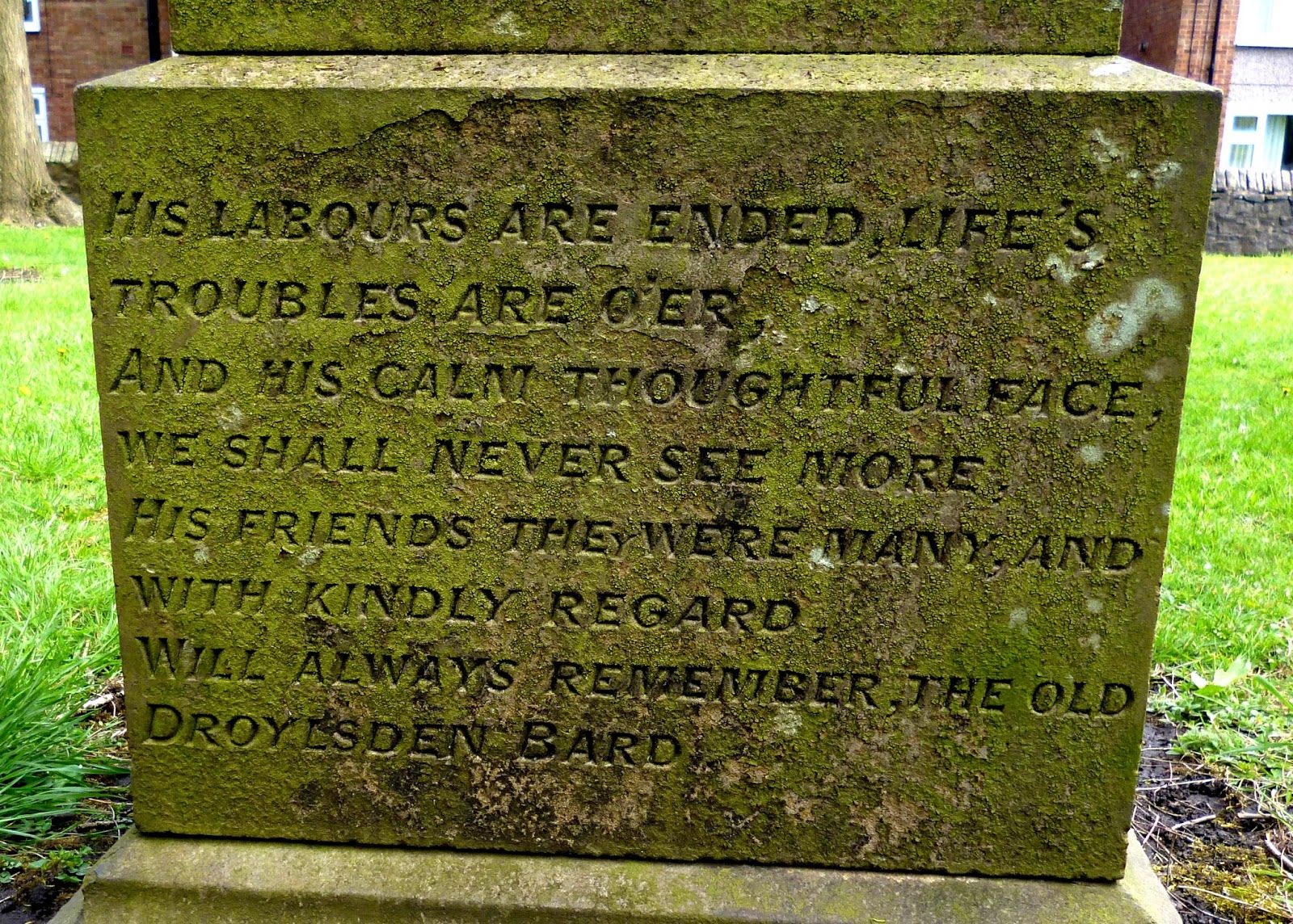
In St Mary's churchyard, Droylsden, are two graves of writers side by side. This is James Burgess's.

'ERECTED
BY
HIS FRIENDS AS A
TOKEN
OF ESTEEM.'

 'IN MEMORY OF
JAMES BURGESS,
WHO DIED ON 11TH OF AUGUST
1870, IN THE 64THYEAR
OF HIS AGE.'
 
'HIS LABOURS ARE ENDED, LIFE'S
TROUBLES ARE O'ER,
AND HIS CALM THOUGHTFUL FACE,
WE SHALL NEVER SEE MORE,
HIS FRIENDS THEY WERE MANY, AND
WITH KINDLY REGARD,
WILL ALWAYS REMEMBER, THE OLD
DROYLSDEN BARD.'
 
 And this is John Higson's:
>
'––––– THE LAST GREAT DAY –––––
HERE LIE THE BODIES OF
JOHN HIGSON,
DIED DECEMBER 13TH 1871 AGED 46 YEARS
ELIZABETH CAROLINE HIGSON
HIS RELICT, AGED 86 YEARS
BOTH THE ABOVE DIED AT LEES
JAMES HAROLD HIGSON
DIED NOV 7TH 1862 AGED 5 WEEKS & 5 DAYS
NOW THAT MY REDEEMER LIVETH
WILLIAM HIGSON
of Lees
BROTHER & THIRD SON OF THE LATE
JOHN & ELIZABETH CAROLINE HIGSON
AGED 65 YEARS'

12 May 2013

Isaac Newton in Woolsthorpe-by-Colsterworth, Lincolnshire

 
Isaac Newton (1642–1727) was born in Woolsthorpe Manor in Woolsthorpe-by-Colsterworth, Lincolnshire. His father (also named Isaac) was a wealthy farmer who died a few months before the birth of his only child, and three years later his mother Hannah married Rev. Barnabas Smith of the nearby village of North Witham. She left her parents James and Margery Ayscough to look after Isaac, although she returned to Woolsthorpe on her husband's death in 1653.
 
Unfortunately, photography is not allowed in the birthplace.
 
 'In this Manor House
SIR ISAAC NEWTON Knt
was born 25th December A.D. 1642'
 
The back and side of the manor facing west.
 
The manor again, showing the courtyard with outbuildings.
 
The National Trust claims that this is the legendary apple tree that inspired Newton.  It's a Flower of Kent and blew down in a storm in 1820, the wood being used for snuff boxes and other novelties. Fortunately the root remained and the tree grew again.
 
Fritillaries were growing nearby.

Ammon Wrigley in Uppermill, Saddleworth

This is the impressive setting for Ammon Wrigley's statue in High Street, Uppermill, Saddleworth.*
 
James Collins's bronze statue on a concrete pedestal was erected in Uppermill High Street in 1991. It shows the poet Ammon Wrigley in his noted flat cap and open coat on the moors he loved to walk. There were objections raised that the concrete base wasn't in keeping with local stone, and that the statue was a little removed from the remote country he loved; on the first issue, concrete was used as a secure base, and on the second, it is doubtful that many people would know of the existence of Ammon Wrigley today if his statue had been, say, in as obscure a spot as the Ammon Wrigley Memorial, which is near the Dinner Stone overlooking Castleshaw: Wrigley's ashes, according to his wishes, were scattered there.

I didn't attempt to find the memorial as yesterday (when we went to Uppermill) the weather was awful, although I found the book I was looking for in the tourist information office next to the car park at the side of the statue: With Ammon Wrigley in Saddleworth, by Sam Seville ([Saddleworth]: Saddleworth Historical Society, c. 1984). Seville was Wrigley's son-in-law, married to his daughter Amy. More posts on Ammon Wrigley will follow in due course.
 
'AMMON WRIGLEY
1861–1946
POET AND HISTORIAN'
 
*Saddleworth is the name of a collection of villages and hamlets in the metropolitan borough of Oldham, of which Uppermill is the biggest.

8 May 2013

Julia Millen: Ronald Hugh Morrieson: A Biography (1996)

In her biography of the New Zealand writer Ronald Hugh Morrieson (1922–72), Julia Millen mentions that his crime was 'being different', and this comes across strongly in the book. Born in the small, conservative Taranaki town of Hawera to a musical family in a house where he lived all his relatively short life, Morrieson rarely ventured further afield, and even his intended life as a student in Auckland only lasted a day or so before he felt forced to return homesick.

The house he lived in was built by his maternal grandfather Charles Bartley Johnson, who, when Ron was born, lived there with his wife Lucy, Ron's parents Hugh Morrieson and Eunice (née Johnson), and Charles and Lucy's other offspring, his unmarried uncle Roy and aunt Doris Johnson. Ron's father died when Ron was only eight, and in time there were just three in the house: Ron, and his mother and aunt, both of whom spoiled him to an enormous degree, and seemed largely in denial of his many demeanours.

At the age of ten Ron made parsnip wine and got a schoolfriend drunk in the lunch hour, and this was really just a foretaste of a lifelong love affair with drink. At eighteen he drove to a dance with some friends in Stratford, a nearby town, did some drinking, and on the way back knocked a girl over: he failed to stop, she was hospitalised, and he later gave himself up to the police, claiming that he hadn't noticed her: he was put on probation for two years, lost his licence, and was forbidden to be out at night after 8pm.

Morrieson played in bands locally until he was 37 and loved the camaraderie, the drinking lifestyle that was inevitably attached to it, and enjoyed the company of a number of female sexual partners. Horseplay is a drama by Ken Duncum that was first shown in 1994 and imagines James K. Baxter visiting Morrieson in Hawera near the end of their lives. In it, Wilma is Morrieson's girlfriend and complains about having to constantly get in and out of the window: before reading the biography I thought this must be some kind of symbol but it's real: Morrieson actually had a ladder leading up to his bedroom window so that his mother and aunt wouldn't have to see his girlfriends going upstairs with him. It's the kind of bizarre – almost unbelievable – detail that could have come from one of his books.

Maurice Shadbolt said that some of Morrieson's characters might well have come from his drinking friends in Hawera, and Millen greatly extends this observation by pointing out a large number of similarities between people or things in Morrieson's books, and those in his life: for instance, the tower in Predicament (a book that Morrieson once wanted to call 'The Tower') that leans (giving Cedric one of his nicknames – Pisa) recalls the leaning (and useless) water tower in Hawera; Cedric's father's eccentric behaviour is not unlike that of Morrieson's grandfather Charles Johnson's; there is obsessive and reckless gambling in illegal, out-of-town crown and anchor games in Comes a Hot Friday, such as Morrieson used to regularly attend in south Taranaki; Salter the Sensational (aka 'The Scarecrow') initially excited the drunks in the lock-in pub, as the magician Carter the Great excited Hawera schoolchildren; Pallet on the Floor involves events in and around a freezing plant: Morrieson worked in one in nearby Patea; and so on and so on.

At 37, Morrieson decided to devote himself to the world of letters, but kept himself afloat (mainly alcoholically) by giving private music lessons at home. The lessons weren't a great success, but they'd have been far less so (in fact, probably non-existent) if Morrieson's short story 'Cross My Heart and Cut My Throat' – with its hungover music teacher lusting after a thirteen-year-old pupil and (unbidden) sneaking a kiss on her lips and briefly touching her inner thigh – had been published while he was alive.

But then, after two novels Morrieson couldn't get anything published, he continued to drink to wild excess, his mother's death came in 1968 and left him a wreck, and four years later continued drinking led to the death he seemed resigned to. Like Morrieson's novels, this is a humorous book as well as a (quietly) violent one, but of course the protagonist brought the violence on himself. Unlike the novels, though, it is also intensely sad.

My other blog posts on Morrieson's work:

–––––––––––––––––––––––––––––––––––

Ronald Hugh Morrieson: Came a Hot Friday (1964)
Ronald Hugh Morrieson: The Scarecrow (1963)
Ronald Hugh Morrieson: Predicament (1974)
Ronald Hugh Morrieson in Hawera, Taranaki, New Zealand

5 May 2013

Jennifer Sturm (ed.): Anna Kavan's New Zealand: A Pacific Interlude in a Turbulent Life (2009)

Anna Kavan (1901–1968) spent just twenty-two months in New Zealand, and from what she wrote for Cyril Connolly's Horizon in September 1943, in the first of a series of articles whimsically called 'Where Shall John Go?', readers might get the impression that Kavan viewed the country in a rather negative light. However, Jennifer Sturm's Anna Kavan's New Zealand, the fruit of eight years' work, is very much a revision of that idea.

Kavan lived in New Zealand with the pacifist Ian Hamilton, initially in Takapuna and then in Torbay. She arrived in February 1941 and left in November 1942, when it became clear to her that Hamilton would receive a prison sentence for conscientious objection.

Almost half of Sturm's book contains Kavan's stories, titled 'Five Months further or what I remember ab[out] NZ', in which she begins by saying that she would like to develop the quality of 'non-attachment' that exists in dreams. These stories are obviously richly autobiographical, containing details of characters she would either have known or heard of in Torbay, or 'Waitahanui'. Names and identities are often disguised.

The stories continue into the period when she took a sea journey back to England with an all-male crew via the Panama Canal and New York. Throughout, war is in the background, and it seems clear that Kavan's restless travelling is in part an attempt to escape from the madness of war, and also in part an attempt to escape from the madness inside her. Sturm believes that Kavan experienced a great calm in New Zealand, that she was clear of her heroin habit, and also that after her return to England she came to idealise the country that she unsuccessfully sought to return to.

Sturm makes a convincing case: much of Kavan's work, not only that written in New Zealand, but also much not in theory set in New Zealand, contain the memory of that country, even Ice. Also, as Katherine Mansfield went out of her way to avoid New Zealand-specific expressions, Kavan embraced them: for instance, she uses the word 'bach' instead of 'hut', and 'morepork' instead of 'owl', as if in defiance of the Anglocentric norm. She concludes, in full cogniscance that it might sound 'incongruous' or 'contentious', that there is more New Zealand in Kavan than in Mansfield.

There are some fascinating things in this book, not the least of which is that scholars have blithely ignored the significance of the NZ link. And it is interesting how biographies – Jeremy Reed's A Stranger from Earth (2006) and David Callard's The Case of Anna Kavan (1992) being full-length works – have simply run with generally accepted assumptions, for example that Kavan returned to England because of her son, which in fact is nonsense. Reed even attempts to construct an essentially lesbian Kavan. But it is shameful how insulting and how masculinist some writers could be, such as Denis Glover, who remarked that Kavan was one of those blondes who go round the world with their knees behind their ears. And this was a comment with which Frank Sargeson – that well-known fighter against the status quo – by no means entirely disagreed.

In the 54-minute video below from the Depot's Cultural Icons project, Dr Jennifer Sturm talks to Debbie Knowles about Anna Kavan. Also linked is my comment on Asylum Piece:

–––––––––––––––––––––––––––––––––––

Anna Kavan by Jennifer Sturm
Anna Kavan: Asylum Piece (1940)

3 May 2013

Frederick Edward Maning in Auckland, New Zealand

In Symonds Street Cemetery:
 
 
'IN MEMORY OF
FREDERICK EDWARD MANING
KNOWN TO COLONIAL FAME
AS THE AUTHOR OF
OLD NEW ZEALAND.
HE CAME TO THIS LAND IN HIS YOUTH
HE LIVED IN IT TO THE VERGE OF OLD AGE
IN NEW ZEALAND'S FIRST NATIVE WAR.
HE SERVED HIS COUNTRY WELL IN THE FIELD.
IN LATER LIFE A JUDGE OF HER LAND COURT
HE DID THE STATE GOOD SERVICE ON THE BENCH'
 
'WHEN FULL OF YEARS YET FULL OF STRENGTH
STRICKEN WITH A PAINFUL MALADY
HE SOUGHT RELIEF IN THE MOTHER COUNTRY
WHERE HE DIED ON THE 25TH JULY 1883
AGED 72 YEARS.'
–––––––
HIS LAST WORDS WERE
LET ME BE BURIED IN THE FAR OFF LAND
I LOVE SO WELL

–––––––

'HERE THEREFORE LOVING FRIENDS INTERRED HIM
IN HIS LAST RESTING PLACE
IN THE LAND OF HIS ADOPTION
AND HAVE RAISED THIS MEMORIAL
TO ONE OF NEW ZEALAND'S EARLIEST COLONISTS
AND MOST FAITHFUL SONS.'

2 May 2013

Frankie McMillan:The Bag Lady's Picnic and Other Stories (2001)

Frankie McMillan is a graduate of Bill Manhire's MA writing course at Victoria University, Wellington, and her first published book was the first serious work of fiction in Shoal Bay Press's eighteen-year history. There are eighteen stories here.

One of them is called 'Truthful Lies'. All stories, of course, even 'truthful' ones, are lies. The narrators of these stories are often first person, and often unreliable, such as the thirty-year-old narrator of 'Swordfish' who is interviewed by her probation officer about an arson attack on her old school and wildly changes her story: the reader has the impression that she might well be guilty.

Unreliability seems to be everywhere. The first story, 'My First Husband', is not about a husband but a young schoolfriend. Irene's mother in 'Ships in the Night' changes her account of the clarinet played by Norman (who turns out to be a psycho) into a fiddle. Harry pretends to be an artist in 'Errant Buttons'. There's an interesting parallax view: in 'Six Snapshots of Rhona', Rhona says that boys use romantic language when they give lovebites, although much later Sara discovers she was 'lying', as they just say they're feeling horny. And it's not clear how seriously the reader is supposed to take Rhona when she speaks of putting her hand on the thighs of old men in a rest home: 'and whoopee, they get a hard on!'.

Owen Marshall (who is a noted short story writer) praises, among a number of other things, McMillan's 'offcentre' world, and inevitably we don't have to look far to find the influence (conscious or otherwise) of another short story writer: for example, the narrator of 'Swordfish' talks about men and watches, and of the power of watches to hypnotise, which recalls Frank Sargeson's 'A Piece of Yellow Soap', an object that the woman in the story uses to hypnotise the mikman.

I think the story I like most is 'Jumping the Broomstick', a highly original, highly amusing – yet oddly disturbing – story about a young female fire-eater which would not be at all out of place as a McSweeney's story.

1 May 2013

Albert Wendt: Sons for the Return Home (1973)

 Albert Wendt's Sons for the Return Home is what I like to call an anonymous novel: not in that author has no name, but in that the characters have no names. In fact Wendt really goes out of his way to give no one a name here, which for me (at the beginning at least) made it less than easy to follow: in one example, is the narrator talking about the protagonist's grandfather or his father? Ah yes, he's speaks about his 'oldest son', and his father only has two sons, so it must be his grandfather. Mercifully, such initial confusions disappear, although we do seem to be in the realm of Oulipian constraints with this novel, but then that of course is all part of the alienation that is the central theme of this book.
 
It is divided into three parts, the first approximately half of the book, and the other two parts of about equal length. In Part I, we learn of the progress of a young Samoan student in New Zealand through an intense relationship with his paheka (or palagi) rich student girlfriend up to the point of her dilemma: she is pregnant by him, and has to decide if she wants to marry him or not. In Part II, in which the couple's problems are measured in relation to their parents' reactions, the girl leaves for Australia, has an abortion and decides to end the relationship. By chance, 'he' sees in a bar the man who humiliated him at a party he and the girl attended – and with whom the girl had her first relationship – and he follows him into the toilet, knocks him out, batters his face and (the reader assumes) castrates him. Part III sees his return, with his parents and brother, to Samoa, and from there his return alone to New Zealand after failing to find peace.
 
Early in Part I there are various flashbacks in which we learn of his parents' early desire to leave Samoa for New Zealand essentially in order to forge an educational future for him, their younger son. Throughout the novel, various forms of alienation are manifested, but particularly in relation to race: the school makes the boy feel ashamed of his parents as they don't speak good English, there are conflicts between 'his' reality and that of the girl's, between her parents and the boy, between the boy's parents and the girl, between their peer groups and their relationship, etc, etc.
 
One of the final ironies about the young man's twenty-year preparation in New Zealand for a highly prestigious position in Samoan society is that he (whose education has (no matter how indirectly) taught him to be an atheist) returns to a country where religion is of vital importance, and where 'he' feels an overwhelming sense of exile: this is a foreign country, and he is as a paheka/pagali in the Polynesian island of his birth.

30 April 2013

Robert Sullivan in Auckland, New Zealand

'KAWE REO / VOICES CARRY
 
'VOICE CARRIES US FROM THE FOOT OF RANIPUKE / SKY HILL / ALBERT PARK TO THE WAI HOROTIU STREAM CLUCKING DOWN QUEEN STREET
 
'CARRYING A HII-HAA-HII STORY — FROM PRAMS AND SEATS WITH NAMES AND RHYMES, WORDS FROM BOOKS AND KITCHEN TABLES.
 
'NOW WE LAUGH AGAIN IN THE ST JAMES STALLS, IN THE BOOKSTORES, SEDDON TECH, PATERSON'S STABLES, ODD FELLOWS HALL, ART GALLERIES
 

'AND OUR GREAT LIBRARY GIFTED BY OUR PEOPLE WHO SAVED THE WORDS OF OUR ANCESTORS FOR ONE AND ALL...
'ROBERT SULLIVAN'
 
Poet Robert Sullivan was a librarian at Auckland Central City Library. His poem here on the steps of the library in Lorne Street is designed to 'celebrate[...] the relationship between Auckland Libraries, the city and its people'. Sullivan says 'I wrote the poem with echoes of nursery rhyme and waiata and used historical information about the library’s place near Horotiu Stream and Lorne Street.'
 
There are also three stone seats at the side, each one with a letter spelling out 'R', 'E', and 'O', indicating 'language' and with the translation of the poem in Māori round the seats; unfortunately, people were sitting on them, making it impossible for me to take a good photo.

Rangitoto Island, New Zealand

I don't have a literary example to give here, but then I don't need one as the photo is eloquent enough. All the same, the volcanic island of Rangitoto, in the Hauraki Gulf, forms the backdrop of many New Zealand literary canvases. I took this from Takapuna beach, which looks deserted, although in reality it was lunchtime and there were a number of people sunbathing and eating and drinking around us, but I just found a moment when no one was walking along the sand.

Frank Sargeson in Takapuna, Auckland, New Zealand

'FRANK SARGESON (1903–1982)
lived at this address from
1931 until his death. Here
he wrote all his best
known short stories and
novels, grew vegetables
and entertained friends
and fellow-writers. Here
a truly New Zealand
literature had its
beginnings'
 
The original bach here, at 14 Esmonde Road (now 14A), was bought by Sargeson's (Davy) family in 1923 as a holiday home where they spent their Christmas summers. It was no more than a primitive one-room, creosoted shed. Sargeson came to live permanently here from May 1931, after leaving his uncle Oakley Sargeson's farm.
 
The new fibrolite dwelling above was built in 1948 by George Hadyn – Vernon Brown drew up the original plans, but the construction would have cost too much and Sargeson objected to the idea of a 'boogeois' (as he called it) terrazzo sinkbench. 
 
The home Hadyn built had a living room-cum-kitchen at the front and a bedroom and bathroom with toilet at the back. This photo shows the original entrance, which was at the back and opened onto the bedroom. The wall on the right of the photo is part of the later extension – see below for more details. Bottom right is approximately the site of the destroyed ex-army hut.
 
The later entrance, with deck at the side of the original bedroom and additional bedroom to the back, was built in the late 1960s: Sargeson had inherited some money from his aunt Diana Runciman, who died in November 1966, and Sargeson's partner Harry Doyle – formerly frequently moving around – was living permanently with him now that he was becoming too ill for any more wandering.
 
Nigel Cook, who at one time had worked on Oakley's farm, was a practising architect living in Auckland, and he designed the extension. The top shelf of the bookcase holds numerous issues of the literary magazine Landfall. Sargeson used to have perishable food stored in the Tremains' fridge next door, but his aunt's death meant he could claim her old fridge for his dairy produce and cat food, etc.
 
The living room, with fitted bookcases, desk...
 
 ...and couch bed. Sargeson didn't like all the windows as it meant that he had to supply curtains for them.
 
On the other side of the living room is the kitchen, where Sargeson prepared his home-grown vegetables (although his garden shrank somewhat with the new property.)
 
Bob Gilbert (who as G. R. Gilbert had a brief writing life and was now working as a lighthouse keeper) built Sargeson a radio. He was delighted to listen to classical music on it, although it brought complaints from his neighbours.
 
The famous Lemora, an 18 per cent fortified grapefruit and lemon wine that Sargeson loved, and which he frequently shared with his friends. This was invented by the Russian immigrant Alexis Migounoff on his farm in Matakana and production went on for sixty years. In 2003, however, the government introduced a tax hike which would have meant an untenable increase on a flagon from $12 to $25. The New Zealand Herald (13 June 2003) reported that one angry Lemora drinker imagined Frank Sargeson rolling in his grave: this is doubly impossible, as he was cremated.
 
 
In 1950 Cristina Droescher (daughter of Greville Texidor) and her partner Keith Patterson (also known as Spud) were leaving for England and left Sargeson with Spud's paintings to brighten up his home.
 
Several other images hang on the walls: Sargeson and Harry Doyle.
 
On the porch bench Sargeson's hand rests on the black cat that walked into his life very shortly after Doyle left it, in 1971. With some hyperbole, he compared Robin Morrison's photo to an early Manet.
 
This delightful shot shows Janet Frame (1924–2004) tap-dancing in Sargeson's living room in 2000. It was taken by Michael King (1945–2004), both Sargeson's and Frame's biographer.
 
In 'The House That Jack Built', George Haydn's contribution to An Affair of the Heart: A Celebration of Frank Sargeson's Centenary (Devonport, NZ: Cape Catley, 2003), Hadyn speaks about the brief row he had with Sargeson over the shower room: Sargeson accused him of profiteering by skimping on materials, whereas Hadyn was in fact making a loss. (OK, I should have used flash.)
 
Hadyn also notes that Sargeson had an obsession with toilet pans: he held that high pans are 'completely unsuitable for natural crapping'.
 
 The first bedroom, with the back door that was the entrance.
 
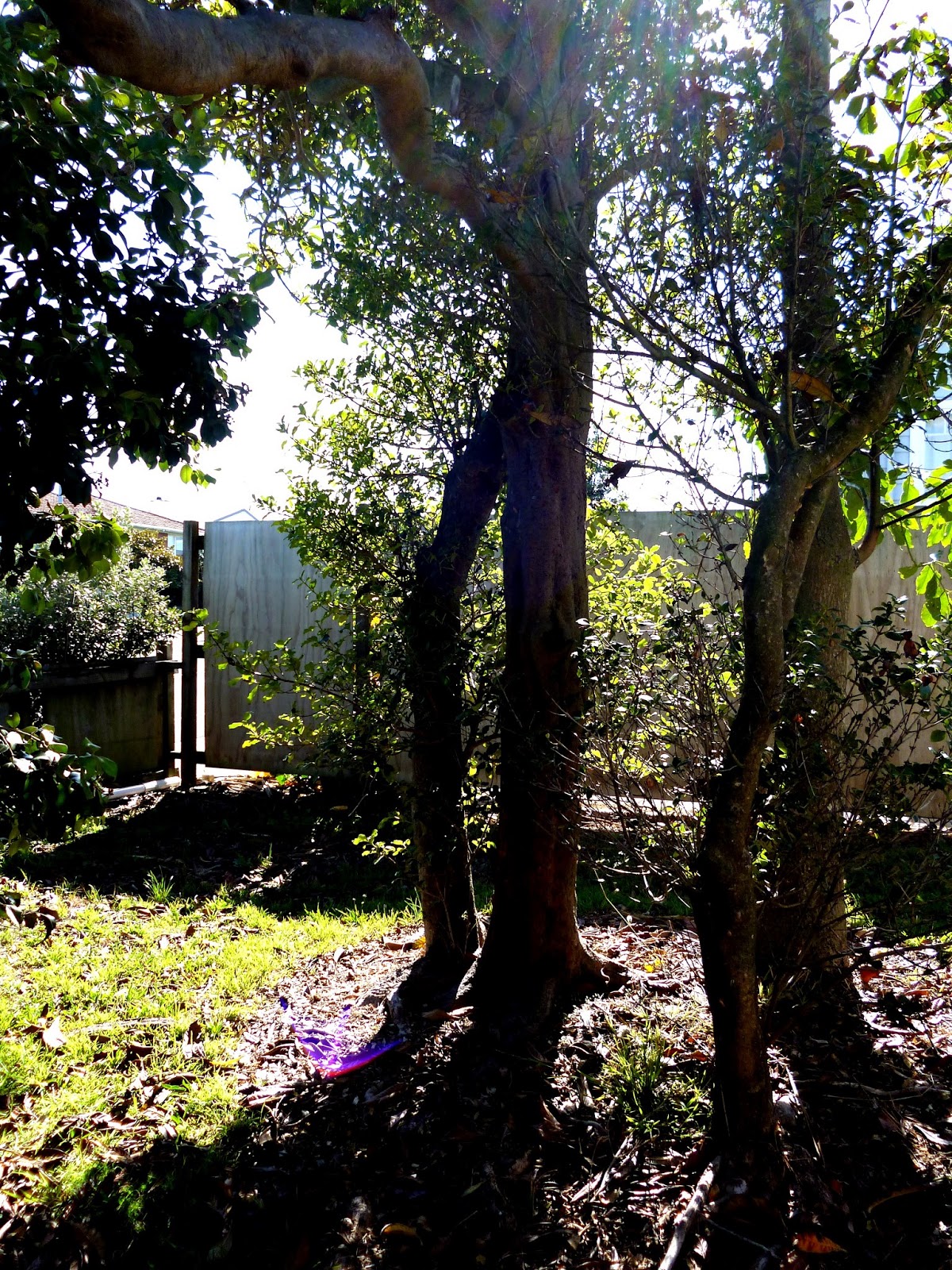
Sargeson's ashes, according to his wishes, were scattered under a loquat tree. Kevin Ireland marked the occasion by reading 'Ash Tuesday'.
 
'FRANK SARGESON
SCULPTURED BY
ANTHONY STONES
PRESENTED BY THE PEOPLE
TO THE
TAKAPUNA LIBRARY'
 
And in Auckland Central City Library is another likeness of Sargeson, this time by Alison Duff, 1965.
 
Many thanks to Vanessa Seymour of Takapuna Library for a very enlightening and fascinating tour of the Frank Sargeson house – and for mentioning this sculpture to us.
 
Link to another Sargeson post:

–––––––––––––––––––––––––––––––––––
Michael King: Frank Sargeson: A Life (1995)