19 April 2013

John Mulgan: Man Alone (1939)

Man Alone is the only novel by John Mulgan, who killed himself (for not altogether clear reasons) on Anzac Day in 1945, in a hotel in Cairo, at the age of thirty-three.
 
 In 'John Mulgan: A Question of Identity', a thirty-five-page article originally published in Islands in 1979 and with a four-page postscript added in 1981 in In the Glass Case (and again in Kin of Place: Essays on 20 New Zealand Writers (2002)), C. K. Stead draws attention to the writing of Alan Mulgan, John's father. Alan Mulgan is seen to represent New Zealand in a cosy, sentimental fashion as opposed to John Mulgan's more negative vision, and an analogy is drawn between England's 'Georgian' romanticism and the reaction of the pylon poets against it.

Stead also points out that there are two very different fictional elements in the novel – the 'economic history' in which the protagonist Johnson (who is given no forename) is a mere 'travelling object', seen from a kind of photographic perspective; and the second is where he becomes the subject, a symbolic representation of New Zealand man. Stead goes on to say that Mulgan is examining the identity of New Zealand, the social and the political weighed against the existential. The ten-page coda Part Two, which brings back the social element by showing Johnson going off to fight in the Spanish Civil War, was added by Mulgan after the publishers requested it.

Johnson, a young Englishman in New Zealand, is an aloof but (generally) sympathetic character, a kind of existential hero without the coldness of a Meursault, without the same egotism, who can join in socially if he chooses without drawing too much attention to his difference, but who also avoids emotional ties, travels light and is prepared to travel far. The story takes him through different farming jobs, through work on a scow, through New Zealand's depression when he is unemployed and sent to a pointless relief camp constructing a scenic road, through a kind of (inevitably fractured) comradeship in the Auckland unemployment riots in Queen Street in 1932.

And Johnson escapes from this life, train hops, and then finds more farm work for a year working for Stenning, who lives with his much younger Maori wife. There is the promise of Johnson getting his own farm in a few years, aided by Stenning, until the unbearable, mounting sexual tension literally explodes in his employer's face and he again flees from a situation that got out of control, but over which he had very little control.

And so it is this general guiltlessness which carries the reader's sympathy for him through the Kaimanawas, the unforgiving New Zealand bush in the centre of North Island, an endurance test in which his physical and mental courage is tried to its greatest extent. He survives, but must continue fleeing from the consequences of the death of Stenning.

Yes, there are two distinct but related parts, although I'm uncertain about the necessity for Part Two.

17 April 2013

Graeme Lay: The Mentor (1978)

The Mentor is Graeme Lay's first novel, and was published by Cape Catley, the publishing company owned by Christine Cole Catley (1922–2011), who was encouraged to publish it by Frank Sargeson.
 
Lay's novel is told in a flashback sandwiched between a very brief beginning and very brief ending set (at the time of publication) fifteen years in the future, in 1993. It follows the development of New Zealander Paul Hopkins through university in Wellington and through three years in England as a(n unqualified) teacher, to a reluctant return to New Zealand.

The vast bulk of this relatively short book is concentrated on the time after this return, when Paul begins casual work in a restaurant but is developing a serious interest in writing. He has previously written articles about English life for the Kiwi magazine Libra, the editor of which is (the nice?) Guy Foreman, who would welcome a feature article from Paul on the elusive/reclusive writer James Paterson.

Graeme Lay bases Paul Hopkins on himself, and James Paterson on Frank Sargeson: Hopkins writes letters (including his short story attempts) to the well known author Paterson, who writes his criticisms back and makes suggestions for improvement. Eventually, Hopkins is invited to the rather isolated island where Paterson (unlike Sargeson) lives (but where he's surrounded by books, has an old radio, etc, much like Sargeson) and the two socially gel to the extent that Hopkins spends three nights there in the company of his genial host.

Whilst at Paterson's home, Hopkins discovers that Foreman, for whom he is ostensibly working, is using him as a stooge to pursue a personal vendetta against the writer. Hopkins then refuses to be led into Foreman's unscrupulous (and ultimately infernal) game. But he's already caught up in it.

This is a surprisingly arresting narrative about the teaching and the learning of the art of writing (and of life and integrity) which is frequently interrupted by stories within stories.

16 April 2013

Ronald Hugh Morrieson: Came a Hot Friday (1964)

Ronald Hugh Morrieson's novel Came a Hot Friday (like his début The Scarecrow, which I shall review a little later after re-reading) is a strange mixture of thriller and comedy punctuated by speech very often in the New Zealand vernacular. It seems more intricately structured, though, with chapters seen from the points of view of different characters who will interweave with others.
 
The blurb on the back of this retro New Zealand Penguin edition seems doubtful about how to sum the book up, and I can understand the problem: it's about Morrie Shalapeski, who sets fire to premises he doesn't realize a man is sleeping in; and Wes Pennington and his chum Cyril Kiddman (incorrectly spelt in the blurb), who start a lucrative betting scam; and Don Jackson (perhaps an older version of The Scarecrow's Neddy Poindexter), who is out to lose his virginity; and Sel Bishop, the violent bookie who has no concern for anyone but himself and how much money he can make; and the absurd but highly sympathetic Te Whakinga Kid, who is a mock-Zorro who pretends so much that things become real.
 
They are all brought together in some way: the man Morrie (eventually) accidentally kills is Pop Simon, whom he knows and likes, and who is known by his boss's wife's friend; Don becomes the third partner in Wes and Cyril's betting scam; Morrie was paid for the arson by the evil Sel Bishop, who towards the end tries to burn Morrie, Wes, and his own girlfriend Claire (who is also Morrie's sister).
 
Oddly, perhaps, almost all of the characters (with the notable exceptions of the bookies Bishop and Cray) are seen in a sympahetic light, often as wounded victims of a life without mercy in which they have to feed their addictions – usually by getting as hopelessly drunk as possible as often as possible, or (to a lesser extent) by extreme gambling. The narrator is aware of the extent of the self-destruction (and seems particularly knowledgeable about the effects of alcohol) but appears to see this behaviour as natural, or at least unavoidable.
 
A special mention should go to the Te Wakinga Kid, the Māori who dresses as a cowboy and uses a cap gun. He is a fusion of a pretend bandit and a pretend sheriff, who – as deus ex machina – transforms himself (for the reader and for the characters he rescues from otherwise certain death) instantly into a real hero. Right at the end of the book though – leaving with the swag – he sees himself as a real bandit only and throws away his sheriff badge: he has grown up and overcome superstition.
 
But, as the last page seems to say, he's just a scared kid after all: he has been as self-deceived about his new role as he was about his former ones.
 
My other blog posts on Morrieson:

–––––––––––––––––––––––––––––––––––
Ronald Hugh Morrieson: Predicament (1974)
Julia Millen: Ronald Hugh Morrieson: A Biography (1996)

15 April 2013

Ronald Hugh Morrieson in Hawera, Taranaki, New Zealand

Outside New Zealand and Australia, I doubt that many people have heard of the writer Ronald Hugh Morrieson (1922–72), and doubt even that he's very well known in New Zealand, the country of his birth. My title is obvious: the small town of Hawera is where Morrieson was born, where he lived and where he died. He hardly ever left the town: when he started university in Auckland he couldn't stand it and returned permanently to Hawera in a week.

It's customary to quote Morrieson's friend, the author Maurice Shadbolt, on what Morrieson said to him: 'I hope I’m not another one of these poor buggers who get discovered when they’re dead'. On Morrieson's death only two novels – The Scarecrow (1962) and Came a Hot Friday (1964) – were published, although these were followed after his death by Predicament (1975) and Pallet on the Floor (1976), which I believe is more of a draft than a finished novel. Subsequently all of the books were turned into films. But only the novel The Scarecrow seems to be widely available: I only found his second novel in one outlet, and his others are out of print. Even in death, he's still somewhat obscure.

Morrieson had a reputation in Hawera as a drunk and a waster, although he was better known locally as a musician than as a writer – earlier, he played in dance bands, and gave music lessons later.

He lived with his mother Eunice and his aunt Doris at 1 Regent Street, where he was born, and was devastated by the death of his mother (who had also been a music teacher) in 1968. The house was built by his maternal grandfather Charles Bartley Johnson, a cabinet maker. In 1993 there were plans to knock down the house and replace it with a Kentucky Fried Chicken outlet, but despite the setting up of a Scarecrow Committee to attempt to prevent this the house was demolished in April 1973.


However, the house was far from completely destroyed: Morrieson's room or attic, where his family say he wrote all his work, was bought by local builder Robert Surgenor to be used as a 'sleep-out' by his daughter. The attic was moved in December 2011 to Tawhiti Museum a few miles outside central Hawera, where it was renovated and now forms the upper floor of a display dedicated to Morrieson.

A poster of the movie The Scarecrow (1982).

Came a Hot Friday (1984).

Predicament (2010).

Morrieson's attic is not all that was preserved from the house: in Morrieson's Café Bar, wood from the house is used in the bar front, table tops, doors, fireplaces and staircase. Express an interest in Morrieson, and you will be shown a large laminated sheet giving a potted biography of the writer.


I'd parked next door to the café, in Countdown supermarket car park, and was intrigued to see Morriesons's van there: 'Let us solve your "Predicament" with a free ride to Morrieson's Café & Bar'.

I asked the very helpful girl at the i-site if she could could tell me where Morrieson's grave is in Hawera Cemetery. She jumped behind the computer and asked:

'What's the first name?'

'Ronald'.

'Oh, that Morrieson!'

I found a copy of The Scarecrow the following day in Whitcoull's in Wanganui ($5 off, making it just $9) and the assistant asked me if I'd read any of his books, and when I replied 'Not yet' she told me they are very odd.* So, I suppose the 'poor bugger' has been discovered by some people.

'In
Loving Memory Of
RONALD HUGH
BELOVED SON OF THE LATE
HUGH F. AND EUNICE H.
MORRIESON.
DIED 26TH DECEMBER 1972
AGED 50 YEARS.'

His aunt survived him:

'ALSO DORIS H. E. JOHNSON
DIED 28TH FEBRUARY 1974
AGED 81 YEARS.'


*She's right too. I've only read The Scarecrow so far, but for a book about a necrophilic serial killer this is a highly amusing work: the key, I think, is that all the sex and violence is understated, often in the form of suggestion.

My other blog posts on Morrieson's work:

–––––––––––––––––––––––––––––––––––

Ronald Hugh Morrieson: Came a Hot Friday (1964)
Ronald Hugh Morrieson: The Scarecrow (1963)
Ronald Hugh Morrieson: Predicament (1974)
Julia Millen: Ronald Hugh Morrieson: A Biography (1996)

14 April 2013

Durie Hill Tower, Wanganui, New Zealand

Durie Hill Tower was built as a World War I memorial. It has 176 steps, but they are well worth climbing for the spectacular view.
 
 
Forty or fifty kilometres up the river is Jerusalem, the tiny place where James K. Baxter had his commune and where he is buried. Parts of the Whanganui River Road are unmetalled, and the car hire firm didn't allow me to drive there. There are other rather longer ways of getting there, but they would have meant taking up the best part of a day, and even then it wasn't guaranteed that I'd see Baxter's grave, so I knew I was beaten.

Wanganui Old and New

Wanganui (or Whanganui) is 193 kilometres north of Wellington, and on the river of the same name. It is noted for its art deco buildings, of which this cinema on Victoria Avenue is an excellent example.
 
Andersons store with the W. H. Watt fountain on the left.
 
'W. H. WATT FOUNTAIN
The fountain was erected in 1881 at this
intersection as a mark of appreciation by the
citizens to W. H. Watt, early settler, Merchant,
and First Mayor of the Borough for the use of
Westmere Lake as a town water supply.
 
When the Tramway system was installed in
1908 the fountain was removed and stood for many years
in Queens Park.
 
It was relocated here in 1993.'
 
I doubt that this is used much, if at all.
 
 
The 2011 Bearing sculpture by David McCracken makes an impressive new addition to the sights of the town here at the side of the river.
 
David Clifford's Balancing Act. I like the title of the Wanganui Chronicle's article on this: 'Pencil Artwork Takes Lead in Competition'.
 
And although this on first appearances might be mistaken for a work of art, it is a course a pooper-scooper.

Katherine Mansfield in Wellington, New Zealand

Katherine Mansfield (1888–1923) was born Kathleen Mansfield Beauchamp at 25 Tinakori Road, Thorndon, Wellington, New Zealand, which is now a museum. The photo on the above leaflet shows Mansfield in 1921, surrounded by a representation of the original wallpaper from the house. Her parents were businessman Harold Beauchamp and his wife Annie (née Dyer).

 
The family moved to Karori when Katherine was four or five years old.
She only remained in New Zealand until 1908, when she left for England, and died just fifteen years later at Gurdjieff's Institute for the Harmonius Development of Man in Fontainebleau, France, at the age of thirty-four.
 
Photography is not allowed in the house.
 
'KATHERINE MANSFIELD BIRTHPLACE
RESTORED HOUSE OPENED BY
HER EXCELLENCY LADY REEVES
14 OCTOBER 1988 CENTENARY
OF THE WRITER'S BIRTH
 
KATHERINE MANSFIELD BIRTHPLACE SOCIETY
PATRON HER EXCELLENCY LADY REEVES
PRESIDENT OROYA DAY
PRINCIPAL ARCHITECT JAMES BEARD
ARCHITECT MARTIN HILL'
 
The Heritage Garden.
 
The Thistle Inn at 3 Mulgrave Street, Thorndon, was built in 1840, burned down in 1866 and rebuilt the same year. Katherine Mansfield's one-page story 'Leves Amores' was written when she was nineteen and begins 'I can never forget the Thistle Hotel'. The unnamed narrator lives in a room opposite a woman in the hotel and one evening invites her to dine and then to the opera. They return to the hotel and the evidently previously sexually charged evening becomes much more sexually charged. Although the sex of the narrator is not mentioned, many have read this as a lesbian story: curiously, she gave it to her father's secretary Matty Putnam to type out, and sent a copy to Vere Bartrick-Baker*, who held onto it until her death.
 
*A friend from when they were at Queen's College, London.
 
There is a link to the story below, along with a link to my review of Claire Tomalin's biography, plus Mansfield in Avon, France:
 
–––––––––––––––––––––––––––––––––––
'Leves Amores', by Katherine Mansfield

Claire Tomalin: Katherine Mansfield: A Secret Life (1987)
Katherine Mansfield and Gurdjieff in Avon, France

11 April 2013

Wellington Writers Walk, North Island, New Zealand

Inspired by Wellington is a fascinating little book of fifty pages and came free of charge courtesy of the Wellington i-site. It contains detailed information (including a necessary map) on the quotations by various New Zealand writers that have been placed in rather haphazard fashion around Wellington harbour (either in the form of concrete plaques or metal on benches), and also provides a little information about the writers. There were 19 quotations, but for reasons unknown to me there are now only 16 of the original ones, although (interestingly) four more were unveiled on the day we left Wellington. I keep to the same number pattern as the book.

1. Eileen Duggan (1894–1972)

As it turned out, the first is one of the missing ones, so I could only take a rather useless photo of where it should have been:

'MY QUIET MORNING HILL
STANDS LIKE AN ALTAR DRAWN
WHEREON HUSHED HANDS SHALL LAY
THE SHINING PYX OF DAWN.

WITH PENITENCE AND STIR,
AND DROWSY FLURRY BY,
THE WIND, A SHAMEFACED SERVING-BOY,
COMES RUNNING UP THE SKY.'

'The Acolyte', from Selected Poems: Eileen Duggan (ed. Peter Whiteford) (1977).

–––––––––––––––––––––––––––––––––––

2. Dennis Glover (1912–80)

'THE HARBOUR IS AN IRONING BOARD;
FLAT IRON TUGS DASH SMOOTHING TOWARD
ANY SHIRT OF A SHIP, ANY PILLOWSLIP
OF A FREIGHTER THEY DECREE
MUST BE IRONED FLAT AS WASHING FROM THE SEA.'

From 'Wellington Harbour is a Laundry' in Come High Water (1977)

–––––––––––––––––––––––––––––––––––


3. Michael King (1945–2004)

'I baited my line, watched it sink, and waited with exquisite anticipation for the pecking of mullet, the sucking of trevally, or – best of all – the sudden pull of kahawai or kingfish.'

From Being Pakeha Now (1999).

–––––––––––––––––––––––––––––––––––

4. Louis Johnson (1924–88)

'From Brooklyn hill, ours is a doll-size city
A formal structure of handpicked squares and bricks
Apprehensible as a child’s construction
Signifying community.'

From 'Last View of Wellington' in Fires and Patterns (1975).

–––––––––––––––––––––––––––––––––––

5. Lauris Edmond (1924–2000)

'IT'S TRUE YOU CAN'T LIVE HERE BY CHANCE,
YOU HAVE TO DO AND BE, NOT SIMPLY WATCH
OR EVEN DESCRIBE. THIS IS THE CITY OF ACTION,
THE WORLD HEADQUARTERS OF THE VERB'

From 'The Active Voice' in Scenes from a Small City (1994).

–––––––––––––––––––––––––––––––––––

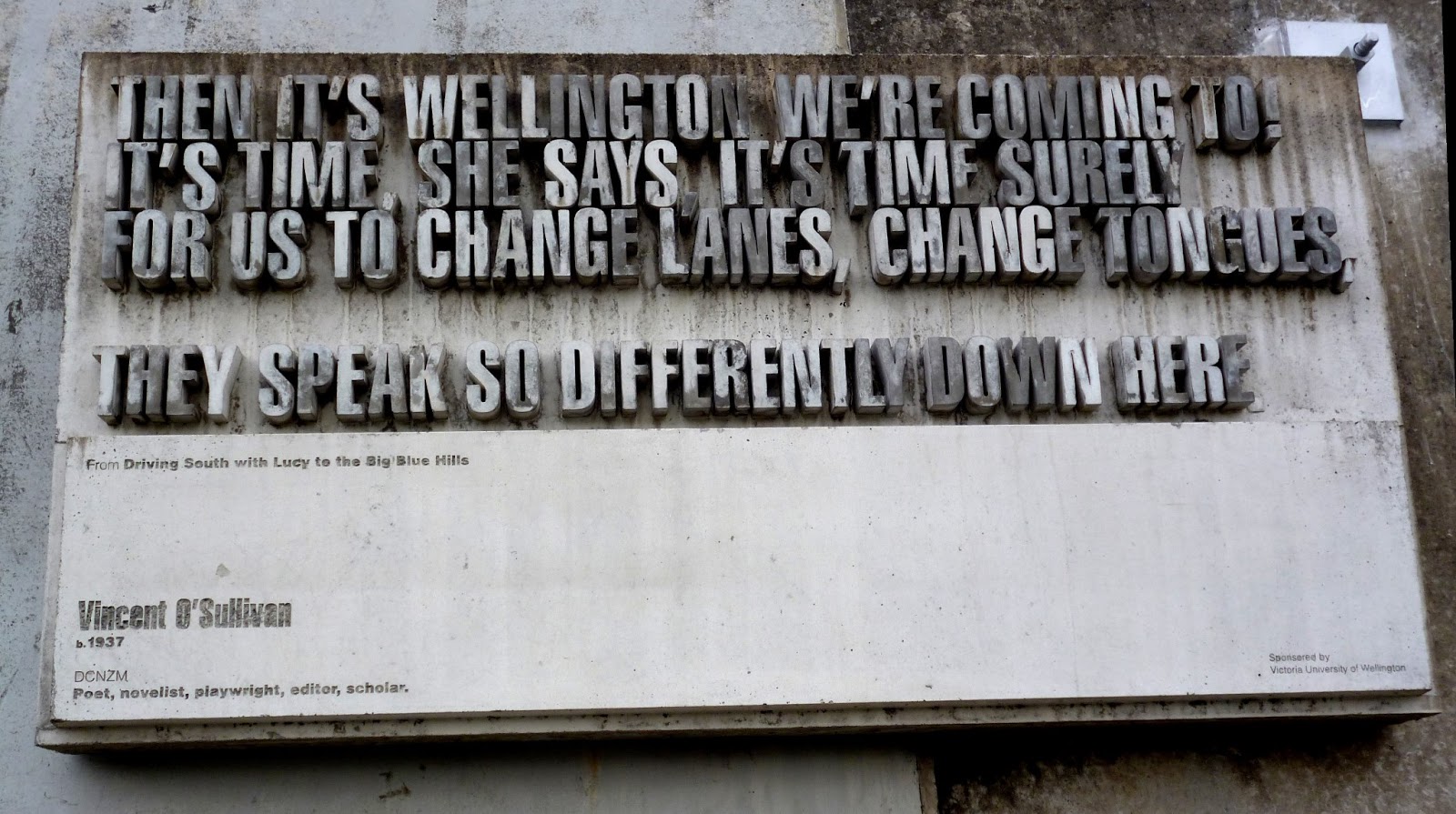
6. Vincent O'Sullivan (born 1937)

'THEN IT'S WELLINGTON WE'RE COMING TO!
IT'S TIME, SHE SAYS, IT'S TIME SURELY
FOR US TO CHANGE LANES, CHANGE TONGUES,

THEY SPEAK SO DIFFERENTLY DOWN HERE.'

From 'Driving South with Lucy to the Big Blue Hills' in Seeing You Asked (1998).

–––––––––––––––––––––––––––––––––––

7. Patrick Lawlor

Again, the plaque is missing, but the quotation read:

'AND NOW, AS I GROW IN YEARS,
I FEEL AT TIMES LIKE AN OLD
VIOLIN PLAYED ON BY A MASTER
HAND. YOU, DEAR CITY, ARE
THE MAESTRO DRAWING THE BOW
OVER THE SENSIBILITIES OF MY
MIND, ECHOING THE MUSIC
OF MY DAYS'

From Old Wellington Days (1959)

–––––––––––––––––––––––––––––––––––

8. Maurice Gee (born 1931).

'THEN OUT OF THE TUNNEL AND
WELLINGTON BURST LIKE A BOMB.
IT OPENED LIKE A FLOWER, WAS
LIT UP LIKE A ROOM, EXPLAINED
ITSELF EXACTLY, BECAME THE
CAPITAL.'

From Going West (1992).

–––––––––––––––––––––––––––––––––––

9. Patricia Grace

'I LOVE THIS CITY, THE HILLS, THE HARBOUR, THE
WIND THAT BLASTS THROUGH IT. I LOVE
THE LIFE AND PULSE AND ACTIVITY, AND THE
WARM DECREPITUDE ... THERE'S ALWAYS AN EDGE
HERE THAT ONE MUST WALK WHICH IS SHARP
AND PRECARIOUS, REQUIRING VIGILANCE.'

From Cousins (1992)

–––––––––––––––––––––––––––––––––––

10. Bill Manhire (born 1946)

'I LIVE ON THE EDGE
OF THE UNIVERSE,
LIKE EVERYONE ELSE'

From 'Milky Way Bar' in Milky Way Bar (1991).

–––––––––––––––––––––––––––––––––––

11. Sam Hunt (born 1946)

'TALL BUILDINGS NO BIGGER THAN BLOCKS ON THE FLOOR,
WELLINGTON AFLOAT ON THE HARBOUR HAZE ...
YOU THINK OF HOW MOST MEN SPEND THEIR DAYS
IN OFFICES AS CRAMPED AS ELEVATORS –'


From 'Letter to Jerusalem 2' in Collected Poems 1963–1980 (1980).

–––––––––––––––––––––––––––––––––––

12. Bruce Mason (1921–82)

'I ASK THAT NOT ONLY MY CITY,
BUT ALL, GIVE THEMSELVES
TO THE ESSENCE OF OUR CULT
– THE RITUAL ASSEMBLY OF AN
INTERESTED COTERIE IN A SPACE
WHERE MAGIC CAN BE MADE
AND MIRACLES OCCUR.'


From 'Theatre in 1981: Omens and Portents', an unpublished manuscript, Bruce Mason papers, J. C. Beaglehole Room, Victoria University of Wellington.

–––––––––––––––––––––––––––––––––––

13. Alistair Te Ariki Campbell (1925–2009)

'BLUE RAIN FROM A CLEAR SKY.
OUR WORLD A CUBE OF SUNLIGHT –
BUT TO THE SOUTH
THE VIOLET ADMONITION
OF THUNDER.'


From 'Blue Rain' in The Dark Lord of Savaiki: Collected Poems (2003).

–––––––––––––––––––––––––––––––––––

14. Robin Hyde (1906–39)

'YET I THINK, HAVING USED MY WORDS AS THE KINGS USED GOLD,
ERE WE CAME BY THE RUSTLING JEST OF THE PAPER KINGS,
I WHO AM OVERBOLD WILL BE STEADILY BOLD,
IN THE COUNTED TALE OF THINGS.'


From 'Words' in Young Knowledge: The Poems of Robin Hyde (ed. Michele Leggott) (2003).

–––––––––––––––––––––––––––––––––––
15. James K. Baxter (1926–72)

This is the final plaque that's missing, and from photos it does seem to have been floating in the sea. The words are well known:

'I SAW THE MAORI JESUS
WALKING ON WELLINGTON HARBOUR.
HE WORE BLUE DUNGAREES.
HIS BEARD AND HAIR WERE LONG.
HIS BREATH SMELT OF MUSSELS AND PARAOA.
WHEN HE SMILED IT LOOKED LIKE THE DAWN.'

From 'The Maori Jesus' in Collected Poems of James K. Baxter (ed. J. E. Weir) (2003).

–––––––––––––––––––––––––––––––––––

16. Katherine Mansfield (1888–1923).

'THEIR HEADS BENT, THEIR
LEGS JUST TOUCHING, THEY
STRIDE LIKE ONE EAGER
PERSON THROUGH THE TOWN,
DOWN THE ASHPHALT ZIGZAG
WHERE THE FENNEL GROWS
WILD... THE WIND IS SO
STRONG THAT THEY HAVE
TO FIGHT THEIR WAY
THROUGH IT, ROCKING LIKE
TWO OLD DRUNKARDS.'


From 'The Wind Blows' in Bliss and Other Stories (1920).

–––––––––––––––––––––––––––––––––––


17. Marilyn Duckworth (born 1935)

'Then with the coming of darkness the
bay opened up beneath us, like a shell splashed
with beads of light.'
 

From  Barbarous Tongue (1963).

–––––––––––––––––––––––––––––––––––

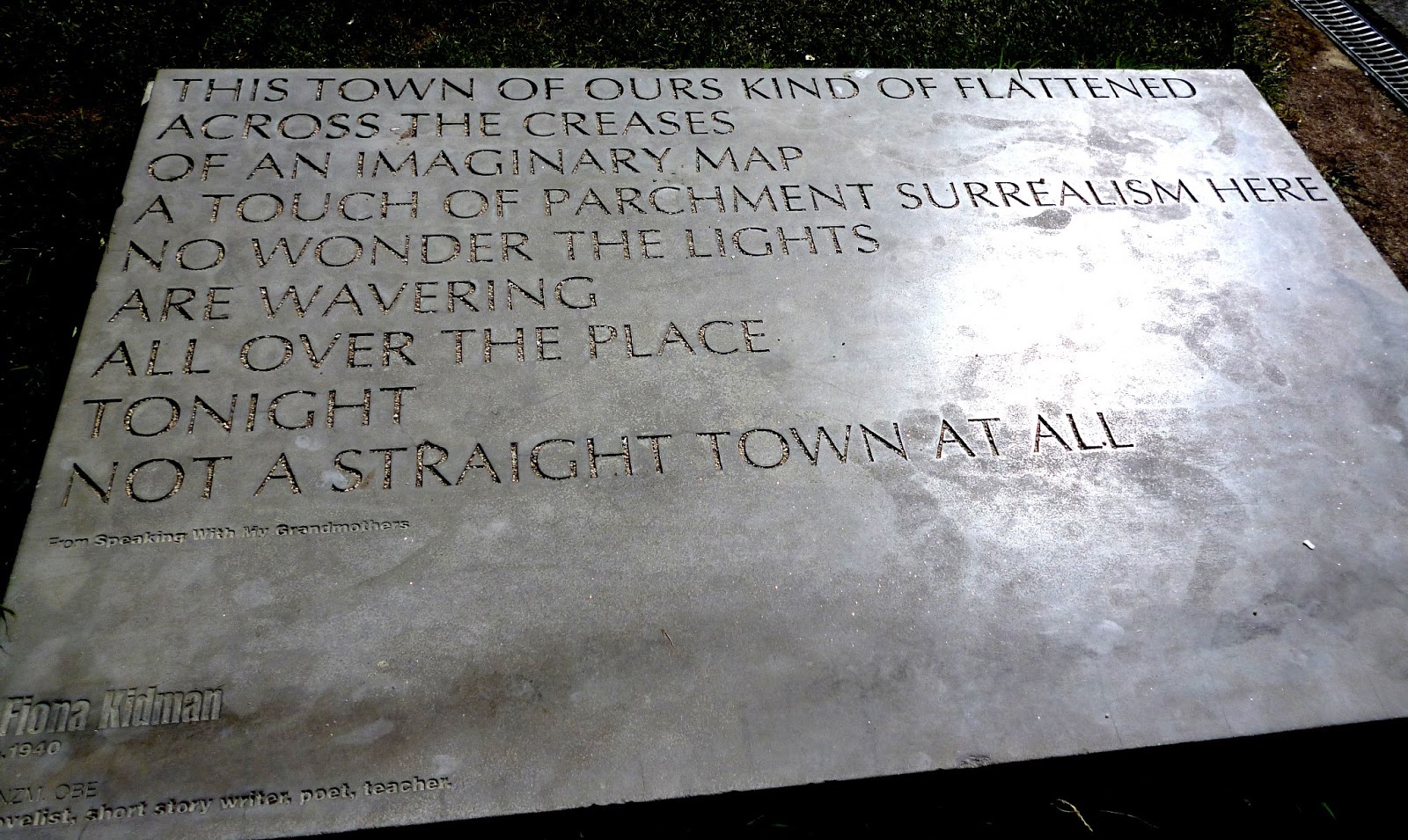
18. Fiona Kidman (born 1940)

The remaining two plaques are a little beyond central Wellington, this one being in the suburb Oriental Bay:

'THIS TOWN OF OURS KIND OF FLATTENED
ACROSS THE CREASES
OF AN IMAGINARY MAP
A TOUCH OF PARCHMENT SURREALISM HERE
NO WONDER THE LIGHTS
ARE WAVERING
ALL OVER THE PLACE
TONIGHT
NOT A STRAIGHT TOWN AT ALL'


From 'Speaking with my Grandmothers' in Writing Wellington (ed. Roger Robinson) (1999).

–––––––––––––––––––––––––––––––––––

19. Barbara Anderson (1925–2013)

The final plaque of the original walk is in the suburb of Roseneath. Barbara Anderson died five days after I took this photo.

'EVERYTHING ABOUT IT WAS
GOOD. THE TUGGING WIND
TRAPPED AND CORNERED BY
BUILDINGS, STEEP SHORT
CUTS BORDERED BY GARDEN
ESCAPES, PRECIPITOUS GULLIES,
WHERE THROTTLING GREEN
CREEPERS BLANKETED THE
TREES BENEATH.'


From 'The Girls' in I Think We Should Go into the Jungle (1989).

–––––––––––––––––––––––––––––––––––

I took the above photos on 19–20 March this year, and by chance noted that there were three more unrecorded quotations added. On the same evening that I took the last photo, I noticed an article in the Dominion Post of that day titled 'Walk on the Write Side' saying that the plaques would be unveiled the following day, only there were four of them: I'd taken photos of three, but missed Jack Lasenby's – but it was too late to search for that, as the following morning we'd be on our way from our hotel in Johnsonville to Wanganui.

(As you can see at the bottom right of the photos below, it's the names of the writers and the sources of the quotations that were unveiled, not the quotations themselves.)

Elizabeth Knox (born 1959)

'The evening light concentrated, till the city and the
topped-up trembling horizon beyond Pencarrow Head would
begin to look like a seaport in someone's lost paradise.'


From 'Provenance' (2001)

–––––––––––––––––––––––––––––––––––

Joy Cowley (born 1936)

'Light dances on hills and office windows
and shakes its skirts over the harbour
in a wild fandango that attracts

the pale moths of yachts in droves.'

From 'After the Southerly'.

–––––––––––––––––––––––––––––––––––

There are several differences between this verse and the one published on Joy Cowley's web site in February this year announcing (very modestly, as she says she doesn't consider herself a poet) the unveiling, and these are no doubt an indication of different states of the poem.

James McNeish (born 1931)

'A ruffian wind is bliss, a blind man's
comfort station. When I get tired of walking
around it, I can always lean against it.'


From The Crime of Huey Dunstan (2010).

–––––––––––––––––––––––––––––––––––

Jack Lasenby (born 1932)

Lasenby's quotation was actually largely hidden before the unveiling, and it is vertical as it is on a pole – there are a few photos of the unveiling on flickr, although I don't know the source of this admirable (albeit utopian) quotation:

'I want to live among people who believe in truth and freedom...
I want to discuss ideas... I want books...'

The links to my posts below may also be of interest:

–––––––––––––––––––––––––––––––––––
The Writers' Plaques, Christchurch, New Zealand
Writers' Walk, Dunedin, New Zealand