
 The poet and author Léon Valade (1844-84) was born in rue Thiac in Bordeaux and was a friend of Paul Verlaine, who dedicated his poem 'Pierrot' to him. Valade, one of the so-called Parnassian school of poets, was one of the first people to recognize the genius of Rimbaud.
This bronze monument in the Jardin Public is the work of Charles-Louis Malric (1872-1942) in 1904. It was melted down during the German occupation, but this new model was made from a plaster mould held in the Musée des Beaux-Arts in Bordeaux.
 Verlaine's sonnet:
Pierrot
A Léon Valade.
Ce n'est plus le rêveur lunaire du vieil air
Qui riait aux aïeux dans les dessus de portes;
Sa gaîté, comme sa chandelle, hélas! est morte,
Et son spectre aujourd'hui nous hante, mince et clair.
Et voici que parmi l'effroi d'un long éclair
Sa pâle blouse à l'air, au vent froid qui l'emporte,
D'un linceul, et sa bouche est béante, de sorte
Qu'il semble hurler sous les morsures du ver.
Avec le bruit d'un vol d'oiseaux de nuit qui passe,
Ses manches blanches font vaguement par l'espace
Des signes fous auxquels personne ne répond.
Ses yeux sont deux grands trous où rampe du phosphore,
Et la farine rend plus effroyable encore
Sa face exsangue au nez pointu de moribond.
Verlaine's sonnet:
Pierrot
A Léon Valade.
Ce n'est plus le rêveur lunaire du vieil air
Qui riait aux aïeux dans les dessus de portes;
Sa gaîté, comme sa chandelle, hélas! est morte,
Et son spectre aujourd'hui nous hante, mince et clair.
Et voici que parmi l'effroi d'un long éclair
Sa pâle blouse à l'air, au vent froid qui l'emporte,
D'un linceul, et sa bouche est béante, de sorte
Qu'il semble hurler sous les morsures du ver.
Avec le bruit d'un vol d'oiseaux de nuit qui passe,
Ses manches blanches font vaguement par l'espace
Des signes fous auxquels personne ne répond.
Ses yeux sont deux grands trous où rampe du phosphore,
Et la farine rend plus effroyable encore
Sa face exsangue au nez pointu de moribond.
 Victor Billaud (1852-1936) was born in Saint-Julien-de l'Escap, near Saint-Jean-d'Angély, Charente-Maritime, and started his own weekly newspaper, La Chronique charentaise, in the town at the age of 22 in 1874. It contained articles on literature, poetry, and science. He abandoned the venture two years later, though, encouraged by Frédéric Garnier, the mayor of Royan, to settle in the town and run his own printing press.
There, he started printing Le Phare Littéraire, which had little success, but he soon established La nouvelle Gazette des Bains de Mer de Royan sur l'océan, which was very successful, particularly after the artist Barthélemy Gautier was recruited to draw for it. René, Billaud's elder son, took over the illustrations after Gautier's death in 1893. The paper became a mine of information on life in Royan.
He also founded several other papers, such as Le Royan, which his son Pierre later directed. But Billaud was also known for his postcards, his Guide du touriste (to Royan, of course), his photography, and also for his poetry. He remains one of the best known figures in Royan.

 Billaud wrote a poem on each occasion of the unveiling of three public monuments in Royan: for the author and journalist Eugène Pelletan's statue in 1892, for Frédéric Garner's in 1907, and the above World War I memorial in 1921. Only the last has survived.
 A street in Royan remembers both Victor Billaud and his son Pierre.
 And Monique Chartier's Victor Billaud: Le Chantre de Royan (Vaux-sur-Mer: Bonne Anse, 2005) makes a very good job of remembering not only Victor Billaud, but also much of the history of Royan in general.

 Étienne Baudry (1830-1908) is not a name well known in France, the country of his birth, let alone the UK, but a new book, Étienne Baudry: Une vie chantentaise...châtelain, dandy et écrivain militant (Saintes: Le Croît vif, 2010), written by his grand-daughter Yvonne Melia-Sevrain, may begin to change things. Baudry was born in Saintes and spent much of his life in the castle at Rochemont, near Saintes. Rochemont more or less depended on the revenue from its extensive vineyards.
In 1864 Baudry married Isabelle Bardin, a younger woman incapable of dressing herself without a servant, and the disastrous marriage was later satirized in Baudry's Le Camp des bourgeois (1868), a publication that came out two years before the essay Les Bras mercenaires. In these publications, along with his La fin du monde, Baudry sketched out his ideas for a future socialistic - even to some extent anarchistic - society, partly influenced by Louis Blanc and Charles Fourier.
Baudry established a workshop at Rochemont, where the artist Louis-Augustin Auguin lived for some months, and, for a longer period and more (in)famously, Gustave Courbet, who was a considerable financial burden to Baudry.
Due to the failure of his vineyards, Baudry was forced to sell Rochemont and move to Royan, where he died. Until recently, his grave in the cemetery in Royan lay unnoticed, and it is only a few years ago that it has been restored.


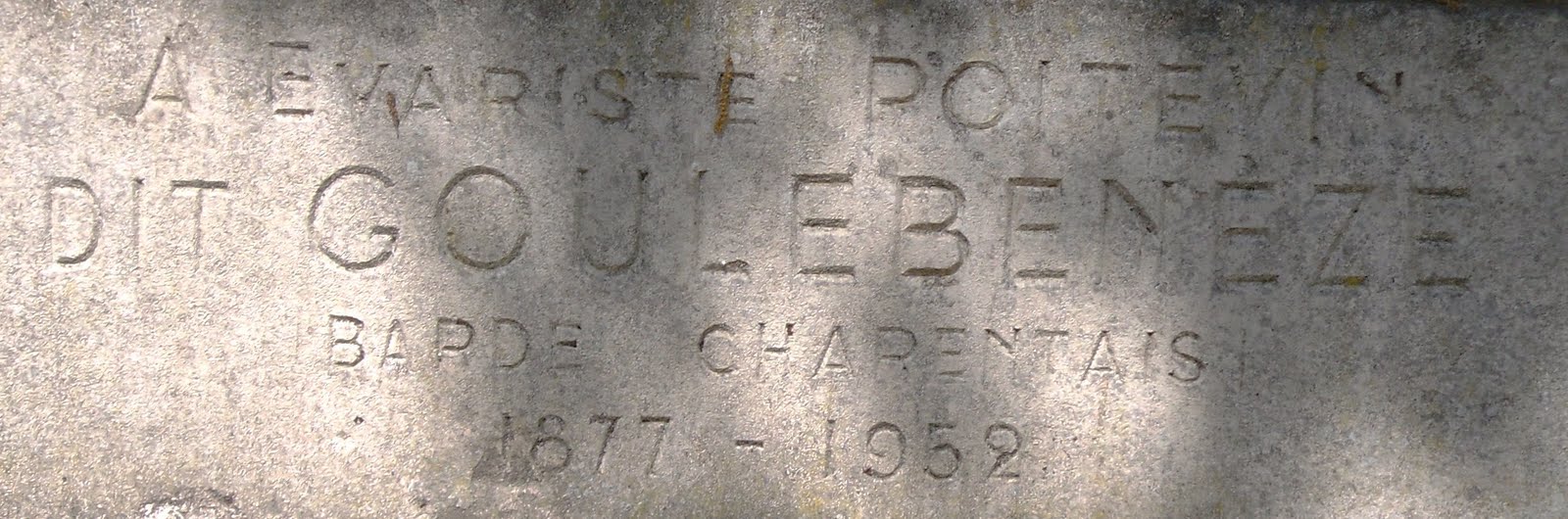
This superb monument to Goulebenéze is tucked away outside the Office du Tourisme, 62 Cours National, in Saintes, Charente-Maritime.

 Goulebenéze ('goule bien aise'), and with an 'e' acute rather than 'e' grave, is the normal appellation of the 'bard', poet, and singer of Charentais songs, of those of the area within Charente, or Santonge. He is Évariste Poitevin (1877-1952), born in Montigny, near Burie, and his poems, writings, and songs were often in the santongeais dialect. Today, he is regarded with great respect in the local area, largely because of his contribution to the local heritage.
From 1902, for 50 years, he was known locally, and even to a minor extent nationally, as an entertainer. He married in 1914, very shortly before being called up, had two children, but had great difficulty preventing his family from falling into debt, slowly having to sell off the family assets.
His poem 'Bonjour Santonge' is one of his most popular, being one that he wrote for the prisoners of World War II.
Goulebenéze died in poverty in Saintes on 30 January 1952, and this is an example of his work, in santongeais:
'Magnière prr' ine jheune feuille d'entortiller un garçon'
'O faut coumincé à pas mais faire cas de li que s'o l'était in méchant cheun de reun du tout. S'il asséye de s'agrâler , o faut chaurit in p'tit et zi virer le thiu aussitout. Thiau gâs s'rat caunit, il érat s'capit dan-n-in coin. Jhuste à thieu moument, o faut avé l'ar de s'éthiuper à causé à in aut' garçon, et d'êt'en grande convarsation avec li, histouère de faire cagné l'aute. O faut n'en resté là prr' le premier cot . O faut pas asseyé de pieumer le canet coum' thieu tout d'in randon, o faut thitté thieuq' coutons à l'ozâ prr' la prochaine renconte.
Thielle lâ lâ arat yieu de peurférence dan-n-in endreit vour o l'arat jholiment de monde : dan-n-in bal prr' exemp'lle. In p'tit de poumade qui sent à bon aux ch'veux, deux ou trois brins de bâz'lit dans l'jhabot, et c' qui ne f'rait pas de tort, ine quoue de langrote dans l'coin dau mouche-nez, et en route prr' le bal !
Gardez-vous beun, sultout, de dévisajhé en rentrant thiaulâ que vous v'lez aguigné. Ne vous avisez pas de vous enguillebaudé avec li, et dansez tout fin jhû ine ou deux veurses ou mazulka, o b' in deux quadrilles. Si sârre les douets in p' tit fort, o faut qu' vout' main à vous devinjhe molle coum' de la laine. En montant vous rafraichit, sonjhez à pas vous laisser lucher les jhottes dans l'escayier: o vaut reun thieu, i se creirait tout parmit.
A la sortie dau bal, au moument de partit, mais à thieu moument seulement, pendant que les veilles peurnant zeux fichut, et que vous êtes en train de vous embobyiné dans voute capeline, vous teurcherez dans la salle l'homme en question, vout oeuil s'appouérat su li coum' in grand aubrât s'abat su in paur' chêtit échardrit, et là, les z'oeuils dans les z'oeuils, vous le fisquerez bin coum' o faut, o s'rat coum' ine éloize, le gas s'rat-t-abrâzé.
Ne vous thittez pas reconduit prr' li. Si le lendemain au matin vous entendez subié dau coûté de vout' porteau, o l' est qu' o l' arat fait effet, et que le gâs est pris coum' in chafouin dan-n-ine bouzine.
A partir de thieu moument , vous peuvez le thitté s'agrâlé sans minfiance et le laissé dénoué vout' devantâ.
Et prr' m' armercier de vous z' avé douné de si bons conseils, vous m' inviterez à la noce!'
I can't imagine anyone ever coming after me with a copyright hammer for reproducing this, as, let's face it, this piece by Goulebenéze is pretty obscure. And how could anyone even consider translating it? The flavor is untranslatable.
 The mark of the sculptor, P. M. Marchand.
 Le Croît vif is a bookshop and publisher of Charentais literature at 2 ruelle de l'Hospice, Saintes. The interesting thing about this shop is that it used to be a grocer's where Goulebenéze regularly went.

Le Maine Giraud manor - now in part a museum remembering Alfred de Vigny, the 19th century romantic poet - was built and altered between the 12th and the 15th centuries, and belonged to Vigny between 1827 and his death in 1863.
Vigny inherited it from his aunt Sophie de Baraudin, who was his mother's elder sister. He had first seen it in 1823, when he was 26 and a military captain, and had been very impressed. His grandfather, the Marquis of Baraudin, was an admiral who wished to remain close to the ports Rochefort and La Rochelle.
On Vigny's inheriting it, the manor was in a bad state of repair, but instead of selling it he decided to restore it bit by bit.
One restoration of note is one of the towers (interior photos below), where he wrote La Mort du loup La Bouteille à la mer, and parts of other poems.


 Le Maine Giraud, near Champagne-Vigny, Charente.
 The bust of Vigny at le Maine Giraud.
 Two different plaques at the entrance to the building.

 The former dining room, which contains many things, including:
 A bust of Vigny.
 A modern sketch of Vigny.
 The last page of Vigny's marriage contract.


 Vigny's tiny room, with twisting stairs leading up to it, where he went to write and relax.
.JPG) Today, cognac is distilled on the premises, and this is an example of the wine they sell.
Today, cognac is distilled on the premises, and this is an example of the wine they sell.
 A quotation in the parking lot at Champagne-Vigny reads:
'Il y a dans le pays le moins connu de l'Angoumois, une chaîne de collines qui s'étend vers la mer, sans se briser et qui forme des sinuosités dont les aspects sont toujours imprévus et pittoresques...'.
'There is in the least known land of l'Angoumois a chain of hills reaching down toward the sea, unbroken and so sinuous, always unexpected and picturesque.'

 There is a monument to Vigny in Champagne-Vigny.
 Vigny's name is well-remembered in this village.

 L'Église St Christophe is where Vigny went with his wife, Lydia Bunbury, to mass when he was staying at le Maine Giraud.
 Vigny presented the church with the statue of the Madonna and child which stands on the lefthand side of the entrance to the chancel. It once stood in a corner in Sophie de Baraudin's bedroom.
 Vigny was the godfather of the church bell, and his name is etched on it.

 The poet and author Léon Valade (1844-84) was born in rue Thiac in Bordeaux and was a friend of Paul Verlaine, who dedicated his poem 'Pierrot' to him. Valade, one of the so-called Parnassian school of poets, was one of the first people to recognize the genius of Rimbaud.
 Verlaine's sonnet:






.JPG)


 Posts
Posts

