26 November 2009

Hendersonville, North Carolina: Thomas Wolfe: Literary Landmarks of the Southern United States, #18

I wasn't even aware of this street marker – or the existence of the angel, for that matter – until I noticed it on a map of Hendersonville that the hotel receptionist had given Penny. But here it is: 'Wolfe's Angel. Marble statue from the Asheville shop of W. O. Wolfe. Inspired title of son Thomas Wolfe's Look Homeward, Angel. Stands 150 feet south.'

And here it is. The story goes that Thomas Wolfe saw it in his father's shop one day, and was so impressed with it that he took it for part of his title, and it then became part of literary history.

Asheville, North Carolina: Thomas Wolfe<: Literary Landmarks of the Southern United States, #17

Thomas Wolfe (1900–38) was born at 92 Woodfin Street, Asheville, North Carolina, the youngest of eight children. His father William Oliver (frequently just known as 'W. O.') was a stonemason with a tombstone shop in Asheville, and his mother, Julia Elizabeth Westall, was a hard-nosed businesswoman who took in boarders and aquired real estate. In 1906 the family bought and moved in to 48 Spruce Street near their former home, and ten years later Julia extended and modernised 'The Old Kentucky Home', as the boarding house was called'. Later, in Wolfe's autobiographical Look homeward, Angel (1929), he called it 'Dixieland'. The house is largely intact, family members having arranged the furnishings as it was then. Because Look Homeward, Angel was so heavily autobiographical, Asheville public library banned it for more than seven years due to less than complimentary outlines of the none too well disguised characters.

A replica of the card Julia got her children to distribute as an advertisement.

The marital bed in which Thomas Clayton Wolfe was born, although of course not in the same house.

The rather spacious dining room – the house has twenty-nine rooms.

A detail from the kitchen.

One of the guest rooms.

I have to add how much we enjoyed our visit to the Old Kentucky Home, which began with a number of photographic representations of Wolfe's brief life, continued with the most enthusiastic, brilliant performance (and that is the only word for it) that I have ever witnessed a guide give, and ended with a short biographical film. It was two (well, very nearly: the parking meter clock still registered a few minutes in our favor) very entertaining hours, and all for one dollar. Compared with the hugely disappointing (and comparatively savagely expensive) autopiloted guide to the Margaret Mitchell home in Atlanta, Georgia (to come: I'm saving the worst till last), well...

Between 13 September through 15 September (three nights), Dr John S. Phillipson, a fan of Thomas Wolfe, was the only guest at the Old Kentucky Home. He had come boarded a Greyhound from Rochester, New York state, to visit a friend in Fort Jackson, South Carolina, and timed his visit to coincide with the anniversary of Wolfe's death on the final day of his stay. He was delighted to be able to talk to Julia Wolfe, and to make notes for the booklet he wrote about his experiences, which includes a rather hazy photo he took of Julia standing beside the writer's grave.

25 November 2009

Clayton, Georgia: Lillian Smith: Literary Landmarks of the Southern United States, #16


The Lillian E. Smith Center for Creative Arts is not too easy to find if you're coming from Clayton town, as it's on the other side of the road, and the entrance is a narrow gravel path leading up Old Screamer Mountain. However, the drive may be very slow, but it's very short and very well worth the effort.

The Director is Dr Nancy Smith Fichter, Lillian Smith's niece, who lives in Smith's former home with her husband Robert Fichter. The front of the building is generally obscured by vegetation, but the other two photos below give a better idea of what the building looks like. The properties here – or rather what is left of them when some were destroyed by arson – in the 1920s through the 1940s, were part of Laurel Falls Camp for Girls. Smith spent most of her life here.

Lillian Eugenia Smith was born in 1897 in Jasper, Florida, close to the border with Georgia. Her father Calvin was a successful wholesaler of lumber and naval goods, until the business failed in 1915, and the family relocated to Old Screamer Mountain, where the family had a summer home, and where Calvin opened an inn named Laurel Falls Hotel.

Lillian gained a teaching certificate, and studied music in Baltimore. Following a little teaching experience, she took a post as head of the music department in a missionary school in Huchow, Chekiang, China, in 1922 for three years. She described her experience there as 'intense and profound' (Anne C. Loveland, Lillian Smith: A Southerner Confronting the South: A Biography, Baton Rouge: Louisiana State University Press, 1986, p. 11).

Lillian's parents were ill and not in a very good financial position on her return in 1925. In 1920 Calvin had made the hotel into a girls' camp, and Lillian had worked there before going to China, and although she had not liked it she felt the need to take control of it. Over the years, Lillian transformed Laurel Falls Camp, and strove to spread her ideas against competition and racial prejudice.


A slightly blurred library, or rather the mantelpiece of it. This was an extension to Lillian Smith's living quarters.

The photos of a young and an older Lillian Smith on the mantelpiece.

Nancy Smith Fichter on the sofa in front of one of the library walls.

A detail from the Lillian E. Smith house museum.

A slightly blurred common room, which was formerly the camp craft shop.

The kitchen through the common room.

A momento from China hanging in the kitchen.

The chimney from 'The Playhouse': all that remains of the camp theatre after the arson attack, and now Lillian Smith's gravesite.

A closer view of the chimney.

The plaque on the grave: 'Lillian Smith December 12, 1897 - September 28, 1966. "Death can kill a man; that is all it can do to him: It cannot end his life. Because of memory..."'

Smith's novel Strange Fruit (1944), which takes its name from the Billie Holiday song about the lynching of a black man. The novel, which involves the sexual relationship between a young white man and a young girl, was banned in Boston, and the postal service refused to send copies out until Eleanor Roosvelt intervened. Smith was a tireless worker for human rights, and many of her opinions relating to this are given in her Killers of the Dream (1949).

As with Strange Fruit, I bought this book from Prater's Main Street Books in downtown Clayton. (I also bought a book on the life and poetry of 'Mountain Singer' Byron Herbert Reece, about whom I'd not heard at all, but that's another story.)

Many thanks to Nancy Smith Fichter and Robert Fichter for their hospitality.

Clifton, Tennessee: T. S. Stribling: Literary Landmarks of the Southern United States, #15

T. S. Stribling (1888–1965) was born in Clifton, Tennessee, and after short and unsucessful (because half-hearted) attempts at being a teacher and a lawyer, he soon took up writing. At first he only wrote short pulp fiction stories, and his first novel – The Cruise of the Dry Dock (1917) – is largely an extended version of these kind of stories. But his second novel, Birthright (1922), is a much more serious and mature work, which concerns an idealistic young man of mixed race who's straight out of Harvard, and who moves back home to the imaginary Hooker's Bend in Tennessee, where he meets the same racial prejudices. In the end he feels the necessity to move back north.

Stribling went on to write 'The Vaiden Trilogy', consisting of The Forge (1931), The Store (1932), and The Unfinished Cathedral (1934), of which the second novel won the Pulitzer Prize. This trilogy is set in Alabama from the beginning of the Civil War through to the 1920s, and the exploitation of blacks by whites is a major theme.

Stribling's two final novels, The Sound Wagon (1935) and These Bars of Flesh (1938) are set in Washington, D.C, and New York City respectively.


Stribling later returned to Clifton, Tennessee, where he died. This was his front porch.

Cliton Library above is a few hundred yards from the small town of Clifton, and now doubles as a small museum dedicated to T. S. Stribling. Opposite it is a fine view of the Tennessee River, where there is a marker stating 'Here the command of Bedford Forrest [a lieutenant general in the confederate army] twice crossed the river on the first west Tennessee raid Dec. 1862–Jan. 1893'.

We now travel about three hundred miles east, via specacular scenery, up and down Monteagle 'Mountain', with its lofty ear-popping ascent and descent with sand bunkers for runaway trucks, and through Chattanooga to a hotel in Cleveland, Tennessee, where we cool off before driving to Clayton, north Georgia, which is still in the mountains.

24 November 2009

Ripley, Mississippi: Colonel William Falkner: Literary Landmarks of the Southern United States, #14

Ripley, Mississippi, at midday Saturday is so dead that you can probably drive round the center in your sleep and come to no harm nor cause any. Venture onto the highway a few hundred yards away, though, and somewhere at least is open: yes, McDonald's is where everyone seems to hang out here. Back in the 19th century, though, Colonel William Clark Falkner – William Faulkner's great-grandfather – was involved in the re-creation of the railroad here. He was also involved in a number of other things, and probably none too popular: an attempt to shot him misfired, although he killed his would-be murderer and got off with self-defense. He became a writer, and wrote a best-selling novel – The White Rose of Memphis (1881). But his days were numbered, and ex-business partner R. J. Thurmond shot him in the street in the center of Ripley: he died the next day.

His great-grandson wanted to be a writer too, and he took his relative (as Colonel Sartoris) as a model in Sartoris (1929; repr. as Flags in the Dust, 1973), and The Unvanquished [1938].


The Colonel's grave is not difficult to find in Ripley Cemetery: with the statue on top of it it stands at 23 feet, and is a very impressive sight. On to Tennessee.

23 November 2009

New Albany, Mississippi: William Faulkner: Literary Landmarks of the Southern United States, #13

'William Faulkner. Here, September 25, 1897, was born the distinguished author, member of the American Academy of Arts and Letters, winner of the Pulitzer Prize and recipient of the 1949 Nobel Prize in Literature.'

Although Faulkner's birthplace no longer exists, a model of it is in the Union County Museum a few houses down from the street marker.

At the back of the museum, as a tribute to Mississippi's most distinguished literary son, is a literary garden, with a large number of plants mentioned in Faulkner's work, and markers showing the appropriate quotations.

Jimson Weed. 'Here. Here's you a jimson weed. He gave me the flower.' '...Ben squatting before a small mound of earth...at either end of it an empty bottle of blue glass that once contained poison was fixed in the ground. In one was a withered stalk of jimson weed...' William Faulkner, The Sound and the fury.

Bridal Wreath/Spirea. 'About this half-moon of lawn...were bridal wreath and crepe myrtle bushes as old as time and huge as age could make them'. William Faulkner, Sartoris.

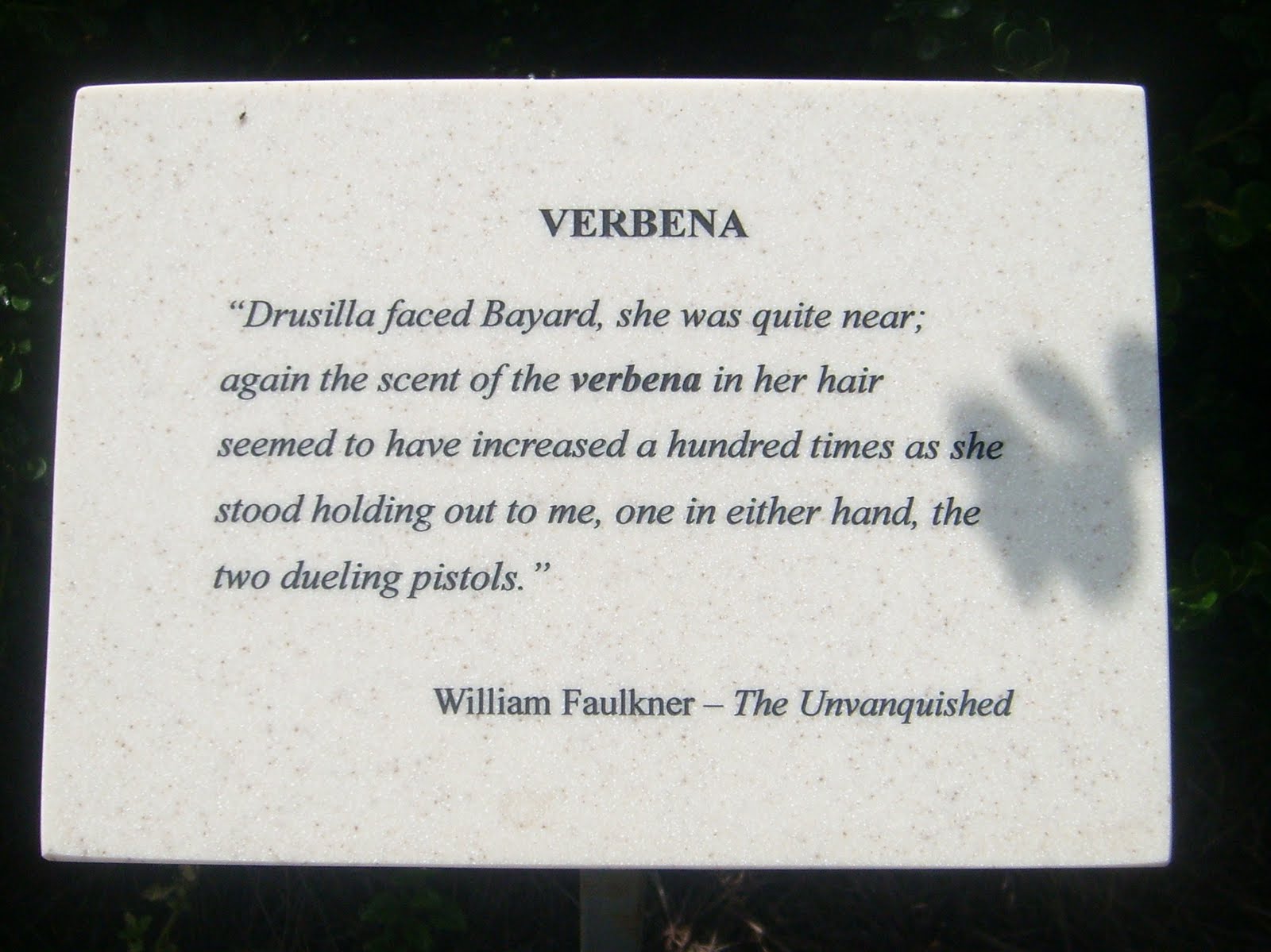
'Drusilla faced Bayard, she was quite near; again the scent of verbena in her hair seemed to have increased a hundred times as she stood holding out to me, one in each hand, two dueling pistols.' William Faulkner, The Unvanquished.

Oxford, Mississippi: William Faulkner: Literary Landmarks of the Southern United States, #12

'The Falkner House. Built in 1931 as the home of Murry and Maud Falkner, the parents of Nobel Prize winning author William Faulkner. [William had added the "u" some years previously.] The house stands on land purchased in 1898 by J. W. T. Falkner, William Faulkner's grandfather.'

William Faulkner bought Rowan Oak, which had been empty for several years, in 1930, when it was then known as 'The Bailey Place'. It was built in the 1840s by Colonel Robert Sheegog, a planter from Tennessee. Faulkner moved in with his wife Estelle and his two step-children, Malcolm and Victoria. Their daughter Jill was born a few years later. Here, the Faulkners lived until Faulkner's death in 1962.

Three views of Rowan Oak.

Faulkner's bedroom. On the mantelpiece on the other side of the room is a prominent '64', an identifying number that Faulkner wore at a horse show.

Faulkner's office has the plot of his novel A Fable written on the wall. He sometimes took the typewriter and one of the Adirondack chairs outside to work.

The library. The painting of Faulkner is by his mother Maud Butler, and the sculpture in the foreground is by the Brazilian Marnarz, a student of Jean Arp's.

Estelle's bedroom, where she painted and bird watched. Faulkner thought air conditioning unnatural, and wouldn't allow any in the house, although Estelle had some installed immediately after his funeral.

Jill's bedroom. The painting of her is also by Maud Butler.

The servants' quarters, and once home of their much loved caretaker 'Mammy Callie'.

Original detached kitchen from the 1840s, adapted by Faulkner into a smokehouse for his hams.

The 1840s barn, which Faulkner used for storage, was later rebuilt from the original wood.

The paddock and stable, built by Faulkner for his horses in the late 1950s.

Memory House on 406 University Avenue, Oxford. This was the home of John Faulkner, William Faulkner's brother, who was also a novelist, and who wrote My Brother Bill: An Affectionate Reminiscence very shortly after his brother's death.