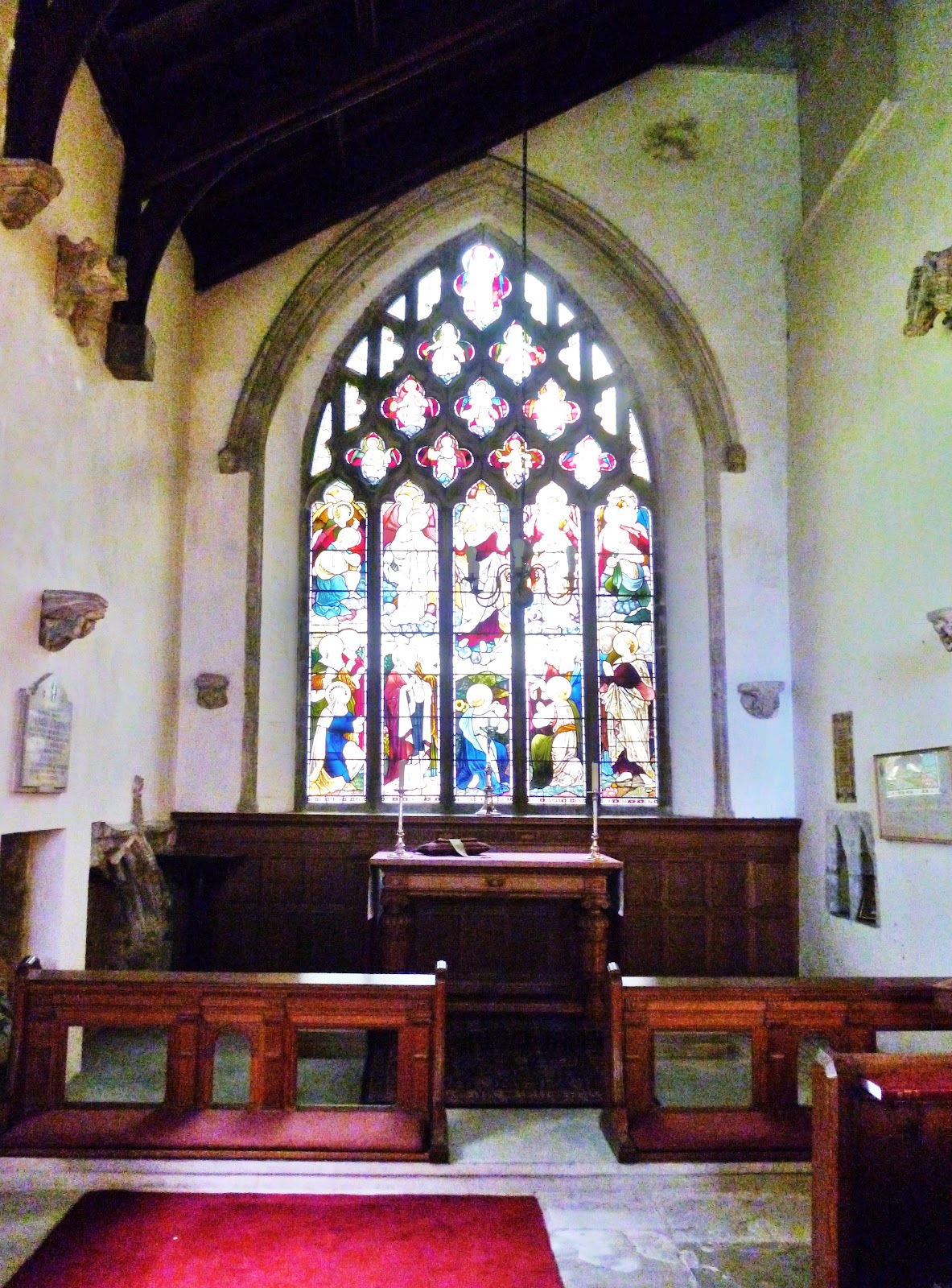
17 July 2012

Writers in Churches in Nottinghamshire #7: Walter Hilton in Thurgarton

'REMEMBER
WALTER HILTON

CANON OF
THURGARTON PRIORY

AUTHOR OF
THE LADDER OF
PERFECTION

DIED MARCH 24
1396'

Tom Errington painted this on one of the pillars in the Priory Church of St Peter at Thurgarton, Nottinghamshire. Hilton was born about 1340 but not a great deal is known of his life, although the best introduction to his work that I've seen so far online is on the Thurgarton History site, the appropriate page of which I link below.

There are other features I found of interest in the church, and I was particularly taken by the triple seat to the right of the altar, with misericords probably dating from the 15th century:


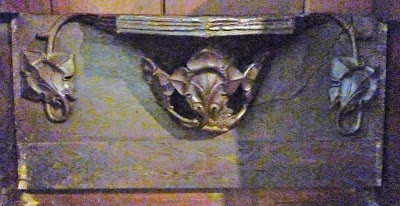
Unfortunately, I didn't see the one with wrestlers.

The west elevation.

(I visited this church because of the Diocese of Southwell & Nottingham's Open Churches Weekends (Saturday and Sunday 14 and 15 July and 21 and 22 July 2012). Details of participating churches and opening times are listed here.)

–––––––––––––––––––––––––––––––––––
Thurgarton History – Walter Hilton

The Scale of Perfection: Introduction, ed. Thomas H. Bestul

The Scale of Perfection: Book I, ed. Thomas H. Bestul

The Scale of Perfection: Book II, ed. Thomas H. Bestul

Writers in Churches in Nottinghamshire #6: Thomas Cranmer in Aslockton and Whatton-in-the-Vale

This east window by Michael Stokes at St Thomas, Aslockton, with Christ showing the nail marks on his hands, is dedicated to Thomas Cranmer, who was born in the village.

At the bottom of the left light is the name Thomas Cranmer, with his date of birth (1489), and the year of his death (1556).

Cranmer is particularly noted for his work on The Book of Common Prayer.

Admidst a little controversy, the Thomas Cranmer Centre in Aslockton was recently built as an extension to the church itself, involving the partial demolition of the north wall. This painting in the Centre of Cranmer is a copy of Gerlach Flicke's portrait of 1545.

––––––––––––––––––––––––––––––––––––––––––––––––

The north aisle of St John of Beverley church in Whatton-in-the-Vale (less than one mile from Aslockton) is the oldest part of the church, and the east end – once a lady chapel – was re-dedicated to Thomas Cranmer in 1957.

 'IN PROUD AND
THANKFUL MEMORY OF
THOMAS CRANMER
ARCHBISHOP OF CANTERBURY 1533–1556
TO WHOSE PIETY, LEARNING, SKILL IN LETTERS
THE BOOK OF COMMON PRAYER
GIVES ABIDING WITNESS.
THIS CHAPEL
IN THE CHURCH WHERE HE WORSHIPPED
AS A BOY WAS RESTORED TO THE
BEAUTY OF HOLINESS
A. D. 1957'


A note in the chapel says that the stone above this close-up is a lifesize memorial to Thomas Cranmer's father, and shows a squire resting and praying, his head on a cushion between the family arms. On the right is a chevron with three cranes: '[a]n heraldic pun for Crane Mer. The lake that provided the habitat for these fine birds gave its name to the Cranmer family village, Aslockton'. Around the figure is the inscription:

'HIC JACET THOMAS CORNMER ARMIGER QUI OBIIT VICESIMO SEPTIMO DIE MENSIS INUII DINI D MILLISIMO M QUINCEN PRIMO CUIUS ANIME PROPICIETUR DEUS. AMEN'

The translation is given:

'Here lies Thomas Cranmer, gentleman, who died on the 27th day of the month of May in the year of Our Lord 1501. May God have mercy on his soul. Amen.'

'In the adjoining hamlet of
ASLACKTON was born, on the
second of July, 1489, the ever-
memorable DOCTOR THOMAS
CRANMER, sometime RECTOR
of this church, ARCHBISHOP of
CANTERBURY in the reigns of
HENRY the eight, EDWARD the
sixth, and the former part of
that of Queen MARY, and the
most eminent Prelate who ever
filled the metropolitan see.
HE was one of the principal
promoters of the REFORMATION,
and had a leading hand in the
compilation of the RUBRIC, the
ARTICLES and HOMILIES of
the established protestant-
church, and, during the pers-
ecutions in the reign of MARY
the first, he suffered Martyr-
dom, by being burnt at a stake,
opposite BALIOL-COLLEGE,
OXFORD, on the 20th. of March
1556, 7 [sic], and died triumphing
his REDEEMER JESUS CHRIST!

                                                  G.P.'

The Cranmer chapel is in front of the window to the left of the photo.

(I visited this church because of the Diocese of Southwell & Nottingham's Open Churches Weekends (Saturday and Sunday 14 and 15 July and 21 and 22 July 2012). Details of participating churches and opening times are listed here.)

16 July 2012

Horseshoes in Scarrington: A Digression

When journeying from the Nottinghamshire villages Car Colston to Aslockton via the backroads, it seems a mistake not to take in the pile of horseshoes at Scarrington, which is said to be the biggest stack of used ones in the world. It is 17 feet high and at the base has a circumference of 19 feet 6 inches and was constructed between June 1945 and April 1965. The shoes are interlinked, but there is no supporting column. The artist was George Flinders, who was a blacksmith at Scarrington for 51 years.

In 1973 Nottinghamshire County Council, fearful that the pile would be lost to the USA, bought the heap. Between 1987 and 1988 some restoration was necessary in part because of general deterioration, but also due to souvenir hunters damaging the stack.

Close up, it's easy to see why this really is a work of art.

Writers in Churches in Nottinghamshire #5: Robert Thoroton in Car Colston

In the church of St Mary, Car Colston, on the wall of the south aisle, is the above plaque which serves as an adequate introduction to Robert Thoroton:

'This Tablet was erected in the year 1908
by a few Members of the Throton Society
in memory of
ROBERT THOROTON,
of Car-Colston,
Doctor of Physick, & a Justice of the Peace
for this County,
who died here in the year 1698, and whose
body was buried in the stone sarcophagus
now preserved in this Church.
In the year 1677 he published
"The Antiquities of  Nottinghamshire,"
a work of great labour
and erudition.'

Against the north wall of the chancel is Thoroton's headstone, the story of which is given in the link at the bottom of the post, which is an article from a 1901 edition of Transactions of the Thoroton Society.

'ROBERT THOROTON
M.D.
DIED NOV 21st
A.D.
1678'


Thoroton's red Mansfield stone coffin, made six years before his death and inscribed with his ancestral heraldic emblems, is also in the church. The chancel underwent restoration work in 1845, during which Thoroton's coffin was found and opened. His skull was displayed in a village shop as a curiosity until the vicar had the remains collected and re-buried. It had to be dug up again in 1863, and the coffin was transferred to the church.

The nave looking east, with the plaque on the south aisle wall to the right of the pillar in the foreground.

St Mary in a rare moment of sunshine (this year).

(I visited this church because of the Diocese of Southwell & Nottingham's Open Churches Weekends (Saturday and Sunday 14 and 15 July and 21 and 22 July 2012). Details of participating churches and opening times are listed here.)

–––––––––––––––––––––––––––––––––––
Dr Thoroton's Headstone, by Thomas M. Blagg

Writers in Churches in Nottinghamshire #4: Erasmus Darwin in Elston

The silhouette of Erasmus Darwin (1731–1802), Charles Darwin's grandfather, looms over the other features in this village sign, and certainly he is the village's most famous person.

But it was not until 2002, two hundred years after Darwin's death, that a plaque and bust were unveiled in All Saints church, Elston.

'ERASMUS DARWIN
(1731–1802)
Born and lived at Elston Hall
1761–1802
Fellow of the Royal Society
1731–1802
Eminent medical Doctor
Scientific Genius
Originator of the Biological Theory of Evolution
Leading poet with the gift of friendship

Died at Breadsall Priory
near Derby'

The bust can't be seen from this view of the nave looking east, but it's on the north wall of the chancel.

All Saints church. Darwin spent 25 years of his life in Lichfield, where there is a museum in his house. A link is below.

(I visited this church because of the Diocese of Southwell Nottingham's Open Churches Weekends (Saturday and Sunday 14 and 15 July and 21 and 22 July 2012). Details of participating churches and opening times are listed here.)

–––––––––––––––––––––––––––––––––––
Erasmus Darwin in Lichfield, Staffordshire

Writers in Churches in Nottinghamshire #3: Thomas Parkyns at Bunny

Sir Thomas Parkyns (1664–1741) of Bunny, second baronet, designed and built his own monument for St Mary the Virgin Parish Church in Bunny, a village several miles to the south of Nottingham.

 In the left bay of the monument is a figure in wrestling stance.

In the right bay the same figure has been felled by Time.

Wrestling was Parkyns's passion, and he published The Inn-Play, or Cornish-Hugg Wrestler in 1713. He believed the old sports were needed to provide strength against the French, and an idiosyncracy of this publication is the mixture of practical advice and scientific expressions. In 1712 he introduced an annual wrestling competition that was held in Bunny Park and continued until 1810.

Parkyns's other publications include A Method proposed for the Hiring and Recording of Servants in husbandry, arts, misteries &c Also, a limitation and appointment of the several rates of wages of artificers, handicraftsmen, husbandmen, labourers, servants, and workmen, within the counties of Nottingham and Leicester, etc [1721], and A Clause propos'd to be added to the late Act concerning bastardy [c. 1724].

Parkyns built a number of places in Bunny, of which this 1700 school is a notable example. The plaque below is above the doorway.


(I visited this church because of the Diocese of Southwell & Nottingham's Open Churches Weekends (Saturday and Sunday 14 and 15 July and 21 and 22 July 2012). Details of participating churches and opening times are listed here.)

15 July 2012

Writers in Churches in Nottinghamshire #2: John Oldham at Holme Pierrepont

This memorial to the poet John Oldham (1653–83), reminiscent of Grinling Gibbons, is one of the first features to greet the visitor to St Edmund church at Holme Pierrepont.

 The Latin inscripton reads:

'M. S.
OLDHAMI poetæ quo nemo
sacro fvrore plenior, nemo rebvs
svblimior avt verbis felicivs
avdax! Cvjvs famam omni ævo
propria ſatis conſecrabvnt carmina
qvem inter primos Honoratiſsimi
GVILIELMI comitis de KINGSTON
amplexvs Variolis correptvm hev!
nimis immatvra mors rapvit et
in cæleſtem tranſtvlit chorvm
Natvs SHIPTON, in agro GLOU
CESTRENSI. in avla Sancti
EDMUNDI OXONIÆ gradvatvs
Obiit 19 April anni Dom
1683 ÆSTATIS 30.'

Essentially, the translation of the above is that the memorial is dedicated to the daring poet Oldham from Shipton, Gloucestershire, a graduate of St Edmunds Hall, Oxford, who was highly esteemed by William, Earl of Kingston, but who died of smallpox on 19 April, 1683, at the age of 30.

A guest of the Earl of Kingston's at Holme Pierrepont Hall, Oldfield died here.

Dryden wrote a poem, 'To the Memory of Mr. Oldman', in 1684:

'Farewell, too little, and too lately known,
Whom I began to think and call my own:
For sure our souls were near allied, and thine
Cast in the same poetic mold with mine.
One common note on either lyre did strike,
And knaves and fools we both abhorred alike.
To the same goal did both our studies drive;
The last set out the soonest did arrive.
Thus Nisus fell upon the slippery place,
While his young friend performed and won the race.
O early ripe! to thy abundant store
What could advancing age have added more?
It might (what nature never gives the young)
Have taught the numbers of thy native tongue.
But satire needs not those, and wit will shine
Through the harsh cadence of a rugged line.
A noble error, and but seldom made,
When poets are by too much force betrayed.
Thy generous fruits, though gathered ere their prime,
Still showed a quickness; and maturing time
But mellows what we write to the dull sweets of rhyme.
Once more, hail and farewell; farewell, thou young,
But ah too short, Marcellus of our tongue;
Thy brows with ivy, and with laurels bound;
But fate and gloomy night encompass thee around.'


(I visited this church because of the Diocese of Southwell & Nottingham's Open Churches Weekends (Saturday and Sunday 14 and 15 July and 21 and 22 July 2012). Details of participating churches and opening times are listed here.)

14 July 2012

Writers in Churches in Nottinghamshire #1: Henry Kirke White in Wilford


The poet Henry Kirke White (1785–1806) was born in Nottingham and lived in the village of Wilford at one time. This marble memorial to him is on the north wall of St Wilfred's church in Wilford, Nottinghamshire.

The window on the south wall of the chancel is a nativity scene dedicated to White.

Unrelated to literature, but of interest nevertheless is the tomb of Captain John Deane in the churchyard, whose story can be read here.

Scratch sundials on the exterior of the south wall.

And a view of the church itself.

(I visited this church because of the Diocese of Southwell & Nottingham's Open Churches Weekends (Saturday and Sunday 14 and 15 July and 21 and 22 July 2012). Details of participating churches and opening times are listed here.)

–––––––––––––––––––––––––––––––––––
The Poetical Works of Henry Kirke White, With a Memoir by Sir Harris Nicolas

Henry Kirke White plaque, Nottingham

13 July 2012

Lynne Ramsay's We Need to Talk About Kevin (2011)

At the end of my blog post linked below, I only half-seriously suggested that Lynne Ramsay's latest film We Need to Talk About Kevin would have a commnual bath scene, but indeed it does, athough not a friendly one like the others. This communal bath begins the film, and is a blood bath featuring a number of people, and although it comes through the filter of the severely disturbed mind of the mother Eva (Tilda Swinton), it is only an exaggeration of the real massacre that her son Kevin (Ezra Miller) has perpetrated at his school.

Ramsay has in her previous films tended to specialize in dysfunctional families and/or disturbed young people, but We Need to Talk About Kevin takes the themes to a new level. It is based on Lionel Shriver's monologic epistolary novel of the same name, which was published in 2003.

Eva is the reluctant mother and Kevin the reluctant son. As a baby Kevin won't stop screaming, and as a child he refuses to accept toilet training until Eva throws him at a wall, breaking his arm and and thus 'teaching' him.

Still he seems to hate his mother, and still he covers up most of his inappropriate behavior to such an extent that father Franklin (John C. Reilly) persists in denying that there's anything wrong with Kevin.

At one point, though, it seems as if Kevin is giving preference to Eva over Franklin because he shoos his father away so his mother can continue reading to him. The reading is from Howard Pyle's The Merry Adventures of Robin Hood: Of Great Renown in Nottinghamshire (1883), from the chapter 'Robin Hood Shoots Before Queen Eleanor'. Eva begins to read, and the viewer will later realize that what she reads is relevant if not crucial to Kevin's deviant development:

'"By my soul!" cried Gilbert. "Art thou the devil in blue, to shoot in that wise?"

"Nay," quoth Robin, laughing, "not quite so ill as that, I trust." And he took up another shaft and fitted it to the string. Again he shot, and again he smote [his] arrow close beside the center; a third time he loosed his bowstring and dropped his arrow just betwixt the other two and into the very center, so that the feathers of all three were ruffled together, seeming from a distance to be one thick shaft.

And now a low murmur ran all among that great crowd [...]'. The sentence (this part unread: the film is set in Connecticut) continues 'for never before had London seen such shooting as this; and never again would it see it after Robin Hood's day had gone', but Franklin interrupts at this point.

Eva continues reading after Franklin leaves, and from the same chapter, but for some reason she goes back about five pages:

'Two hundred and eighty score shafts were shot in all, and so deftly were they sped that when the shooting was done each target looked like the back of a hedgehog when the farm dog snuffs at it.'

Eva has now provided ammunition for Kevin's apparently senseless war on the world, even provided him with an interest apart from persecuting her: archery, beginning with arrows with rubber tips and then progressing to metal arrowheads, all of which is encouraged by Franklin.

Kevin will continue to manipulate and persecute Eva while hoodwinking Franklin, and carry out a number of not quite provable but inappropriate or harmful acts until the final massacre, when all four members of the family will be destroyed physically or mentally – along with Kevin's many victims.

This is an extremely powerful film.

–––––––––––––––––––––––––––––––––––
Lynne Ramsay's Ratcatcher (1999) and Morvern Callar (2002), plus three Shorts

12 July 2012

Philippe Delerm: Les Amoureux de l'Hôtel de Ville (2001)

François has become unemployed at the age of forty, and now has time to reflect, to bring back memories of his childhood and of his youth, and among other things he revisits his ageing father and his old university friends and reflects some more.

It's his childhood memories which are the most vivid – the Dinky toys, the Solex, Tintin, or the sounds, such as the quiz show Quitte ou Double with Zappy Max on Radio Luxembourg or later on Radio Monte Carlo.

Some objects of his youth have an iconic importance, such as Joseph Losey's The Go-Between (Le Messager in French) and the young boy of the title with whom he identifies – a film he says he's seen a hundred times.

Most of all, though, it's Baiser de l'Hôtel de Ville ('The Kiss'), Robert Doisneau's world famous 1950 photo of a young couple kissing in a crowded street with the Hôtel de Ville in the background, that transfixes the narrator. It's of particular importance as a kind of 'family photo' because his parents used to (apocryphally) claim that they were the lovers in the foreground, and he minutely dissects the photo.

This is not so much a trip down a middleaged person's Memory Lane as a meditation on the nature of memory and its deceptions, its constructions, and also on the vividness of the past compared to that of the present.

My other posts on Philippe Delerm:
–––––––––––––––––––––––––––––––––––
Philippe Delerm: Quiproquo
Philippe Delerm: La Première Gorgée de bière et autres plaisirs minuscules
Philippe Delerm: Quelque chose en lui de Bartleby

11 July 2012

Jacques Godbout: Salut Galarneau! (1967)

I've just read Jacques Godbout's Salut Galarneau!, which is a very interesting French Canadian work translated as Hail Galarneau! in English. This is a powerful short novel concerning much more than it would at first appear (particularly historically, culturally and linguistically), so the best thing for me to do is to leave the link below to an MA dissertation that is a study of Godbout's first three novels: L'Aquarium (1962), Le Couteau sur la table (1965), and Salut Galarneau! (1967).

–––––––––––––––––––––––––––––––––––
'Godbout: The Journey from L'Aquarium to Salut Galarneau!' (1977), by Diane Elizabeth Cloutier

10 July 2012

Michel Hazanavicius's The Artist (2011)

 
It's not often that I bother commenting on a major Oscar winner, but this one is unusual in being French, silent, and black and white. Michel Hazanavicius also sounds very interesting, so I leave a paragraph about his work as a footnote which is actually larger than my comment.*

The Artist is set between 1927 and 1933, a crucial period in movie history which falls between the final years of the silent and the ineluctable triumph of the sound era, as personified by George Valentin (Jean Dujardin), the dashing and all-too-proud king of the silents who is fading fast because he won't accept change – and Peppy Miller (Bérénice Bejo), who will rise to sparkle as the queen of the talkies but still has her eye on George. Brilliant performances, and let's not forget wonderful Uggie, the dog.

*Michel Hazanavacius made a number of French television movies before his first feature in 1996, Mes amis ('My Friends'). This movie (which I've not seen but would like to) concerns a producer of secondrate sitcoms who, with his lead actor, spends the night with a prostitute who dies as a result a sex game which misfires. They decide not to tell the police and try to hide the body, but a trainee records the crime and decides to blackmail them.

Hazanavacius's next two movies, which The Artist followed, are very loosely based on the work of Jean Bruce (1921–63), a prolific French espionage novel writer whose early material preceded Ian Fleming's by four years, and whose name (after his death in a 200 kph car crash) was continued in the similar writings of his wife Josette and his children François and Martine. Hazanavacius's inspiration came from the Bruce family's OSS (Office of Strategic Services) series, using the name of an American spy of French origin called Hubert Bonisseur de la Bath. Both movies star Jean Dujardin, the first also Hazanavacius's wife Bérénice Bejo: OSS 117: Le Caire, nid d'espions (OSS 117: Cairo, Nest of Spies) (2006), and OSS 117: Rio ne répond plus (OSS 117: Lost in Rio) (2009).

Alexander Payne's The Descendants (2011)

After Election (1999) and About Schmidt (2002), both movies set in Nebraska, Alexander Payne moved westward to California for Sideways (2005), and then westward further still to Hawaii with his latest, The Descendants (2011), based on Kaui Hart Hemmings's novel of the same name. But this is not a clichéd paradise of young surfers as so many movies set in the 50th state of America are: early on, shots of down and outs, a man in a wheelchair, and elderly folk make this quite clear. And as Matt King (George Clooney) says over these images, the reality is a little different from the outsiders' picture of Hawaiians 'sipping Mai Tais, shaking our hips, and catching waves'. George's wife Elizabeth (Patricia Hastie) is in a coma following a powerboat accident, and George's life is now 'IVs and urine bags and tracheal tubes. Paradise? Paradise can go fuck itself!'

Ironically, the very first scene of the movie is a happy water-skiing one off Waikiki beach, Honolulu, but this is before the (unseen) accident. Elizabeth will never come out of the coma, and her life support machine will be disconnected. First, though, her friends have to be gathered so they can say goodbye to the woman who can't say goodbye back. That should also include Brian Speer (Matthew Lillard), the man Matt learns Elizabeth has been having an affair with.

And Matt is to learn a lot more in a short space of time: he can't undo the damage brought to his marriage by his overworking, but he can undo the damage that he's been doing to his relationships to his precocious daughter Scottie (Amara Miller), and his slightly wild older daughter Alexandra (Shailene Woodley), who's at boarding school on the Big Island.

To complicate things more, Matt's learning curve involves not just the general well-being of himself and his kids, but his family's heritage and the rest of the people in Hawaii: he is the only trustee to 25,000 acres of pristine land on Kauai which is his extended family's birthright, and it would mean megabucks for them if he sold the property, as most of them want him to do. But it would also change Hawaii.

The movie charts Matt's rapid maturity, and the scene before the last is off Waikiki beach again, but this time Matt, Scottie and Alex are throwing Elizabeth's ashes into the Pacific.

The last scene shows the same one-parent family settling down on the sofa together to watch TV.

It's a great pity more Hawaiian movies aren't as mature as this.