Showing posts with label Île-de-France. Show all posts

5 October 2014

Cimetière parisien de Thiais, Val-de-Marne (94), Île-de-France #10: Jean-Jacques Krafft

Jean-Jacques Krafft (1910–97) was a sculptor who worked in various materials, but particularly in wood in his later years.  He spent much of his time in the 12th arrondissement, and is noted for both his religious and his nude works.

This is the last of the graves I noted in Thiais. Again, I thank H. for helping us so much with our searches, and he has recently informed me that the prolific English writer Peter de Polnay (1906–1984) is also buried in this cemetery: we shall be back next year!

Cimetière parisien de Thiais, Val-de-Marne (94), Île-de-France #9: Paul-Clément Jagot

'PAUL C.
JAGOT
1889–1962'

Paul-Clément Jagot was an occultist and a very prolific writer of works on personal development, hygiene, esotericism, applied psychology, hypnotism, parapsychology, etc. His Wikipédia entry calls him one of the precursors of New Age thinking, but gives no reference to back this up.

Born into a family of modest means, Jagot was an autodidact with a prodigious memory and of great erudition.

Cimetière parisien de Thiais, Val-de-Marne (94), Île-de-France #8: Francisco Boix-Campo


'FRANCISCO BOIX-CAMPO
DÉPORTÉ EN 1941, À L'ÂGE DE 21 ANS,
AU CAMP DE CONCENTRATION DE MAUTHAUSEN.
DÉCÉDÉ LE 7.7.1951
DES SUITES DE SA DÉPORTATION.
ANIMÉ D'UN GRAND COURAGE, IL SUBTILISA
AUX S.S. DES DOCUMENTS PHOTOGRAPHIQUES
ACCABLANTS POUR LES NAZIS QUI IMPOSÈRENT
LE RÉGIME CONCENTRATIONNAIRE.

L'AMICALE DES DÉPORTÉS DE MAUTHAUSEN'

'FRANCISCO BOIX-CAMPO
DEPORTED IN 1941, AT THE AGE OF 21,
TO MAUTHAUSEN CONCENTRATION CAMP.
DIED 7.7.1951
DUE TO COMPLICATIONS RELATING TO HIS DEPORTATION.
MOTIVATED BY HUGE COURAGE, HE HID
FROM THE S.S. PHOTOGRAPHIC DOCUMENTS
DAMNING FOR THE NAZIS WHO IMPOSED
THE CONCENTRATIONARY RÉGIME.

THE ASSOCIATION OF MAUTHAUSEN DEPORTEES'

Boix, as he is usually known, was a photographer and a Spanish republican exiled in France in 1939. In Mauthausen he was assigned to the photographic department. In 1946 he was a witness at the Nuremberg trails, where he provided photographic evidence of Nazi atrocities as well as the involvement of high-ranking former Nazi officials in Mauthausen concentration camp.

He later worked as a reporter for such publications as Ce soir, L'Humanité, and Regards.

4 October 2014

Cimetière parisien de Thiais, Val-de-Marne (94), Île-de-France #7 Jean Hérold-Paquis


'Jean HÉROLD-PAQUIS
1912 – 1945'
–––––––––––––

Jean Hérold-Paquis was an extreme right-wing French radio journalist shot dead on 11 October 1945 at Fort de Châtillon, being noted for his pro-German activities with Radio Paris under the Vichy régime. In the previous decade he had worked for the fascists in the Spanish Civil War. His epitaph: 'Ce n'est qu'un au revoir mes frères...' ('This is only an au revoir, my brothers') was no doubt intended to have a chilling ring to it.

1 October 2014

Cimetière parisien de Thiais, Val-de-Marne (94), Île-de-France #6: Eugène/Ievgueni Zamiatine | Yevgeny Zamyatin

'EUGÈNE ZAMIATINE
ÉCRIVAIN RUSSE
19.I.1884 – 10.III.1937'

Yevgeny Zamyatin (in English spelling) is most noted for his science fiction novel We, set in a police state, which was published in Russian in France in 1920* and in translation in English in 1924. In 1923 it was banned in the Soviet Union until 1988. Zamyatin went into exile in France in 1931.

*The later French translation is called Nous autres.

Cimetière parisien de Thiais, Val-de-Marne (94), Île-de-France #5: Han Ryner | Henri Ner


'HAN RYNER
HENRI NER
3 DÉCEMBRE 1861
5 JANVIER 1838'

The dates of Henri Ner (who preferred to be call himself Han Ryner) are in conflict here with Wikipédia, which claims he was born on 7 December and died on the 6 December, but these are minor matters of little importance.

Of much greater importance to me (as Ryner is a fascinating character) is the inscription lower down on the upright stone, which is difficult to read because of the weathering and the slight blurring of the image, but even more difficult to understand (for me at least) is the meaning of the inscription itself. What are the 'trois jours' he's referring to, and how does the inscription relate to the Greek (which I don't understand anything of anyway) below the French? I suspect that the French is a quotation from one of his many books, although I can find nothing online, and I've searched a number of his books. This is my reading of the French:


'HONORÉ[,] COMBIEN DURERONT
MES "TROIS JOURS" [?]
MAIS JE SUIS DE CEUX
QUI LIRONT CETTE INSCRIPTION [:]'

And then the Greek begins.

Ryner was a pacifist anarchist and a very prolific writer of novels, stories, essays, plays, and poetry. For Ryner, freedom is interior and he was much influenced by the ancient Greeks, particularly the Stoics. Two books give an idea of the range of his interests: Prostitués, études critiques sur les gens de lettres d'aujourd'hui (1904) (a critique of writers of the day) and L'Homme-fourmi (1901), about a man who turns into an ant. Some of his works were kinds of parables.

30 September 2014

Cimetière parisien de Thiais, Val-de-Marne (94), Île-de-France #4: Joseph Roth

Our search for the graves in Thiais which follow was greatly assisted by an extremely helpful man who wishes simply to be known as Mister H. Many thanks to you: you saved us a great deal of time!

'JOSEPH ROTH
ÉCRIVAIN AUTRICHIEN
MORT À PARIS EN EXIL
2.9.1894 – 27.5.1939'

Roth's books – which were due to be destroyed by the Nazis – were marked by nostalgia for the Jewish past. Roth exiled himself as soon as Hitler took power in 1933, eventually settling in Paris. In 1939 he collapsed in front of his local – the Café Tournon, above which he lived – and died four days later of alcohol-related illness.


Some of his noted works are Hôtel Savoy (1924), Le poids de la grâce (1930), La Marche de Radetzky (1932), and La Crypte des Capucins (1938).


Cimetière parisien de Thiais, Val-de-Marne (94), Île-de-France #3: Marcel Thiébaut

'MARCEL THIÉBAUT
ÉCRIVAIN
1897–1961'

Thiébaut was a literary critic who ran Revue de Paris almost on his own for some years. He also wrote plays, including Doris (1946), Le Prince d'Aquitaine (1947), and Les Bonnes cartes (1949).

Cimetière parisien de Thiais, Val-de-Marne (94), Île-de-France #2: Étienne Hadju

'Je suis amoureux 1957
ÉTIENNE HADJU 1907–1996'

These words, which of course translate as 'I'm in love', are in fact the title of this work of sculpture by Étienne Hadju, made in 1957, which forms Hadju's gravestone: the 'folds' presumably represent a couple under a sheet in a bed, and this is quite a remarkable sight.

Hadju was a sculptor of the nouvelle École de Paris persuasion. He was born in Romania of Hungarian parents and went to Paris in 1927, where he was for a brief time a student of Antoine Bourdelle, and then of Paul Niclausse. He then discovered Fernand Léger and from 1930 he associated with Vieira da Silva Árpád Szenes.

20 September 2014

Lise Lamarre in Versailles, Yvelines (78): Cimetière des Gonards #5

Lise (or Louise) Lamarre was a poet and a journalist.

'LISE LAMARRE
      DONT LA VIE FUT VOUÉE
À L'ART ET À L'AMITIÉ...
                                  15 JUIN 1951'


'Esprit pur, je connais enfin la Vérité.
La Lumière, l'Amour, et ma force sereine
retrouve le but où tend l'humanité
     Lise Lamarre'

Louise Bryant in Versailles, Yvelines (78): Cimetière des Gonards #4


Louise Bryant (1885–1936) was an American writer who espoused socialist and anarchist causes. Her first marriage was to John Reed – who died in 1920 – and she moved to Paris with her second husband, William Bullitt, in 1923. A few years later she was diagnosed with Dercum's disease.  Bulitt divorced her due to her heavy drinking and her lesbian relationship with Gwen Le Gallienne, and Bryant died in in Sèvres of a brain hemorrhage.

The film Reds (1980) is a representation of the Bryant and Reed story.

Robert de Montesquiou-Fezensac in Versailles, Yvelines (78): Cimetière des Gonards #3

A superb image of a dandy: the gay poet Robert de Montesquiou-Fezensac (1855–1921) was the model for Esseintes in Huysmans's À Rebours (1884) and one of the models for the Baron de Charlus in Marcel Proust's À la recherche du temps perdu.


The statue on this anonymous grave is the angel of silence is from Vitry-sur-Seine château. Montesquiou is buried next to his secretary and lover Gabriel Yturri (1860–1905).

Armand Renaud in Versailles, Yvelines (78): Cimetière des Gonards #2

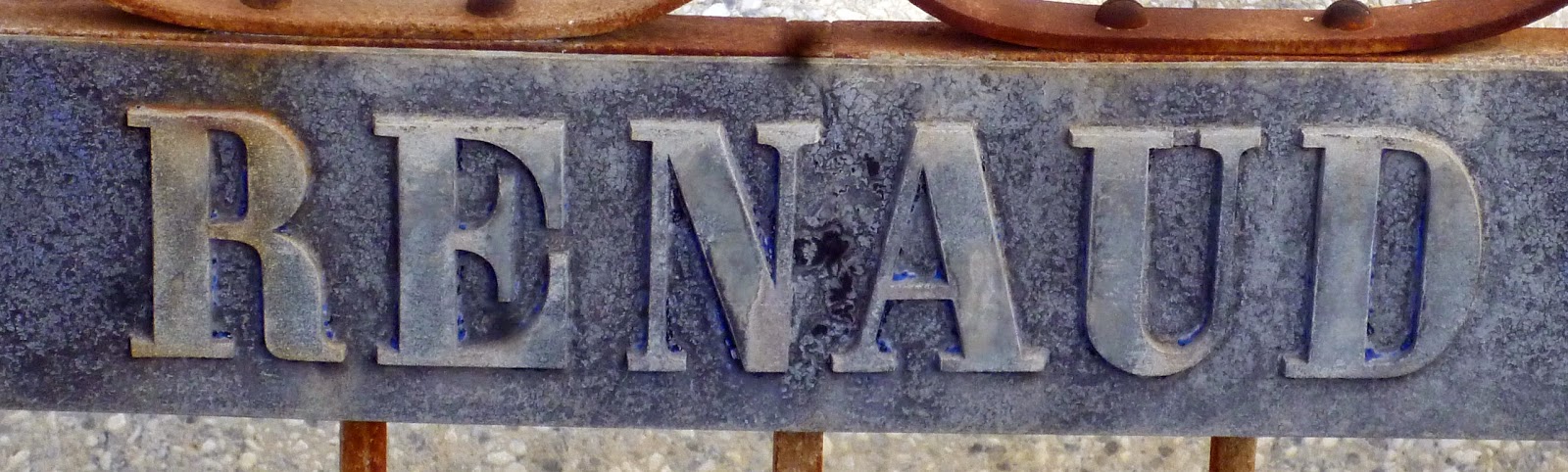
The Renaud plot in the Cimetière des Gonards includes a rather impressive bust of the poet Armand Renaud (1836–95).


Armand Renaud was born in Versailles and was a civil servant, progressing to inspector of fine arts. He wrote a great deal of poetry, some influenced by Persian and Japanese literature, and some of which was put to music by Camille Saint-Saëns (1835–1921).

19 September 2014

Edith Wharton in Versailles, Yvelines (78): Cimetière des Gonards #1

'EDITH WHARTON
NÉE EDITH NEWBOLD JONES
24 JANVIER 1862 – 11 AOÛT 1937'

Edith Wharton's grave in the Cimetière des Gonards, Versailles. Below is a link to a long earlier post I made on Wharton in the Mount, Lenox, Massachusetts, with many images of her home there:

–––––––––––––––––––––––––––––––––––
Edith Wharton in Lenox, Massachusetts

13 September 2014

Roger Martin du Gard in Maisons-Laffitte, Yvelines (78)

Roger Martin du Gard (1881–1958), who won the Nobel Prize for Literature in 1937, lived in Maisons-Laffitte from 1890 to 1895. He based the house above, in the place Wagram, on the patriarch Oliver Thibault's summer house in Les Thibault.

Arthur Koestler in Maisons-Laffitte, Yvelines (78)

2 place de Wagram, Maisons-Laffitte.

'Arthur
KOESTLER
1905–1983
Écrivain engagé
a sejourné en 1934
dans cette maison.'

'La Villa Voltaire', as it was then called, was built in 1838 by Saint Georges Catherine Molesworth. In the 1930s it became a children's garden nicknamed 'La Pouponnière' ('The Crèche' | 'The Nursery'), which Koestler organised for two months. He welcomed children whose parents were Jews or communists pursued by the Nazis. Koestler also wrote his first novel here, although it was never published.

14 February 2014

Jean-Baptiste Piketty in Meudon-sur-Seine, Hauts-de-Seine, France

The Piketty family tomb in the Cimetière des Longs Réages in Meudon.
 
Archeologist Jean-Baptiste Piketty (1827–94) wanted to be buried in a dolmen, so – despite some opposition – bought the Ker-Han dolmen in the commune of Saint Philibert (Morbihan), Brittany, and arranged for it to be transported here.


'DOLMEN
DE KER-HAN
CNE DE ST PHILIBERT
PRÈS DE CARNAC
MORBIHAN'
 

13 February 2014

Rabelais in Meudon-sur-Seine, Hauts-de-Seine, France


This sculpture is in front of the town hall and is the work of George Saupique and erected in 1946. François Rabelais was the parish priest of Meudon from 1551 to 1553, slightly conflicting with the dates below.

'FRANÇOIS RABELAIS
Curé de Meudon de 1550 à 1552
Oeuvre d'ANDRÉ FRANÇOIS TRUMPHÈME
1820 - 1888
offerte aux Meudonnais par les
CIGALIERS DE PROVENCE
en 1886 lors des premières fêtes Rabelais.
Le buste a été détruit en 1942.
En 1996 la Ville de Meudon a commandé une
nouvelle fonte d'après le plâtre original,
inauguré le 5 Octobre
par Henry Wolf, Maire de Meudon.'

So the original bust, presented to the people of Meudon by Frédéric Mistral's 'Cigaliers de Provence' in 1886, was destroyed in 1946 and reconstructed from the original plaster model in 1996 here in Place Rabelais.

Rabelais is of course associated with the Pierre levée dolmen in Poitiers, although his relationship to this dolmen, at the northern entrance to the Parc de l'Observatoire in Meudon, is far more tenuous.


I couldn't resist including these two views of Paris from the park: here you can see the Eiffel Tower to the left, and the Sacré Cœur in the middle background. The large building in the middle is Bouygues Telecom tour Sequana at Issy-les-Moulineaux.

A blanched La Défense seen through the trees.

My François Rabelais posts:
–––––––––––––––––––––––––––––––––––
François Rabelais in Seuilly
Rabelais in Meudon-sur-Seine
Rabelais at Saint-Maur-des-Fossés