Showing posts with label Mouret (Emmanuel). Show all posts

22 February 2022

Emmanuel Mouret's Changement d'adresse | Change of Address (2006)

David (Emmanuel Mouret) is a French horn player and teacher who's moved to Paris and finds accommodation sharing a flat with Anne (Frédérique Bel). Just a friendly arrangement of course, as she's got someone in her life, although has she? And when they end up in bed together it's by accident, naturally: they've both forgotten about it by the morning, as they tell each other.

Anyway, David is in love with a nineteen-year-old student of his who's learning the French horn: Julia (Fanny Valette), who lives with her mother (Ariane Ascaride), who's surprised she's not got a boyfriend. But of course David's working on this, and although Julia's responses to his attempts to get her interested in him have proved a little lukewarm, Anne's parents have a place in Deauville where they can spend a weekend. And things look good for David: she doesn't seem to mind there's only one bed, and they're getting on well at the seaside.

Until, that is, restauranteur Julien (Dany Brillant) rescues Julia's handbag from a thief, they invite him back for a drink and he starts massaging Julia's shoulders, and David has that everything's lost look and spends the night out in the cold just smoking: it's a bit like in Vénus et Fleur with Fleur spending the night out on the beach when Vénus is screwing the local lothario, only Fleur was, er, full of happiness at the time with Bonheur. When he returns in the morning, Julien has just left and Julia is in love.

Of course, Julia expects Julien to phone him, but he doesn't. On the rebound, she gets with David (and they get a similar look from Anne when she sees it happening) and – much to mother's contentment, they start living together until, that is, David bumps into Julien. Now Julien – who by chance is the stocky guy who plays Rudolph the aggressive boyfriend in Fais-moi plasir ! – hasn't phoned Julia because he couldn't. And although he's not aggressive like Rudolph, he's lost his business because of the way he feels about Julia, and is really desperate to find her: can David help? David is the same kind of bumbling, stuttering, hesitant awkward guy as in other films he's played in, and obviously doesn't want to admit that he lives with her. But in the end, leaving Julien and Julia for five minutes in Luxembourg, he makes his exit from the jardin as the gates are being locked.

His loss is his gain: Julien (now of course united with Julia) finds him another flat, and what do you know Anne is looking for one two, and doesn't care that there's only one bed: it's not just a case of will-they-won't-they as much as how will they. I'd called this Emmanuel Mouret absurd-lite: the absurdities aren't missing, but are far more subdued than, say, the later Fais-moi plaisir ! And increasingly, Mouret brings to mind Truffaut: here particularly with the scene of David and Julia reading in bed reminding me of Domicile conjugal, the twist being that David's magazine is upside down.

21 February 2022

Emmanuel Mouret's Laissons Lucie faire (2000)

Again, I'm reminded of both Rohmer and Woody Allen in this Emmanuel Mouret film. Here we have Lucie (Marie Gillain), who sells swimming costumes on the beaches of Marseille and lives with Lucien (Emmanuel Mouret), who doesn't do anything much but would like to be a gendarme. And then he doesn't make it to be a gendarme but becomes a secret agent with his cover being the bourgeois layabout he is.

Of course, secret agents have to remain very strictly secret, as does Lucien unless he uses the stupid password 'Il fait beau', which of course leads to (very minor) hiccups. And then he meets Jennifer (Dolores Chaplin) who wants him to initiate her into love techniniques, but he scares her off by accident when trying to cure her hiccups. Then Lucie becomes attracted to Bernard (Arnaud Simon), and although Lucien's lied to her about sleeping with someone else so as not to blow his cover, she doesn't respond to his overtures in the end.

Of course, there are subterfuges, evasions, misunderstandings, confusion in general, especially with Lucien being – as can only be expected of the main Mouret character – awkward, shy, etc. But in spite of himself he seems to be a good secret agent, although he now changes his cover: selling swimming costumes on the beaches with Lucien.

6 February 2022

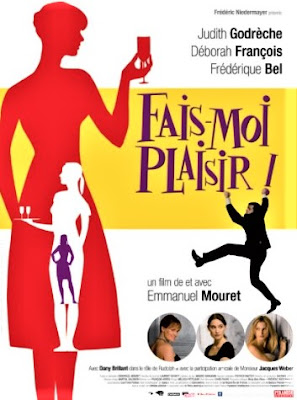
Emmanuel Mouret's Fais-moi plaisir ! | Please Please Me! (2009)

Ariane (Frédérique Bel) is the girlfriend of Jean-Jacques (Emmanuel Mouret) and sees him as fantasising about Élisabeth (Judith Godrèche), considering that the only way out of the problem is to have sex with the woman to get it out of his system.

This film is different from Vénus et Fleur in that it belongs more to the world of slapstick, and instead of having the director appearing as a Hitchcockian extra he's the main character. This last point, along with the preoccupation with sex, links it to Woody Allen films, although the improbable (indeed sometimes impossible) gags are more in the territory of Jacques Tati: the ingénu tied up in a world with which he is out of sorts leads him into absurd, even surrealistic, situations.

The key drive behind the initial action here is a the ability of a man (Frédéric Épaud) to make women fall for him by having a piece of paper given to them: this contains such charming words that they act as a kind of magic spell on the women. By accident, Jean-Jacques has come into possession of one of the papers and the spell has worked on Élizabeth.

He goes along to a function she's invited him to and the Tati element begins: he's caught up in a plush, modern world which the famous and powerful inhabit, and which is out of kilter with a man of modest means who drives a wreck of a car. First he has to find the verbal key to make the lift work; then he meets the president (Élizabeth being his daughter); his finger gets stuck in a vase and the prime minister of Japan helps him get it out; he drops a mobile phone into an ornamental toilet with a statue of a naked woman on top; he gets his flies caught in a curtain: it's a repeating helter-skelter situation in which Jean-Jacques is the dummy who can't put a foot right. But contrived as this all may sound, it's highly enjoyable because Mouret has a knack of making it work without at the same time making it appear stupid.

5 February 2022

Emmanuel Mouret's Vénus et Fleur (2004)

The very Rohmerian film director Emmanuel Mouret is concerned with the twists and turns, the understandings and the misunderstandings, of the heart. He was born in Marseille, and this – his second feature – is set in the city. The two principal characters are Vénus (Veroushka Knoge) and Fleur (Isabelle Pirès), followed by (in both senses) Dieu (Frédéric Niedermayer) and Bonheur (Julien Imbert): the name Dieu is perhaps a joke as the producer was Frédéric Niedermayer, and Bonheur may well be a prediction of the future.

Fleur's parents in Paris, where all three live, have paid for their daughter to spend her holidays in a small house in Marseille, and by chance Fleur picks up another young woman's identical bag in a café, which Vénus returns to exchange for her own. Although the two women are very different from each other – the Russian Vénus being extroverted, obsessed with young men, in general quite superficial, Vénus being introverted, shy with people and her affections and bookish (she is reading Pessoa's Le Livre de la tranquillité) – they strike a chord, and Fleur invites Vénus to stay with her.

The ill-matched pair make for the beach but Vénus's attempts to lure men by pretending to accidentally hit them with a beach ball fall flat and they return home manless. The only man interested initially is Dieu, a neighbour, but Vénus is at first uninterested, and Fleur has no interest at all. And then Bonheur – a friend of Fleur's brother – arrives for a few days and although both women are interested it's agreed that he's for Vénus, who's keen to marry a Frenchman and have dual nationality children.

One day Bonheur leaves Marseille for a few days walking, leaving Vénus in the rapacious hands of Dieu. But Bonheur returns unexpectedly and Fleur is forced to lie, saying Vénus is out for the day, saying there's no food in the house, and they go looking (fruitlessly) for an open restaurant, make do with a baguette sandwich, listen to someone playing guitar on the beach, where they innocently spend the night.

The next day Bonheur phones Fleur to tell her to meet him as he has something of vital importance to tell her: since the previous year when he met her he is obsessed with her, but (always mindful that she's 'given' him to Vénus), Fleur tells him that the feeling isn't mutual. Dieu tries it on with Fleur to no avail, Vénus comes in after being with Bonheur and it's obviously not worked out, and Dieu makes an exit, cock between his legs.

Then the next day Vénus leaves, still longing for contact, and Bonheur phones from his two-star hotel in the city to say goodbye as he's leaving. Even before Fleur rushes out and they meet up, the viewer knows that he isn't going at all.

There is bang-on improvisation in this film, which has an amazing realistic quality: time I saw some more Mouret.