Showing posts with label Montmartre. Show all posts

17 September 2018

Max Jacob in the 18th arrondissement

'LE POÊTE
MAX JACOB
1876 – 1944
A HABITÉ CETTE MAISON
DE 1907 – 1911'

7 Rue Ravignan.

Maurice Utrillo and Suzanne Valadon in the 18th arrondissement

Maurice Utrillo (1883–1955) was the son of Suzanne Valadon, an acrobat and model encouraged, for instance, by Degas, Toulouse-Lautrec and Renoir to develop a powerful expressionist painting talent. Unusually, Utrillo was a painter of Montmartre who was born there. La Maison Rose was immortalised by a number of painters of the time. Utrllo is buried in Le Cimetière Saint-Vincent, Montmartre, and Suzanne Valadon in the Cimetière parisien de Saint-Ouen, both graves of whom are on this blog.

Rue des saules.

Le Moulin de la Galette in the 18th arrondissement

Le Moulin de la Galette at the corner of rue Lepic and rue Girardon, Montmartre, formerly a noted guinguette. The mill is not accessible to the public, although the front is a restaurant.

15 September 2018

Audrey Tautou in the 18th arrondissement

Anyone reading my blog will be aware of how much I detest tourism, but occasionally you just have to ignore the tourists and do your thing. Jean-Pierre Jeunet's brilliant movie Le Fabuleux Destin d'Amélie Poulin (2001), boringly Anglicized to Amelie, has a number of scenes set in the Café des 2 Moulins, rue Lepic, Montmartre. As expected, there are shots of the actor Audrey Tautou on the walls, although I suspect that the vast majority of people who know this movie just prefer to take an outside shot of this place, whose interior isn't entirely recognisable from the film.

Le Lapin Agile (revisited) in the 18th arrondissement


Well, it's been seven years since I last saw Le Lapin Agile, and I'm pleased to see that there's now an 'Histoire de Paris' plaque there. It doesn't really say anymore than I wrote before (just key in the words to the left), and especially notes Roland Dorgelès's donkey hoax), so I'll say no more.


But let's not forget the origin of the place's sign: André Gill: Le Lapin Agile was originally the work of the painter Gill: Le Lapin à Gill.

Alfred Adam in the 18th arrondissement

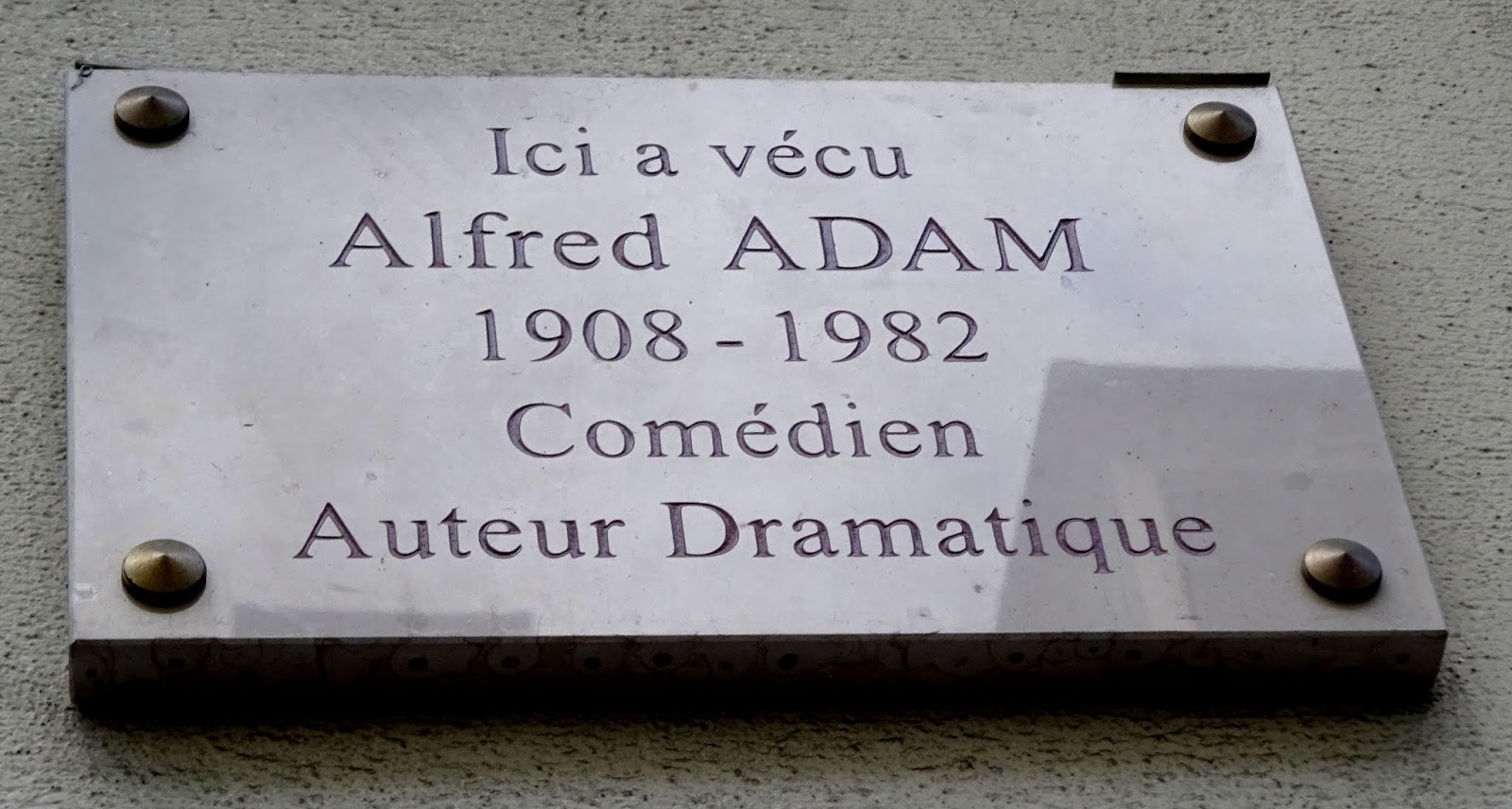
'Ici a vécu
Alfred ADAM
1908 – 1982
Comédien
Auteur Dramitique'

Alfred Adam appeared in many feature films and many televison films. According to Wikipédai, the wrote six plays: Sylvie et le fantôme (1942; La Fugue de Caroline (1945); La Fête du gouverneur (1949); Many (1952); Bateaux en Espagne (1952); and La terre est basse (1957).

20 September 2017

Bernard Dimey in the 18e arrondissement, Paris


Poet and singer Bernard Dimey is commemorated in this plaque in rue Germain Pilon. He spent fourteen years with painter and sculptor Yvette Cathiard, who wrote about it in La Blessure de l'Ogre (1993). 

5 October 2016

Cimetière de Montmartre (continued): #25: Vaslav Nijinski

For some reason, probably because I've been concentrating on authors, I've previously missed the very attractive grave of the Russian choreographer and dancer Vasclav Nijinski (1889–1950), so I couldn't resist including it as my last post on the Cimetière de Montmartre.

25 September 2016

Cimetière de Montmartre (continued): #23: Juliusz Słowacki


'JULES SŁOWACKI
NÉ LE 26 MAI 1809
DÉCÉDÉ LE 3 AVRIL 1897

GRAND
POÈTE
POLONAIS'

Juliusz Słowacki was a Romantic Polish poet who mainly wrote plays but also poetry. He spent the last years of his life in Paris.

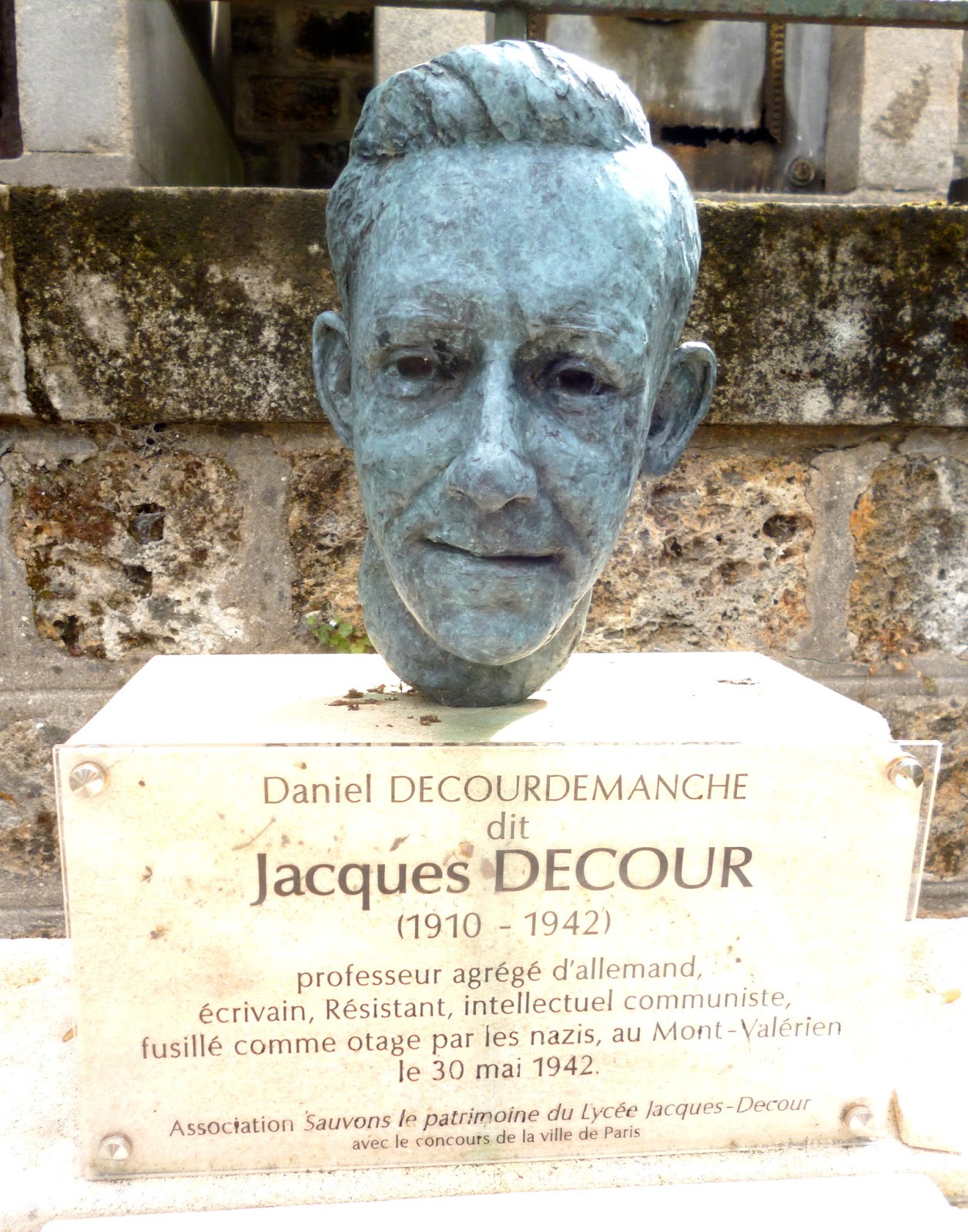
Cimetière de Montmartre (continued): #22: Jacques Decour

'Daniel DECOURDEMANCHE
dit
Jacques DECOUR
(1910 – 1942)
professeur agrégé d'allemand,
écrivain. Résistant, intellectuel communiste,
fusillé comme hotage par les nazis, au Mont-Valérien
le 30 mai 1942.'

Jacques Decour was a French writer and member of the Resistance. He was responsible for two papers, L'université libre (1940) and La Pensée libre (1941), which was to be the most important publication in occupied France. He was arrested in March 1942 and executed by the Germans three and a half months later.

Cimetière de Montmartre (continued): #21: Jean-Marc Roberts

'Jean Marc ROBERTS
1954 – 2013
Éditeur–Écrivain'

Badly indicated on the cemetery map (as is Bernard-Marie Koltès's grave), Jean-Marc Robert's grave took some finding. Roberts, who is the subject of Vassilis Alexakis's novel of homage, La Clarinette (2015), died of lung cancer at the relatively early age of fifty-eight. Included in the mourners were Bernard Pivot, Patrick Rimbaud, Jean Rochefort, Sandrine Bonnaire, Valerie Trierweiler, and there was a wreathe from president Hollande. Difficult to imagine that from this. My blog post on the only book by Roberts that I've read, Les Seins de Blanche-Neige, is here.

Cimetière de Montmartre (continued): #20: Marie Duplessis


'ICI REPOSE
ALPHONSINE PLESSIS
NÉE LE 15 JANVIER 1824
DÉCÉDÉ LE 3 FÉVRIER 1847.'

Marie Duplessis, or Alphonine Plessis, was the courtisane who died of tuberculosis at the age of twenty-three, and who inspired Alexandre Dumas fils to write La Dame aux camélias (1848), where she name is disguised as Maragurite Gautier.

Cimetière de Montmartre (continued): #19: Bernard-Marie Koltès


Bernard-Marie Koltès (1948–89) wrote plays about exile. His works include Sallinger (1977), Dans la solitude des champs de coton (1987) and Le Retour au désert (1988). He died of AIDS.

Cimetière de Montmartre (continued): #18: Jérôme Tharaud

'Jérôme THARAUD
1874 – 1953
Membre de
l'Académie Française'


This plaque was originally attached to the front of Tharaud's grave, although it is now loose at the back and virtually illegible.

This is a very difficult grave to find, especially as the cemetery map, which includes over a hundred notable people, doesn't include this one, although Jérôme Tharaud won the Goncourt in 1906. Or rather, he co-won it with his brother Jean: they wrote many works together. The book is Dingley, l'illustre écrivain, thought to be inspired by Rudyard Kipling.

Cimetière de Montmartre (continued): #17: Laure Junot, Duchess of Abrantès


Laure Junot, the duchess d’Abrantès, born Laure  Adelaïde Constance Permon (1783–1838). After the death of her husband who killed himself in 1813, she began a literary career aided by the young Balzac, who became her lover in 1928. She is perhaps most noted for Mémoires historiques sur Napoléon Ier. Her success lasted a few years, but she died in poverty. The grave is by David d'Angers.

Cimetière de Montmartre (continued): #16: Mimi Barthélémy

'Port au Prince 1939 – 2013 Paris
Mimi Barthélémy
Conteuse haïtienne'

Mimi Barthélémy was a story teller, writer and singer of Haitian stories, in both French and French creole, who published a number books and albums collecting her stories.

Cimetière de Montmartre (continued): #15: Patrick Cauvin / Claude Klotz

'Claude KLOTZ dit Patrick CAUVIN
Romancier
1932 . 2010
  -------'

Patrick Cauvin came from a working-class background in Marseille, where his father fostered his great love of the cinema. He earned a degree in Philosophy from the Sorbonne, became a teacher and helped Joseph Joffo to write Un sac de billes. He wrote a number of detective novels under his real name and later wrote non-genre novels as both Patrick Cauvin and Claude Klotz. As Cauvin, he was particularly successful with Monsieur Papa (1976) and E=mc2 (1977).

Cimetière de Montmartre (continued): #14: Henri Rochefort


Henri Rochemont (1831–1913) was born in Paris and died in Aix-les-Bains. He was a journalist, playwright and politician. A radical with exreme left-wing views, he was exiled to Nouméa, New Caledonia in 1873, leaving on the same boat as Louise Michel. But he managed to escape along with several others, and after a round-the-world trip, he arrived in London where he was greeted by fellow Communard exiles. He returned to france in 1880 to become the director of the paper L'Intransigent, which was very much the voice of the former Communards. Unfortunately he was an anti-Dreyfusard on the grounds of anti-Semitism, causing him to lose much of his popularity, particularly among the working classes.

24 September 2016

Cimetière de Montmartre (continued): #13: Philippe Soupault


Philippe Soupault (1897–1990) was a prolific poet and a journalist. He was a friend of André Breton and Louis Aragon, and with Breton wrote Les Champs magnétiques (1919), one of the first examples of automatic writing, and also a protype of surrealist writing. By the endd of the 1920s he was a noted journalist. He also wrote many novels and essays.

Cimetière de Montmartre (continued): #12: Pierre Ponson du Terrail


Pierre Ponson du Terrail (1829–71) died at the age of twenty-one, but found the time to write 200 popular novels. He was born in Montmaur in the Hautes-Alpes, educated at Apt Vaucluse in Provence, and died in Bordeaux. among his influences were Paul Féval and Eugène Sue.