Showing posts with label Alton (Hampshire UK). Show all posts

24 April 2012

Flora Thompson in Alton, Hampshire, UK

The photo of Flora Thompson below (which I've slightly cropped) was taken in 1921 by Walter C. Corin of Haslemere.

I parked the car in Alton to view a few buildings associated with Jane Austen, but quite by chance we came upon The Allen Gallery in Church Street. Here was an exhibition of wood engravings by Sue Scullard inspired by Flora Thompson's partly autobiographical Lark Rise to Candleford trilogy: Lark Rise (1939), Over to Candleford (1941) and Candleford Green (1943). There were also relevant photos, and both engravings and photos usually had a quotation from one of Thompson's works added. I have sometimes slightly cropped the other photos.

'The Garden Well'

'In dry summers, when the hamlet wells failed, the water had to be fetched from a pump at some farm building half a mile distant. Those who had wells in their garden would not give away a spot, as they feared if they did, theirs, too, would run dry.'

'The Family Pig'

'The family pig was everybody's pride and everybody's business [...]. The children, on their way home from school, would fill their arms with sow thistle, dandelion, and choice long grass, or roam along the hedgerows on wet evenings collecting snails in a pail for the pig's supper [...]. When the pig was fattened [...] the date of execution had to be decided upon. It had to take place sometime during the first two quarters of the moon: for, if the pig was killed when the moon was waning the bacon would shrink in cooking, and they wanted it to "plimp up".'

As a vegetarian I find this horrific, and even the gallery note under the quotation mentions 'the apparently ambiguous connection between the country cottager and their "pet" pig'.

'Spring'

'"Ah! I thought so!" he said as he plunged his arm into the hedge at a spot from which he has seen a bird flutter out, and he came out with two bright blue eggs in his palm, and let them all feel and stroke them before putting them back in the nest. They were warm and as soft as satin.'

'Laura in the Woods'

'Cottisford School c. 1902'

'Fordlow [i.e. Cottisford] National School was a small grey one-storied building, standing at the cross roads to the entrance to the village. The one large classroom which served all purposes was well lighted with several windows'.
'Queenie Massey, bee keeper and lace-maker'

'Queenie represented another form of life which had also ended and been forgotten by most people [...] her lace-making was a constant attraction to the children [...]. Every fine day, throughout the summer, she sat there "watching the bees".'

'Bett's Cake Shop'

'Candleford was but a small town [but] to Laura it was both town and country and in that lay part of its charm. It was thrilling, after being used to walking miles to buy a reel of cotton or a packet of tea, to be able to dash out without a hat to fetch something from a shop for her aunt.'

A note under this quotation suggests that Candleford is an amalgam of four nearby towns – Buckingham, Brackley, Bicester, and Banbury – and states that Bett's Cake Shop in Banbury is where the female protagonist in Thompson's Still Glides the Stream journeyed to have tea before going shopping in the town.

'The Fringford Forge'

'On the farther, less populated side of the green a white horse stood under a tree outside the smithy waiting its turn to be shod and, from within, as the spring-cart drew up, the ring of the anvil and the roar of the bellows could be heard [...]. Their arrival has not been unobserved, however, for, as the cart drew up, a young smith darted from the forge and, seizing Laura's trunk, bore it away on his shoulder as if it weighed no more than a feather. "Ma'am! The new miss has come," they heard him call.'

This is a photo of the Fringford (or Candleford Green) forge taken in the 1890s, when, the note points out, Laura would have arrived as the 'post mistress's "learner".

Bog-myrtle and Peat (1921) was Flora Thompson's first published book, containing poems.

11 April 2012

Jane Austen in Chawton and Alton, Hampshire

Jane Austen (1775–1817) was born in the rectory at Steventon, Hampshire, where her father George was its incumbent. George died in 1805, after the Austens had moved to Bath, and in 1809 Jane, her mother Cassandra, her sister Cassandra Elizabeth, and Martha Lloyd moved to Chawton, where Jane would stay until a short time before her death in Winchester in 1817. It was in Chawton that Jane either wrote or revised her novels, and from where she became known as a novelist four of her six novels were published in her lifetime – Sense and Sensibility (1811), Pride and Prejudice (1813), Mansfield Park (1814) and Emma (1816), and the remaining completed two, Northanger Abbey and Persuasion, were published posthumously in 1818.

Now known as 'Jane Austen's House Museum', this late 15th or early 16th century property was a farm house until 1769, when it was bought by Thomas Knight to become part of his estate and was a pub called the New Inn until it became home to the manager of the estate. Jane's brother Edward had been adopted by the childless Knight family (and he changed his name to Knight), and as he had inherited the property he let the women live rent free here until Jane's sister Cassandra's death in 1845, after which it was divided into three cottages for farm workers.

'JANE AUSTEN'S HOME
GIVEN BY
THOMAS EDWARD CARPENTER, J.P. OF MILL HILL
IN MEMORY OF HIS SON
LIEUT. PHILIP JOHN CARPENTER,
EAST SURREY REGT.
KILLED IN ACTION, LAKE TRASIMENE, 1944

OPENED 1959 BY THE DUKE OF WELLINGTON, K. G.,
PRESIDENT OF THE JANE AUSTEN SOCIETY,
FOUNDED 1940 BY DOROTHY DARNELL, OF ALTON.'

'JANE AUSTEN
LIVED HERE FROM 1809–1817
AND HENCE ALL OF HER WORKS
WERE SENT INTO THE WORLD.
HER ADMIRERS IN THIS COUNTRY
AND IN AMERICA HAVE UNITED
TO ERECT THIS TABLET

SUCH ART AS HERS
CAN NEVER GROW OLD'
The Bakehouse.
 
This was separate from house itself, and baking, the washing of clothes, and salting of pigs would have been carried out here.

This donkey carriage belonged to the Austen women. Jane and Cassandra walked for a few hours each afternoon, but the carriage was used for shopping trips to nearby Alton.

The Austens paid a cook, and the housekeeping would have largely been the responsibility of Cassandra and Martha Lloyd.

Unfortunately, in the house itself photography is not allowed.

At the entrance, we were asked if we wanted a 'short guide' for £1, so I took a leaflet from the plastic tray marked 'Short Guides £1' and bought it. It wasn't a guide at all and was obviously a hell of a rip-off, but when I later spotted one free in Alton, I realized they'd placed free leaflets in the wrong holder. Plus, the ten-minute video on the half hour didn't happen. Let's be polite and say there is room for improvements.
––––––––––––––––––––––––––––––––––––––––––––––

Once belonging to the Knight family and therefore passing into the inheritance of Edward, this is now Chawton House Library – see the link at the bottom of this post.

At the parish church, it's easy to find the graves.

And the matching tombstones stand side by side.

'IN
MEMORY OF
CASSANDRA AUSTEN
WHO DIED THE 18TH. DAY
OF JANUARY 1827,
AGED 87 YEARS.'

'IN
MEMORY OF
CASSANDRA ELIZABETH
AUSTEN,
WHO DIED THE 22ND. DAY
OF MARCH 1845
AGED 72 YEARS.'

'IN MEMORY OF
CASSANDRA AUSTEN,
DAUGHTER OF THE LATE
REVEREND THOMAS LEIGH
RECTOR OF HARPSDEN OXFORDSHIRE,
AND RELICT OF THE LATE
REVEREND GEORGE AUSTEN,
RECTOR OF STEVENTON HANTS,

SHE DIED THE 18TH DAY OF JANUARY 1827,
AGED 87 YEARS.

LEAVING FOUR SONS
AND ONE DAUGHTER SURVIVING NAMELY
EDWARD KNIGHT,
OF CHAWTON HOUSE IN THIS PARISH,
HENRY THOMAS AUSTEN,
FRANCIS WILLIAM AUSTEN,
CHARLES JOHN AUSTEN, AND
CASSANDRA ELIZABETH AUSTEN
WHO HAVE INSCRIBED THIS TABLET
TO THE MEMORY OF
AN AFFECTIONATE AND BELOVED PARENT.'

 'IN MEMORY OF
CASSANDRA ELIZABETH
AUSTEN
DAUGHTER OF THE LATE
REVEREND GEORGE AUSTEN
RECTOR OF SCREVETON
IN THIS COUNTY
DIED 22ND MARCH 1845 AGED 72'.

The plaque marking 200 years since Jane Austen's arrival in Chawton.

1 High Street, Alton, where Jane Austen dined with Rebecca Parker Terry following the death of her friend's father William.

4 High Street, the home of Jane Austen's doctor William Curtis.

 
'Site of Austen, Gray and Vincent
– the bank of Henry Austen
(brother of Jane Austen)

1806–1811'

–––––––––––––––––––––––––––––––––––––––––––

9 April 2012

Edmund Spenser in Alton, Hampshire


'HERE LIVED
EDMUND SPENSER
POET – 1590'
 
I chanced upon this building in Amery Street after visiting the exhibition at the Allen Gallery on Church Street, Alton, which at the moment contains a number of exhibits based on Flora Thompson's literature, mainly on Sue Scullard's wood engravings inspired by Thompson, of which more in another post.

Addendum: Jane Hurst of Alton has kindly sent me an attachment containing her research on the above plaque and Edmund Spenser's supposed relation to 1 Amery Street, which I précis below with my comment.

What the 'evidence' of Spenser's living here amounts to is that John Aubrey (1626–97) mentions in Brief Lives that the poet Samuel Woodford told him that Spenser once lived in the Alton area. That's all: no place is specified, and no date given. To find the next reference to Spenser here, we have to fast forward to the mid-19th century, when the Rev. George Gilfillan (1813–78) becomes a little more specific and writes that Spenser once spent some time in Alton. It's around the turn of the 19th century that William Curtis, writing in a book on the history of Alton, says that 'it appears' that Spenser lived in Alton, and he 'suppos[es]' that it was at 1 Amery Street.

In the 1930s the house was going to be demolished but its 'literary association' saved it. I'm pleased that it did as this is quite an attractive building. Spenserian scholar Douglas Hamer (1897-1981) of Sheffield University once said that the plaque's removal would be 'to the credit of Alton'. I disagree: whilst it seems clear that the plaque's existence is due to a series of historical distortions, it's nevertheless a fact that this myth is a part of Alton's history.

8 April 2012

Fanny Adams in Alton, Hampshire

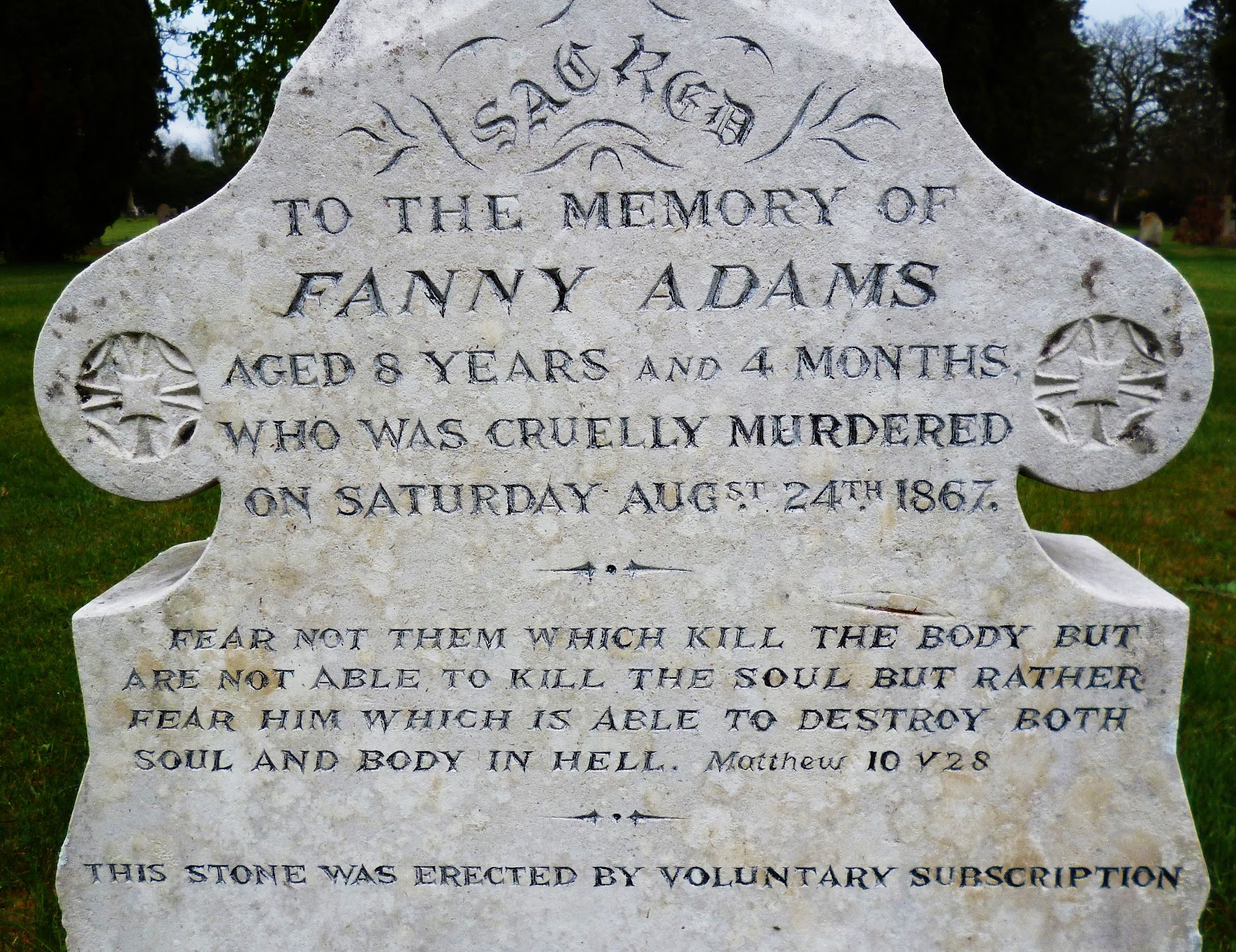
The grave of Fanny Adams is in Alton Cemetery, Hampshire.

'SACRED
TO THE MEMORY OF
FANNY ADAMS
AGED 8 YEARS AND 4 MONTHS,
WHO WAS CRUELLY MURDERED
ON SATURDAY AUGST. 24TH. 1867.
–––––––––––––––––––
FEAR NOT THEM WHICH KILL THE BODY BUT
ARE NOT ABLE TO KILL THE SOUL BUT RATHER
FEAR HIM WHICH IS ABLE TO DESTROY BOTH
SOUL AND BODY AND HELL. Matthew 10 V 28
–––––––––––––––––––
THIS STONE WAS ERECTED BY VOLUNTARY SUBSCRIPTION'

Fanny Adams (1859–1867) was murdered on 24 August 1867 by solicitor's clerk Frederick Baker at the age of eight years and four months. Her head and legs had been severed and her eyes gouged out. Although there was a history of mental illness in Baker's family, including himself, Baker was hanged outside Winchester prison on 24 December 1867.

The expression 'Fanny Adams' was adopted by sailors discontented with their rations to mean meat of no worth. By extension, 'sweet FA' has come to be a euphemism for something of no value, in other words 'fuck all'.

ADDENDUM: Very oddly, there's a French expression 'faire Fanny', which some sources say comes from the 19th century too, when a twenty-year-old called Fanny from the Croix-Rousse region of Lyon used to console players scoring 'nul points' at pétanque (or boules) by taking them aside and showing them her arse. Some, of course, might see this as an insult, and other stories take it as exactly that. And then, there's an expression called 'embrasser Fanny', when 'Fanny' kissed the losers, although this expression is said to originate from different eastern areas of France. It seems an odd coincidence that 'Fanny' is used to mean zero in both France and England and in such unrelated circumstances, but now how did the American 'Fanny' (in the sense of 'ass' meaning 'arse' or, er, posterior), come into being, and apparently have no relationship with the young French girl(s)? Weird.