Showing posts with label Blidworth (Nottinghamshire UK). Show all posts

11 February 2019

James Prior plaque, Blidworth, Nottinghamshire


'In Commemoration of
James Prior Kirk
1851 - 1922

Poet and Author of 'Forest Folk'
A tale of Blidworth and Blidworth Folk

"I have put the best of myself into my books.
they are me and nobody else".'

At last! A commemoration of James Prior in Blidworth, Nottinghamshire, in which almost all of his novel Forest Folk (1901) is set. This is on the planter in Forest Folk Corner, close to the land on which the Forest Folk pub stood. Thank you to Alan Higgins, Chairman of Blidworth and District Historical and Heritage Society, for informing me of this. Nottinghamshire County Council and Blidworth parish council supported the Society's project, and local interest has been 'very positive'.

The Forest Folk pub, taken by me in about 1992. It bore the datestone '1926' and many people were shocked by the news in 2001 that it was to be knocked down and a supermarket put up in its place. It was actually demolished in 2005.

My James Prior posts:
–––––––––––––––––––––––––––––––––––
James Prior's Forest Folk (dissertation): Introduction
James Prior's Forest Folk (dissertation): Chapter One
James Prior's Forest Folk (dissertation): Chapter Two
James Prior's Forest Folk (dissertation): Chapter Three
James Prior's Forest Folk (dissertation): Conclusion
James Prior (1851–1922) in Bingham
James Prior's Parents' Grave, Nottingham
James Prior: Three Shots from a Popgun (1880)
The Forest Folk memorial window
James Prior plaque, Blidworth

Rocking Chair Ceremony, Blidworth, Nottinghamshire

The Rocking Ceremony in Blidworth, Nottinghamshire, is more than 600 years old. The information plaque by the sculpture informs us that the ceremony is 'based on an old bible play about "the presentation of the baby Jesus in the temple".' It was revived in 1922 and takes place annually in the parish church on the first Sunday in February, when the baby boy born nearest to Christmas day is baptised and rocked in a 100-year-old wooden cradle. The church is 'the last church in the country, and possibly the world, to perform the ceremony'. This sculpture was made by Morris Reddington, and presented to the village free of charge in March 2010.

13 November 2018

The Forest Folk memorial window, Blidworth, Nottinghamshire

Now that we live in the north-west of England, in the Manchester area, we only go back to Nottingham a few times a year. After learning that there are remains of the lamented Forest Folk pub windows dedicated to James Prior, the regional novelist who wrote Forest Folk (1901), I had to see them. They're in the chapel of St Andrew's Mission Hall, The Crescent, Blidworth, and even if you have a supply of phone numbers you still might have to work on the task some time, especially if you don't live in the area. But we made it! Not all of the windows, of course, were salvaged, but these are all the remaining ones, showing animals in a rural setting. There are a number of posts relating to Prior on this blog, including my full (75, 000 word) MA on the book as a de-historicised, working-class take on the New Woman. (The Forest Folk pub, by the way, was opened in 1926 and demolished in 2005.)


20 November 2016

James Prior and Robert Dodsley in Mansfield, Nottinghamshire


Many thanks to Bob O'Neill for sending me scans of this programme, which he discovered among some old documents that his mother L. B. Allsop had saved. This details two plays performed at Queen Elizabeth's Grammar School, Chesterfield Road, Mansfield, in the School Hall on 24 March 1947: Robert Dodsley's The King and the Miller of Mansfield (1737) and a stage version of James Prior's novel Forest Folk (1901) by J. H. Rowley. The programme gives these notes on the authors:

'JAMES PRIOR KIRK, son of a Nottingham tradesman, wrote his neglected regional masterpiece in 1901. In addition to the vigour, charm and humour of the narrative, and the vivid depiction of the vanishing life and speech of the countryside, he introduces three momentous historical disturbances that changed the aspect of England – the Enclosure of the Commons, the Industrial Revolution and the Methodist Revival. Our play presents the opening chapters in a sequence of dialogues. We regret that exigencies of production have necessitated liberties with the text and plot, and deprived us of the principal character in the drama – Sherwood in all its moods, but we have faithfully endeavoured to preserve the spirit of our author and the fabric of his dialogue, and commend any who may be pleased or displeased by our rendering to meet the original in the fine new Bromley Press edition.

ROBERT DODSLEY, son of a Dissenting Schoolmaster of Mansfield, and presumed to be an Old Boy of the School, fled from his apprenticeship as a Stockinger to take service as a Footman in London, where his literary talent attracted the favour of his aristocratic employers. He became the most illustrious publisher of the age, and the friend of distinguished writers, noblemen and divines, being generally esteemed for his kindliness, wisdom and integrity: This interlude, based on a legend of his native town, was one of the most popular productions of the day, and we shall endeavour to suggest within our limitations not only the costume but the theatrical style of the period.'

A link to a number of my other posts on James Prior is here.

29 November 2012

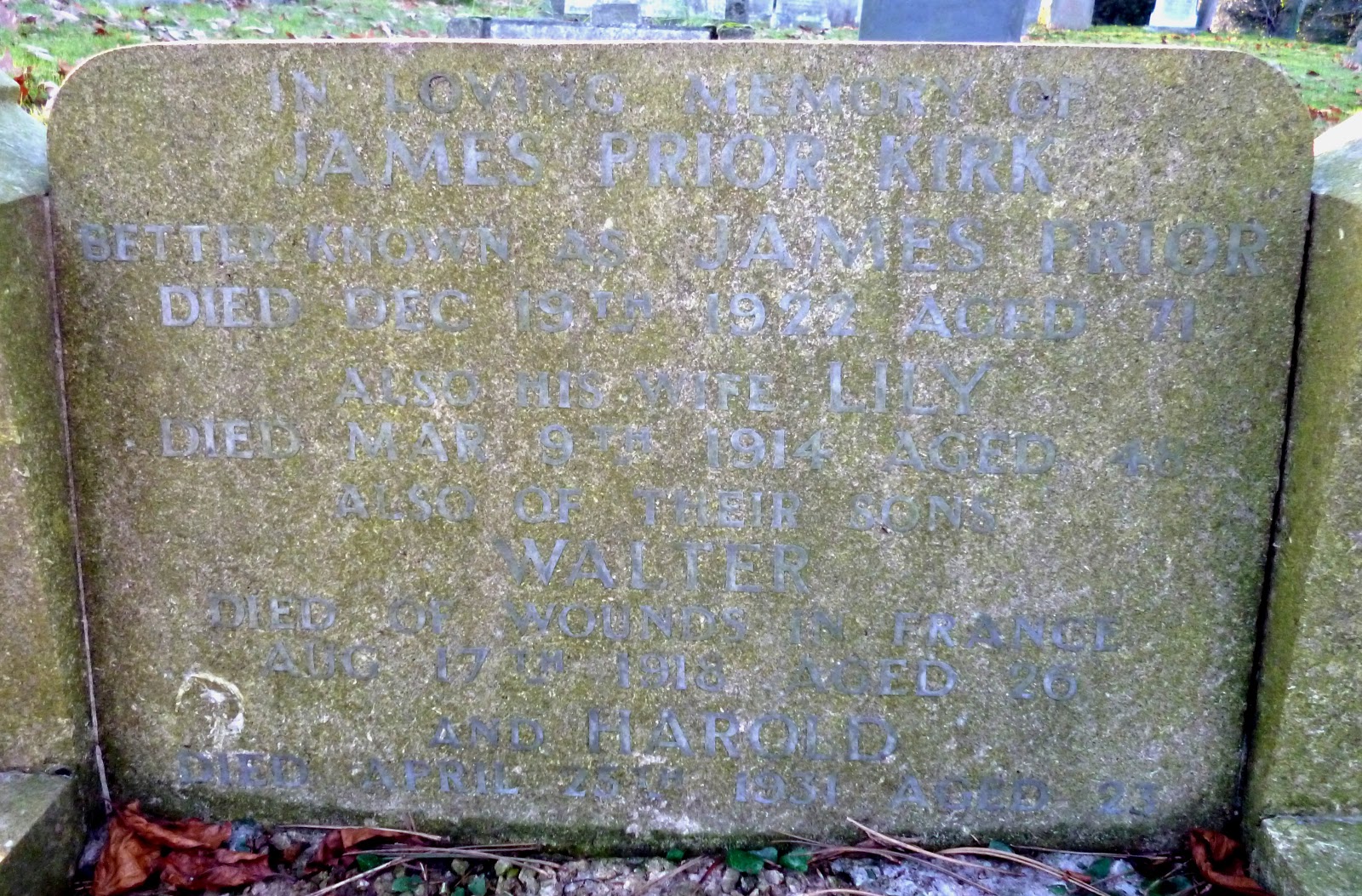
James Prior (1851–1922) in Bingham

Finally, I located the grave of the novelist James Prior, most noted for Forest Folk* (1901), in Bingham Cemetery, Nottinghamshire.


'IN LOVING MEMORY OF
JAMES PRIOR KIRK
 BETTER KNOWN AS JAMES PRIOR
DIED DEC 17TH 1922 AGED 71
ALSO HIS WIFE LILY
DIED MAR 9TH 1914 AGED 48
ALSO OF THEIR SONS
WALTER
DIED OF WOUNDS IN FRANCE
AUG 17TH 
1918 AGED 26
AND HAROLD
DIED APR 25TH  1931 AGED 23'

2001 not only marked the centenary of Forest Folk, but also 150 years since the birth of James Prior. To my knowledge there was not a single mention of this from Nottinghamshire County Council, Bingham Town Council, or any local history societies. When I found Prior's grave yesterday I had to spend some time cleaning it up: I am as yet (29 November 2012) aware of no other photo of Prior's grave.

James Prior, with the exception of early D. H. Lawrence, is probably the only regional writer from Nottinghamshire in the early 20th century, and yet not even his adopted home of Bingham seems to appreciate his achievements. There is an organization called Bingham Heritage Trails Association, but virtually the only (extremely limited) information it gives on Prior on its website is from a Nottinghamshire County Council webpage.

Lushai Cottage in Fisher Lane is where the Kirk family lived at the beginning of their stay in Bingham in 1891. This photo is one I took for my book Hidden Nottinghamshire (Wilmslow: Sigma Leisure, 1998), an example of my, er, juvenilia.

My MA of 2000 contains a little previously unpublished biographical material on James Prior and is viewable in full on this blog: it was posted in consecutive chapters in October 2012 and is the only long study ever made of Prior's work, although almost all of it concentrates on Forest Folk. It may still contain a number of minor typos as I had to re-type it and remember a few lost pages.


(Walter Kirk was in fact buried in Huon Military Cemetery, Le Treport, Seine-Maritime (76), France.)

* The pub The Forest Folk in Blidworth, named after the novel, was built in 1927 and was demolished some years ago. The entrance room had a small area (including a window) commemorating James Prior.

In August 2011, it was announced that a planter and plaque would be placed at 'Forest Folk Corner' to mark the site. Well, it's not exactly a plaque but it's at least something.

A commemorative plaque in Bingham (where James Prior lived for over 30 years) would be recognition of the important part that the man played in the county's literary history.

My James Prior posts:
–––––––––––––––––––––––––––––––––––
James Prior's Forest Folk (dissertation): Introduction
James Prior's Forest Folk (dissertation): Chapter One
James Prior's Forest Folk (dissertation): Chapter Two
James Prior's Forest Folk (dissertation): Chapter Three
James Prior's Forest Folk (dissertation): Conclusion
James Prior (1851–1922) in Bingham
James Prior's Parents' Grave, Nottingham
James Prior: Three Shots from a Popgun (1880)
The Forest Folk memorial window
James Prior plaque, Blidworth

25 October 2012

James Prior's Forest Folk: A Novel Construction of the New Woman and the New Man: Introduction

Introduction
 
The novelist James Prior was born James Prior Kirk in Mapperley Road, Nottingham in 1851 to Sarah and James Kirk, his father having a millinery concern in the city of Nottingham. He went to a preparatory school run by the Goodalls before going to a school run by a man named Porter for ten years, and then began working for a solicitor: his father intended him to join the legal profession, but instead Prior spent a great deal of time studying languages and literature. He left the legal profession following a major argument with his father, but his intention to pursue a career in writing initially proved fruitless. He taught for a short time, attempted a degree, but problems with his eyes, including intervals of temporary blindness, put paid to any future career prospects.1

Prior was under thirty when his father died in 1880, and after continuing the family business for a year left for Uppingham, Rutland, to help an uncle in difficulties with his farm, but in the process Prior lost a considerable amount of money, presumably inherited from his father. By the time of his permanent move to the small Nottinghamshire market town of Bingham with his wife Lily and two daughters in the early 1890s, he had already written a book of short stories – Three Shots from a Popgun (1880) – and three plays – Don Pedro the Cruel (1882) and John Smith of London and Live and Let Live (both published in one volume in 1883).2 All failed to bring Prior any commercial success or critical acclaim. It was not until after his first two novels, Renie (1895) and Ripple and Flood (1897), that he began to gain recognition.3 He published four more novels: Forest Folk (1901), Hyssop (1904), A Walking Gentleman (1907) and Fortuna Chance (1910).3

All of the published novels are set in the East Midlands, predominantly in Nottinghamshire, and reveal a considerable interest in and knowledge of local history and local working-class characters. Forest Folk, his most well-known book, was a modest success and is a good example of Prior's use of the Nottinghamshire dialect and of the countryside. It is set in the early nineteenth century when Luddism was at its height, and takes place in and around the Nottinghamshire village of Blidworth. But Fortuna Chance was the last book of Prior's to be published: two later novels – 'November' and 'Loosestrife' – remained in manuscript stage.5


1 Jean Anabel–Cooper, 'James Prior – An Appreciation', Nottinghamshire Countryside Volume 26, No. 1, 1965, pp. 23– 25.

2 James Prior, Three Shots from a Popgun (London: Remington, 1880)
–––––, Don Pedro the Cruel: A Historical Tragedy (London: Hamilton, Adams, 1882);
–––––, John Smith of London: A Comedy in Five Acts and Live and Let Live: A Comedy in One Act (Nottingham: James Prior, 1883).

3 James Prior, Renie (London: Hutchinson, 1895);
–––––, Ripple and Flood (London: Hutchinson, 1897).

4 James Prior, Forest Folk (London: Heinemann, 1901; repr. Nottingham: The Bromley Press, 1946);
–––––, Hyssop (London: Heinemann, 1904);
–––––, A Walking Gentleman: A Novel (London: Constable, 1907);
–––––, Fortuna Chance (London: Constable, 1910).

5 Ivory Buchan, 'James Prior: An Appreciation', Nottinghamshire Countryside, July 1941, pp. 8–9.


Prior may in large part have lived for his pen, but he certainly did not live by it. Census returns for 1891 (a short time before his move to Bingham) show him living with his wife and two baby daughters in the neighbouring village of Radcliffe on Trent. He is listed as 'living on his own means', although these means inevitably began to dwindle. Perhaps an indication of this is in his poem 'Girl and Woman', written in 1914 in the unpublished 'Canticles by Vacuus' shortly after the death of his wife, where the dead narrator Lily speaks of 'giving cheerfully out of a scanty store'.6 For his contributions to literature Prior was given a small civil pension, but a mixture of circumstances conspired to destin him to oblivion. He was shy and retiring and a strong indication of his nature is revealed in a letter of 1919 declining an invitation to give a talk on an unspecified subject. Writing to W. A. Briscoe, he first thanks him for his 'attack upon the lethargy' of his publishers and then exclaims: 'But to lecture! even "talk" publicly! A mild-mannered man like myself, only accustomed to raise my voice authoritatively in the bosom of his complaisant family!'. He continues to give his self-effacing excuses:

'I simply shouldn't know how to do it. I know that you will say I should only have to stand & stutter, but I should not be sure of the stutter; & as for the standing, probably in my blind eagerness [...] I should plunge straight down among the audience.'7

There is more than a hint of Prior's sense of humour in the letter, indicating a spontaneity that some critics have suggested is lacking in his narrators. Although the local dialect of his characters' dialogues sparkle with wit and energy in the novels, his narrative style perhaps bears too much of a strained formality out of keeping with the new century. Prior said that his writing probably came from his father, who had 'a gravely exact way of expressing himself with a pen'.7 Publishers were no longer interested. The James Prior Memorial Committee was set up shortly after his death and such writers as J. M. Barrie, John Buchan and Eden Phillpotts lavished great praises on his work. Despite the irony of Prior being a teetotal Methodist, the Forest Folk pub was built in Blidworth, incorporating a memorial room with a stained glass window in his honour.8 But his books have remained out of print for many years. Prior is now unknown apart from among a few regional novel enthusiasts and local historians, and there is almost no critical work on him.


6 James Prior, Nottinghamshire Archives Office, M263, 17 November 1919.

7 S[tephen] Fisher, James Prior (Nottingham: James Prior Memorial Committee, [1917(?)]), p. 3.

8 Gordon Wright and Brian J. Curtis, The Inns and Pubs of Nottinghamshire: The Stories Behind the Names (West Bridgford: Nottinghamshire County Council, 1995), p. 16.


Moving to the dissertation itself, my principal intention is to show that there are correspondences between James Prior's novel Forest Folk, and New Woman and New Man representations at the fin de siècle and beyond. The dissertation is divided into three chapters.

In Chapter One, 'The Fin-de-Siècle New Woman in Context', I shall begin by exploring the nature of representations of the New Woman both during and after this period. I shall make use of several secondary works which provide information on the fictional construct that is the New Woman. Jenni Calder's Women and Marriage in Victorian Britain shows the changing roles of women throughout the Victorian era, commenting on events leading up to and including the New Woman. Elaine Showalter's Sexual Anarchy and Sally Ledger's The New Woman both give further focuses on the time before and during Prior's books, indicating exactly what the 'anarchy' consisted of and how it manifested itself. Both books examine specific texts relating to the New Woman. Elaine Marks's Bicycles, Bangs, and Bloomers focuses on the stereotyping of the New Woman in the media. The series of essays in Angelique Robinson and Chris Willis's The New Woman in Fiction and in Fact provide the most recent research in the field. All of these secondary works give a different idea of the various forms the New Woman took, and so help towards establishing a definition. With the information in these secondary texts I then draw on a number of primary texts which incorporate representations of the New Woman and the New Man. These include novels which feature different aspects of the New Woman question, such as Charlotte Perkins Gilman's Herland, Kate Chopin's The Awakening, George Gissing's The Odd Women, Mary Cholmondeley's Red Pottage, and Ménie Muriel Dowie's Gallia. Because of her particular similarities to Prior's work, Olive Schreiner's extended essay Woman and Labour forms a common thread throughout the three chapters. Gender inversion and androgyny were predominant in New Woman novels and I draw a parallel between them and those in Prior's work, although I go on to suggest that Prior's New Woman is very different from conventional New Woman representations. It is the similarities and the differences that are important to this dissertation.

Chapter Two is called 'Prior's New Woman', where I shall look at Forest Folk in some detail, examining the correspondences between working-class Nell Rideout and representations of the New Woman in literature in and around that period, notably in that of George Egerton and Olive Schreiner. Here I make clear that such anarchy as was seen in Chapter One is very much in the foreground of Prior's novels, and examples from Forest Folk underline this. My argument, as already stated, is that Prior introduces a very different New Woman. Whereas conventional New Woman representations of the time are middle class, Prior's are working class, sometimes with gipsy blood, or having the qualities of benign witches, as is the case with Nell. Under the influence of Borrow in particular, Prior transforms the mannish Girton girl of so many fin de siècle Punch caricatures of the New Woman into a timeless young woman with a broad Nottinghamshire accent and with 'masculine' behaviour. There is an obvious parallel with this behaviour and that of her counterpart in conventional New Woman fiction. Prior welcomes the gipsy and the witch as the embodiment of his understanding of bisexuality and almost seems to suggest that they should be seen as the saviours of mankind.

Chapter Three is entitled 'Prior's New Man' and directly follows on from the word of the last paragraph because mankind, rather than womankind, is where Prior believes the problem lies. In Prior's novels there is also some psychological evolution on the part of the male towards the 'New Man', a term about which there has been very little written and which I shall define and investigate here. Patricia Marks gives examples of satirical representations of the New Man in periodicals in the years leading up to the close of the nineteenth century. But it is probably Olive Schreiner who named him as a phenomenon to be taken seriously in the later Woman and Labour (1911), indicating an ideal, equal partner. This New Man not only closely resembles Prior's New Man but also our own contemporary understanding of the term. George Egerton's characters from Keynotes and Discords also serve as similar parallels. Prior's gipsies – along with the 'witch' Nell in Forest Folk – represent a fusion of male and female which Prior sees as necessary to a civilisation in which man and woman should cohabit as friends and partners. My argument is that it is the male in particular who has not discovered the key to free himself from his prison of gender consciousness, although the New Woman has the key: her teaching can unlock him from the prison. Equally important for Prior, though, is a harmonious relationship between not only man and woman but also working class and middle class, symbolised here by Nell and Arthur, and Lois and Tant. And as dialect in Forest Folk is such an important part in the definition of what it is to be working class, I stress the importance of it.

My Conclusion attempts to set Forest Folk in context, sum up Prior's achievements in it, and also suggests the principal reason for Prior's present obscurity.

In the New Woman, Ledger adopts Michel Foucault's brief use of the expressions 'dominant discourse' and 'reverse discourse' to explore the warring patriarchal and New Woman discourses. I borrow this usage in Chapter One because the labels act as a convenient, albeit rather inexact, generalization over a number of diverse texts: the New Woman, however different in her various guises, was still a force against the dominant patriarchy. However, when discussing Forest Folk in the following two chapters, I find it more appropriate to be more specific about the several principal discourses present in the book: it is far more coherent to deal with several discourses in a single text than in a number of texts. And certainly the reality of discourse, as Foucault says, is rather more complicated:

'There is not, on the one side, a discourse of power, and opposite it, another discourse that runs counter to it. Discourses are tactical elements or blocks operating in the field of force relations; there can exist different and even contradictory discourses witin the same strategy; they can, on the contrary, circulate without changing their form from one strategy to another, opposing strategy.9

It is by examining the various conflicting discourses in Forest Folk that I intend to arrive at a fuller understanding of the text, of what Prior is saying.


9 Michel Foucault, The Will to Knowledge: The History of Sexuality: Volume I (as The History of Sexuality: Volume I, An Introduction (London: Lane, 1979; repr. Penguin, 1998), pp. 101–02.

My James Prior posts:
–––––––––––––––––––––––––––––––––––
James Prior's Forest Folk (dissertation): Introduction
James Prior's Forest Folk (dissertation): Chapter One
James Prior's Forest Folk (dissertation): Chapter Two
James Prior's Forest Folk (dissertation): Chapter Three
James Prior's Forest Folk (dissertation): Conclusion
James Prior (1851–1922) in Bingham
James Prior's Parents' Grave, Nottingham
James Prior: Three Shots from a Popgun (1880)
The Forest Folk memorial window
James Prior plaque, Blidworth

James Prior's Forest Folk: A Novel Construction of the New Woman and the New Man: Chapter One

CHAPTER ONE

The Fin-de-Siècle New Woman in context
Broadly speaking, the 'woman question' was concerned with the rights of women in society, although there was no consensus about the exact nature of the question. As Claire Buck claims:

'No single cultural myth prevailed, and the idea of "Woman"; her "mission", her "sphere" and her "influence" became a site of struggle where competing ideologies strove for dominance. Some commentators challenged the constraints placed upon middle-class women's loves and argued for greater vocational and educational opportunity; others argued passionately that women and men should operate in separate spheres of existence.'1

In 1792, in the seminal feminist work A Vindication of the Rights of Woman, Mary Wollstonecraft wrote about marriage, and the limits of women's education and work. These subjects and others were to be addressed later in the next century. The 'woman question' grew more important as the nineteenth century wore on and became the theme of two important poems: Alfred Tennyson's The Princess of 1847 (education) and Elizabeth Barrett Browning's Aurora Leigh of 1857 (women's independence). Martha Vicinus says that 'job opportunities, marriage laws, female emigration, and education were only some of the issues debated at the time'.2 The 1851 census shows that there were 400,000 more women in the population than men – and this number was to increase over the years, with obvious implications for power relations if the franchise was extended to both sexes.

Then the fin de siècle brought the New Woman, also described by other writers as a vague concept: Peter Keating says 'New Woman novelists did not constitute a school of writers in any formal sense', and Lyn Pykett describes her as 'a Protean figure', going on to claim:  'The [i.e. the real] New Woman did not exist.'3 She was a constantly shifting, literary and journalistic construct as distinct from a wholly coherent reality. But she was also an increasingly acknowledged, and increasingly threatening, part of the female Zeitgeist, dangerous enough to be seen as 'a threat to the status quo', and a threat to marriage in particular.4 Along with the issues that Vicinus cites above, other questions raised by the New Woman argument included the extension of the franchise, sexual autonomy, and independent (i.e. unchaperoned) mobility. In George Meredith's The Egoist (1879) 'the classic Victorian male image of the word' is evident when Sir Willoughby imagines Clara waiting at home for him to return from his 'masculine pursuits'.5 It was viewpoints like this that the New Woman discourse seriously attacked. However multi-faceted the New Woman might be, she was questioning the raison d'être of the patriarchal order. Emboldened women writers even dared to make a 'frank depiction of issues relating to sexuality, including venereal disease, the sexual double standard, and the dire consequences of women's ignorance about sexual issues before marriage'.6


1 Claire Buck, ed., Bloomsbury Guide to Women's Literature (London: Bloomsbury, 1992), p. 1146.

2 Martha Vicinus, ed., A Widening Sphere: Changing Roles for Victorian Women (London: Century, 1990), p. ix.

3 Peter Keating, The Haunted Study: A Social History of the English Novel 1875–1914 (London: Secker & Warburg, 1989), p. 189;
Lyn Pykett, Foreword, in The New Woman in Fiction and in Fact: Fin-de-Siècle Feminisms, ed. by Angelique Richardson and Chris Willis (Basingstoke: Palgrave, 2001), pp. xi–xii (p. xi).

4 Sally Ledger, The New Woman: Fiction and Feminism at the Fin de Siècle (Manchester: Manchester University Press, 1997), p. 11. (All below references to this book simply refer to 'Ledger'.)

5 Jenni Calder, Women and Marriage in Victorian Fiction (London: Thames & Hudson, 1976), p. 184.

6 Carolyn Christensen Nelson, British Women Fiction Writers of the 1890s, ed. by Herbert Sussman, English Authors Series, 533 (New York: Twayne, 1996), p. 4.


As I stated in the Introduction, a convenient way to view the situation here is to see the traditional patriarchal (and predominantly middle-class) argument as the 'dominant discourse', and the modern fin-de-siècle voice of the New Woman as a 'reverse discourse' fighting the dominant. Eliza Lynn Linton's was one of the strongest voices against the reverse discourse, exaggeratedly describing a 'Wild Woman' who, Ledger states, 'opposed marriage, who vociferously demanded political rights, and who sought "absolutely personal independence coupled with supreme power over men"'.7 In 1887 the New Woman 'type' was seen as a 'feminine Frankenstein'.8 However, it is important to note that the expression 'New Woman' was not actually used until 1894 – first by Sarah Grand (without the capital letters), and then several times a few months later by Ouida (with the vital identifying capitals).9

It is perhaps easy to understand the fears. Elaine Showalter quotes Gissing's observation that sexual codes in the 1880s and 1890s were falling apart, and also quotes Karl Miller's assertion that 'men became women. Women became men. Gender and country were put in doubt. The single life was found to harbour two sexes and two nations.'10 It was this perceived gender anarchy which periodicals, particularly via cartoons, attacked in their representations of the New Woman. To the patiarchal world of Punch and the like, the New Woman was certainly real enough to threaten the dominant discourse. One strategy of this discourse is to attempt to negate the reverse discourse by satire, but paradoxically the reinforcement of identifiers such as 'New Woman' has the effect of reification.

The satirical representations of the New Woman in Punch are typical of the time in their depictions of gender reversal: in one cartoon, two confident young women wearing ties and other rather 'masculine' clothes sit in the foreground smoking cigarettes. One says to a timid-looking man reaching for the door-knob: 'You're not leaving us, Jack! tea will be here directly!', to which Jack retorts that he is having tea with the servants, because he is missing female company.11 Elsewhere, there are many other cartoons of the 1890s showing middle-class women riding bicycles and wearing 'rational dress' such as knickerbockers or split skirts. The periodials fed the fear among the Old Men that women were becoming masculinized in their strivings towards equality.

The cigarettes in the cartoon are also highly significant because the cigarette was at once a symbol of the liberated woman and of the gender malaise, a fact borne out by the prominent one maladroitly lit at both ends in Albert George Morrow's poster depicting a liberated young woman for Sidney Grundy's play The New Woman.12 Further proof of the cigarette as symbol is shown – somewhat more bizarrely – in the behaviour of Grand's doting companion, Gladys Singers-Bigger, who meticulously labelled and dated the ends of Grand's discarded cigarettes and saved them for posterity.13

Also worthy of note here, before I deal with Prior's constructions of the New Woman in Chapter Two, is the fact that it is the middle class in which the New Woman is almost invariably found: Ledger, for example, notes that New Woman representations are 'rarely working class'.14 The servants are not seen as stricken be the wildness Linton mentions: the threat to the dominant discourse is working from within.

7 Ledger, p. 12.

8 Calder, p. 164.

9 Ellen Jordan, 'The Christening of the New Woman: May 1894', Victorian Newsletter, 63 (1983), 19–21 (p. 20).

10 Elaine Showalter, Sexual Anarchy: Gender and Culture at the Fin de Siècle (London: Bloomsbury, 1991), p. 3.

11 Ledger, p. 98.

12 Jean Chothia, ed., The New Woman and Other Emancipated Plays (Oxford: Oxford University Press, 1998), front cover illustration.

13 Elaine Showalter, 'Smoking Room', TLS, 16 June 1995, p. 12.

14 Ledger, p. 160.

But the New Woman representatives in the literature that purveyed the subversive ideas of the reverse discourse were far from these facile reductions to clearly visible (and movable) female types. The New Woman was an intellectual, pluralistic entity, with perhaps her only two common denominators being a strong desire both for independence and for equal rights with men. But these things did not of course mean the same thing to all New Women. There were more than one hundred New Woman novels written between 1883 and 1900, although it is unclear if this includes the New Woman detective sub-genre described by Willis.15 But the figure obviously excludes drama, and therefore Henrik Ibsen, said to be the virtual inventor of the New Woman.16 A 1913 issue of The Bookman also cites Ibsen's A Doll's House (1879) as an early member of the New Woman genre.17 The above period – 1883 to 1900 – can perhaps be described as the 'high' New Woman era, although the first wave continued beyond the Edwardian period and extended to other countries.

The subject matter of New Woman literature, then, was diverse and often one author's aims conflicted with another's. Some New Woman literature, such as Elizabeth Robin's play Votes for Women! and its novel counterpart The Convert – both from 1907 – are unequivocally proselytizing, demanding political change and the right of women to a positive independent voice. Marriage is a major theme in New Woman literature, and is typically seen as a mental and physical prison: in Votes for Women!, the unmarried Vida Levering says 'the only difference between me and thousands of women with husbands and babies is that I'm free to say what I think. They aren't'.18 Calder finds that Meredith's views strongly concur:

'Meredith was perhaps unique in explicitly exposing the situation of women as the key to a critique of society. He saw marriage as an instrument of restraint. It stifled women, limited men, reinforced class barriers, and inhibited freedom of thought and action. In all his best fiction these destructive operations are at work.'19

15 Angelique Richardson and Chris Willis, Introduction, in Richardson and Willis, pp. 1–38 (p. 1);
Chris Willis, '"Heaven defend me from political or highly-educated women!": Packaging the New Woman for Mass Consumption', in Richardson and Willis, pp. 53–65.

16 Sally Ledger, 'Ibsen, the New Woman and the Actress', in Richardson and Willis, pp. 79–93 (p. 79).

17 Ledger, p. 2.

18 Elizabeth Robins, Votes for Women!, in Chothia, pp. 135–210 (p. 198).

19 Calder, p. 170.

Alternatives to marriage are common in New Woman literature, although they frequently end in misery. In From Man to Man (1911), Schreiner suggests that virtually the only recourse for the 'fallen woman' is prostitution, incidentally a word which for Schreiner includes consent to sexual relations in an unhappy marriage. Hermione Barton in Grant Alllen's The Woman Who Did (1895) is the mother of a child whose father she has refused to marry; she kills herself in the end to save her daughter's reputation. The 'free union' is also discussed in Gissing's The Odd Women (1893), although the Rhoda Nun/Everard Barfoot partnership is aborted before it really begins. If we incorporate Jane and Mary Findlater's Crossriggs (1908) into the New Woman genre – and there is no reason why we should not – Alexandra Hope's choice of spinsterhood as opposed to an unhappy marriage seems a prime example of another such alternative.20 Kate Chopin's The Awakening (1899) explores woman's usually repressed sexual desires; the protagonist Edna Pontellier leaves her husband and has a sexual relationship with the local Lothario, although at the end she commits suicide. At the time, of course, the reason for any failure to find an alternative to marriage was the power of the dominant discourse rejecting any other discourse. All was not misery, though, and I shall turn to some perhaps more positive texts.

Before moving to a few texts in which the idea of the couple is paramount, though – as of course it is in Prior's work – there are two significant New Woman texts that challenge the late nineteenth- and early twentieth-century attitudes to gender. In 1893 Ménie Muriel Dowie wrote Women Adventurers, which according to Helen Small is 'a collection of biographical studies of women cross-dressers, travellers, explorers and fighters.'21 But it probably gave no idea of what to expect from Gallia, which exploded on Victorian sensibilities in 1895. In this novel the eponymous New Woman makes a conventional decision but does so in a highly unusual – and also highly subversive – manner. Gallia chooses to marry Mark Gurgon purely because she wants to be a mother. She says, 'I want you to be my husband – or rather, the father of my child.'22

'Gallia' as a forename is unusual. In her Notes on Dowie's novel, Small suggests, although not altogether convincingly, that it is 'apparently a feminine form of "Gallio"', this being Seneca's brother whose 'name became a byword for indifference to public opinion.'23 More interestingly, and perhaps more credibly, it could also suggest the word 'gallinaceous', or the Latin gallina – meaning 'hen-like' or 'hen', an animal usually associated with birth and nurture. Albert Dauzet's Dictionnaire étymologique lists first names beginning with the prefix galli-, and notes that this written form for this species of bird is of Corsican or Italian origin.24

But although Gallia may to some extent have opted for the traditional human mother hen role, she transgresses traditional gender codes in other ways. She is not in love with Gurdon, but delighted that he had a mistress whom he has made pregnant. The mistress is a half-gipsy, someone at the time perceived as racially and socially inferior, albeit sexually useful to unattached young men. This knowledge to Gallia merely serves to attest Gurdon's ability to give her a child: she is mainly interested in his fertility. In this marriage, it is certain who will rule the roost.

And in Gallia, as so often in New Woman literature – and as opposed to the popular press of the day – it is the traditional male who is lampooned. When Gallia reveals not only her awareness of Gurdon's mistress, but also of her 'illness' (an abortion) he is understandably dumbstruck by Gallia's indifference. Instead of the man manipulating the woman to serve his ends, and unlike the exploited gipsy, Gallia is in fact sexually exploiting him. He is indeed, as Gail Cunningham comments, 'hoist [...] with his own petard'.25 But the most withering attack on men in the book comes from Miss Janikon, who, in a statement about men bragging about their sexual conquests, says:


'Men are like children who have come home from the seashore. [...] They have to tell about how they paddled, and just how deep they went in, and all about the queer things they fished out, and about the crabs that caught hold of their toes. [...] And all the time you see how awfully frightened at the crabs they have been.'26

20 Jane and Mary Findlater, Crossriggs (London: Smith, Elder, 1908; repr. London: Virago, 1986).

21 Ménie Muriel Dowie, Gallia (London: Methuen, 1895; repr. London: Dent, 1995), p. xxix.

22 Dowie, p. 191.

23 Dowie, pp. 205–06.

24 Albert Dauzet, Dictionnaire étymologique des noms de famille et prénoms de France (Paris: Larousse, 1951), p. 276.

25 Gail Cunningham '"He-Notes": Reconstructing Masculinity', in Richardson and Willis, pp.94–106 (p. 97).

26 Dowie, pp. 198–99.

However, the following novel shows a movement towards a reconciliation of the sexes after the women have given the men an education in gender. Gilman's Herland adopts a more balanced approach to the issue, although in an unconventional way. Herland was first published serially in 1915 – five years after Prior's last published work – and is a Utopian novel largely set in an imaginary country consisting of only women. Gilman uses the term 'bi-sexual' to describe a society inhabited by both sexes. The Herlander Somel carves through the gender constructs when she tells the explorers Terry, Jeff, and Vandyck, all of whom are from a bi-sexual country, although from the narrative the men and women might be from different planets: 'We can quite see that we do not seem like women – to you. [...] But surely there are chacteristics enough which belong to People, aren't there?'.27 The male narrator notes that the long absence of a history of gender in Herland means that the women have no concept of what is 'manly' or 'womanly'.

But although they do appear to the male strangers as devoid of what their society would consider 'feminine', all three – perhaps a little improbably, although with varying success – soon find partners. The narrator arrives at an enlightening thought: the qualities that he and his society had hitherto considered 'feminine' are in effect 'not feminine at all, but merely reflected masculinity – developed to please us because they had to please us'.28 We seem to be shifting steadily towards an ideology of androgyny – if in fact that has any meaning in this context – although in her Introduction, Ann J. Lane is quick to emphasize Gilman's conventional ideas concerning 'the nuclear family or monogamous marriage'.29

But it is in earlier literature emphasizing the importance of the couple that the New Man is found, so I now turn to this phenomenon. Peter Schwenger quotes Annette Lolodny: 'If we insist on discovering something we can clearly label as a "feminine mode," then we are honor-bound, also, to delineate its counterpart, the "masculine mode."30 Following this logic, it seems clear that a New Woman should automatically suggest a New Man, the existence of whom was first mentioned at the fin de siècle. As well as being the New Woman's partner, the New Man in a sense follows on from the Foulcauldian idea of a reverse discourse, although perhaps it would be more accurate here to call it a reverse discourse support, or an extension of the New Woman reverse discourse. In jest, Max Beerbohm refers to 'the amalgamation of the sexes' as 'one of the chief planks of the decadent platform'.31

However, the association of the New Man with the decadent movement does not concern me here, as Prior's fiction involves more a mixture of male and female within both sexes in a purely hererosexual context. At the fin de siècle there was certainly an interest in androgny that extended far beyond the decadent movement. The New Man, apart from the homosexual/decadent, or the satirized variety, is in fiction not usually allowed a separate existence outside that of the New Woman – he is defined by her and exists for her, and in the light of fictional representaton would surely not be fully coherent in his own right.

27 Charlotte Perkins Gilman, Herland (Forerunner, 1915; repr. London: The Women's Press, 1979), p.89.

28 Herland, p. 59.

29 The Charlotte Perkins Gilman Reader: The Yellow Wallpaper & Other Fiction, ed. by Ann J. Lane (London: The Woman's Press, 1981), pp. [ix]–xlii (p. xxviii).

30 Peter Schwenger, 'The Masculine Mode', in Speaking of Gender, ed. by Elaine Showalter (London: Routledge, 1989), pp. 101–12 (p.101).

31 Ledger, p. 96.

Perhaps inevitably, the earliest references to the New Man were in jokes in the press: Marks (whose Bicycles, Bangs, and Bloomers is dedicated to 'To the [present?] New Man') reveals that Punch showed the New Man 'as an effeminate creation of his club-going [but not wielding] wife'.32 And the following verse, printed in the coincidentally appropriately named Pick-Me-Up in 1896, depicts gender inversion in its full satirical glory with rampant young amazons chasing a sexually timid man:

'School-girls with satchels of wild oats
Have come to make mankind their prey;
And some have dofft their petticoats
As being rather in the way.
To prove that they are frank and free,
Lord knows what else they would not doff;
But voila! [sic] When they turn to see –
The Newest man is making off!'33

In general, though, New Woman fiction's New Men are not of the effeminate or timid kind. They very much tend to resemble our present-day understanding of the term, believing in equality with women in a hererosexual relationship. In Mary Cholmondeley's Red Pottage (1899), though, the new New Man never has the opportunity to put his ideas into practice. Hugh Scarlett (the scarlet New Man?) has had an affair with Lady Newhaven. After drawing the shorter straw with Lord Newhaven, Scarlett must now do the honourable thing and kill himself, although he finally turns coward and Lord Newhaven kills himself instead. Scarlett continues to deceive the New Woman figure, Rachel West, with whom he is in love and who is largely cognizant of the details of the 'gentleman's agreement' although not of the result. But towards the end of the book, after all evidence of the agreement has been destroyed, Scarlett confesses his dishonourable action. For Rachel though, it is too late, and she rejects him. It is left to her friend the bishop to rebuke her:

'[A]t last, in a moment, when you showed your full trust and confidence in him, he shook off for an instant the clogs of the nature which he brought into the world, and rose to what he had never been before – your equal.'34

Scarlett may now be on his way to a pointless death, but at least he has become, amidst a mass of villains in New Woman literature's back pages, one of the most shining examples of a New Man in the whole genre. The bishop makes a few interesting points here to aid the reader's identification of him: 'the clogs of the nature which he brought into the world' in part refers to original sin, but the bishop is in addition referring to the extreme effort Scarlett has made to build himself into a New Man. Unlike becoming a New Woman, which usually seems far more 'natural' in the genre, it appears that becoming a New Man is a part of social evolution. And the bishop also stresses equality here, which is a vital component in the relationship between the New Woman and the New Man.

Turning to Olive Schreiner's view of the New Man, at the end of The Story of an African Farm (1883) Gregory Rose becomes a transvestite nurse who lovingly looks after the New Woman Lyndall. Ledger describes him as 'a species of "New Man"', although she admits that '[Schreiner's] sympathies appear [...] to lie more readily with the type of "new manhood" embodied by the intellectual dreamer, Waldo Farber'.35 In the unfinished Man to Man (finally published posthumously in 1927), Drummond has also been identified by some critics as another specimen of the New Man breed. Buck, for instance, says that 'this story ends with Rebekah's deepening friendship with Mr Drummond, a friendship which signifies the gender equality Schreiner's writing so constantly and so hopelessly drives toward.'36

But there is too little information for the reader to judge: Drummond only appears towards the end to the book, and the events are too inconclusive for the reader to decide if the relationship concerns gender equality or just intellectual and temperamental equality. But Schreiner is probably the first person to mention the New Man in a serious context, and Schreiner's New Man, as I shall demonstrate in Chapter Three, strongly appears to resemble Prior's.

At the end of Woman and Labour (1911), Schreiner spends almost thirty pages discussing her New Man. She introduces the idea of an ideal partner – someone, Brandon argues, that she did not find in Havelock Ellis, Karl Pearson, or her husband Cron Cronwright, although ironically she may to some extent have found him in the homosexual Edward Carpenter.37

32 Patricia Marks, Bicycles, Bangs, and Bloomers: The New Woman in the Popular Press (Lexington: University of Kentucky, 1990), p. 133.

33 Marks, pp. 33–40.

34 Mary Cholmondeley, Red Pottage (London: Arnold, 1899; repr. London: Virago, 1985), p. 356.

35 Ledger, p. 83.

36 Buck, p. 563.

37 Ruth Brandon, The New Women and the Old Men: Love, Sex and the Woman Question (London: Secker & Warburg, 1990), p.90;

Ruth First and Anne Scott, Olive Schreiner: A Biography (London: Deutsch, 1990; repr. The Women's Press, 1989), p.217.

In a long, rambling sentence that builds to a dramatic italicized crescendo, the second half of which I quote below, Schreiner says her ideal man is:

'[N]ew in the sense in which [the New Woman] is new, in that he is an adaptation to material and social conditions which have no exact counterpart in the past; more diverse from his immediate progenitors, than even the woman is from hers, side by side with her to-day in every society and in every class in which she is found, stands – the New Man!'38

The sentence is highly significant. From this powerful trumpeting of the new breed, Schreiner goes on to discuss the nature of this wonderful creature. But it is quite clear from the above that the New Man, like the New Woman, fits tidily into Schreiner's evolutionary thinking, which was influenced by Spencer and Emerson. It is also clear from the expression 'side by side' – a repetition of the first words of the sentence as well as an integral part of the reader's understanding of the end of it – that Schreiner is giving emphasis to the equal nature of this perfect, and ipso facto Utopian, evolutionary partnership. She calls the woman's movement

'[A] part of a great movement of the sexes towards each other, a movement towards common occupations, common interests, common ideals, and towards an emotional sympathy between the sexes more deeply founded and more indestructible than any the world has yet seen.'39

Schreiner's language is co-operative rather than confrontational. In her widened sphere, the New Woman will work on an equal basis with the New Man. Throughout Woman and Labour, her argument is that men and women have over the centuries lost a kind of Edenic state. They have become separated from each other, and she looks forward to a future – typically seen in evolutionary terms as a caterpillar changing into a chrysallis before the imago – when man will flap his wings with woman in the sunshine of togetherness.40 This idealistic state appears to be not unlike that represented by the principal couple in Forest Folk.
Schreiner would easily fit into Gilbert and Gubar's 'gradualist' camp. Here the authors describe the approach of later – albeit considerably diverse – theorists such as Beauvoir, Freidan, and Greer, who sought changes within the existing social structure itself. They 'implicitly defined a redeemed future populated by New Women, New Men, mother-men, and androgynes'.41 At the fin de siècle, Calder rather optimistically sees evidence outside the conservative press arena of a widespread acceptance of the need for women's increasing independence.42

But certain central issues, such as the extension of the franchise, or woman's status in the workplace at home, needed to be seriously addressed. Nevertheless, the publicity the women's movement had gained meant that everyone was aware of its presence, and this is evident in Prior's Forest Folk, where he creates his own idiosyncratic version of the New Woman and the New Man described in the following chapters.

38 Olive Schreiner, Woman and Labour (London: Unwin, 1911), pp. 253–54.

39 Woman and Labour, p. 259.

40 Woman and Labour, p. 281.

41 Sandra M. Gilbert and Susan Gubar, No Man's Land: The Place of the Woman Writer in the Twentieth Century, 3 vols (New Haven: Yale University Press, 1988–94), III: Letters to the Front, 369.

42 Calder, p. 164–66.


The links below are to the posts I've made on James Prior:

–––––––––––––––––––––––––––––––––––
James Prior's Forest Folk (dissertation): Introduction
James Prior's Forest Folk (dissertation): Chapter One
James Prior's Forest Folk (dissertation): Chapter Two
James Prior's Forest Folk (dissertation): Chapter Three
James Prior's Forest Folk (dissertation): Conclusion
The Grave of James Prior (1851–1922) in Bingham
James Prior's Parents' Grave, Nottingham
James Prior: Three Shots from a Popgun (1880)

16 January 2008

James Prior, Forest Folk and Blidworth

The Forest Folk, Blidworth

Lushai cottage in Bingham, Nottinghamshire, was for a time the home of the novelist James Prior Kirk, who just wrote under the name of James Prior. Prior was born in 1851, and has with some hyperbole been called the Thomas Hardy of the Midlands. But like Hardy, Prior set some of his novels in the area where he was born.

Prior was the son of a hat manufacturer, and like many sons in his position at the time, his father wanted him to join the legal profession. After a few years, though, he abandoned this in favour of teaching, farming, and then working for his father.

With the cousin he married in 1886, he moved to Radcliffe on Trent for a short time before settling down in the nearby town of Bingham, where he died. Whereas he had previously written plays and short stories, he now began to write novels. By 1910 he had written all six: Renie (1895), Ripple and Flood (1897), Forest Folk (1901), Hyssop (1904), A Walking Gentleman (1907), and Fortuna Chance (1910). Prior earned a minor reputation as a novelist, and the young teacher D. H. Lawrence read his works with some interest in Croydon. Prior, though, said that the two authors lived in different worlds.

James Prior is remembered for Forest Folk more than any other work, and although now long out of print, it went through several editions. It is set in the Luddite era, and is a working-class take on the late Victorian New Woman. Prior died in 1922, and in 1926 the Forest Folk pub was built in Blidworth to commemorate his achievement; it had a stained glass window and a small lobby area dedicated to the novelist. More significantly, it is a very rare example of a pub named after a book rather than a writer, although it was demolished a few years ago to make way for a shopping complex.

---------------------------------------------------------------------------

Almost twenty years ago, my (ex-)wife and I began capturing many photos of the county's pubs in an attempt to record a heritage that we realized would soon fall to the bulldozer. When I sold my Carlton Road house a few months ago, I had little time to move things before I went on a research trip in southern Illinois for several weeks. Therefore I gave away many of the possessions of mine that had long been gathering dust, and I had intended to do this with the several hundred pub photos I had taken. Thinking that the Nottingham branch of the Campaign for Real Ale (Nottingham CAMRA) would appreciate these, I offered to donate them to them, writing an email to the secretary to their most recent address as given in the then latest version of their newsletter. I received no acknowledgement whatsoever of my email from Nottingham CAMRA: the degree of this rudeness is scarcely credible. However, I still have the photos, and in future I shall be posting some of them to this blog, beginning with more Nottingham and Nottinghamshire's literary pubs.

My James Prior posts:
–––––––––––––––––––––––––––––––––––
James Prior's Forest Folk (dissertation): Introduction
James Prior's Forest Folk (dissertation): Chapter One
James Prior's Forest Folk (dissertation): Chapter Two
James Prior's Forest Folk (dissertation): Chapter Three
James Prior's Forest Folk (dissertation): Conclusion
James Prior (1851–1922) in Bingham
James Prior's Parents' Grave, Nottingham
James Prior: Three Shots from a Popgun (1880)
The Forest Folk memorial window
James Prior plaque, Blidworth