Showing posts with label Morris (William). Show all posts

7 August 2013

William Morris in Kelmscott, Oxfordshire

St George's Church, Kelmscott.
 
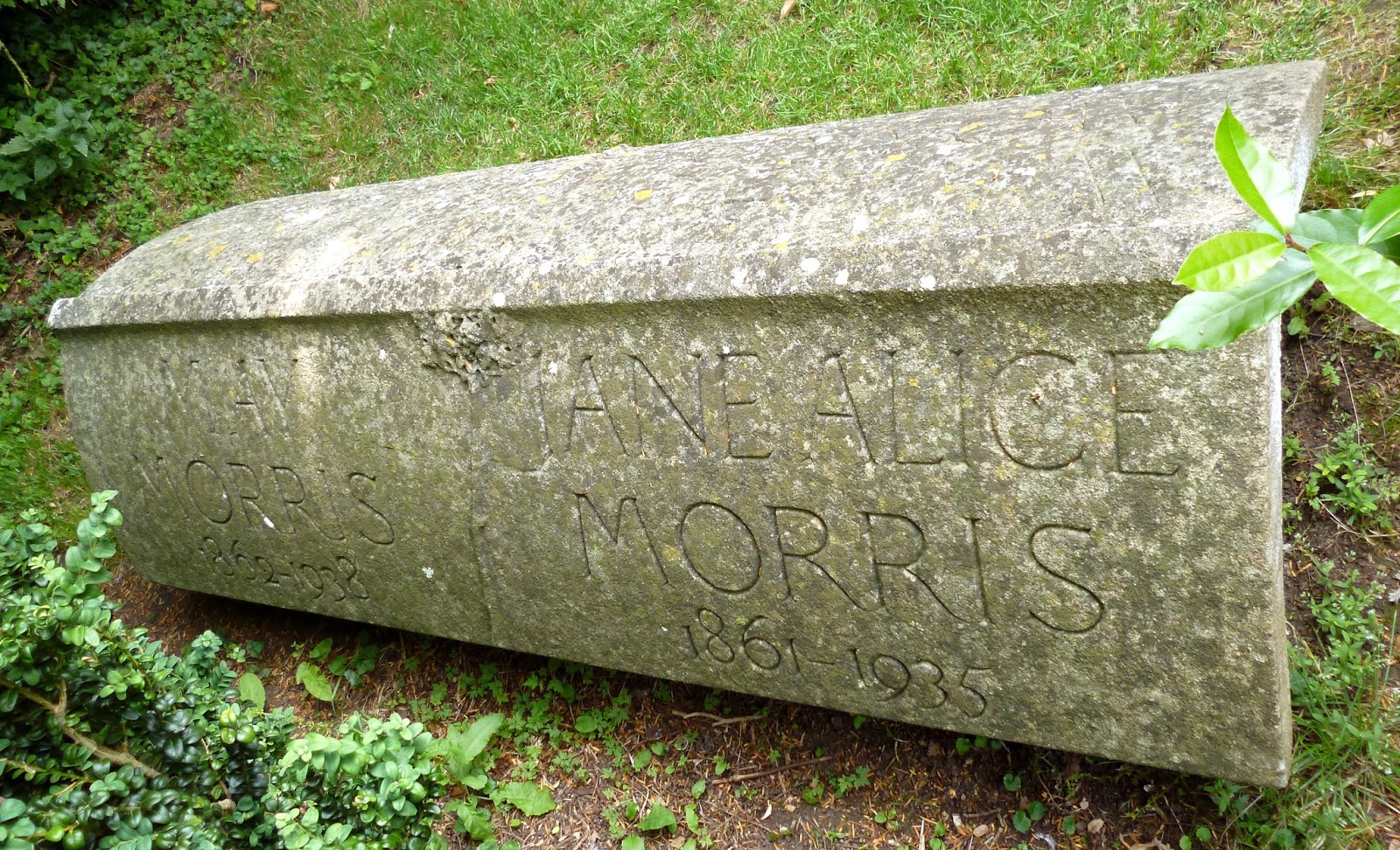
Buried in the graveyard are William Morris (1834–1896) and his wife Jane Morris (1839–1914). Morris's friend Philip Webb designed the simple but attractive tombstone, although this side is barely legible now due to weathering.
 
Also buried here are their two daughters, May (1862–1938) and Jane Alice (1861–1935). May edited her father's Collected Works.
 
Only their initials 'JAM' and 'MM' appear on these stones.

18 September 2012

William Morris in Bexleyheath, Kent: London #30

 'RED HOUSE
built in 1859–1860
by Philip Webb, architect,
for
WILLIAM MORRIS
poet and artist
who lived here
1860–1865'
 
For Dante Gabriel Rossetti, this Victorian Gothic structure was 'more a poem than a house'.
 
William Morris (1834–96) married Jane (or Janey) Burden in April 1859, and moved here when his friend Webb had completed it the following year. The weather vane is inscribed 'WM 1859' with a horse's head at the side. Shown here is the Well Courtyard: the original intention was for a similar building at the side for Edward Burne-Jones and his family to live in, but it was not to be.

A closer view of the well with its very impressive roof.
 
The west elevation with the oriel window of particular note.
 
The north elevation, showing the main entrance.
 
Morris named the garden porch 'Pigrims' Rest' as this would have been near the route taken by Chaucer's Canterbury group.
 
The tiling behind the bench here is worth a closer look.
 
On some of the tiles, Morris's motto 'Si je puis' is curled round an oak tree, with his initial at the side.
 
But on most of the others it's the Tudor rose.
 
An early example of Morris's stained glass, with figures by Edward Burne-Jones.
 
–––––––––––––––––––––––––––––––––––
William Morris in Walthamstow: London #29

William Morris in Walthamstow: London #29

William Morris (1834–96) was born in Walthamstow and was the son of a well-to-do bill broker and mining speculator who left his family in a reduced, but nevertheless very comfortable, position when he died in 1847. Morris went to Marlborough College the next year, and the family moved to what was then known as Water House (above), which was smaller than their previous house.
 
'WILLIAM
MORRIS
1834–1896
LIVED HERE 1848–1856
EDWARD
LLOYD
PUBLISHER
LIVED HERE
1857–1885'
 
The house has been the William Morris Gallery since 1950, and is set in what is now Lloyd Park.*
 
There is a 40ft moat at the back of the house where the Morris children used to fish, and skate on in the winter. They played on the island, William delighting in dressing up as a medieval knight. 
 
*Lloyd Park was opened in the summer of 1900, with brass bands playing on the island. Subsequently, bands played every Sunday in August and September, the audience being so big that a second bridge had to be built.
 
–––––––––––––––––––––––––––––––––––
William Morris in Bexleyheath, Kent: London #30

23 July 2012

Writers in Churches in Nottinghamshire #10 Constance Penswick Smith and William Morris in Coddington

Constance Penswick Smith (1878–1938) was twelve years old when she came to Coddington, where her father had been appointed as the new vicar of All Saints'. It was in 1913 that she learned of the American Anne Jarvis's plans to introduce Mother's Day into the UK, which Smith felt would take the religious significance of the tradition of Mothering Sunday. Consequently she devoted the rest of her life to campaigning for the re-establishment of that tradition, writing a book, plays, and articles dedicated to that purpose.

The lady chapel in the south aisle was originally designed as a Sunday school. It was dedicated to Constance Penswick Smith in 1951:

The window is by Wiliam Morris:

The left light: St Joseph.

The centre light: St Mary Magdalene.

The right light: St John.

The east window.

Top left is a self-portrait by William Morris as St Peter, one of a number of such windows that he designed.

By the south porch is the grave of Constance Penswick Smith, the inscription acknowledging her as 'the founder of the Movement for the Revival of the Observance of Mothering Sunday'.

And next to her is the grave of her father, the Rev. Charles Penswick Smith, who spent 32 years as vicar of the parish.

All Saints' Church.

(I visited this church because of the Diocese of Southwell & Nottingham's Open Churches Weekends (Saturday and Sunday 14 and 15 July and 21 and 22 July 2012). Details of participating churches and opening times are listed here.)

4 May 2010

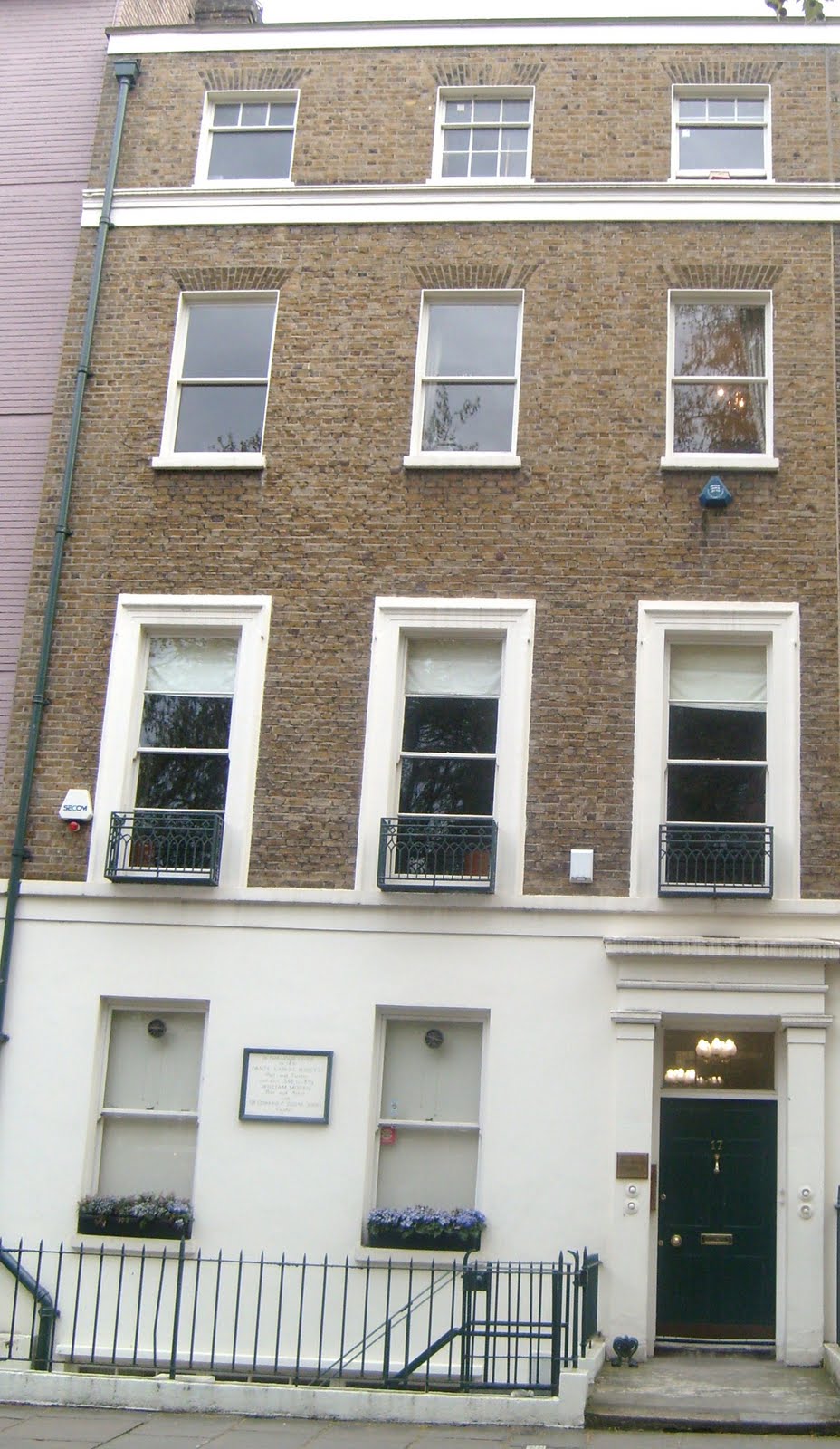
Dante Gabriel Rossetti, William Morris, and Edward Burne-Jones at Red Lion Square, Bloomsbury: Literary London: #19

17 Red Lion Square. 'In this house in 1951 lived Dante Gabriel Rossetti Poet and Painter and from 1856 to 1859 William Morris Poet and Artist and Sir Edward C. Burne-Jones Painter'.

When Morris moved in there was no furniture, so he and Burne-Jones made furniture after the medieval fashion that was later to become his hallmark style.