13 June 2018

Jean-Baptiste Blanc, Maussane-les-Alpilles, Bouches-du-Rhône (13)


Jean-Baptiste Blanc (1877–1953), a félebre who was born in Saint-Rémy-de-Provence and died in Maussane-les-Alpilles, was a  provençal poet and storyteller known as 'Jan di Baragno', who wrote Li Passo-temps d'un bon per rèn (1932):  'The interests of a good-for-nothing'. The cemetery where he is buried is on the street which bears his name.

Elzéar Pin in Apt, Vaucluse (84)


Elzéar Pin (1813–83) is perhaps best known as a politician who was born in Apt, Vaucluse, and died in Paris. But Wikipédia states that his main passions were literature, poetry and agriculture. He published three works, two of which are collections of poetry: Poèmes et sonnets (1839), Projet de ferme régionale et d'endiguement de la Durance à Villelaure (1848) and Souvenirs poétiques (1870).

12 June 2018

Henri Cartier-Bresson, Pierre Citron and others in Montjustin, Alpes-de-Haute-Provence (04)

In Guide des tombes d’hommes célèbres Bertrand Beyern describes Montjustin in Alpes-de-Haute-Provence as being in a ‘dream setting’ in ‘a tiny village at the end of the world’. I know what he means. The road is tarmacked but mainly slender, and 2.5 kilometres seem much longer. We drove up a road which seemed to be going up a mountain, until I turned back, thinking we must have missed it in a few houses we’d passed. On the way back a work van managed just to get by, although not before I’d asked the driver of the whereabouts of the cemetery. He looked at me as if I were a little crazy, but I told him I was certain that it was in Montjustin, so all he could do was shrug his shoulders. Further down I saw a woman mowing the grass and asked her about the cemetery, which she told me was back where I’d come from, in the village. There’s a village up there? Yes, there is (population 57 in 2015), so we turned back and found it, but didn’t know where to go in a place with just a few houses, no shops, no bar, no obvious administrative buildings, but a post box. I parked in a vacant area off the road, looked for life, and found a guy who told me to walk up the village street after parking in the proper (I’d say about seven-space) car park, ignore the left turn after 50 metres, then I’d find a school after 300 metres, and the cemetery was ‘down’ from that. I found the school but couldn’t figure out what to do after that, but fortunately I saw another woman who shook us by the hand in great welcome, after which I asked her for directions to the cemetery. She was delightful, and showed us the original medieval cemetery, which is about the size of an average bathroom and I could only see one grave. She also showed us a group of cypress trees which appeared to be a great distance away, and pointed out that this is where the cemetery is. However, she kindly led us back in front of the school, where there was a dirt track marked as leading to the cemetery (but which you can only see on the way back!) and said that led directly to the cemetery. My partner Penny was worried about the distance, so I told the woman Penny couldn’t understand our conversation and wanted to know how far away it was, and the answer was only five minutes. I’d say four minutes, but at least we’d made it to the ‘end of the world’ in relatively quick time. I noticed that the cemetery gates (spelt right, Morrissey!) were held together by a piece of waxed rope, and figured that they should always be kept so. On our return I met the guy who’d given us the original directions, who asked us if we’d found the place, and to his second question, I assured him that we’d closed the gates.

Ah yes, the cemetery in Montjustin: there are in fact two cemeteries there, one of which includes the grave of the world-famous photographer Henri Cartier-Bresson (1908–2004). Pierre Citron (1919–2010), an expert on Jean Giono whose doctoral thesis was titled La poésie de Paris dans la littérature française de Rousseau à Baudelaire, is also buried here.

Unfortunately, it was only after my visit today that I learned of the second adjoining cemetery: how we both missed it is beyond me. In it are the graves of the poets Jean Mogin (1921–86) and his wife Lucienne Desnoues (1921–2004), as well as the friend of Jean Giono, the poet, painter and engraver Lucien Jacques (1891–1961) and the painter Serge Fiorio. A return journey was essential.

One of the cemeteries in Montjustin.


Cartier-Bresson's wife, the Belgian photographer Martine Franck (1938–2012).


11 June 2018

Sculpture and Maximilien Vox in Lurs, Alpes-de-Haute-Provence (04)

This sculpture at the entrance to Lurs village, consisting of forty-two upright stones, is designed to explore writing systems and the origins of the alphabet. Obviously, it is not by chance that this exhibit is in Maximilien Vox's villag

John Hamilton in Lurs, Alpes-de-Haute-Provence (04)

The grave of Arthur Henry Patrik [sic] Hamilton (1917–94), born in Breinton, Hereford (UK), and died in Lurs. His stone against the cemetery wall says that he was an English teacher in Paris, and a poet in Lurs, although if he ever had anything published, in English or French, I can find nothing. In World War II he was a flight lieutenant in the RAF.

John Pudney (1909–77) was a short story writer, poet, writer of children's books, and also with RAF associations. I very much doubt if the two men ever met, but a very popular poem of Pudney's, 'For Johnny', is inscribed under this epitaph: 'Do not despair/For Johnny-head-in-air/He sleeps as sound // As Johnny in the cloud/And keep your tears/For him in after years // Better by far/For Johnny the bright star/To keep your head/And see his children fed.'

John Pudney

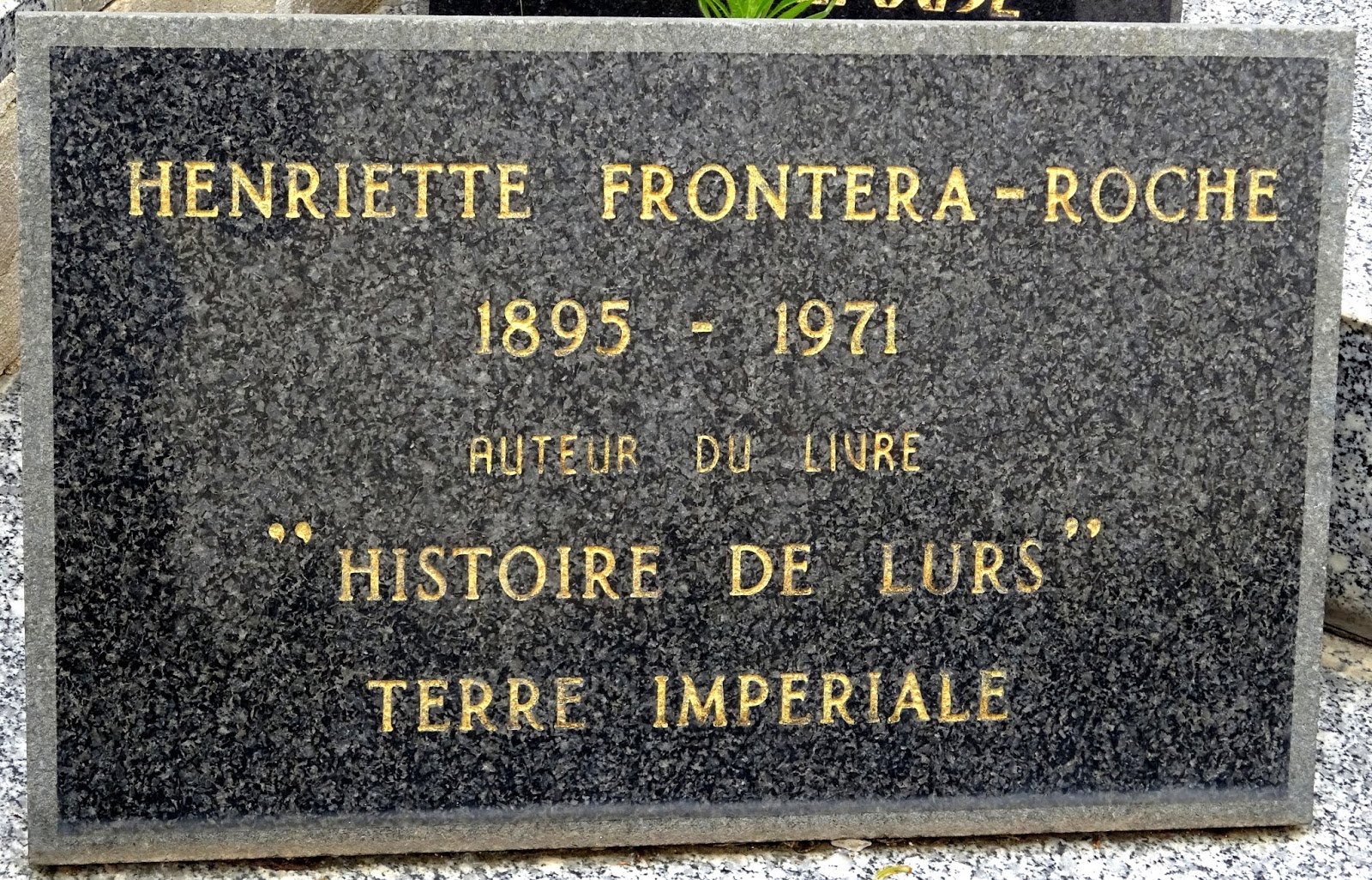
Henriette Frontera-Roche in Lurs, Alpes-de-Haute-Provence (04)


Local historian Henriette Frontera-Roche (1895–1971) apparently wrote just one book: Histoire de Lurs (1969). Below is how Lurs (population 377 (in 2015)) looks today – OK, yesterday to be exact.


10 June 2018

Maximilien Vox in Lurs, Alpes-de-Haute-Provence (04)

Maximilien Vox (born in Condé-sur-Noireau in 1894 and died in 1974 in Lurs), was born Samuel William Théodore Monod and, among many other things, was a drawer, illustrator, publisher, theorist and historian of international letters, or characters. Throughout the world, he is recognised as an expert in typography. His son Sylvère Monod (1921–2006), who wrote his doctoral thesis on Charles Dickens, was a prominent translator from English to French, including Charlotte Brontë, Conrad, Walter Scott, Shakespeare, and – it perhaps goes without saying – Dickens. His son Richard Monod (1930–89) was a teacher of Theatrical Studies.

Henri Laborit in Lurs, Alpes-de-Haute-Provence (04)

Henri Laborit (born in Hanoi in 1914 and died in Paris in 1995) was a medical surgeon and neuro-biologist. By introducing antipsychotic drugs in 1951 he revolutionised psychiatry, and he also revolutionised anaesthetics. He became known to the general public by popularising neuroscience, and took part in Alain Renais's film Mon oncle d'Amérique. He published a huge number of works.


8 June 2018

Batisto Bonnet in Bellegarde, Gard (30)

Batisto Bonnet (1844–1925) was a Provençal writer born in Bellegarde in 1844 who died in Nîmes in 1925. Alphonse Daudet translated some of his work into French, such as Vie d'enfant.


10 rue du château, Bellegarde, where Batisto Bonnet was born.


Batisto Bonnet's grave in the cemetery outside Bellegarde village, which mentions his Félibrige name 'Brisquimi', and that of his dog Barbason. It also mentions that he is the co-founder of the félibrige de Paris.


Fittingly, there is also a street in Bellegarde named after Alphonse Daudet.

Charloun Rieu in Paradou, Bouches-du-Rhône (13)

Charloun Rieu (1846–1924) was a poet from a modest background who spent his life as an agricultural worker in and around Paradou, where he was born and where he died. He is buried in Paradou cemetery in a gloriously ornate tomb. He has been named the 'Verlaine des champs' (Verlaine of the fields), and this grave (the work of Férigoule and René Inché) has a number of striking sculpted images (now sadly in need of restoration) of rural life. His work helped to preserve the Provençal language, and he was of course highly esteemed by the Félibrige. Marie Mauron published Charloun Rieu in 1949, which recieved the Frédéric Mistral prize the following year.


This, apparently, represents a scene from Daudet's L'Arlésienne.


7 June 2018

Boîte à lire, La Roque-d'Anthéron, Bouches-du-Rhône (13),


Boîtes à lire never cease to fascinate me, and although these two in the village of La Roque-d'Anthéron aren't exactly rainproof, they are wonderful gestures.

Boîtes à lire:
––––––––––––––––––––––––––––––––––––
Boîte à Lire, Dicy, Nièvre
Boîte à lire, Maisons-Laffitte, Yvelines
Boîte à lire, Sorigny, Indre-et-Loire
Boîte à Lire, Jonzac, Charente-Maritime
Boîte à lire, La Roque-d'Anthéron, Bouches-du-Rhône
Boîte à Lire, Épineuil-le-Fleuriel, Cher
Boîte à lire, Marseille, Bouches-du-Rhône
Boîte à lire, East Markham, UK
Boîte à lire, La Folie Couvrechef, Caen, Calvados
Boîte à lire, Bergues, Nord
Boîte à lire, Le Havre, Seine-Maritime
Boîte à lire, Villerville, Calvados
Boîte à lire, Saint-Servan, Saint-Malo, Ille-et-Vilaine
Boîte à lire in Caen, Calvados
Boîte à Lire, Noyant d'Allier, Allier
Boîte à lire, Dampierre-en-Burly, Loiret
Boîte à lire, Illiers-Combray, Eure-et-Loir
Boîte à lire, Chartres, Eure-et-Loir
Boîte à lire, Saint-Romain-au-Mont-d'Or, Rhône

Jean-Daniel Pollet, Cadenet, Vaucluse (84)


Jean-Daniel Pollet (1936–2004) is generally unrecognised today, although he is an important member of the nouvelle vague cinema, making important experimental movies. He can be said to have made two different types of film, of which the first often included the shy, hesitant 'Léon' (played by Claude Melki). Later, he branched into poetic cinema, making use of the works of such literary figures as Philippe Sollers and Jean Thibaudeau. In 1989 a serious traffic accident severely restricted his movement, and he came to see Francis Ponge as his main poetic influence. He was forced to limit his activities to Cadenet, in the shadow of the Luberon.

Madame de Sévigné, Grignan, Drôme (26)

'Marie de Rabutin-Chantal, Marquise de Sévigné.' Madame de Sévigné's statue, erected in 1857, holds pride of place in the centre of the tiny village of Grignan.

The Château de Grignan owes most of its reputation to the writer Madame de Sévigné, who corresponded with her daughter Françoise Marguerite, wife of the Count of Grignan, who was also  General Lieutentant of Provence in Louis XIV's reign. Madame de Sévigné died in the castle in 1696 during her third stay here.

Pierre Gascar, Baume-les-Messieurs, Jura (39)

The writer Pierre Gascar (1916–97) is also buried in Baume-les-Messieurs. He won the Prix Goncourt in 1953 for Les Bêtes, which I commented on below.

Baume-les-Messieurs, Jura (39)


Baume-les-Messieurs is a cul-de-sac village in the Jura département, noted mainly for its caves, its abbey and its waterfall. When we went there were many visitors in the village hamlets themselves but although we spent about an hour in the church graveyard and the church at the entrance to the village, not a single person entered. And yet there are some very interesting things to see there: does no one know about Les Trois Cloches these days? Jean Villard (aka Gilles) wrote the song 'Les Trois Cloches' in 1939, and it was made famous after the war by Édith Piaf. Gilles was a Swiss poet, chansonnier, actor, writer and composer born in Montreux in 1895 and who died Saint-Saphorin in 1982. Er, the 'village au fond de la vallée' mentioned in the song is Baume-les-Messieurs and was inspired by Gilles when he stayed there one day. The Jean-François Nicot named in the song is borrowed from François Nicot (1858–1929), whose grave Gilles noted in the churchyard.

Or not. It appears that this is a modern legend created by journalist Jean Barthelet in 1970, who later confessed that he had made the story up, and to verify this Jean Villard himself said that he had no knowledge of Baume, that he made the song up on the banks of Lac Léman.

All the same, here is the tomb of François Nicot:

And a photo of a gîte called, you'd never guess: