5 August 2017

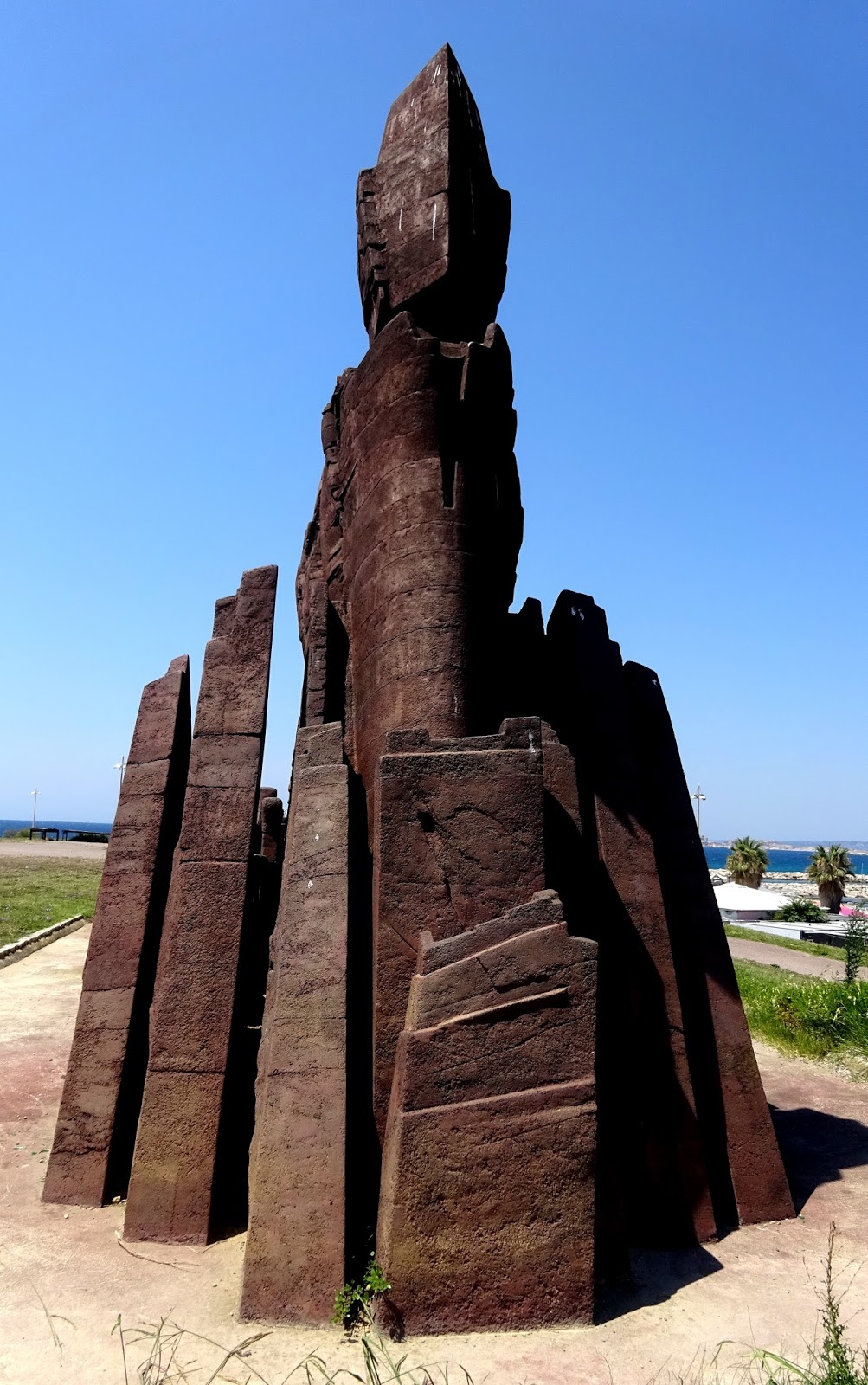
Arthur Rimbaud, Parc Balnéaire du Prado, Marseille, Bouches-du-Rhône (13)

"'JE SAIS LES CIEUX CREVANT EN ÉCLAIRS ET LES TROMBES,
ET LES RESSACS ET LES COURANTS JE SAIS LE SOIR,
L'AUBE EXALTÉE AINSI QU'UN PEUPLE DE COLOMBES,
ET J'AI VU QUELQUEFOIS CE QUE L'HOMME A CRU VOIR.'

Arthur Rimbaud – Le bateau ivre"

The monumental homage to Rimbaud (1854–91), in the Parc balnéaire du Prado, Marseille, sculpted by Jean Amado (1927–95) and installed in 1989. Rimbaud died at the age of thirty-seven, and wrote 'Le Bateau ivre' when he was seventeen. He died of cancer in Marseille.




My Arthur Rimbaud posts:
–––––––––––––––––––––––––––––––––––
Yanny Hureaux: Un Ardennais nommé Rimbaud
Arthur Rimbaud and the Vilains bonhommes, Paris 6e
Rimbaud's 'Le Bateau ivre' sculpture, Paris 6e
Arthur Rimbaud, Parc Balnéaire du Prado, Marseille
Arthur Rimbaud in Charleville-Mézières cemetery
Arthur Rimbaud in Roche
Arthur Rimbaud quotations, Charleville-Mézières
Arthur Rimbaud memorial, Charleville-Mézières
Arthur Rimbaud murals in Charleville-Mézières
Rimbaud and Verlaine in Camden Town
Arthur Rimbaud museums in Charleville-Mézières
Arthur Rimbaud in Attigny
Arthur Rimbaud and Hervé Tonglet in Charleville-Mézières

Claude McKay in Marseille, Bouches-du-Rhône (13)

This plaque, dedicated to one of the leading lights of the Harlem Renaissance, writer Claude McKay (1889–1948), was only unveiled in Vieux Port in June 2015. McKay spent several months in the late twenties in the poor (and now non-existent) area La Fosse, where he wrote the novel Banjo: A Story without a Plot (1929), which is set in low-life Marseille. The eponymous main character is an occasional dock worker and lives among immigrants and drifters of many nationalities, prostitutes, pimps and the like.

4 August 2017

Louis Brauquier in Marseille, Bouches-du-Rhône (13)

I'd not have heard of the Marseillais poet Louis Brauquier if I'd not read any of Jean-Claude Izzo's works, although he's Izzo's favorite, and he's remembered here in the Vieux Port. Izzo quotes him a lot, his love of Marseille itself and the sea here in particular. I'll be honest: Brauquier is much more of a must to read than the Château d'If is to visit, especially with a horde of tourists in tow.

Le Château d'If, Marseille, Bouches-du-Rhône (13)

Le Château d'If in the centre background from Notre Dame de la Garde.

And from the Corniche.

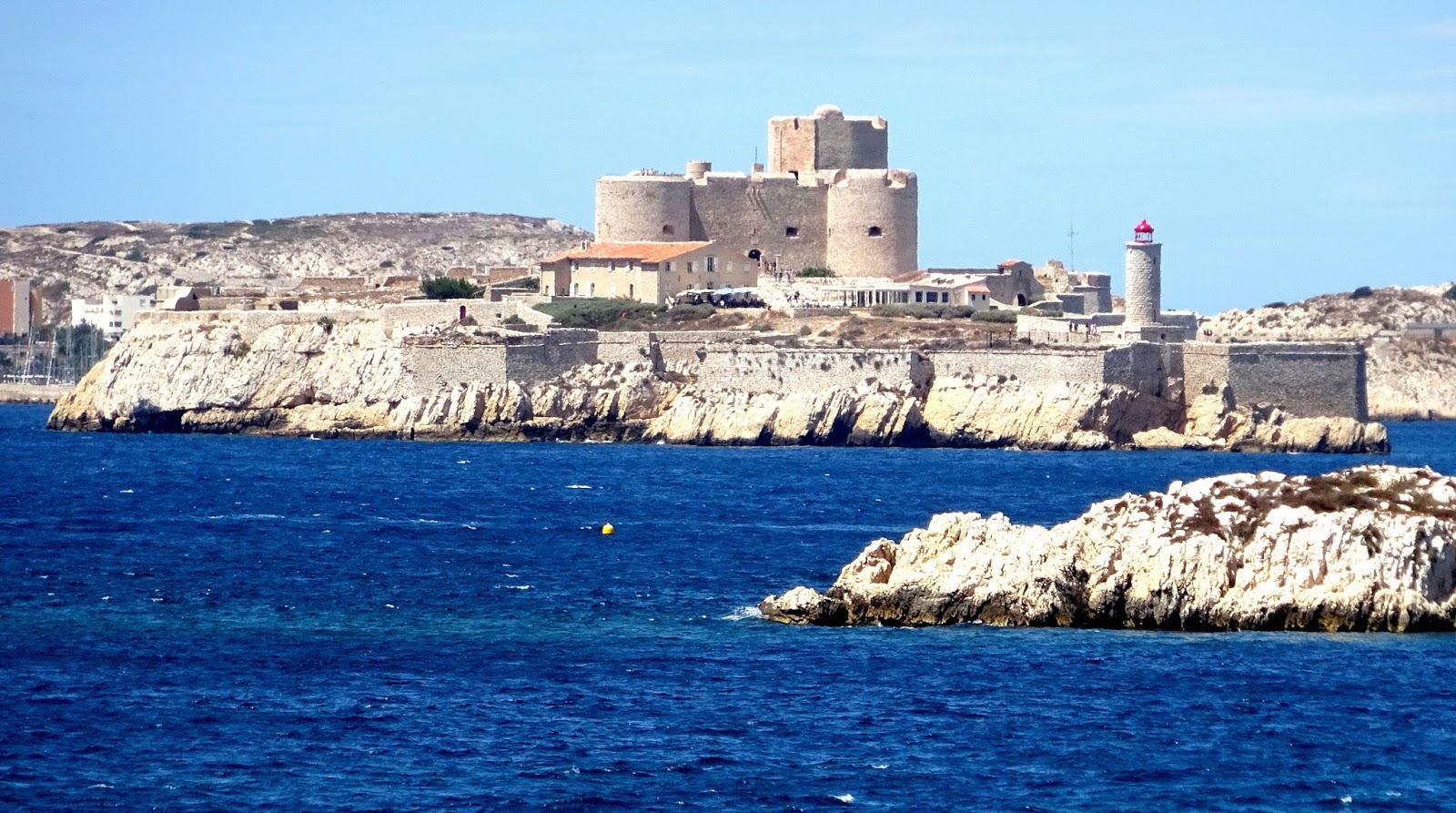
Le Château d'If, close to the archipelago of Frioul (otherwise known as the Ratonneau and Pomègues islands) just off the coast of Marseille, is of course a tourist must which remained a prison for four hundred years, and which was made famous by Alexandre Dumas's novel Le Comte de Monte-Cristo (1844–46), where the fictional Edmond Dantès was incarcerated. Something like 100,000 tourists visit it a year, and the queues are long. In the castle are labelled Dumas-related locations: a fiction within a fiction. No, we didn't bother to visit it: too touristy, too false, too much of a time waste. Why trouble to take a short cruise to see this place when you can enjoy the ferries from the much more peaceful L'Estaque to Le Vieux Port or (even better) the tiny village of Les Goudes (where the fictional Fabio Montale of Jean-Claude Izzo's Marseille trilogy lives) to Le Vieux Port – or vice versa?

A mural near the ferry terminal in Les Goudes.

And the ferry approaching Marseille from Les Goudes, with Notre Dame de la Garde in the centre middleground.

28 July 2017

Thyde Monnier in Allauch, Marseille, Bouches-du-Rhône (13)

Thyde Monnier (1887–1967) was born in Marseille and died in Nice. Twice married, she believed that marriage leads to the extinguishing of the powers of women. She lived with her first husband Maurice Pourchier for about five years in Allauch, where her novel La Rue Courte (1937) is set. The actual Rue Courte in Allauch has now been renamed Rue Thyde Monnier, and recently Espace Thyde Monnier and a school bearing her name was established a few kilometers from the village.

My other Thyde Monnier post:
––––––––––––––––––––––––––––––––––––
Thyde Monnier: Les Desmichels I : Grand-Cap

The Windmills in Allauch, Marseille, Bouches-du-Rhône (13)


There are five remains of windmills here in Allauch (roughly pronounced 'allo', but the 'o' is not a diphthong). By chance, the Esplanade Frédéric Mistral is appropriate not just because of the regional poet himself but also due to the existence of the mistral wind.

Dating from 1729 and built by Louis Ricard, a baker from Allauch, this was the last windmill to be built on the Frédéric Mistral promenade. It was restored in 2013 and is open to the public at limited times.

27 July 2017

Corniche Kennedy, Marseille, Bouches-du-Rhône (13)

Corniche Kennedy, looking out onto the Mediterranean, at more than two kilometres is one of the longest benches in the world. It stretches from Fausse Monnaie to Sofitel.

César's thumb, Bonneveine, Marseille, Bouches-du-Rhône (13)


In the middle of the roundabout in Bonneveine, Marseille's eighth arrondissement, and very close to the Musée d'art contemporain, is César Baldaccini's sculpture of his own thumb. César (1921–98), of working-class Italian origin, is also the creator of the César film award, the French equivalent of the Oscar: the awards are of compressed metal that he was noted for in his sculptures.

Cité Radieuse by Le Corbusier, Marseille, Bouches-du-Rhône (13)

Le Corbusier, then, designed this building, La Cité Radieuse, which was completed in 1952 after several years' work and is on the Boulevard Michelet in the eighth arrondissement. And the 'song' of the cicadas is clearly present here.


26 July 2017

Le Petit Monde de Marcel Pagnol, Aubagne, Bouches-du-Rhône (13)

Le Garlaban near La Treille, being the rock which held so much importance to Marcel Pagnol. This shot was taken from the centre of Aubagne.

A closer view shows the cross at the top more clearly.

 
Le petit monde de Marcel Pagnol is a recreation of Pagnol's fictional world in miniature, using santons – typically tiny Provençal figurines – to illustrate his characters.

Notice Le Garbalen in the background to the middle right at the back.


Marcel Pagnol by Daniel Scaturro on the centenary of his birth.

My Marcel Pagnol posts:
–––––––––––––––––––––––––––––––––––
Marcel Pagnol's Birthplace, Aubagne
Le Petit Monde de Marcel Pagnol, Aubagne
Claude Berri's Jean de Florette / Manon des Sources
Marcel Pagnol: La Gloire de mon père | My Father's Glory
Marcel Pagnol: Le Château de ma mère | My Mother's Castle
Marcel Pagnol: Marius
Marcel Pagnol in La Treille, Marseille
Marcel Pagnol: Le Schpountz

Marcel Pagnol's Birthplace, Aubagne, Bouches-du-Rhône (13)

The birthplace of Marcel Pagnol (1895–1974), film maker, writer, academician, etc, is 16 Cours Barthélemy in Aubagne. At the time of visiting the house (today, as I write) external renovations were being made. This meant that a photo of the house itself would have had a very negative look, so I avoided taking one. Sculptor Daniel Scaturro's bust of Pagnol, revealed on 28 February 2015, on the 120th anniversary of Pagnol's birth, was covered in very closely woven blue netting. However, I was able to point my lens through it and obtain photos that are at least recognisable.


Marcel Pagnol was the son of Joseph and Augustine, and the family lived in a flat on the third floor. The reconstruction of some of their rooms, is now on the ground floor.

None of the furniture or clothing presented here are original to the Pagnol family, although they are in keeping with the period and are from the Provence area. This is a reconstruction of the salon, and Marcel's mother tended to produce the children's clothes.

The reconstruction of the salon.

Joseph, the father of the family, was teacher at the Lakanal school, and supplemented his income by drawing maps for the publishers Vidal-Lablache.

There are photos of two other noted people from Aubagne: Louis Sicard (1871–1946), the creator of the famous ceramic cicada, who also lived in the house. His sister Thérèse Neveu found a means of making santons (tiny Provençal figures) more durable.

A reconstruction of the Pagnol kitchen.

Bartavelles, or royal partridges, so often mentioned in La Gloire de mon père.

My Marcel Pagnol posts:
–––––––––––––––––––––––––––––––––––
Marcel Pagnol's Birthplace, Aubagne
Le Petit Monde de Marcel Pagnol, Aubagne
Claude Berri's Jean de Florette / Manon des Sources
Marcel Pagnol: La Gloire de mon père | My Father's Glory
Marcel Pagnol: Le Château de ma mère | My Mother's Castle
Marcel Pagnol: Marius
Marcel Pagnol in La Treille, Marseille
Marcel Pagnol: Le Schpountz

25 July 2017

Stendhal in Marseille, Bouches-du-Rhône (13)

14 Rue Venture, Marseille.

'EN 1805 ET 1806
STENDHAL
AVANT D'ÉCRIRE
LA CHARTREUSE DE PARME
VEÇUT QUELQUES MOIS
DANS CETTE MAISON'

I suppose it shows how famous Stendhal is to put up a plaque informing viewers that he spent several months living there before creating his masterpiece La Chartreuse de Parme. The implication, I think, it that it was conceived here. 

Marcel Pagnol in La Treille, Marseille, Bouches-du-Rhône (13)


Marcel Pagnol (1875–1974) was born in Aubagne (13), although he is more associated with Marseille, perhaps with the small village of La Treille in particular, which is mentioned in his novels Le Château de ma mère and La Gloire de mon père, which his family passed on foot on their way to their rented summer holiday home which is in reality slightly outside of La Treille: Les Bellons is a hamlet in the commune of Allauch. He is buried with his mother Augustine and his three-year-old sister Estelle.

There is another Pagnol tomb here containing members of the same family. Marcel fell out with his father Joseph (1869–1951) for marrying someone younger than himself, Madeleine (1887–1949). Along with his father and step-mother, Marcel's brothers Paul and René and his sister Germaine are buried here.


Marius Broquier (1899–1977) was a mason by profession and a childhood friend of Marcel Pagnol's, who employed him for set decoration in several of his films.

Also in this tiny cemetery is Baptistin David Magnan (1898–1918). He was another childhood friend of Pagnol's, killed in the First World War, but Pagnol novelised his relationship and named him Lili des Ballons in Le Château de ma mère and La Gloire de mon père.


At the entrance to the village is a mural, at the side of which is a quotation by Pagnol (with a sketch of him) from La Gloire de mon père: '... nous sortîmes du village, alors commença la féerie et je sentis naître un amour qui devait durer toute ma vie' ('... we left the village and then began the enchantment and I felt a love growing within me which would last all my life'). This is the hold that Pagnol has over people today, and his grave is visited by many people of all ages.

The only thing that makes me cringe a bit is that, although Pagnol is undoubtedly an important southern French writer, how much of the adulation for him is due not to reading his works but to seeing his work on screen and to sentimentalising? For some reason (harshness? lack of sentimentality?) Jean Giono (beyond any doubt a deeper writer) doesn't receive anything like the same acclaim.

NB. Much of the information above about the cemetery and the Pagnol connections come from my reading of Bertrand Beyern's website: any factual errors here are almost certainly my fault.

My Marcel Pagnol posts:
–––––––––––––––––––––––––––––––––––
Marcel Pagnol's Birthplace, Aubagne
Le Petit Monde de Marcel Pagnol, Aubagne
Claude Berri's Jean de Florette / Manon des Sources
Marcel Pagnol: La Gloire de mon père | My Father's Glory
Marcel Pagnol: Le Château de ma mère | My Mother's Castle
Marcel Pagnol: Marius
Marcel Pagnol in La Treille, Marseille
Marcel Pagnol: Le Schpountz