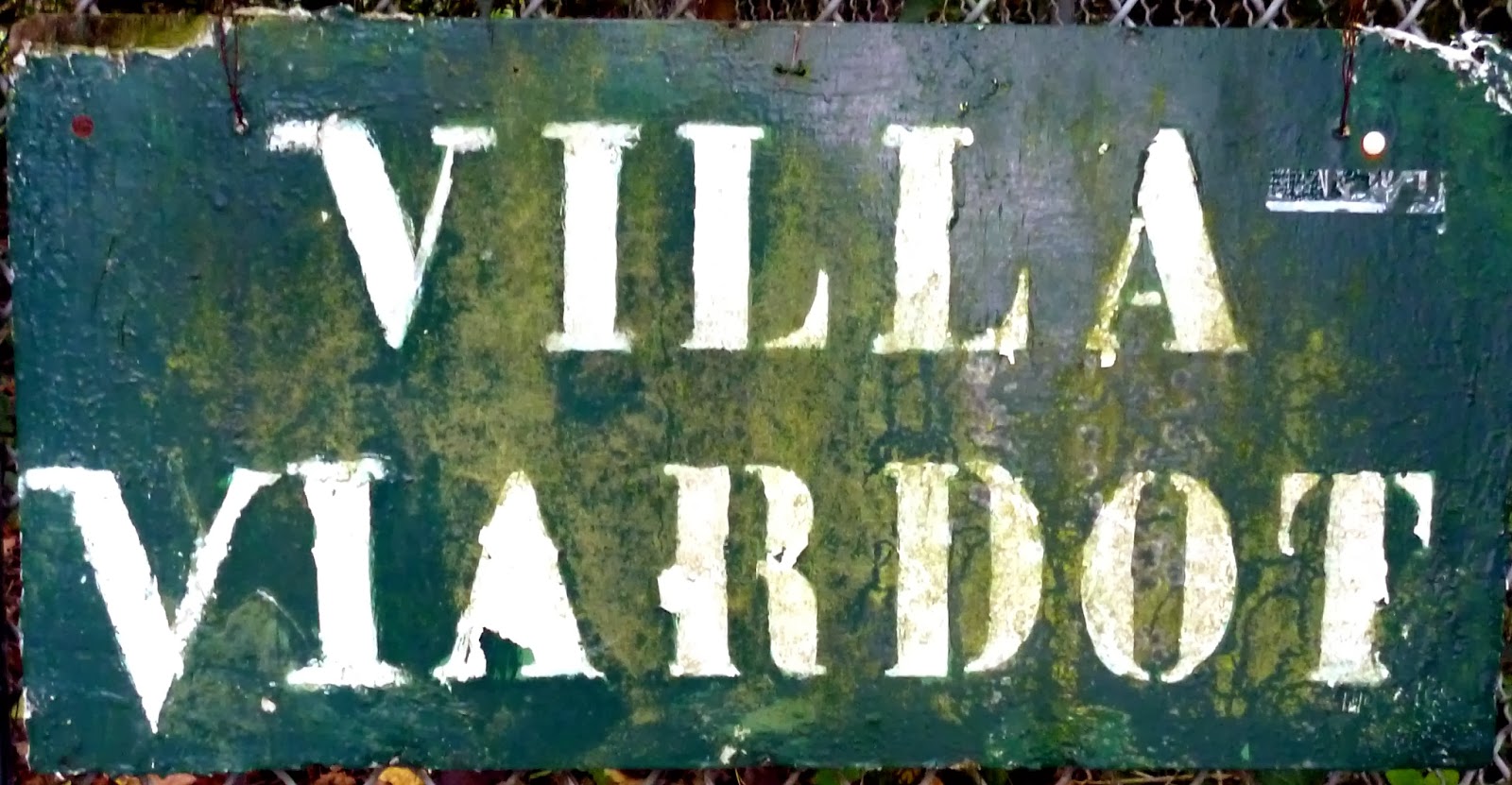
11 February 2014
Hector Guimard and Castel Béranger
Libellés :
Art Nouveau,
Guimard (Hector),
Paris,
Signac (Paul)
––––––––––––––––––––––––––––––––––––––––––
'Histoire de Paris
Le Castel Béranger
––––––––––––––––––––––––––––––––––––––––––
Né à Lyon le 10 mars 1867, Hector Guimard entre
en 1882 à l'École des Arts décoratifs de Paris,
dans l'atelier de Charles Genuys, puis à l'École
des Beaux-Arts en 1885. Destiné à l'Exposition
universelle de 1889, le Pavillon de l'Électricité
préfigure dejà son goût pour le néo-gothique et
l'emploi des matériaux modernes, très influencé
par "les Entretiens sur l'Art" de Viollet-le-Duc.
Entre 1894 et 1895, deux étés de voyages en
Angleterre, en Hollande et en Belgique, où il
fréquente Paul Hankar and Victor Horta,
achèvent sa formation intellectuelle. Dès
la réalisation de ce Castel aussitôt sur-
nommé "Dérangé", édifié entre 1895 et
1898, son architecte de vingt-sept ans
fait figure de grand-maître de l'Art
nouveau. Manifeste artistique, cet
immeuble d'habitations à loyers
modérés, dont Guimard lui-même
occupe le rez-de-chaussée à
partir de 1897, est primé au
premier concours de faça-
des de la Ville et célébré
avec enthousiasme par
ses premiers locatai-
res, ldont le peintre
Paul Signac.'
––––––––––––––––––––––––––––––––––––––––––
'History of Paris
Castel Bérenger
––––––––––––––––––––––––––––––––––––––––––
Hector Guimard was born in Lyons on 10 March 1867, and
in 1882 went to the School of Decorative Arts in
Paris, in Charles Genuys's workshop, then to
the School of Fine Arts in 1885. Destined for
the Universal Exhibition of 1889, the
Pavilion of Electricity already prefigured his taste
for the neo-gothic and the use of modern materials,
very influenced by Viollet-le-Duc's "Interviews on Art".
Between 1894 and 1895 he completed his intellectual
training with two summer trips to England, Holland
and Belgium, where he met Paul Hankar and
Victor Horta. As soon as he finished this
"Castel" – built between 1895 and 1898 and
immediately called "Dérangé" – its twenty-
seven-year-old architect was looked upon as one
of the great masters of Art Nouveau. An
artistic manifesto, this building – divided
into flats at moderate rates, in which
Guimard himself occupied the
ground floor from 1897 – won
first prize for the town's facades,
which was enthusiastically celebrated
by its first tenants, one of whom was
the painter Paul Signac.'
Castel Béranger is in the 16th arrondissement.
My other Guimard post is linked below:
–––––––––––––––––––––––––––––––––––
Hector Guimard's bouche du métro, Porte Dauphine
Ossip Zadkine in the 6th arrondissement
Libellés :
Paris,
Zadkine (Ossip)
The unimposing entrance to the Musée Zadkine in rue d'Assass in the 6th arrondissement. It's very easy to miss, but well worth the visit. The sculptures below are all by Ossip Zadkine (1890–1967).
Torse d'Hermaphrodite (1925–31).
Projet de Monument à Guillaume Apollinaire (1948).
La Mélancolie (1929–37).
Rébecca ou la grand porteuse d'eau (1927).
La Forêt humaine (c. 1947).
Statue pour une montagne ou cœur venteux (1958).
Statue pour un jardin (1943–44).
La Ville détruite (1951).
Orphée (1956).
Torse de la ville détruite (1951–63).
Tête de Prométhée (1956–7).
Projet pour le monument aux frères Van Gogh (1963).
Auguste Comte in the 3rd arrondissement
Libellés :
Comte (Auguste),
Paris
5 rue Payenne.
'CHAPELLE
DE
LUMANITÉ
MONUMENT HISTORIQUE'
The Chapelle de Humanité was built by Brazilian positivists in 1903, being a smaller replica of the Templo da Humanidade in Rio de Janeiro. Auguste Comte (1789–1857), the founder of positivism, had drawn up the plans but was of course unable to see the building in his lifetime.
10 February 2014
Édouard Louis: En finir avec Eddy Bellegueule | The End of Eddy (2014)
En finir avec Eddy Bellegueule (translated as 'The End of Eddy') is Édouard Louis's first novel, published when he was twenty-one, and is highly autobiographical. Louis is also strongly influenced by the work of Pierre Bourdieu. 'Eddy' is obviously not a 'natural' French name and was chosen by his father to make it sound American, a bit 'tough guy', and indeed much of the book is about Eddy failing to be a tough guy, or 'un dur', not being a 'man' but more like a 'woman'.
In spite of the self-tormenting comical bits, this is a very bleak vision of the underclass in Picardy. There was a danger, I felt, of creating a classist binary – a fact reinforced by the colloquial speech in italics which comes from the locals – although I think Édouard Louis just about escapes from it by depicting some of his characters in a sympathetic light, if not all the time then at least some of it.
Below is a link to an interview with Édouard Louis discussing his book.
ADDENDUM 1: There is also a link to an article showing the reactions of the Bellegueule family in Hallencourt (Somme) to En finir avec Eddy Bellegueule. Interestingly, the article also contains a few paragraphs on the book's dedicatee: Didier Eribon, a sociologist and philosopher at the Université de Picardie Jules Verne, Amiens, is also gay and from a working-class background, and wrote of his return to Muizon, Reims, in Retour à Reims (2009).
ADDENDUM 2: I've just noticed that Édouard Louis's book is to be translated into English by Sam Taylor as The End of Eddy and will be published March 2017(?).
ADDENDUM 3: The second novel by Édouard Louis is Histoire de la violence and will be published on 7 January 2016. A résumé is here.
–––––––––––––––––––––––––––––––––––
Édouard Louis: En finir avec Eddy Bellegueule (2014)
Courrier picard: 'Les deux visages d'Eddy Bellegueule'
Édouard Louis: Histoire de la violence
7 February 2014
Maurice Leblanc: Arsène Lupin: gentleman cambrioleur (1907)
Libellés :
French Literature,
Leblanc (Maurice),
Lupin (Arséne)
And now for something a little lighter. I've been meaning to go to Étretat – in Marcel Leblanc's Pays de Caux territory – for several years, mainly to visit Leblanc's house museum, but also to see the Porte d'Aval and l'Aiguille. This is the stamping ground of Lupinophiles, although I can hardly count myself in their number as until yesterday I hadn't read a single Arsène Lupin book.
So I logically began with Arsène Lupin: gentleman cambrioleur, which is the first published book about this gentleman burglar. The cover shows him in a top hat and in evening dress with a flower in his button hole, a monocle, and carrying a cane: this is certainly the typical image most people have of Lupin. However, he reminds me of Woody Allen's Zelig, who is a kind of chameleon man, changing appearance, even changing shape to some extent to suit his surroundings. He turns up everywhere, frequently using a pseudonym.
There are nine short stories in this book, only the first three of which – concerning Lupin's arrest in New York, his imprisonment in Paris, and his escape from prison – are consecutively linked. The other stories are almost entirely separate from the others, although the detective Ganimard makes regular appearances; and in the final playfully-named story – 'Herlock Sholmes arrive trop tard' (before the surname acquired a grave 'e') – the smitten Miss Nelly Underdown (who previously appeared in the first story) makes a second entrance.
Although Lupin is a professional thief it is impossible not to admire his cool, his aplomb, his sense of humor and justice, his generosity, his decency, even his sheer arrogance. Most of all it is his intelligence we admire, not just the cat and mouse games he plays with the police, but how he can think his way both out of and into even the most apparently impossible places.
The general public obviously love him and he can call upon seemingly endless numbers of people to assist him. More significantly, though, detectives – such as Ganimard and Herlock Sholmes – love pitting their wits against his.
It's perhaps hardly surprising – in a country that has so many streets named after anarchists – that Arsène Lupin should still be such a popular fictional character in France. But a very stylish one: in his Preface to this book, Pierre Lazareff says: [Lupin] isn't an aristocrat living as an anarchist, but an anarchist living as an aristocrat'.
My Maurice Leblanc posts:
––––––––––––––––––––––––––––––––––––
Maurice Leblanc in Étretat (76), Seine-Maritime
Maurice Leblanc L'Aiguille creuse | The Hollow Needle
Maurice Leblanc: Arsène Lupin: gentleman cambrioleur
Maurice Leblanc: Les Trois Yeux
––––––––––––––––––––––––––––––––––––
Maurice Leblanc in Étretat (76), Seine-Maritime
Maurice Leblanc L'Aiguille creuse | The Hollow Needle
Maurice Leblanc: Arsène Lupin: gentleman cambrioleur
Maurice Leblanc: Les Trois Yeux
5 February 2014
Jérôme Ferrari: Le Sermon sur la chute de Rome (2012)
Libellés :
Corsica in literature,
Ferrari (Jérôme),
French Literature,
Prix Goncourt
Le Sermon sur la chute de Rome was the 2012 Goncourt winner. Jérôme Ferrari's title relates to the sermons Saint Augustine made about the fall of Rome in Hippone, where he was bishop between 396 and 430, and which is now Annaba, Algeria. However, in spite of the quotations from Saint Augustine's sermons which introduce all sections of the book apart from the last one, and in spite of the final section relating to Saint Augustine's words on the fall of Rome, the book doesn't obviously concern the fall of Rome in any way: it ostensibly just concerns a village pub in Corsica.
4 February 2014
Marie-Claire Blais: Une saison dans la vie d'Emmanuel (1965)
Libellés :
Blais (Marie-Claire),
Canada,
Québec Literature
Marie-Claire Blais's Une saison dans la vie d'Emmanuel won the Prix Médicis in 1966, although it was seen by some in Quebec itself – the author's home and where the book is set – to show the province in a negative light.
My other Marie-Claire Blais post:
–––––––––––––––––––––––––––––––––––
Marie-Claire Blais: Les Nuits de l'Underground
31 January 2014
Thomas Hal Phillips: The Bitterweed Path (1950; repr. 1996)
The Bitterweed Path (1950) by Thomas Hal Phillips (1922–2007) is an interesting book in the history of homosexual literature. It features in Anthony Slide's Lost Gay Novels: A Reference Guide to Fifty Works from the First Half of the Twentieth Century (Routledge: 2003), which includes novels published from 1917 to 1950, and not necessarily written by authors who were gay.
André Birabeau: La Débauche (1924); trans. as Revelation (1930)
Libellés :
Birabeau (André),
French Literature,
Gay Literature
I can never stop repeating that I have a serious allergy to novels in translation, so it is very unusual for me to read one. As I can read French novels fluently in the original language, it is almost unknown for me to read a French novel in translation. However, La Débauche – apparently the only novel by the playwright André Birabeau (1890–1974) – was originally published in 1923 in Oeuvres libres, then the following year (probably in a very small print run) on its own by Flammarion, but seems unfindable at any price. So, it had to be Una Troubridge's translation into English as Revelation (1930).
I particularly wanted to read it because it is generally believed to be the first fictional representation of a mother's reaction to her son's homosexuality. I was very pleasantly surprised to find not only that the essential ideas of the book bear up to translation, but also that the book in general reads very well.
Mathilde Casseneuil is married to a 'special reporter' who has spent almost all of the twenty years of his marriage away from his Parisian wife, who now discovers that her son Dominique – in his early twenties and working for a car company in Avignon – has been killed in a car crash. Distraught, Mathilde flies (by train, as people of course had to do in those days) to Avignon.
The novel is interrupted at times by Mathilde's recollections of Dominique, who at the age of six wanted to marry a girl acquaintance of the same age who had 'masterful ways' and held a 'tyranny over him'. A sentence, addressed in thought to the tyrannical girl about Dominique, prepares the reader for the future 'revelation': 'Of the two of you, he was undoubtedly the girl', as does the knowledge that he was 'timid', '[f]ragile', and 'a mother's child': such language served to 'demasculinise' the male child, and (as I have acknowledged in my thesis on Lionel Britton) served to act as a code used by often homosexual writers – as in the examples I give by Rhys Davies and John Hampson – to suggest homosexuality.
Mathilde Casseneuil finds a cache of love letters written to Dominique, and at first believes them to be by a girl whose spelling is bad. As she reads on, though, she discovers that Dominique's lover was a man. She is shocked by what she considers to be an 'abomination', and returns to Paris feeling very differently, very negatively towards her son.
Mathilde eventually decides that Dominique had always been weak, 'too yielding', had become the victim, and she buys a gun to return to Avignon and kill 'the beast' who corrupted her son. But on meeting Gilbert Savinnes, her son's lover, she realises that they have a vital thing in common: her husband never really had the time to know Dominique, whereas here is a man who has something in common with her: they both loved him.
24 January 2014
Joshua Cohen: Witz (2010)
Libellés :
Cohen (Joshua)
Joshua Cohen's Witz is a trade paperback containing 817 very densely-packed pages published by the wonderful Dalkey Archive Press of Urbana-Champaign, IL. When I began reading it I couldn't help but think of David Foster Wallace's Infinite Jest, William Gaddis's The Recognitions, Jean-Pierre Martinet's Jérôme, James Joyce's Ulysses, Lionel Britton's Hunger and Love, Alexander Theroux's Laura Warholic, Marguerite Young's Miss MacIntosh, My Darling, and of other literary monsters I have known. Now I'm more or less back on planet Earth but still reeling a little from the after effects, I can see that it in some way resembles all of these books.
– Witz has the ambitious scope of David Foster Wallace's Infinite Jest and that book is obviously a vague background influence – is it merely a coincidence, for instance, that Cohen also mentions Perdue chickens? – but although the word 'witz' means joke, I didn't (unlike Infinite Jest) find the book itself particularly funny.
– It is immensely digressive like Lionel Britton's Hunger and Love, but has an important Oulipian element: it's a book about Jews where the word 'Jew' is never mentioned, being substituted by the expression 'Affiliated'.
– It has an esoteric language in some ways similar to Alexander Theroux's Laura Warholic, although Cohen draws from a huge Yiddish pool. And there are similar long-drawn-out sentences and unconventional compound words.
– As with Marguerite Young's Miss MacIntosh, My Darling – whose sentences are also very long – there are long descriptive passages that hold up the story, only whereas Cohen is concerned with often violent external detail, Young is mainly interested in the lulling strains of the internal monologue.
– In Jonathan Frederick Post's 'An Infinite Frolic of His Own: Joshua Cohen’s Witz' (which of course alludes to works by both Foster Wallace and Gaddis) the author states that the main work he would compare Witz to is the paintings of Hieronymus Bosch. The Jérôme Bauche in Jean-Pierre Martinet's Jérôme, as the 2008 Finitude cover transparently underlines, is clearly an allusion to Bosch.
– I was reminded of the difficulty of William Gaddis's The Recognitions, somewhat akin to E. M. Forster's bizarre but brilliant analogy, in Abinger Harvest, between the meaning of Virginia Woolf's writing and a pen trapped in his coat lining: 'So near, and yet so far!'
– Finally, it is evident that Joyce's Ulysses is an influence behind Witz, as it is an obvious influence (no matter how small) behind any serious work written after 1922.* But understandably, Joshua Cohen was annoyed when an unnamed friend of his father's described Witz as a 'like the Jewish Ulysses', completely ignorant of the fact that, as Cohen states in The Daily Beast (15 June 2010): 'James Joyce’s Ulysses is already the Jewish Ulysses'.
Cohen wrote this in an essay entitled 'The Heirs of Joyce's Ulysses', in which he names the works from twelve different countries as the 'Ulysses' of those countries, including Woolf's Mrs Dalloway as 'The English Ulysses', Dylan Thomas's Under Milk Wood as 'The Welsh Ulysses', etc. Oddly, there is no French Ulysses, although I certainly feel that Yann Moix's 1142-page Naissance (which I've not yet read but which begins with a baby born as a Jew (without a foreskin) to a Christian couple), which won the prix Renaudot in 2013, meets Cohen's criteria as a 'Jewish Ulysses'. But a French Ulysses proper? Something from Oulipo?
What is Witz about then? Well, Cohen says '[I]t’s about a Wandering Jew – the Last Jew in the world.' This is after all the Jews in the world (apart from first-born ones) die in a plague on Christmas Eve 1999, although very soon Benjamin Isrealien – a really nice innocent guy, born as an adult complete with glasses and beard and without a foreskin – becomes the only remaining Jew, and a superstar. But maybe that's going too far into the story.
For me, Witz may be very difficult – in fact it's a book I wouldn't recommend to many people because of those difficulties – but Joshua Cohen has produced a fascinating book: one he had a large number of problems getting published, one that at least one publisher wanted him to cut considerably, but that he in the end succeeded in communicating uncut to the world. It certainly won't make him a fortune, but then that clearly isn't his aim: he realises how destructive MFAs can be: 'The M.F.A. is a degree in servitude. [...] It is a way to keep writing safe – to keep reading safe from writing'. Obviously, writers in England would never be interested in such nonsense: they only want to pretend to be innovative, sell books, and, well, just get rich if possible.
At least Joshua Cohen, much as his work may be painful (because so difficult), is trying to push the envelope, not merely going for the cash. I have so much more respect for such writers, rather than those who insist on pretending that 1922 never existed.
*1922 was the year Ulysses and T. S. Eliot's The Waste Land were published.
23 January 2014
Hyde Colliery Explosion, 18th January 1889
Libellés :
Greater Manchester,
Hyde (Greater Manchester),
Tameside
'THE HYDE COLLIERY EXPLOSION
18th January 1889
18th January 1889
This plaque is located near to the site where a
horrific gas explosion in the Hyde Lane Coal Pit
killed 23 men and seriously injured 5 more victims.
horrific gas explosion in the Hyde Lane Coal Pit
killed 23 men and seriously injured 5 more victims.
The inquest recorded that the explosion took place
at some distance from a shaft, which was known
as the "Two Foot Level", shortly after 9.00 a.m.
at some distance from a shaft, which was known
as the "Two Foot Level", shortly after 9.00 a.m.
The verdict reported that the incident was
accidental and was caused by the use of
naked lights by the miners.
accidental and was caused by the use of
naked lights by the miners.
Unveiled by Councillor Joe Kitchen,
Cabinet Deputy of Lifelong Learning,
on February 21st 2001'
Cabinet Deputy of Lifelong Learning,
on February 21st 2001'
Related post below:
Joseph Sidebotham and Haughton, Denton
Subscribe to:
Posts (Atom)