
Diego Rivera made many frescoes on official buildings in Mexico, and is an inspiration to Courcoult. Rivera's partner Frida Kahlo is also in this mural, but unfortunately can no longer be seen because of the maniac who defaced it.
Diego Rivera made many frescoes on official buildings in Mexico, and is an inspiration to Courcoult. Rivera's partner Frida Kahlo is also in this mural, but unfortunately can no longer be seen because of the maniac who defaced it.

Jacques Vaché was a writer and illustrator originally in the 'Groupe des Sârs', also known as 'Groupe de Nantes', with Jean Sarment (aka Jean Bellemère), Eugène Hublet and Pierre Bisserié. He had a great influence on the surrealists, particularly on André Breton. He died at the age of twenty-three from an opium overdose in a hotel in Nantes. A tiny portrait of Breton sits on Vaché's shoulder.

Jacques Demy – a major film director and a major person born in Nantes – is sadly on the point of being almost forgotten in the city he loved so much: Varda's loving tribute to him in Jacqou de Nantes is an important film, as are the films which Demy set in Nantes – Une chambre en ville and Lola. But he's not forgotten in this mural, which shows him behind the movie camera, Varda behind him and Anouk Aimé (as Lola) in front. Some shots were taken in places which no longer exist, although others are set in the art nouveau splendour of La Cigale restaurant.

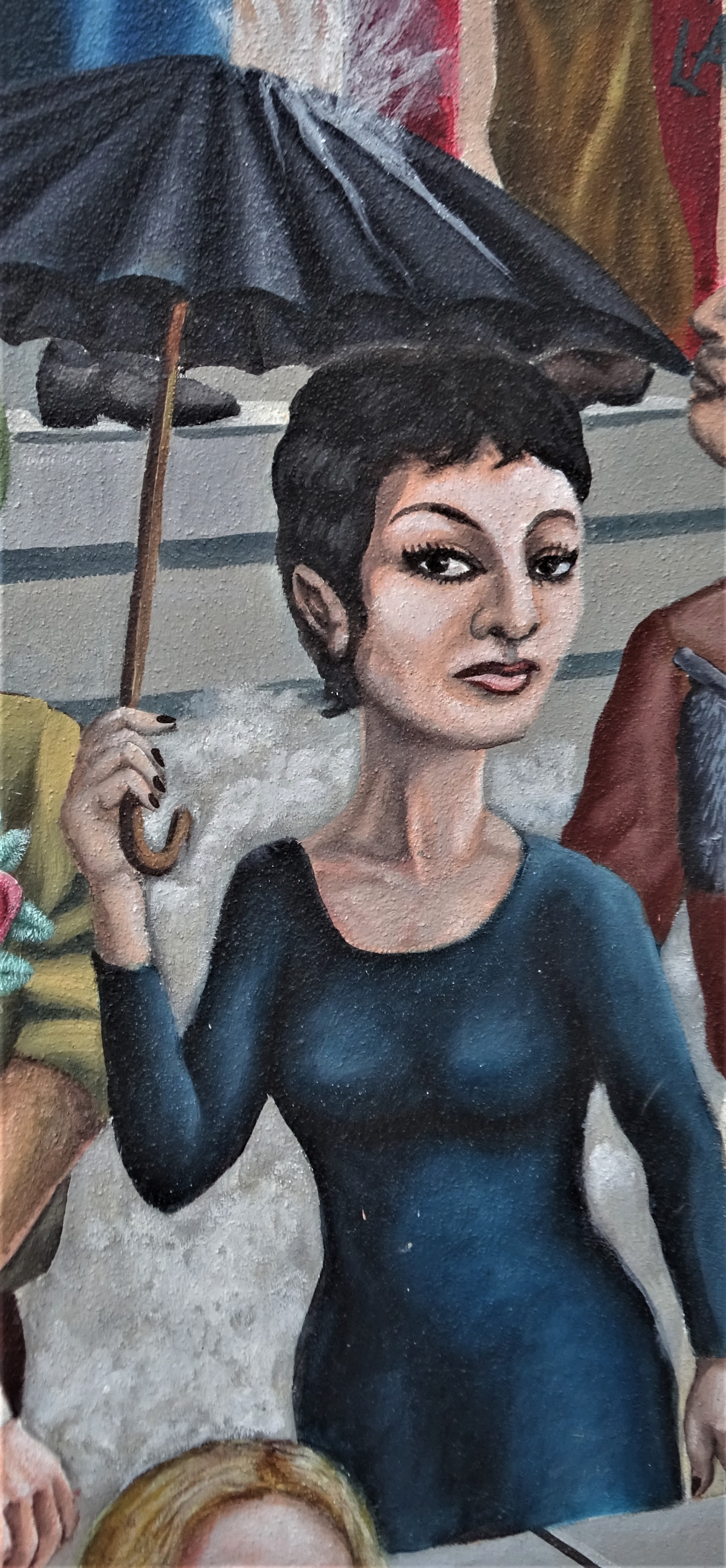
One of Barbara's most well-known songs is 'Nantes', where her runaway father Jacques Serf led a marginal existence and where he died. The first line of the song is 'Il pleut sur Nantes', probably not meant literally but hence the umbrella.* See my other post on La Rue de la Grange au Loup.
*Yes, she meant it literally: it was raining when she arrived in Nantes, as I've just read in her (unfinished but published) book.

Pierrick Sorin is a video director and actor from Nantes given to burlesque self-derision and derision of human existence in general.

The wall fallen from the sky which I featured in an earlier post deserves far more than a few brief words. I can only mention some of the many features in this wall, partly because many are now hidden beneath the act of mindless vandalism of some tag fanatic. It's a history of Nantes, also of many of the people who've made some contribution to that history. And behind it is Jean-Luc Courcoult, co-founder of the Royal de Luxe theatre, of Les Géants, instigator of street happenings, and eternal child. Here he is in the painting.
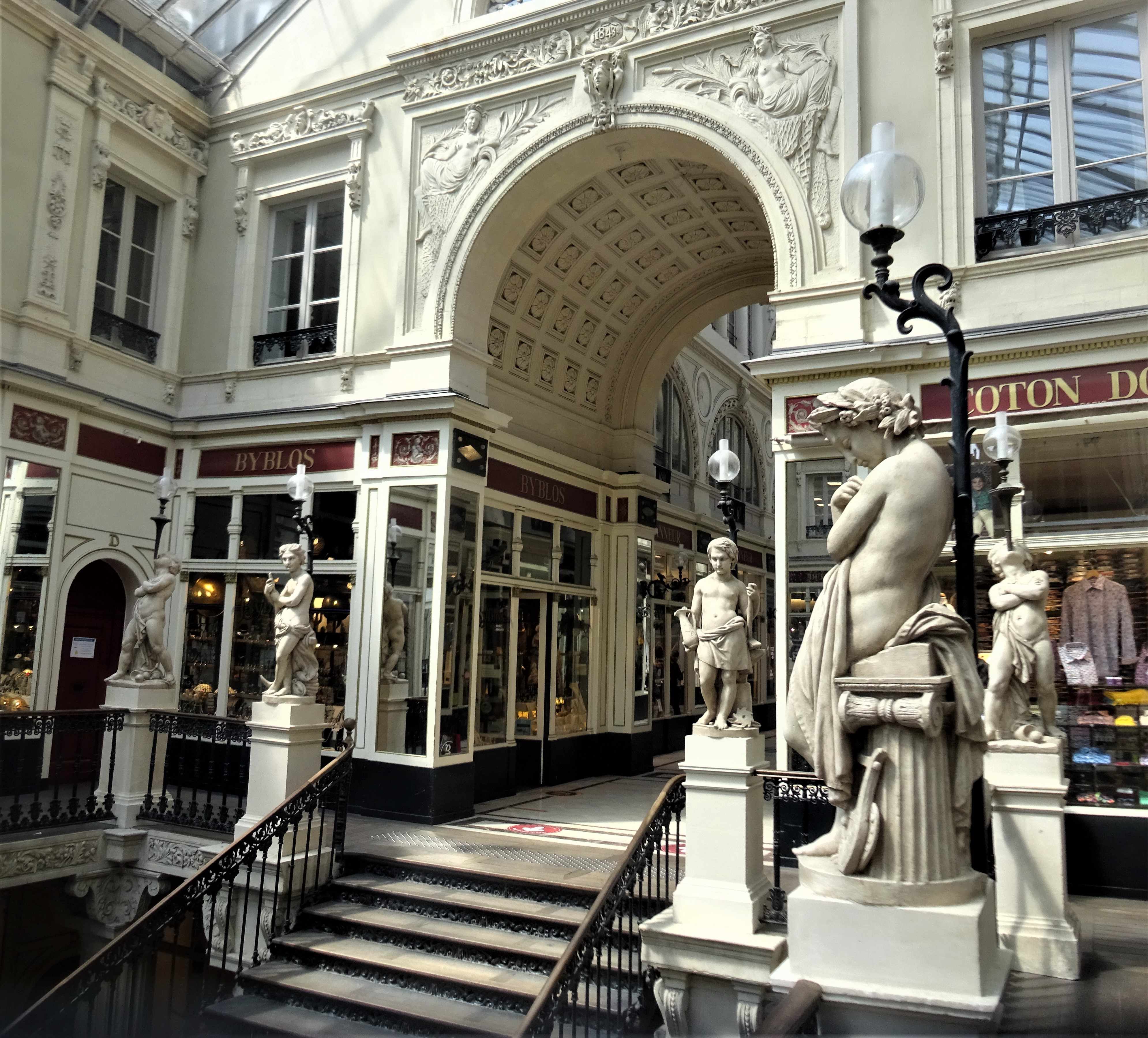
Le Passage Pommeraye, made famous by Jacques Demy in his films Lola and Une chambre en ville, has 66 boutiques and the building was instigated by Louis Pommeraye after similar examples in Paris and finished in 1843. It is now one of Nante's major tourist attractions, although that expression is demeaning. Passage Pommeraye was built a over a slum area, joining the theatre quarter to the working-class La Fosse. It is on three levels and is a true feast for the eyes. Since 1976 it has been a Monument historique. The head of Pommeraye himself is quietly prominent.




La Maison Radieuse in Rezé was designed by Le Corbusier and finished in 1955. There are 294 flats with a nursery school at the top. It is 52 metres tall.


I first noticed someone going towards Trentemoult with a huge rucksack, with a number of objects attached to his back, including a wok. I thought that perhaps Trentemoult is somewhat alternative, and our visit today proved that this is the case, although in a very sophistacted way: a number of houses are brightly coloured, cats are everywhere and almost seem to be part of a religion, and murals are also everywhere.
Today the former fishing village of Trentemoult is perhaps best remembered for Jean-Loup Hubert's 1991 film La Reine blanche, and in particular for 'Au confort moderne' featured in the film, the facade of which has been preserved.




Looked at from one angle, this bizarre wall appears to be a remnant from an old period, although it is in fact an art exibit by Jean-Luc Courcoult created in 2011. It's a great pity it's been vandalised to such an extent though. A map of the features and characters (the vast majority of which are associated with Nantes) lists eighty-four.


'Nantes' is one of Barbara's most famous songs, not the least famous for the lines 'Pourtant j’étais au rendez-vous / Vingt-cinq rue de la Grange aux Loups'. The words relate to an at the time fictional street in Nantes where Barbara states that her father died, although these words conceal as much as they reveal. Her father sexually abused her from when she was ten years old and he left home when she was nineteen, to lead a vagabond life-style existing on odd jobs such as a dock worker. He died in hospital in 1959 in Nantes, living at the time in Beaujoire, a suburb in the north-east of Nantes. He was buried anonymously in a communal grave in the Cimetière Miséricorde.
In 1964 the song was published in Barbara's album Dis, quand reviendras-tu ?, being the final one on it. In 1986 La Rue de la Grange au Loup became a reality in Saint-Joseph de Porterie next to Beaujoire, during an inauguration in which Barbara and her friend Gérard Depardieu were present. Barbara died in 1997, leaving behind an unfinished book Il était un piano noir, which was published the following year. In it, she says 'I've forgotten all the harm you have done me, and my biggest disappointment is not having been able to say to the father I have hated so much: "I forgive you, you can rest in peace."' (My translation.) Several writers have also suggested that Barbara's song 'L'Aigle noir' is a symbolised version of her father's sexual abuse of her.
In 2000 an allée was created in La Rue de la Grange au Loup, with a small statue of Barbara on a concrete base. A plaque in the allée suggests that the expression 'La Grange au Loup' relates to Barbara's father living near an area of land where a wolf prowled, and that it was recommended that young girls avoid the place. Um.


Jean-Romain Lefèvre married Pauline-Isabelle Utile in 1850, and the combination of the initials of their surnames, LU, were to become worldwide names. The former LU factory is now a cultural space, and a wonderful building, a highlight in Nantes: a Lieu Unique.


This statue of Jules Verne, who was born in Nantes, is the work of Jean Mazuet, and is the replacement of a bronze one which was lost in 1945.


 Posts
All Comments


