8 August 2013

Alfred Williams in South Marston, Wiltshire


'ALFRED WILLIAMS
HAMMERMAN POET
BORN IN
CAMBRIA COTTAGE 1877.'
 
After Richard Jefferies, Alfred Williams is probably the most well known Wiltshire writer. Cambria Cottage was built for Alfred's parents, Elias and Elizabeth (née Hughes), although they shared it with George Ockwell's family. Elias had taken out a second mortgage to finance a business in Swindon in which he was described as a 'joiner, carpenter and builder'. But the business folded in 1882, bailiffs threatened, and Elias fled, leaving Elizabeth to support her children.
 
 
'ROSE
COTTAGE
1865'
 
'POET AND WRITER
ALFRED WILLIAMS
LIVED HERE
1881 – 1903'
 
The Williams family, then, moved next door to Rose Cottage, which was built by Elizabeth's father Joshua Hughes, and this is where Elizabeth had met Elias when he and his father David lodged here as travelling carpenters. Alfred stayed here until he married Mary Peck in 1903.
 
Dryden Cottage in South Marston, where Alfred Williams and his wife Mary lived for fifteen years.
 
I was unable to find Alfred's grave in the church cemetery, although I discovered the grave of his mother and his brother Henry. Elizabeth Williams died in October 1917 at the age of 68. Her epitaph is from Matthew 11:28: 'Come unto me all ye who are weary and heavy laden, and I will give you rest'. Her son Henry Oliver Williams died less than two years later, in May 1919, at the age of 43.
 
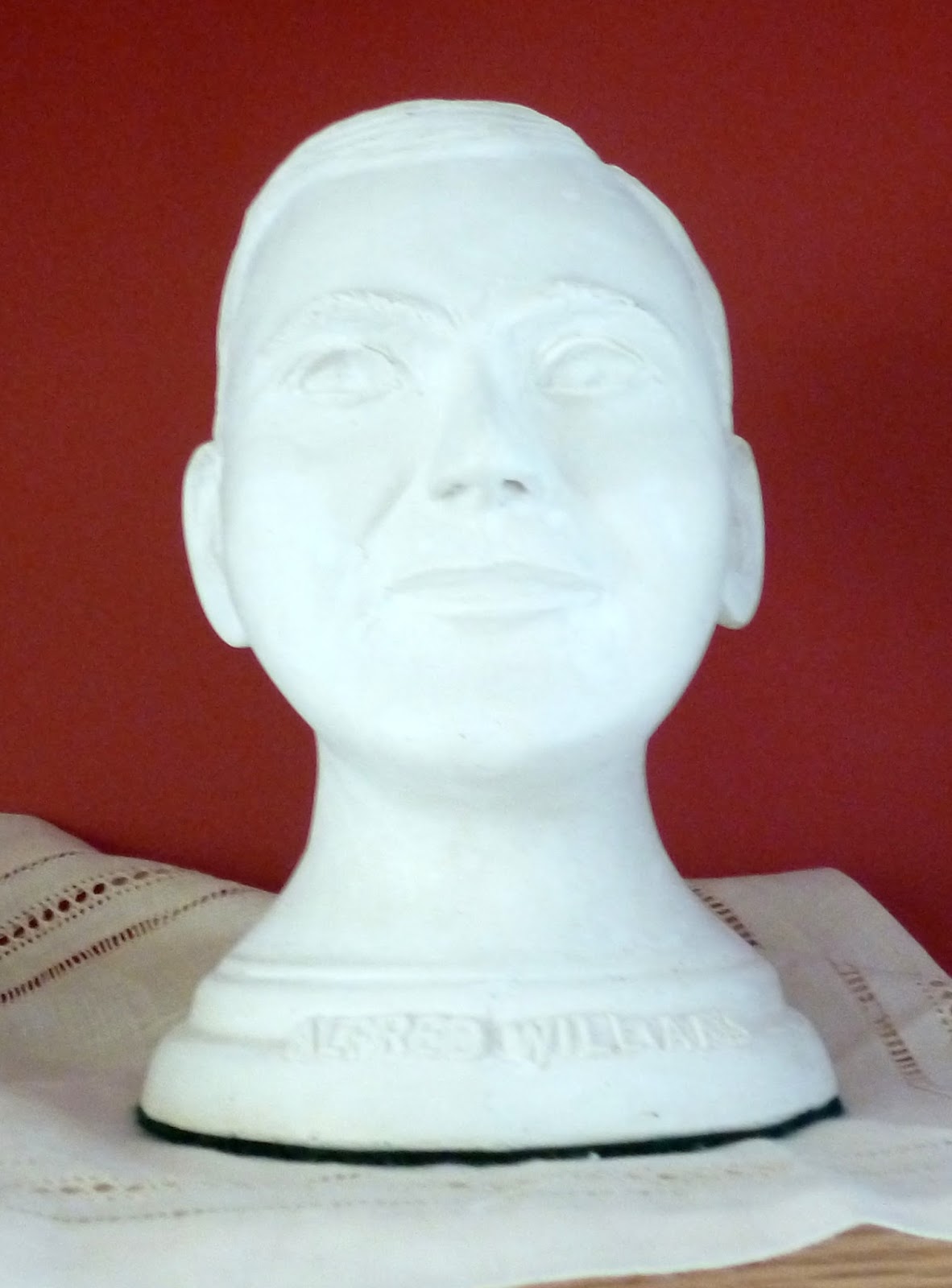
In the parlour of the Richard Jefferies Museum at Coate there is a small bust of Alfred Williams, although I know nothing of its history.
 
Much of the above material was culled from the Alfred Williams Heritage Society website, which is very informative and linked below:
 
–––––––––––––––––––––––––––––––––––
Alfred Williams Heritage Society

Three Mitford Sisters in Swinbrook, Oxfordshire

The graves of three Mitford sisters in a row in Swinbrook, Oxfordshire, which was their family home.
 
'NANCY
MITFORD
Authoress
wife of
Peter Rodd
1904–1973'
 
Despite what the gravestone says, Nancy Mitford was divorced from Rodd in 1959. She was noted for her novels, particularly The Pursuit of Love (1945) and Love in a Cold Climate (1949). She also popularised the whimsical expressions 'U' and 'non-U' in an essay in Noblesse Oblige: An Enquiry Into the Identifiable Characteristics of the English Aristocracy (1956).
 
'UNITY VALKYRIE
MITFORD
Born 8th Aug 1914
Died 28th May 1948
Say not the struggle
naught availeth'
 
Now we come to the notorious two sisters. Unity Mitford is famous for her obsession with Adolf Hitler, for stalking him and greatly impressing him with her Ayrian looks (and her middle name).  And after Britain declared war on Germany she shot herself in the head, although it took nearly nine years for the bullet still lodged there to kill her.
 
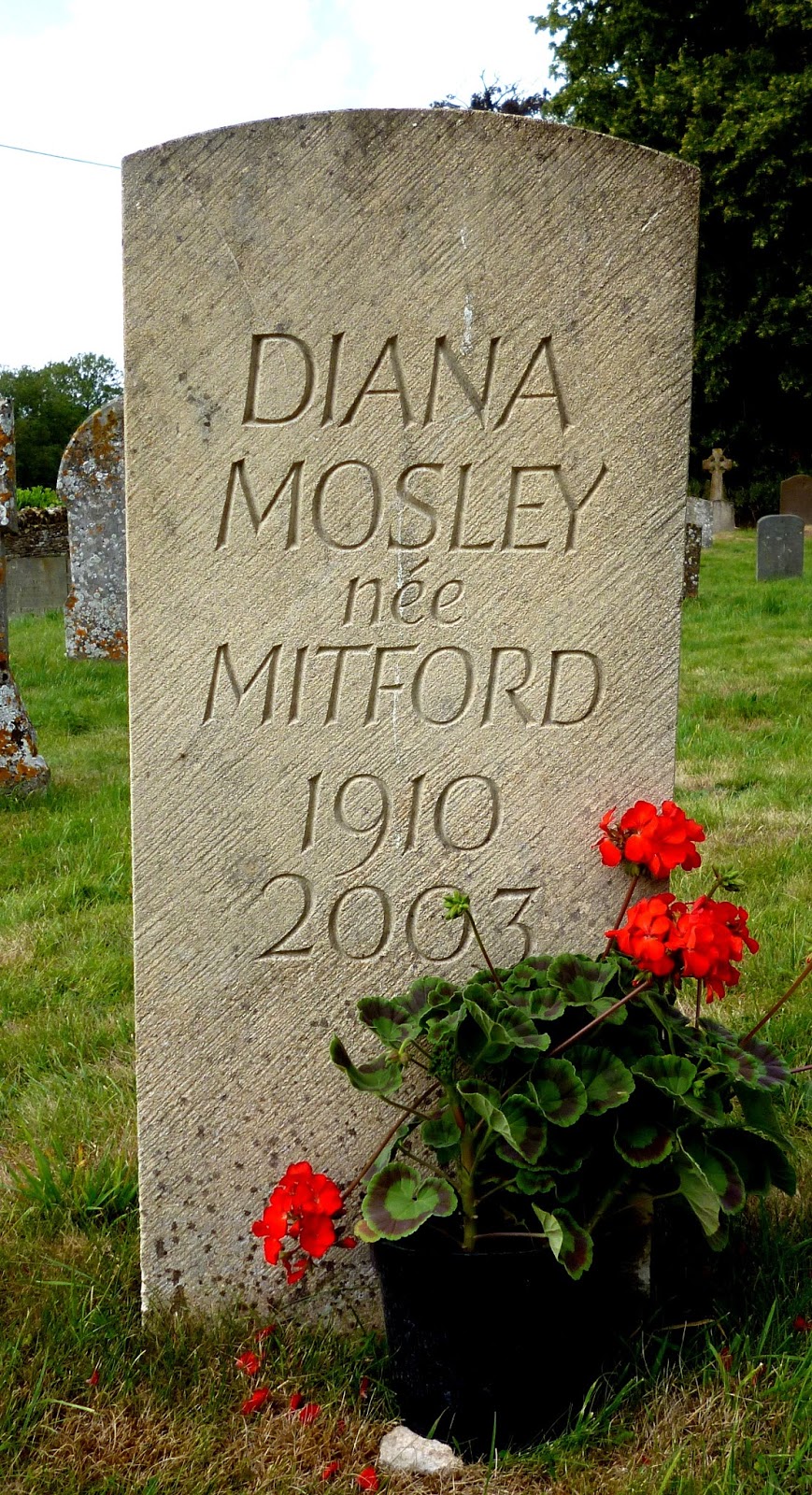
'DIANA
MOSLEY
née
MITFORD
1910
2004'
 
Notorious for – among other things – leaving her husband Bryan Guinness for the fascist leader Oswald Mosley, having her second marriage at Goebbels's house with Hitler as guest of honour, etc. Some called her the most hated woman in the country: it wasn't exactly surprising that her appearance on Desert Island Discs in 1989 should have received so many complaints.

Arturo Barea and Other Spanish Writers in Oxfordshire

The Times Literary Supplement's 26 April 2013 issue contains a fascinating article by Martin Murphy titled 'Pub Poets: The Exiles of Eaton Hastings'. In 1934 the socialist and pacifist Gavin Henderson inherited the Buscot estates in Oxfordshire from his grandfather Alexander Henderson, the first Lord Faringdon. Gavin Faringdon was a founder of the National Council for Spanish Relief during the Spanish Civil War, which commissioned a ship to transport four thousand refugee Basque children following the siege of Bilbao. Some of the young exiles were housed at a lodge of Faringdon's (still called Basque House) in the hamlet of Eaton Hastings, and the death of one of them in an Oxford infirmary led the poet Luis Cernuda – who witnessed the death – to write a poem: 'Elegía a un muchacho vasco muerte en Inglattera'.

In 1939 a group of adult Spanish exiles came to Basque House, among them the poets Domènec Perramon and Pedro Garfias, and the journalists Eduardo de Ontañon and Fermí Vergés. Most of them moved on to Mexico, although Perramon stayed in England and became a translator of Spanish.

Arturo Barea was the son of a washerwoman and was very proud of his working-class roots. He left Spain in 1938 but didn't arrive at Eaton Hastings until 1947, where he spent his last ten years at Gavin Faringdon's Middle Lodge. He had married the Austrian journalist Ilsa Kulcshar, née Pollak. As 'Juan de Castilla', Barea broadcast eight hundred programmes for the BBC's Spanish American service, from 1940 until the year of his death. He is most noted for his autobiographical trilogy La forja de un rebelde, which his wife (as Ilsa Barea) translated as The Forging of a Rebel (1946).
 
Barea's ashes were strewn over his garden at Eaton Hastings, and Ilsa returned to Austria, although their friend Olive Renier erected a memorial to them in the cemetery on Coach Lane, Faringdon, behind Ilsa's parents' grave above.
 
'POR ARTURO BAREA
BORN MADRID 20TH SEPT 1897.
DIED BUSCOT 24TH DEC 1957.
AND HIS WIFE
ILSE BAREA POLLAK
BORN VIENNA 20TH SEPT 1902
AND DIED THERE
1ST JANUARY 1973.'

7 August 2013

William Morris in Kelmscott, Oxfordshire

St George's Church, Kelmscott.
 
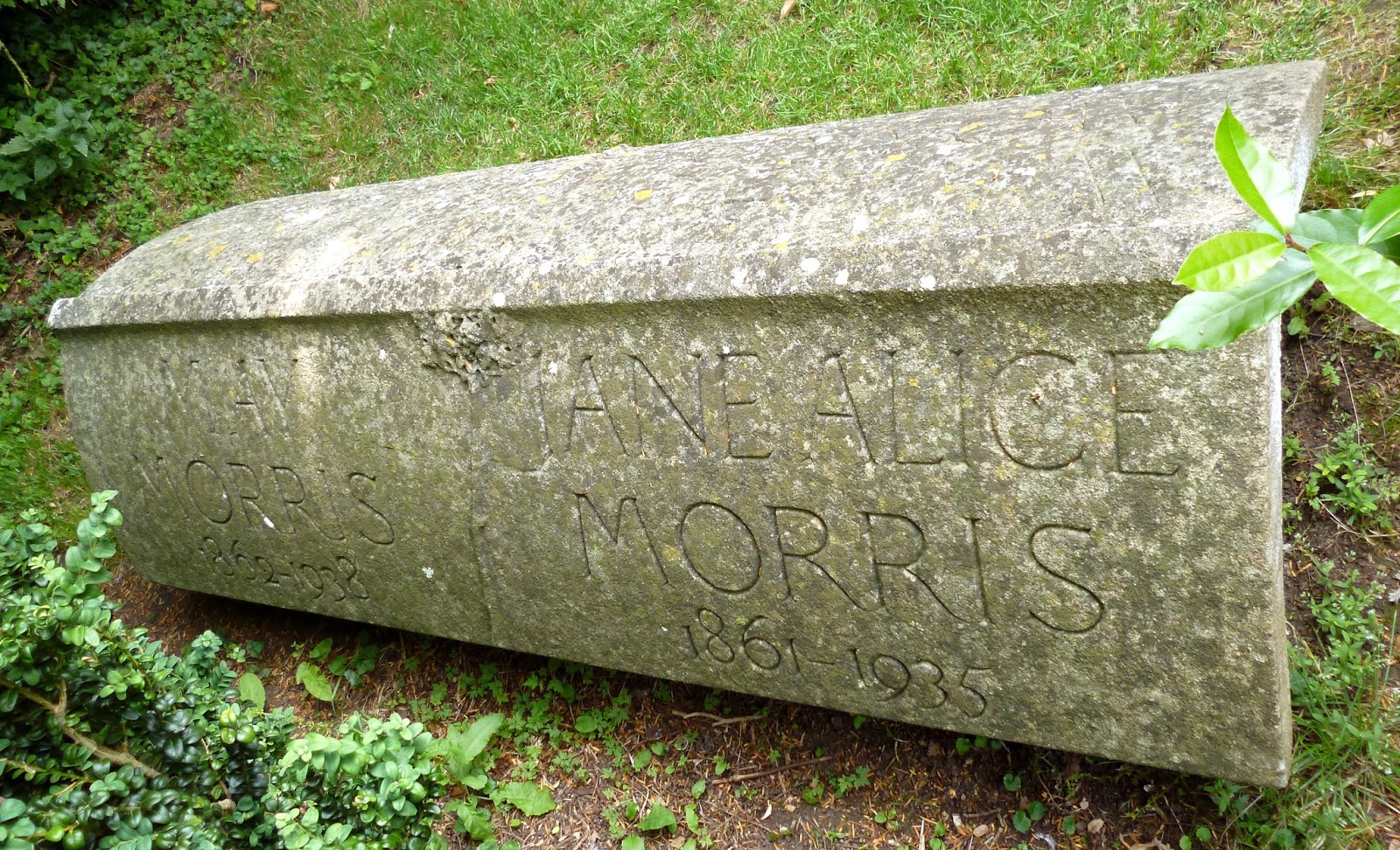
Buried in the graveyard are William Morris (1834–1896) and his wife Jane Morris (1839–1914). Morris's friend Philip Webb designed the simple but attractive tombstone, although this side is barely legible now due to weathering.
 
Also buried here are their two daughters, May (1862–1938) and Jane Alice (1861–1935). May edited her father's Collected Works.
 
Only their initials 'JAM' and 'MM' appear on these stones.

Barbara Pym in Finstock, Oxfordshire

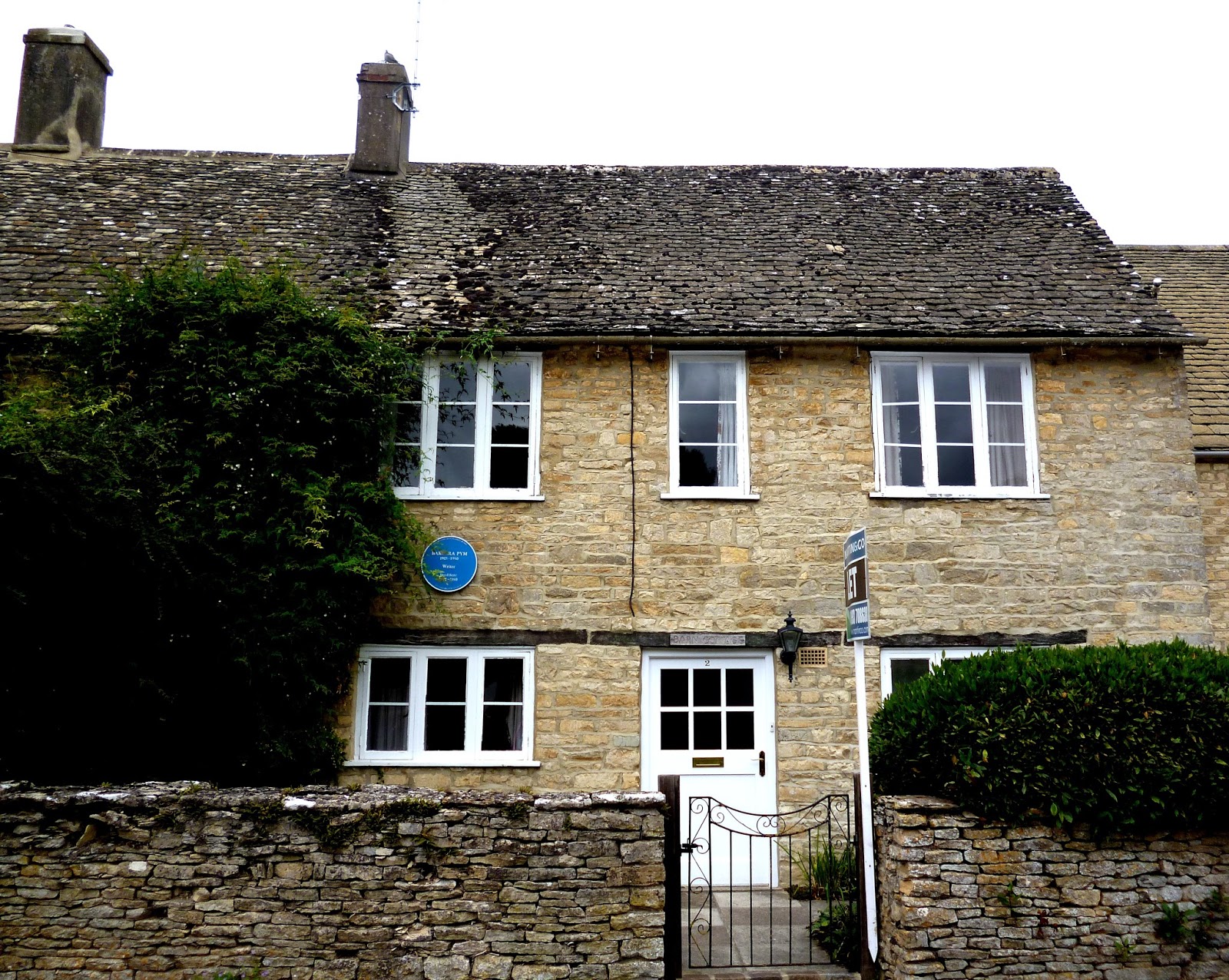
Barn Cottage, Finstock, Oxfordshire.
 
'BARBARA PYM
1913–1980
 
Writer
 
lived here
1972–1980' 

Following Barbara's sister Hilary's retirement from the BBC they bought Barn Cottage in Finstock, actually a converted wheelwright's shop. As Barbara was still working at the International African Institute in London she found cheap accommodation there and rejoined Hilary at weekends until her retirement in 1974. (My information above was gleaned from Hazel Holt's excellent book A Lot to Ask: A Life of Barbara Pym (1990).)

Holy Trinity, the church the sisters attended. (This is also where T. S. Eliot joined the Anglican Church in a secret ceremony in 1927.)

'BARBARA PYM
WRITER
1913–1980
WORSHIPPED
HERE'


'THIS LECTERN, DEDICATED ON THE 3RD JUNE 1984,
HAS BEEN GIVEN IN MEMORY OF THE WRITER
BARBARA PYM, WHO ORGANISED THE READING OF
THE EPISTLE DURING THE TIME SHE LIVED IN
FINSTOCK, 1972–1980.'


'BARBARA PYM
Writer
2nd June 1913–11th Jan. 1980
HILARY WALTON
née PYM
13th Jan. 1916–7th Feb. 2004'

I didn't know where Pym's grave was, so I asked a couple of elderly locals tending a grave if they knew. They had no idea, although in fairness one of them did know she was a writer.

Links to my other Pym posts:

–––––––––––––––––––––––––––––––––––
Barbara Pym: Some Tame Gazelle (1950)

Barbara Pym: Excellent Women (1952)

Arkell's Brewery Mural, Swindon, Wiltshire

Arkell's Brewery was established in Swindon in 1843 and moved to Kingsdown, Swindon in 1861. It remains an independent family brewery. The above mural, completed in 1985, is in County Road and is by Sarah Faulkner.

6 August 2013

Richard Jefferies in Coate, Swindon, Wiltshire

 
The Richard Jefferies Museum is the only literary museum in Wiltshire, and is on the Marlborough Road a few yards from Coate Water Country Park and next to the Sun Inn.
 
Coate is only about two miles from central Swindon, although this photo deceptively looks deep in the countryside.
 
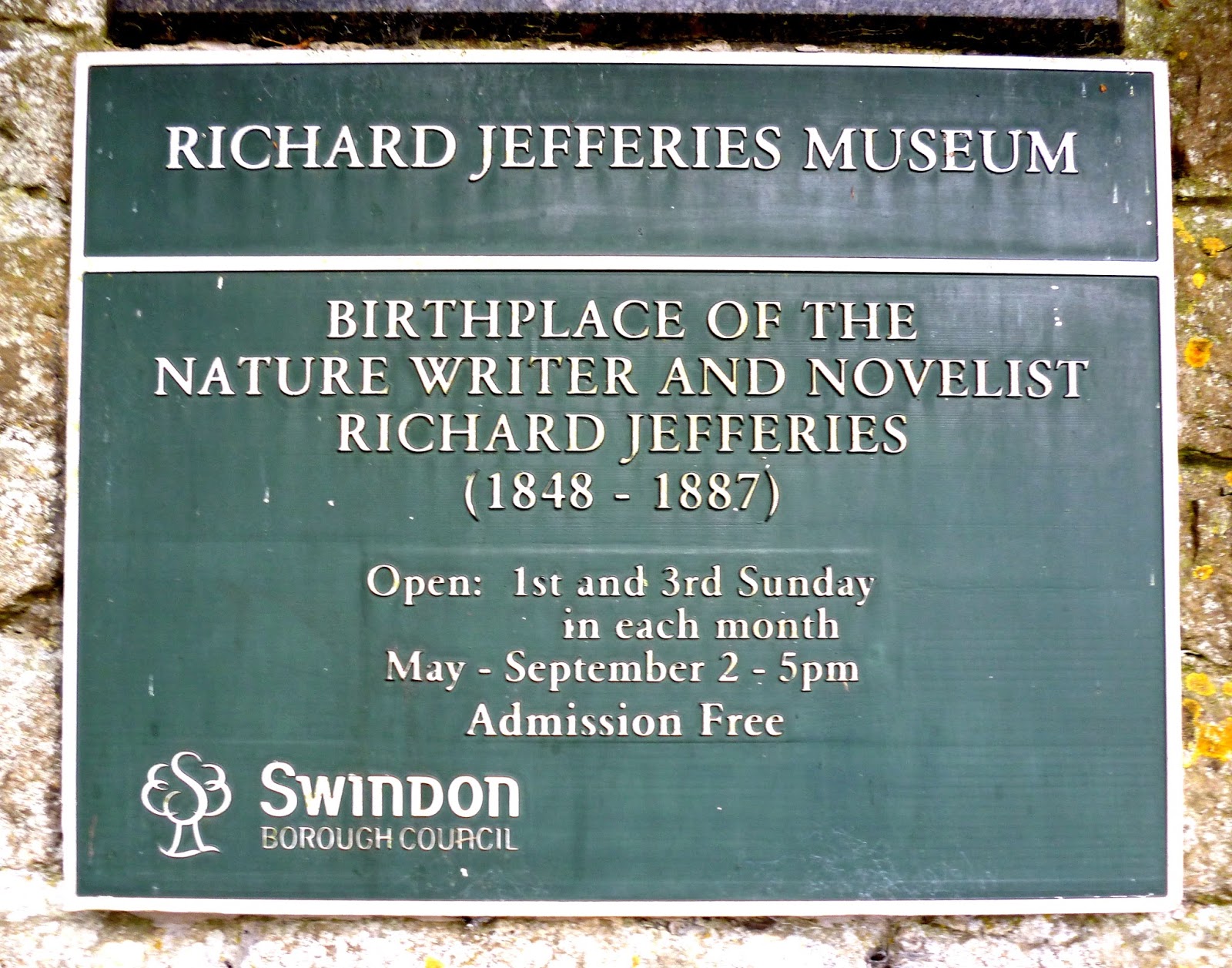
'RICHARD JEFFERIES MUSEUM
––––––––––––––––––––––––––––––––
BIRTHPLACE OF THE
NATURE WRITER AND NOVELIST
RICHARD JEFFERIES
(1848–1887)
 
Open 1st and 3rd Sunday
in each month
May–September 2–5pm
Admission Free'
 
'BIRTHPLACE
OF
RICHARD JEFFERIES
BORN
NOVEMBER 6TH 1848
 
Coate Farm, originally known as Jefferies Farm, was bought by Richard's great-grandfather, a baker and miller, in 1800. Richard's grandfather John was also (reluctantly) the principal miller and baker in Old Town, Swindon, and his father James Luckett Jefferies was a farmer here.
 
Richard had no interest in farming. He went to school in Swindon, began working for the North Wiltshire Herald at seventeen, and remained in journalism the whole of his short life. In 1874 he married Jessie Baden who lived nearby, and the couple went to live in Swindon. Jefferies wrote a large number of books largely filled with his observations of nature culled from his childhood in and around Coate, and he is perhaps best known for the autobiographical novel Bevis (1882).
 
He died in Goring at the age of 38 and was buried in Broadwater and Worthing Cemetery, West Sussex.
 
And this is the entrance door to the museum.
 
In the sitting room is a replica of a bust sculpted by Margaret Thomas. The original was unveiled in Salisbury Cathedral in 1892.
 
In the parlour and on the stairs are paintings of 'Jefferies's Land' by Kate Tryon (1864–1952), an artist from Massachusetts who was a very keen enthusiast of Jefferies's work, who visited Wiltshire six times and produced 230 Jefferies-themed works. The above painting is of Upham House (1910).
 
The interior of Upham House.
 
At the top of the stairs is another bust, this time by K. M. Harwood, dating from 1948.
 
The room on this floor was a bedroom but now contains exhibits. This plaque, a memorial to Jefferies and the Wiltshire poet Alfred Williams, was salvaged from Liddington Hill after it had been used for target practice by troops during World War II. Shame about the reflection.
 
A manuscript page of Jefferies's children's novel Wood Magic (1881) with a few emendations.
 
Jefferies's study is in the attic.
 
A closer view of that representation of Jefferies as a child.
 
Jefferies's original writing desk.
 
A first edition of the triple-decker Bevis: The Story of a Boy.
 
And a first of the two-volume Wood Magic.
 
The rear of the property.
 
'THIS TREE WAS PLANTED BY THE
CHILDREN OF THE SWINDON BRANCH
OF THE WORKERS EDUCATIONAL ASSOCIATION
AND DEDICATED BY THE
RT REV THE LORD BISHOP OF MADRAS
TO
RICHARD JEFFERIES
NATURES GREAT PROSE WRITER
SEPTEMBER 21ST 1921.'
 
Penny and I really enjoyed our visit to Richard Jefferies Museum, and it's evident that a great deal of excellent volunteer work is being done here. My thanks to all involved, particularly to the chair of the Richard Jefferies Society, John Price, with whom I had a brief conversation about Jefferies.
 
As far as obscurity goes this museum is nothing like as little known as some authors' house we've visited – such as Lillian Smith's place halfway up Old Screamer mountain in Clayton, Georgia; or Frank Sargeson's rebuilt bach in Takapuna, New Zealand – but perhaps it could do with a little more publicity.
 
Linked below is an excellent, well illustrated 28-page guide to the museum by the Richard Jefferies Society, and I'd recommend that anyone going there read it first.
 
–––––––––––––––––––––––––––––––––––
In the Footsteps of Richard Jefferies: A Guide to Coate Farm

5 August 2013

Lord Berners in Faringdon, Oxfordshire


'FARINGDON FOLLY

'THIS 100FT HIGH TOWER WAS BUILT IN 1935 BY THE
14TH LORD BERNERS. IT IS THE LAST MAJOR FOLLY
TOWER TO HAVE BEEN BUILT IN BRITAIN AND WAS
ERECTED ON THE SITE OF A MEDIEVAL CASTLE AND A
CROMWELLIAN BATTERY.

'AFTER CARRYING OUT MAJOR RESTORATION WORKS TO
THE TOWER, MR. ROBERT HEBER PERCY IN 1982 SET
UP A FARINGDON FOLLY TRUST. THE PURPOSE
OF THE TRUST IS TO ENSURE THAT THE PUBLIC HAVE
USE OF, AND ENJOYMENT OF THE TOWER AND ITS
SURROUNDINGS.

'THIS PLAQUE WAS PROVIDED BY THE FARINGDON ENVIRONMENTAL TRUST 1989'
 
'Gerald Hugh
Tyrwhitt-Wilson
14th BARON BERNERS
1883–1950
Composer, Writer, Artist
Eccentric
 
lived at Faringdon House
1919–1950
and built this tower'
 
"PRAISE THE LORD / HE SELDOM WAS BORED"'
 
The rhyming couplet above is part of a short epitaph that Berners wrote for himself and seems typical of the image he wished to project. He was an accomplished composer and the writer of three volumes of autobiography and six novels, one of which – The Girls of Radcliff Hall (1932) – was a lesbian girls' school romp, a roman à clef in which young female representations of Berners, Cecil Beaton and Olive Messel appear. The title of the novel is of course a play on the name of the writer Radclyffe Hall, who published the lesbian novel The Well of Loneliness in 1928.

Berners was wilfully eccentric. As a child he is said to have thrown his mother's dog from a window in the belief that it would learn to fly – the story being that he had heard that a dog learns to swim if immersed in water. Fortunately the dog survived, although I'm uncertain if the fantail doves he later dyed in bright colours were as lucky. He also had a pet giraffe and a horse with whom he had tea.

He was a great socialite and a friend of John Betjeman and Nancy Mitford, whose character Lord Merlin in The Pursuit of Love (1945) is based on Berners.

Berners delighted in the fact that he had no reason for building Folly Tower, apart perhaps from annoying his neighbours. He commissioned his friend Lord Wellesley to build a gothic tower, knowing – another story goes – that Wellesley hated this style. Building began when Berners was abroad, and returned to find most of it finished but built in a classical style. He insisted that the remaining section be completed in gothic style, which explains the rather odd mixture that is Folly Tower.

The tower was given as a birthday present to Berners' much younger boyfriend, the extroverted 'Mad Boy' Robert Heber-Percy (1911–87), who would have preferred a horse. In turn, two years before Heber-Percy's death, he gave the tower to the people.
 
A view from the Belvedere room near the top.
 
From the top of the tower, the surrounding woodland in the foreground and the town of Faringdon in the middleground.
 
An interior view from the steps, with a model blackbird.
 
There are several blackbirds in and around the tower and they allude to another writer. Henry James Pye (1745–1813) planted the outer circle of trees, the Scots pines, on Folly Hill. He is said by many to have been the worst ever Poet Laureate, even worse than Alfred Austin. One critic of the day mocked Pye's birthday poem to King George III, with its chirpy style, in what has come to be a well-known nursery rhyme about 'four and twenty blackbirds baked in a pie'.

1 August 2013

Mary Alice Monroe: Sweetgrass / The Secrets We Keep (2005)

This is the English edition of Sweetgrass, retitled The Secrets We Keep. I'm not too sure why though: did the publishers think the word 'sweetgrass' would be unknown to English people, did they think it so obscure that they had to change it to something safer, more sellable? I suspect this is the case, although the effect is to take the flavor out of the whole thing because sweetgrass is not only a central theme of the book but it serves as one of the geographical anchors.

Like two of the books by Mary Alice Monroe that I've read before – The Beach House (2002) and Swimming Lessons (2007)* – Sweetgrass is an example of the Lowcountry subgenre of Southern literature, being set around Charleston. Because South Carolina is the 'palmetto state', references to that tree are almost mandatory, as are references to the devastation of the 1989 Hurricane Hugo, and of course references to sweetgrass and the traditional baskets made from this product. Whereas Monroe's two earlier books reveal a great deal of research into turtles and their plight, in Sweetgrass a major concern is in the craftwork that goes into that commodity, and its increasing scarcity due to housing development in the region.

The main story, though, is about the secrets alluded in the unfortunate English title. Preston Blakely is the husband of Mary June  – that double name obviously being an important Southern identifier – and they are the parents of their dead older son Hamlin, the younger Morgan who hasn't seen his parents for a number of years, and their daughter Nan, whose husband Hank seems bent on estranging her from her family history and therefore from herself.

Enter Morgan, back to the family after his father has suffered a serious stroke. Both Mary June and Preston have distanced themselves from him, although Mary June has in particular following the accidental death of Hamlin. But Morgan will soon more than redeem himself in their eyes (or at least in Preston's one functioning eye).

Crunch time comes when the rapacious Adele – Mary June's ex-friend and sister-in-law, and also Hank's employer – plots with Hank to make a financial killing out of selling the Blakely home, which is also called Sweetgrass, and is becoming an increasing economic burden to Mary June and Preston. While examining the legal niceties of Adele's intended takeover, Morgan chances upon love letters revealing that shortly before marrying Preston, Mary June had a brief love affair with Preston's older brother Tripp, which resulted in her carrying the future Hamlin in her womb: after the accidental death of Tripp she very quickly marries Preston.

Morgan discovers a legal escape route that reveals the extent of Adele's treachery, and together with this the chance discovery of a nearby forgotten slave cemetery (at the same location as a secret sweetgrass patch) neatly put an end to Adele's intended acquisition of the house. In this way, both the property and the sweetgrass themes are woven together.

The good guys win in the end, OK, and maybe there's a bit too much plot in the mix to hold together completely convincingly, but on the plus side no attempt is made to tie everything in a neat bow, although I was mighty pleased to see that Hank got Nan's feminist hackles up far enough for her to ditch her slimy husband.

* I've also read Time Is a River (2008) although, unusually for Monroe, that novel is set in the Appalachians around Asheville, North Carolina.

–––––––––––––––––––––––––––––––––––
Mary Alice Monroe and The Isle of Palms, South Carolina