25 August 2011

Eugène Ionesco: La Cantatrice chauve (1950), La Leçon (1951), Rhinocéros (1959), and Le Roi se meurt (1963)

La cantatrice chauve was Ionesco's first play, and was inspired by his learning English through Assimil. The stage directions in the opening paragraph are only just over eight lines long, although the word 'anglais' is used to describe this 'bourgeois' setting sixteen times. The first scene introduces Mr and Mrs Smith, and the husband's first words I translate as:

'I say, it's nine o'clock. We've eaten soup, fish, potatoes in pig fat, English salad. The children have drunk English water. We've eaten well tonight. That's because we live near London and our name is Smith.'

Obviously some form of parody is intended here, probably of both the lessons and the English people. The conversation between Mr and Mrs Smith degenerates as exaggerated realistic moorings get lifted and the play moves into – well – Absurd waters, and the name 'Bobby Watson' is used for a whole family: confusion begins to become part of the norm.

When Mr and Mrs Martin knock, the Smiths retire to dress (which they don't actually do), and the Martins are left alone to play out a farce in which they 'discover' (as if they are long lost friends) that they have not only come from the same city but they live on the same road and share the same bed, etc. As they fall into each others' arms and fall asleep, the maid returns to explain that they aren't who they say they are, and that she (Mary) is Sherlock Holmes.

When the Smiths return, the conversation between the two couples becomes a trading of meaningless and rather mindless facts, with a number of mock exclamatory words of surprise for the most banal details, as if, again, Ionesco is parodying these bourgeois types. The entry of the fire chief (Capitaine des Pompiers) into the scene takes the play to a new level, when the characters exchange meaningless stories full of paradox, plays on words, non sequiturs, and it is deeply mediocre. But humorous too, of course: Ionesco has a gift for making the boring enjoyable.

He originally intended to call the play 'L'anglais sans peine' ('English without Tears'), but a change in the dialogue by the actor playing the fire chief – from 'l'institutrice 'blonde' ('the blond schoolteacher') to 'la cantatrice chauve' (translated as 'the bald soprano') – proved far preferable a title.

On the fire chief's exit to attend to a fire that probably is so insignificant as not to be worth attending to, the language degenerates even further, with the characters voicing largely meaningless invented proverbs and rhymes ('Prenez un cercle, caressez-le, il devient vicieux' (Take a circle, caress it, it becomes vicious')/'Mon oncle vit à la campagne mais ça ne regarde pas la sage-femme' ('My uncle lives in the country but that's of no interest to the midwife')). Isolated words or phrases are uttered and repeated, or changed according to a whim of assonance, etc, until 'C'est pas par là, c'est par ici' ('It's not that way, it's this way') is repeated over and over, and the curtain falls.

The use (or rather abuse) of language is evidentally all-important in Ionesco's world.
––––––––––––––––––––––––––––––––––––––––––––––

La Leçon illustrates the tyranny of language, or the tyranny of power represented by a member of the bourgeoisie – a professor. Overwhelmingly, this is a dialogue between the fiftysomething Professor and his eighteen-year-old new student, with Marie the maid making several brief appearances.

The Professor begins rather timidly, and the student confidently, although this situation is rapidly reversed, with the Professor gaining total control over the helpless student. The lesson begins with extremely basic arithmetic, and the student has no problems, even later being able to swiftly calculate the multiplication of quadrillions. But she is incapable of even the most basic substraction: it is as if she's resisting loss, or death.

In spite of Marie warning about the grave danger of the Professor moving from Mathematics to Philology, he pitches into it in a frenzied, crazy lecture in dictatorial fashion, not allowing the student to say anything, and ignoring her increasingly impassioned pleas that she has toothache: his words are causing her great pain. She is completely in his control, and he stabs her to death with one knife blow, and the directions tell us it is either a real or an imaginary knife, but the effect of the word 'couteau' (knife) - which is repeated many times by the Professor - obviously has a profoundly violent physical effect on the Student anyway. The phallic nature of the weapon is obvious to the audience, and the Student's widely spread legs also suggest a sexual attack.

Just before the next student arrives, the Professor and Marie get rid of the body, which we learn is the 40th in a week.  

Bérenger – a name that appears in several Ionesco plays – is the main character in Rhinocéros, which begins with Bérenger talking to his friend Jean in a café one morning in the small unnamed provincial town where they live. Bérenger is a little dishevelled from a drinking session the previous evening, and the responsible and respectable Jean disapproves of his friend's behavior. The conversation – and the peace of the day – are scattered by the appearance of one of two rhinoceroses: it isn't clear if it's the same one seen twice, and there is much debate over this.

The next day, when Bérenger arrives at the office, he finds the people there hotly discussing a snippet in the paper about a rhinoceros killing a cat: the boss Monsieur Papillon, who is anxious that the workers don't spend all there time gossiping about the odd occurrence; Daisy, with whom Bérenger is madly in love; Dudard, who is a rival for Daisy's heart; and Botard, a pedantic ex-schoolteacher who disbelieves in the rhinoceros's existence. However, it soon becomes evident that the rhinoceros is real, as it destroys the bottom of the office stairs, effectively imprisoning them until the fire brigade can rescue them. Madame Boeuf, who has come to excuse her husband for being unable to come to work, discovers that the attacking rhinocero is in fact Monsieur Boeuf.

Bérenger goes to see Jean, who left the café in disgust with Bérenger, although he doesn't remember anything about it, and nothing of the rhinoceros either. At the beginning, the two men find each other slightly odd, although Jean is not feeling very well, and in fact he very rapidly turns into a rhinoceros before the eyes of Bérenger, who is forced to flee for his life, although he meets a a herd of rhinoceroses outside, which are making a terrible noise.

The next day Bérenger is doing what perhaps most other people would do under the circumstances – tranquillizing (or immunizing, as he would prefer to call it) himself with alcohol – when Dudard enters, and there is much talk of the rhinoceros 'epidemic'. Slowly, Dudard breaks the news to Bérenger that Monsieur Papillon has also turned into a rhinocereros, although Bérenger thinks that he had the strength to resist it.

Later, Daisy joins the two men and informs them that Botard has become a rhinoceros, along with others she knows. When Dudard leaves, Bérenger confesses his love, and Daisy is in love with him too, although all the time, as the monstruous noises of the rhinoceroses sound more musical, and the brutes themselves appear to have a certain beauty, Daisy is seduced, and leaves Bérenger to his own devices.

In spite of the strange attraction the beasts can have, Bérenger stands firm: 'Vous ne m'aurez pas, moi. [...] Je reste comme je suis. Je ne vous suivrai pas, je ne vous comprends pas. Je suis un être humain. Je suis un être humain.' ('You won't take me. [...] I'm staying as I am. I won't follow you, I don't understand you. I'm a human being. I'm a human being.') And it is this stance which makes Bérenger – a man with an obvious propensity to alcoholism and little regard for his personal apearance – a slightly unconventional hero. Ionesco intended the play to be understood in the light of Nazism, which is perhaps only too obvious, although  by extension the rhinoceros madness can be seen as conformity in general, refusal to join the crowd, refusal to accept assimilation. Certainly, there is some similarity between Bérenger's defiant final words, 'Je ne capitule pas !' and Hugo's final words in Sartre's Les Mains sales: 'Non récuperable !'

Ionesco's Le Roi se meurt is titled Exit the King in the English translation, in which the king is Béranger I, who has two wives, the first being Marguerite and the second Marie. This has been thought by some critics to be Ionesco's most Beckettian play, as things gradually disappear from the stage, contrary the proliferation in Ionesco's usual sets.

Bérenger is dying but refuses to accept it: 'Je mourrai quand je voudrai, je suis le roi, c'est moi qui décide' ('I'll die when I want to, I'm the king, I make the decisions.')

In the end the characters leave him to die and he sits alone, while around him the doors, windows, and walls slowly disappear, as does the king himself.

16 August 2011

George Orwell, Lionel Britton, and 'The Proletarian Writer'

For a number of years now the transcript of 'The Proletarian Writer' – Desmond Hawkins's Home Service radio interview with George Orwell on 6 December 1940 – has been available in Peter Davison's A Patriot After All: 1940–1941, but I've only just noticed it online. As I've mentioned this in several posts before, I won't dwell on it again, except to repeat that it's very interesting how affected Orwell was by Lionel Britton's Hunger and Love: almost ten years after publication he's still talking about it, even calling it an 'exceptional book'. It seems hardly surprising, then, to find echoes of Britton in – for example – Keep the Aspidistra Flying and Coming Up for Air.

The transcript is here.

15 August 2011

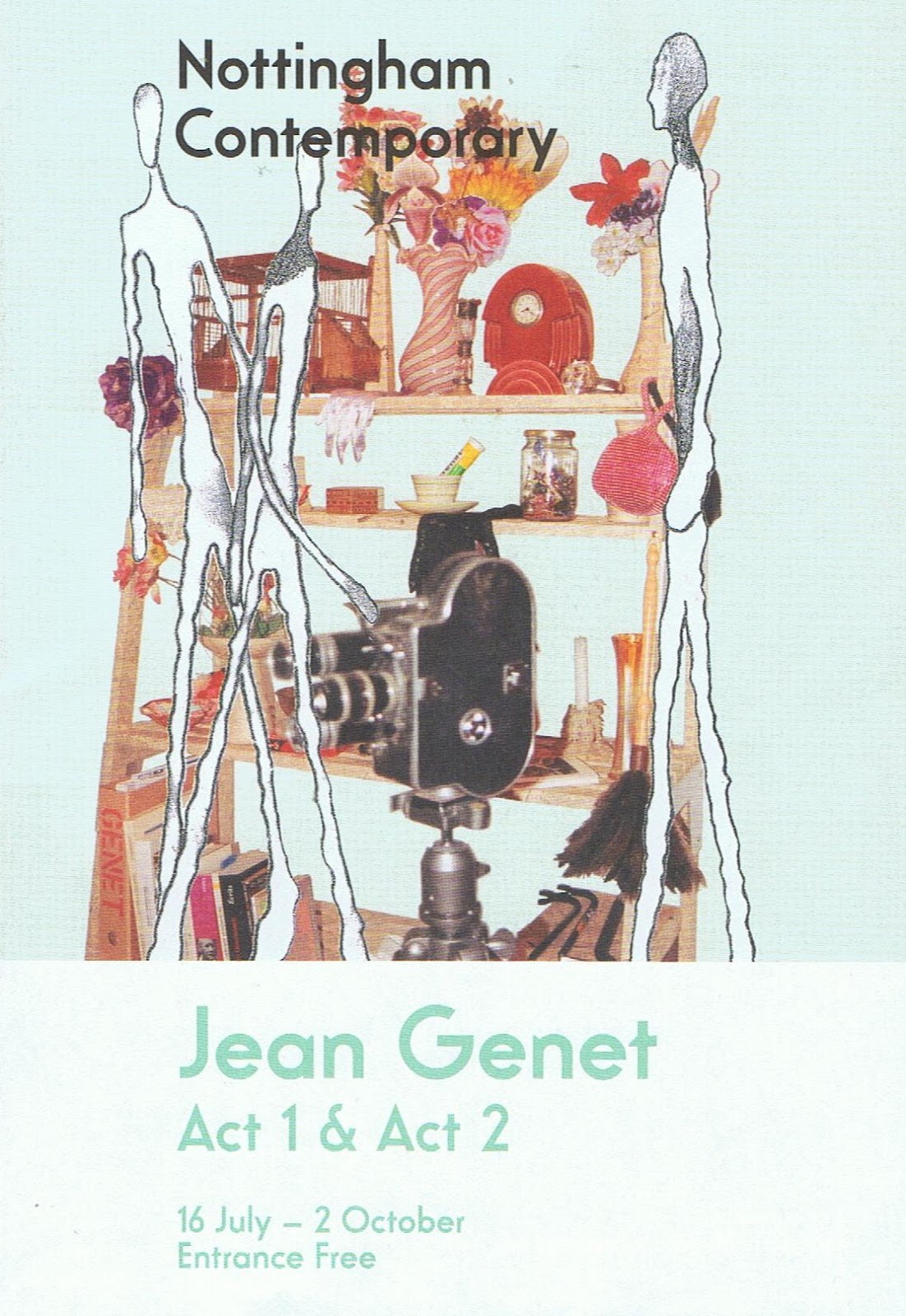
Jean Genet in Nottingham


The art gallery Nottingham Contemporary's summer (16 July 2011 – 2 October 2011) exhibition is entitled 'Jean Genet' as it is inspired by the French rebel writer, and it is in two 'Acts'.

Act 1 features work by Marc Camille Chaimowicz, and also includes sculptures (notably Man Pointing) and the portrait of Genet by Alberto Giacometti. Others works shown in Act 1 are by Tariq Alvi, Lukas Duwenhögger, Mathilde Rachet, and Wolfgang Tillmans.

Act 2 concentrates on Genet's later politically involved years, and features the film Nervus Rerum by The Otolith Group, which moves round Jenin refugee camp on the West Bank with readings from Genet's Prisoner of Love (Captif amoureux) and Fernando Pessoa's O Livro do desassossego (The Book of Disquiet). Lili Reynaud–Dewar's walls speak passages from Prisoner of Love and L'Ennemi déclaré (The Declared Enemy), with books by north African writers displayed, such as Nabile Farès's Le champ  des oliviers and Tahar Ben Jelloun's Harrouda. Act 2 also features work by André Acquart, Emory Douglas (Black Panther graphic work), Latifa Echakhch, Mona Hatoum, Glenn Ligon, Abdul Hay Mosallam, Gil J. Wolman, Akram Zaatari, and Carole Roussopoulos.

9 August 2011

Jim Loach's Oranges and Sunshine

Ken Loach is a major British director, and his movies have frequently been strong attacks on social problems often perceived as stemming from governmental policies, from the television Play for Today Cathy Come Home (homelessness) through Kes (state education in a working-class community), Family Life (conventional psychiatry), Ladybird, Ladybird (the Social Services), and The Navigators (New Labour's privatization of the public sector). Now, Ken Loach's son Jim has made his first feature film, which involves abuse by British governments in the recent past.

Oranges and Sunshine is the ironic title of this partly fictionalized story, and alludes to a 'promise' made to British children in home care that the British government deported, often to be abused sexually and by other violent physical means. Over a large number of years, perhaps as many as 150,000 of these children were deported to different Commonwealth countries as a source of labour, although the movie concentrates on Nottingham social worker Margaret Humphrey's discovery of a number of children sent to live permanently in Australia between the 1940s and 1970.

Initially an Austalian woman approached Humphreys (played remarkably well by Emily Watson) because she was seeking to find out about her parents. The movie charts the rapid increase in Humphreys's knowledge as she is given the two-year task of unearthing the facts about this abuse. A particularly poignant moment is when Len (played by David Wenham - a brilliant foil to Watson) shows Margaret the Christian Brothers' Keaney College in Bindoon, which he (along with other children) had built brick by brick, and where many were otherwise abused. Much time is spent in detective work trying to track down the parents of a number of children.

The former British Prime Minister Gordon Brown made a public apology for past governmental abuse in February 2011.

One thing I hated about the movie: the Cat Stevens song. Perhaps Humphreys would have been unaware of Stevens's (or rather Yusuf Islam's) comments on the Rushdie fatwa, but many of us are aware of them.

(Some scenes take place in Nottingham, and the streets of Sneinton to the south-east of Sneinton Boulevard, the former Sneinton Market buildings, and William Reid Dick's Welcome statue inside the Council House are clearly recognizable.)

4 August 2011

Mike Mills's Thumbsucker (2005)

This was director Mike Mills's first feature, and was filmed in Beaverton and Portland, Oregon.

Seventeen-year-old Justin Cobb (played by 17-year-old Lou Pucci) is the thumbsucker of the title, and this is an adaptation of Walter Kirn's 1999 autobiographical novel of the same name. Mills is fascinated by transgressions, and what – thinking about it – can be much more transgressive than an adult addictively sucking his thumb? Justin's father Mike (Vincent D'Onofrio) finds it repulsive; he does it at school in a toilet cubicle just as he might conceal mastubatory activity; he daren't reveal his secret shame to his would be girlfriend Rebecca (Kelli Garner); and his orthodontist Dr. Perry Lynham (Keanu Reeves) more or less hypnotizes him out of it.

One of the joys of this movie is that people don't do what is expected of them, and kids and adults have equal weight: no one is magically wise due to age, and age can actually confer lack of maturity. Adults are seen to hesitate about courses of action relating to younger people, and even young kids can have a lot more going for them mentally.

Yes, of course there are a number of Oedipal references, and in the long conversation between Kirn and Mills (a special feature on the DVD), the novelist asks why thumbsucking should be seen as so taboo when sucking on a can of beer is seen as masculine behavior. This idea (not actually mentioned in either the conversation or Mills's commentary on the movie) is underlined toward the end when Perry (who is also Justin's unofficial analyst and other self, and who has earlier identified the thumbsucking as in part a substitute for the mother's breast) very improbably but very tellingly lights up two cigarettes in rapid sucession in the dental surgery.

This is after Perry has admitted to previous hippy philosophizing, declared that thumbsucking is in fact OK behavior, and made a statement of brilliant uncertainty: 'The truth is living without an answer. I think'.

Mills wholeheartedly agrees with the above remark, and says that the aim of the film is to 'help you feel more permissive about yourself'.

Elliott Smith was set to do the whole score, consisting of covers such as John Lennon's 'Isolation' and Leonard Cohen's 'The Sisters of Mercy', but, sadly, died before finishing it. A few of Smith's songs are still in there, such as Cat Stevens's 'Trouble', which Mills sentimentally remembers from Hal Ashby's Harold and Maude. (Many people have far less fond memories of Cat Stevens, and for very good reasons, but we'll save that for the next post.)

A movie about outsiders in which everyone (yes, that's all of us) is the outsider: I'm really looking forward to watching Mike Mills's recent Beginners.

31 July 2011

Robert Owen, Manchester

This statue of the Welsh social reformer Robert Owen (1771–1858) stands outside the Co-operative building at the corner of Balloon Street and Corporation Street, Manchester. It was sculpted by Gilbert Bayes and is a copy of the one erected in Newtown, Montgomeryshire – where Owen was born - in 1956. It was commissioned by the Co-op plc.

'THIS STATUE WAS UNVEILED ON 28TH MAY 1994 BY HUGHIE TODNER
PRESIDENT OF THE 1994 CO-OP CONGRESS
IN THE PRESENCE OF
THE LORD MAYOR OF MANCHESTER CLLR. SHEILA SMITH
THE LEADER OF THE CITY COUNCIL CLLR. GRAHAM STRINGER
THE MAYOR OF NEWTOWN CLLR. DAVID PUGH
THE CHAIRMAN OF THE CO-OPERATIVE BANK TOM AGAR
THE MANAGING DIRECTOR OF THE CO-OPERATIVE BANK TERRY THOMAS'

This is a link to the Robert Owen Museum in Newtown, and the website also contains a great deal of information about Owen, including his Manchester years, and there are a number of excerpts from his writings.

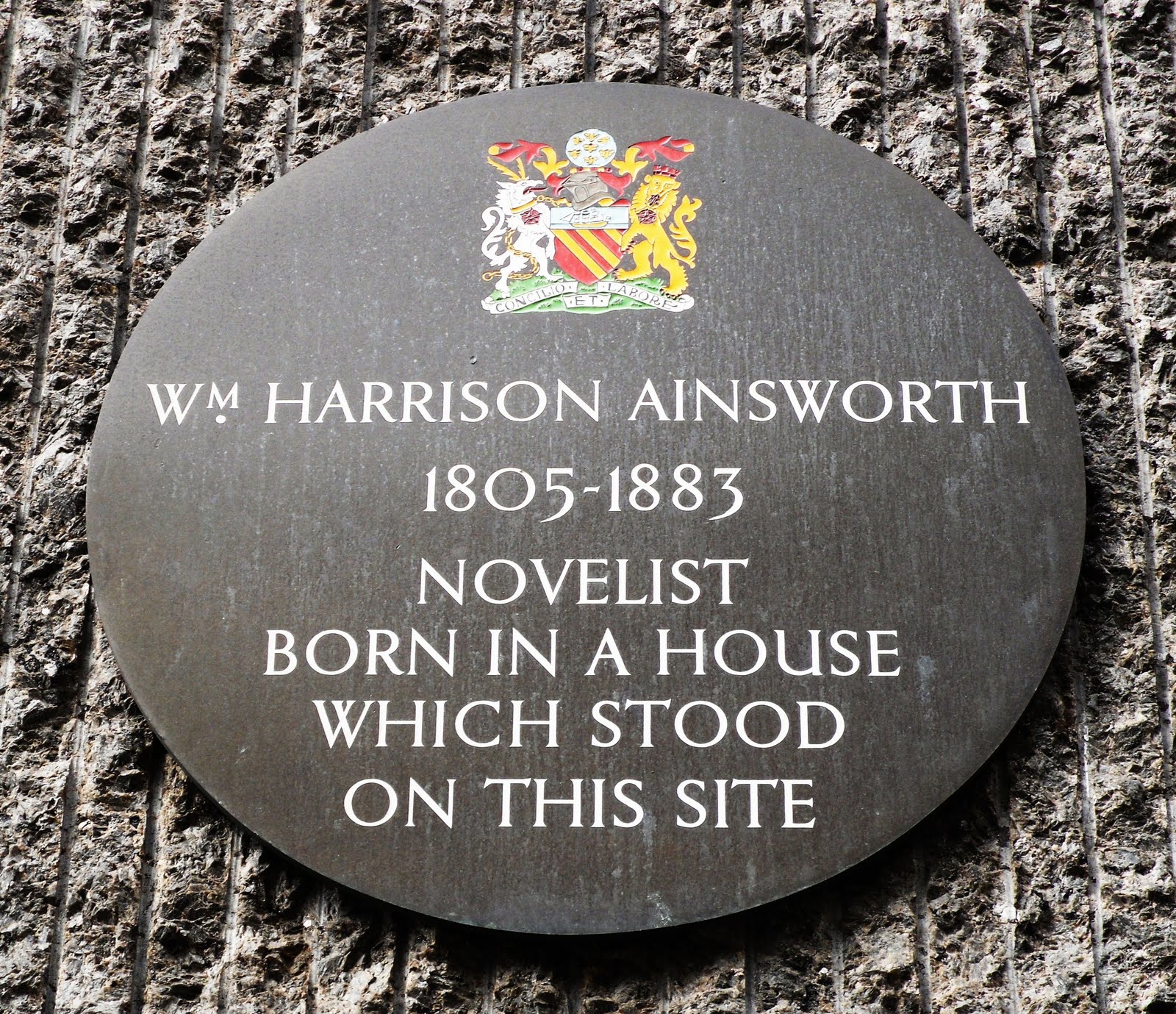
William Harrison Ainsworth, Manchester

'WM. HARRISON AINSWORTH
1805-1883
NOVELIST
BORN IN A HOUSE
WHICH STOOD
ON THIS SITE'

This plaque commemorating William Harrison Ainsworth's birth is on the National Westminster Bank building,  King Street, central Manchester.

His early 'Newdigate' novels (Rockwood (1834) and Jack Sheppard (1839)) romanticized highwaymen, and were satirized by William Thackeray in Catherine (1839–40). He wrote 39 (mainly historical) novels, among which the most noted perhaps are The Lancashire Witches (1848), Old St Paul's: A Tale of the Plague and the Fire (1841), and Windsor Castle (1843).

Elizabeth Gaskell House, Manchester

'ELIZABETH CLEGHORN
GASKELL
(1810–1865)
Novelist and authoress of 'Mary Barton',
'Cranford' and many other works
lived here
(1850-1865)'

I'm sure there must be many people like me who wince at the use of the term 'authoress': it smacks of 18th or 19th century male disparagement, and spoils the effect of the plaque. How come no one spotted it? At least she's no longer referred to as 'Mrs Gaskell'.

Elizabeth Gaskell House, 84 Plymouth Grove, Manchester, where the novelist lived with her Unitarian minister husband William and their four daughters. It is also where Gaskell wrote most of her published work, and where guests included Charlotte Brontë, Charles Dickens, John Ruskin, and Harriet Beecher Stowe.

Restoration has been under way for some time, and the awful pink paint has now gone. Unfortunately, so too has most of the roof, from which lead was stolen in May this year, adding another £250,000 to the projected cost of the restoration.

The rear of the house. An earlier post I made about Gaskell's Knutsford, Cheshire (where she spent her earlier years) is here.

29 July 2011

Carl Corley: Sky Eyes (1967)

After reading Hubert Creekmore's Cotton Country (see the post below), I got curious about other obscure Mississippi writers, and then noticed a link at the bottom of Creekmore's Wikipedia entry, which led to some pages of John Howard's Men Like That: A Southern Queer History, which told me very little about what I wanted to know, although the mention of Carl Corley proved a gem.

Corley was born in Florence, Mississippi in 1921, and was an artist in the 1950s, although in just five years – from 1966 to 1971 – he published 22 erotic gay pulp novels. The cover art (see above) was always his own.

Sky Eyes begins with a stagecoach ride in 1831 from Louisiana (where Corley moved to) to Fort Adams in south-west Mississippi, during which the young, innocent and strikingly handsome Vik Alta meets the older hunk Rafe Savage. After a night of unbridled oral and anal sex, they continue up the Natchez trace, until the stagecoach is attacked by Choctaw indians, the driver and Rafe are killed, and Vik is taken prisoner.

Cutting things short, Vik (renamed 'Sky Eyes') becomes a sex slave to the (male) leader Neshoba, although their first encounter makes Vik a very willing one. The narrator is very quick to stress how civilized the Indians are when compared with their white counterparts:

'They were tactful - Vik grew to learn – ambitious, grave, humble on occasion if it were warranted, were clean of body (though he had not considered so at first) even going swimming in the river when it was edged with ice, and adhered, with strict obedience, to the laws of their tribe. Unlike the white man, they did not steal from one another (though they stole with relish from the paleface) did not commit adultery, rape nor incest, and did not kill, except in lust for domination of the tribe; a lust strong in the heart of every brave who longed to become chief of the Hiwannee and the Kewannee.'

Also:

'[T]he males were all extremely well proportioned in bone and muscle; were golden smooth of complexion, boasted shiny manes of jet black hair, and wore hardly enough to hide their nakedness.'

It seems that Vik has accidentally stumbled on some kind of paradise.

Soon, Neshoba and Vik develop a strong love for each another, and they get married. One day shortly after, though, when Neshoba and friends are out attacking a wagon train, Nik can't resist having sex with the virgin squaw Winona, although a member of his tribe sees the girl entering the honeymoon tepee and tells Neshoba, who blows a fuse. Winona's punishment: being strung up, her breasts hacked off, and a poisonous snake shoved right up between her legs. This is the first prong of Vik's punishment – the second is that Neshoba is no longer going to lay a finger on him.

Out on his own one day, Vik is amazed to meet Rafe, who in fact survived, and has come to take Vik back to white man's land. After some hesitation - well, he certainly deeply loves Neshoba, but what does that mean if he can't express it to him - he decides to go back with Rafe. But Neshoba has sent out a scout to watch Vik, definitively sinks a tomahawk into his rival Rafe's head, and gives Vik the choice: either return freely to Fort Adams and white civilization, or stay with him with the Indians. The problem is, Vik wants to return to the loving sexual relationship he had with Neshoba before his heterosexual dalliance with Winona. That's not a problem, says Neshoba: everything will be as before. So Vik agrees.

There are more than a few creaky elements in this novel - what do you expect with someone who seems to write faster than Amélie Nothomb? But the interesting thing is the subversion of sexual norms, especially bearing in mind the date this was written: utopia, the (admittedly very violent, especially when jealous) noble savage, and  the eternal triangle are all seen within a homosexual context.

Most of Corley's books aren't readily available, and I suspect that the printrun was very small. Not one of his novels is listed in the Library of Congress or British Library catalogs. It is probably impossible to find any of his books online at a reasonable price, but Sky Eyes is online here. It's in four sections - to move to the next, simply change the number at the end of the URL from '1' to '2', etc.

27 July 2011

Hubert Creekmore: The Fingers of the Night (1946), aka Cotton Country (1950)

Hubert Creekmore (1907-66) was born in Water Valley, Mississippi, and the son of a lawyer from a renowned planter family. Before the publication of his first novel, The Fingers of the Night (later retitled Cotton Country), he had published three books of poetry. He published more poetry, also translating works from Latin and other European languages, but only produced two more novels: The Welcome (1948) and The Chain in the Heart (1953). In general, Creekmore's novels were considered to negatively reflect the then poorest state in the union. A book I haven't read more or less sums up the reason for his early death: To Hubert Creekmore: Who Died in a Taxi on His Way to the Airport on His Way to Spain, by William Jay Smith (1967).

My attention was first drawn to Creekmore's existence by a very recent article by J. B. Slogan: 'Roughhousing, Again, in the Southern Libraries: Pulp in the Afternoon' in the current (summer) issue of Oxford American (number 73). Slogan and I didn't read the same book, of course – no one ever does, even if we're the same person reading at different times – and my verdict on Cotton Country is really much more positive. Obviously I didn't expect this to be anything like as good as Faulkner (who lived just twenty miles north of Water Valley) or Welty (Creekmore's sister-in-law), but after reading such a negative article I'm so impressed by how good it actually is. No, J. B. Slogan, you can't judge this book by its cover, and Cotton Country deserves a far better one (the American one being actually better than the UK one because the characters are better drawn, although they're perhaps a little too moviestar glamorous).

Cotton Country is a strong indictment of Mississippian religious fundamentalism in the 1940s, essentially concerning – throughout – the relationship between the young Cleance and Tessie (née Ellard) Andrews and Tessie's (generally unrecognized as) psychotic father Maben (usually called Pa). Pa belongs to a church that segregates man from woman (aisle-wise) in its services, and we later learn that Cleance's father has left the flock, calling the congregation 'too holy to be human', and stating that he 'wouldn't go to no church that didn't believe in life.'

Why is Pa certifiably insane? Well, his wife was 'sinning', and it's about the time of her death (probably caused by Pa beating her senseless in tandem with giving her (or her giving herself, it's unclear) a very dangerous abortion) that the church went crazy. And Pa almost killed his daughter Bett for 'sinning' (the exact crime is unclear), and sent her boyfriend Tuck Manning running by giving him a gunshot wound. Not only does he believe that sex is a sin, but that marriage is a sin as it leads to the sin of sex, as opposed to the ideal virgin birth. Whatever would this guy do to his younger daughter Tessie, who's been enjoying Cleance's attributes in the cotton barn, as well as other unmentionable places?

Slogan cites a paragraph at the beginning of the book – when Cleance and Tessie, er, come together in the cotton barn – and seems to find it laughable and/or badly written, skipping several paragraphs and so missing the one that should have been quoted: the two together:

'Her eyes looked past his shoulders and saw the vaporous walls quake as if a wind had crossed them. She arched her back. The smell of cotton seed swept into her nose.

'Drops of saliva ran between Cleance's teeth and open lips, overflowed at the center and fell on her neck. He closed his mouth too late and licked his gums as if they were dry.'

This is way before the Chatterley trial, and it paid to be careful, so this is what authors had to do: euphemize. And I think it worked.

So Tessie gets pregnant, has to marry Cleance, and flee with him. Life in cotton country ain't easy, though, because they are scratching for a living. No, they can't afford a midwife, but quite by chance an African American one is there to greatly help at the time. At the time, of course, they weren't called African Americans, and the Jim Crow laws were still strong, but the presentation of this black family by the narrator makes them shine brightly against the inhuman prejudices of the whites. Any (extremely minor, let's be honest) racist thoughts in this novel, I'm sure, belong to the characters in the book, and not to the author of it.

Oh, and Creekmore was gay. Surely some transfer could be applied here?

Dorothy Allison: Cavedweller (1998)

Like Reynolds Price, Dorothy Allison comes from North Carolina. And like Price's first novel A Long and Happy Life, which I wrote about here, Allison's Cavedweller begins with a motorcycle, a macho guy riding with a young woman behind him. The difference, though, is that the ride in Price's novel leads to a funeral, whereas the ride in Allison's novel causes a funeral.

The state is California and the dead man is the rock singer Randall Pritchard, who - before becoming too reckless – had lived with Delia Byrd, who had run away from her abusive husband Clint in Georgia.

Delia then decides to leave Venice Beach, where she lives with Cissy – her young daughter by Randall – to return to Georgia, where Amanda and Dede, the two daughters she had by her husband – are living with her mother-in-law.

So Delia drives Cissy across America, away from a rock-and-roll lifestyle in coastal California to smalltown Cayro, which like Cairo, GA, is some way off the I–75, although this is fictional and north of Atlanta, and the nearest town is Marietta.

The novel charts Delia's painful progress through the still extant perceptions – on the part of most of the population – of psychological damage of her own making, through living with her three daughters and for a short time with Clint, whom – teeth firmly gritted – she nurses through the terminal stages of cancer.

And as the years pass, the attention shifts to the development of the daughters, all of whom are very different: Amanda, a religious fanatic, marries another religious fanatic; Dede loves Nolan, but will only ever live with him unmarried as she fears love dies after marriage; and Cissy - surely by no means the only  'cavedweller' of the title, as this must be multi-layered – has an increasingly serious interest in speology, and will return to California to try her hand at studying a related university subject.

But to return to the comparison between Reynolds and Allison: when Dede shoots Nolan in a fit of jealous madness, Delia says: 'What did I ever teach you but how dangerous love is?' The line might have come straight out of a Reynold Price novel, as a central theme in his novels is that love often kills (although in this case, Nolan survives).

And another major theme of Reynolds's is how genetic traits are passed on from generation to generation. In Cavedweller, Delia also tells Dede, in the same scene: '[I]f you want to know a man's heart, look at his mama. Look into her eyes, not his. That will show you what to expect.'

24 July 2011

Chartists Ernest Jones and Thomas Cooper

I took this shot very recently in Bow Lane, Manchester, England:

'ERNEST JONES
1819-1869
CHARTIST LEADER AND
BARRISTER AT LAW
PRACTISED FROM
CHAMBERS HERE
1863-69'

A link to information on Ernest Jones is here.


This reminded me that I'd taken a blue plaque shot of another Chartist a few years before, at 11 Church Gate, Leicester:

'Leicester City Council
THOMAS COOPER
Chartist
1805-1892
Had a coffee shop at this address
in which he organised the
movement in Leicester'

And a link to information on Thomas Cooper is here.

Amélie Nothomb: Robert des noms propres (2002)

In English this is The Book of Proper Names, but much is missed in the translation of this title.

At the age of nineteen Lucette and Fabien marry, although they have no idea what they're going to do with their lives. When she's eight months pregnant, Lucette fires bullets into the sleeping Fabien's head because she wants to protect her child from a commonplace name – Tanguy or Joëlle – that Fabien has decided on. In prison, after ensuring her baby daughter is baptised Plectrude, she hangs herself with a rope of torn prison sheets.

Lucette's older sister Clémence and her husband Denis then adopt the baby. Plectrude is loved by the whole family, which includes the slightly older daughters Nicole and Béatrice, who devour food and grow, whereas Plectrude eats little, and only her eyes grow. And it is her eyes that cause her to be rejected from nursery school, because they frighten everyone, almost as if she were a witch. She has no problems when she takes ballet lessons, though, as she is brilliant and loved by all.

When Plectrude begins her compulsory schooling, she hates it, and is only saved by Roselyne, a friend from ballet lessons. Later, a boy called Mathieu Saladin joins the class, and although Mathieu and Plectrude are in love with each other, they never exactly have the occasion to express it.

Plectrude is determined to make a career as a dancer, so goes to the Opéra de Paris boarding school, where there are echoes of the concentration camp (cf. Les saboteurs amoureux and Acide sulfurique), where she becomes anorexic, stops taking calcium, and eventually puts an end to any possible career as a dancer by breaking a leg.

Plectrude joins a theater group, but when she starts only reading Ionesco things become really absurd: like her mother, she gets pregnant (but through a casual relationship) and decides to commit suicide (but by jumping from the Pont-Neuf), although she is saved by the magical appearance of Mattieu Saladin, who shows her that there is life after attempting to get your leg over the Pont-Neuf.

The reader is spared a description of the years of bliss that Plectrude (now known as the singer Robert (not RoBERT)) shares with the musician Mathieu, but a character called Amélie Nothomb becomes a kind of sister to her, although she talks too much and must be dealt with, so the problem Robert and Mathieu have is 'Amélie, or How to Get Rid of It', which of corpse (sorry – couldn't resist it) is the central problem that Amédée and Madeleine have in Ionesco's 1954 play Amédée ou comment s'en débarrasser (Amédée, or How to Get Rid of It), which, as the narrator points out, is just one syllable different.

The book may end there, but not the background to the novel, which adds a fascinating dimension to it: the Robert dictionary books are an obvious link to the title, but more importantly the novel is a fictionalized biography of Myriam Roulet, better known as the singer RoBERT, who was a very close friend (like a sister) of Amélie Nothomb's for a number of years. RoBERT is a singer of songs often concerned – like a number of Nothomb's novels – with childhood and death (the latter actual or symbolic), with a mixture of the magical and the tragic. RoBERT is married to the musician Mathieu Saladin, and she (or rather Roulet) too began a classical dancing career that ended with leg trouble, and... I don't know. Did RoBERT's mother kill her father when she was pregnant with her? As RoBERT says (these being her only words in English) in an eccentric (how could it not be?) interview: 'That is the question'. Nothomb told RoBERT that she was pregnant with her, which is less bizarre than it sounds as 'pregnancy' is far from an unusual sensation authors experience when writing books. RoBERT also says that Nothomb took truths and mixed them around in the novel, partly to protect RoBERT. The four-minute interview is here.

RoBERT's album Celle qui tue (best translated as 'The Woman Who Kills') contains six tracks written by Nothomb, with the music by Mathieu Saladin: 'A la guerre comme à la guerre', 'Le Chant des sirènes', 'Nitroglycérine', 'Sorcière', 'Celle qui tue,' 'Requiem pour une soeur perdue'. It was released a few months after the novel, and it is rewarding to view both novel and album side by side: Nothomb (presumably only in certain respects) considers music to be a far more superior medium than literature, but is incapable of making music herself.

My Amélie Nothomb posts:
––––––––––––––––––––––––––––––––––––

Amélie Nothomb: Autobiographical novels
Amélie Nothomb: Hygiène de l'assassin
Amélie Nothomb: Robert des noms propres
Amélie Nothomb: Les Combustibles
Amélie Nothomb: Antichrista
Amélie Nothomb: Tuer le père
Amélie Nothomb: Le fait du prince
Amélie Nothomb: Péplum
Amélie Nothomb: Le voyage d'hiver
Amélie Nothomb: Une forme de vie
Amélie Nothomb: Acide Sulfurique
Amélie Nothomb: Mercure
Amélie Nothomb: Journal d'Hirondelle
Amélie Nothomb: Attentat
Amélie Nothomb: Cosmétique de l'ennemi
Amélie Nothomb: Les Catilinaires

21 July 2011

Rob Epstein and Jeffrey Friedman's Howl (2010)

The Allen Ginsberg estate wanted something commemorating the 50th anniverary of the poem Howl (1956), although the project took a little longer than expected to come to fruition. What resulted from the work of Rob Epstein and Jeffrey Friedman is a very successful movie, particularly as they had a very low budget.

Howl is a documentary, but a very unconventional documentary:

1. It is set in color in 1957 with Ginsberg (played by James Franco) talking either to a tape recorder or to unseen interviewers.

2. We see a number of court trial scenes in color - also taking place in 1957- which are reconstructions of the obscenity trail in which the poet Lawrence Ferlinghetti is accused of obscenity for publishing Howl and Other Poems at his City Lights bookstore on Columbus Avenue, San Francisco.

3. There are numerous flashbacks in black and white to Ginsberg's life, in which a number of actors very briefly play well-known characters in it, such as Jack Kerouac, Neal Cassady, Peter Orlovsky, Carl Solomon (to whom the poem is dedicated), etc: they have non-speaking roles. The main flashbacks, though, are to 7 October 1955, where Ginsberg (Franco, of course) is reading his poem to a rapt audience at the now defunct Six Gallery on Fillmore Street, San Francisco.

4. Animated sequences, in color, essentially illustrate some of the text of the poem.

On the DVD, there's a fascinating playback of the movie with Franco, Epstein, and Friedman making various comments on the making of the film and the life of Ginsberg in relation to the poem.

Bob Rosenthal, Ginsberg's secretary, once said that Howl turned Ginsberg from a boy to a man, and certainly the difference between the pre-Howl person and the 1957 person lies far more than in the growth of a beard. Not all of Ginsberg's earlier problems are mentioned in the movie, although most of them are, and a few more are added in the commentary.

Madness is a pervasive theme: Ginsberg's mother was first institutionalized from when he was six, he was intitutionalized himself, and his fear at the time of not being 'normal' because of his sexuality troubled him. But then, he was surrounded by madness: his friend Lucien Carr had killed his homosexual stalker David Kammerer; William Burroughs (accidentally) killed his wife Joan Vollmer by shooting her in the head; Tuli Kupferberg (who died just over a year ago) jumped off Manhattan Bridge in a suicide attempt; Herbert Huncke was crashing at Ginsberg's and bringing masses of stolen property there; and being barred from seeing his occasional sex partner Neal Cassady by his wife Carolyn (who'd caught him giving Neal a blow job) couldn't have helped. His life was seemingly hopelessly chaotic.

In the commentary, two 'breakthroughs' are mentioned: being inspired by Cézanne's paintings at the Met went stoned, and having a vision of William Blake while masturbating. But the appearance of his life-long lover Peter Orlovsky obviously changed his life in other respects.

Howl was the place to release the outsider scream, to let out the frustrations, speak of the traumas, spit out the madness, yell about friends, twist things in a surreal way in places, who cared, it would never be published.

And then, of course, Ferlinghetti wants to publish Howl, and the rest is history. Howl the movie represents some of Ginsberg's history, and does it brilliantly.

19 July 2011

The International Anthony Burgess Foundation, Manchester

The International Anthony Burgess Foundation is at the corner of Cambridge and Hulme streets, Manchester. It states that its mission 'is to encourage and support public and scholarly interest in all aspects of Anthony Burgess's life and work'.

The premises are at the Engine House, Chorlton Mill, where there is a café, a reading room housing Burgess's personal library, and a room available for hire for various events.

The windows bear several quotations by Burgess: 'Literature is not easy, but without literature we are lost.' Yes indeed.

'The world has much solace to offer: love, food, music, the immense variety of race and language, literature, and the pleasure of artistic creation.'

The room where various events take place, which contains furniture that belonged to Burgess.

And this piece of furniture is an example, with a polite notice asking people not to place glasses on it.

The Reading Room and display cases are downstairs, where we find this introduction to the man:

'ANTHONY BURGESS (1917–1993)

'Anthony Burgess was a prolific force in English letters, working as an author, composer, journalist, translator and teacher in a career spanning over forty years. Though he is best known for his novel A Clockwork Orange (1962),  Burgess produced thirty-three novels, twenty-five works of non-fiction, two volumes of autobiography, three symphonies and various other musical works, screenplays for film and television, and an impressive body of journalism, television and radio work, book reviews and interviews.

'Burgess is one of Manchester's most famous writers. Growing up in Harpuhrey and Moss Side, he attended Xaverian College in Rusholme and studied English at the University of Manchester. In later years he lived in Malaya, Brunei, Italy, the United States, Malta and Monaco.

'As the novelist A. S. Byatt has said:

"There were two Anthony Burgesses, perhaps. One was atheist,  English, Northern, and interested in the quiddities of the demotic. The other was Catholic, Irish, Latin, and interested in the spiritual life."

'Several major themes connect Burgess's writing, including a preoccupation with Catholism and guilt, experimentation with language and the form of the novel, the role of the artist in society, the relationship between literature and music, and the humorous treatment of human foibles. Burgess's conviction that art should represent the clash of opposites - darkness and light, good and evil, Eastern and Western cultures - informs much of his fiction. He was a voracious reader, and significant influences on his writing include James Joyce, Gerard Manley Hopkins,  and D. H. Lawrence.'

'LIANA BURGESS (1929–2007)

'Liliana Macellari Burgess was born in Porto Civitanova, in the Marche region of Italy. She was the daughter of Gilberto Macellari, a photographer and actor, and the Contessa Maria Lucrezia Pasi della Pergola.

'Liana was the Italian translator of Lawrence Durrell and Thomas Pynchon, and read and admired Burgess's novels Inside Mr Enderby and A Clockwork Orange. Burgess and Liana met in Chiswick in 1963, while she was teaching linguistics at Cambridge University, and married in 1968. Liana was Burgess's greatest source of support, acting as his literary agent, translator and collaborator.

'Liana Burgess established the International Anthony Burgess Foundation in 2003 to encourage and support public and scholarly interest in all aspects of Anthony Burgess's life and work.'

'Sixtieth anniverary of the Malay College, Kuala Kangsar (1905–1965).'

'Anthony Burgess taught as an education officer in the British Colonial Service between 1954 and 1959. While living in the East, he published the three novels that are now collected as The Malayan Trilogy: Time for a Tiger, The Enemy in the Blanket, and Beds in the East.

'What sets Burgess apart from other colonial authors is his use of other languages in his works. During his posting to Kuala Kangsar, Burgess was determined to learn the Malay language:

'"There was a very large princely vocabulary and it had to be learned. [...] [L]essons took place on the verandah of the King's Pavilion while mosquitoes zoomed and struck and flying beetles boomed, copulated, shed their wings and died." (Little Wilson and Big God), pages 383–4)'

'Anthony and Liana Burgess. Malay language cards for the glossary of The Malayan Trilogy (1980).'

'Anthony Burgess, handwritten fragment of MF.

'"Bill Conrad, back at Warner Brothers, had facetiously suggested putting on a black Oedipus and calling it Mother-Fucker. My initials of that book were a homage to that idea, but they also stood for the hero, Miles Faber, who summed up man by being both a soldier and an artificer. The plot was based on incestuous relationships, but as seen through the lens of Lévi-Strauss's Structuralism." (You've Had Your Time, page 268)'

'Burgess collected tarot and playing card decks. In his hand-drawn James Joyce deck, he modifies the suits of traditional playing card, in order to better suit Joyce's literary landscape. "Hearts" are changed to "Kidneys", "Spades" to "Ashplants", "Clubs" to "Shamrocks", and "Diamonds" became "Flowers of the Mountain". The face cards represent some of Joyce's best-known characters: Leopold Bloom, Molly Bloom, Stephen Dedalus,  and the brothers Shem and Shaun.'

'Will and Testament: A Fragment of Biography by Anthony Burgess with eight screenprints by Joe Tilson. (Verona: Plain Wrapper Press, 1977).

'Will and Testament is Anthony Burgess's most lavishly and most beautifully presented work - a limited edition run of 86 folio-sized copies, printed on a Washington hand-press by Plain Wrapper Press of Verona.' The work is housed in a wooden box, bound in leather and printed on handmade paper with calligraphic embellishments. Each copy is signed by both Burgess and Tilson.'

'The short story reworks Rudyard Kipling's 'Proofs of Holy Writ', and imagines that William Shakespeare casually inserted his name into Psalm 46 of the St James Bible.'

From the top:

1. Olivetti lettera 35
2. Olympia Traveller de Luxe
3. Olivetti lettera 25
4. Olympia Splendid 66
5. Hermes Rocket

'I have earned my living with a typewriter for the last twenty-five years years, and I have developed a love for the instrument analogous to my love for my old Gaveau piano, which once belonged to Josephine Baker. But whereas a piano, once acquired, becomes a permanent article of furniture, typewriters break down irreparably and have to be replaced. Yet the old loved name – Qwert Yuiop – reappears and proclaims a continuity of identity, minimally modified when it gets into Italy or France and becomes Qzert Yuiop. Without Qwert Yuiop's willingness to submit to my punishing fingers I doubt if I could have sustained the profession of author.'
                 (Anthony Burgess, from Homage to QWERT YUIOP, 1986)

Burgess's harpsichord, with a very reasonable notice about seeking permission to use.

Burgess with his son Andrew Burgess Wilson.

'Anthony Burgess. Handrawn 15th birthday card to Andrew Burgess Wilson, 9 Aug 1979.'

'Andrew Burgess Wilson was proud of his Scottish heritage, and studied the traditional music and instruments of Scotland from a young age. Anthony Burgess celebrates his son's love of Scottish music [...] complete with bagpipes, a birthday fanfare, and a poem.'

'Letter to Andrew Burgess Wilson from Anthony Burgess with musical signature, 5 May 1981.

[...]

'Andrew Burgess Wilson and Anthony Burgess's relationship was strengthened by their shared love of music. In this letter to his son, Burgess mentions the forthcoming performance of his Glasgow Overture, his idea for the book This Man and Music [London: Hutchinson, 1982], and laments that there is no profit to be made from serious music, signing off with a handwritten stave.'

Anthony Burgess's interest in writing music for instruments in the recorder family, especially the great bass recorder, was prompted by his son Andrews's passion for these instruments.


I really enjoyed my visit to the International Anthony Burgess Foundation, and just wish he were more recognized today. The IABF's website is here.

George Albert Thomas, by Robert Hughes

Robert Hughes, the great-nephew of the writer Lionel Britton, continues to throw light on his family history, this time concerning the Spanish Civil War.

George Albert Thomas was born in Coventry, Warwickshire, England, 25 Feb 1915, and was previously mentioned in this blog in an entry dated 17 November 2008, which described how his parents brought him to Saskatchewan, Canada.

His father was George Thomas, b. 1873 in Billancourt, Paris, to Samuel Thomas and his Belgian wife Marie-Antoinette (née Goffin).

His mother was Ethel May Thomas (née Morris), b. 1884 in Holt, Wiltshire, England, to Albert William Morris, a gardener on a big estate, and his wife Mary Ann (née Fisher).

Initially George and Ethel May went to Wolseley, where George’s brother Frank had already established himself as a nurseryman. Forestry was very big in the province at that time and Frank seems to have found employment planting trees, but George, the father of George Albert, seems to have been more of a mechanic, and eventually gravitated to the larger city of Saskatoon.

George Albert clearly joined the Mackenzie-Papineau Battalion and fought in the Civil War in Spain, where he died - details here.

Under the heading of ‘The Volunteers’ we can see there is only one George Thomas and that he is listed as Missing in Action, which in the context of that war meant he is almost bound to have been killed. (See any number of sources about the Spanish Civil War, which amply confirm that foreign ‘irregulars’ were not given Prisoner of War status, and therefore summararily executed.)

It is worth speculating about a radical streak in the Thomas family: in this guy it manifested itself in an urge to fight and die for a quixotic cause, and in the case of Lionel Britton a determination not to be sent out to die for any cause. (He was a conscientious objector in World War I.)

George Albert has a significant physical resemblance to his grandmother Marie-Antoinette, see photo below. Put him in drag and grey his hair and you would never know.


This lad will have gone to give his life for something he believed in, but to me as a cousin of his it seems a tragedy.