19 July 2011

Lemn Sissay's 'Flags', Tib Street, Manchester

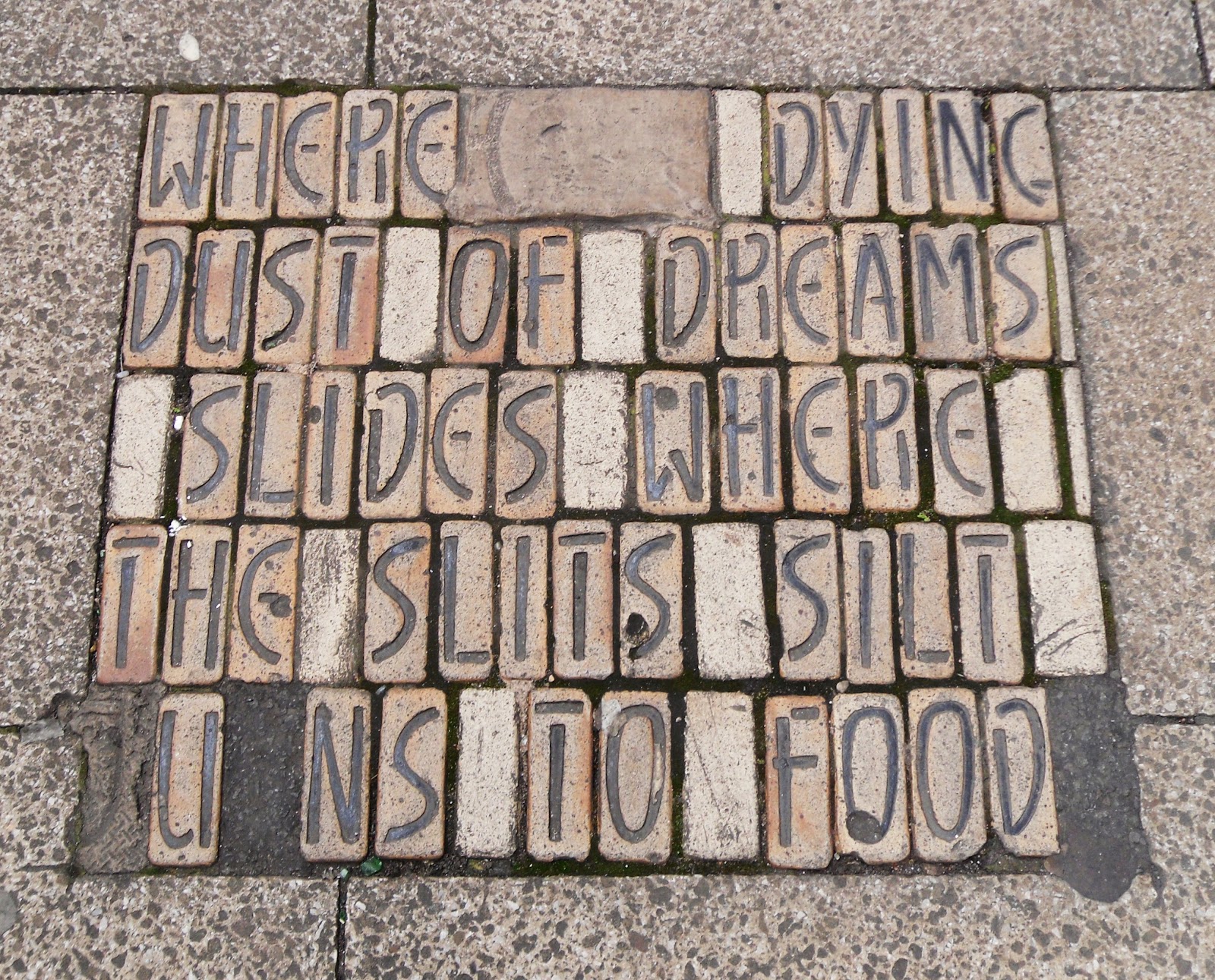
Lemn Sissay's poem 'Flags' is written into the sidewalk of Tib Street, Manchester, from Market Street toward Swan Street, and stretches a little less than a mile, on the righthand side of the street only. Sometimes, where stones have disappeared, you have to guess the missing letters, which is usually easy, but very occasionally comprehension is impossible. Sometimes you have to kick aside cigarette ends to read more clearly, or wait for a momentarily parked car to move. This is living poetry, uncertain poetry, where people oblige by walking into the road as you take your photo, but no one stares at you, you merge with the life of the street.

Occasionally, I may have gotten something wrong, and I'm sure someone will tell me so, knowing I won't mind. I could, of course, pretend that the error was deliberate. And then, perhaps the person who laid the stones got something wrong, or the poet is occasionally mischievous. Just to keep us on our toes.

 Lemn Sissay

THESE PAVEMENT CRACKS
ARE THE PLACES WHERE
POETS PACK THEIR
WARRIOR WORDS

THESE PAVEMENT
CRACKS ARE THE
PLACES WHERE
SLEEPING SHADOWS
OF MOVING
BRIDGES STOLE


WHERE DYING
DUST OF DREAMS
SLIDES WHERE
THE SLITS SILT
TURNS TO FOOD

WHERE HOME
TRUTHS TRICKLE
HOME AND CONFIDE
WHERE THE SILENT
FORESTS BROOD


WHERE SPINES BENT
?? THE BRIDGES
ARCHES WHERE THEY
VAULTED WITH A
SICE(?) TO ? SPEAK

AND UNITY SOWN
ON TO THE SKIN
OF ALL TRADES
PERHAPS THEYRE
A SCRIPT WORDS
OF THE STREET

PERHAPS THESE PAVEMENT
CRACKS ARE THE PLACES
AWHERE FLATTENED FLAGS
LIES SOLIDIFIED WAVES

THE TELLING LINES
WITHIN A SEA OF FACES
WHERE SUFFERERS
TAKE COVER
OF STREET CAVES

WHERE WANDER THE
WAYWARD AND LOST
WHERE THE RUNAWAY
CAN CHART HIS
JOURNEY BACK HOME

WHERE THE WATER RUNS
AS THE WORLD DEFROSTS
THE STREET BREATHES
BENEATH THIS STONE

AND PERHAPS THE
PAVEMENT CRACKS ARE
THE PATTERN OF
CONCRETE BUTTERFLIES

WHERE THOUGHTS
CAREFULLY
CULTIVATED
WAITING TO
WAKEN GROW
WINGS AND FLY

LIKE US THEY HOLD

THE PEOPLE OF A
MODERN EARTH
THIS WORLD
BETWEEN THE
WINDSWEPT FLAGS

WHERE PAVEMENT
CRACKS ARE THE
PLACES WHERE
SLEEPING SHADOWS
OF MOVING
BRIDGES STOLE
THE COLD

ADDENDUM: Lemn Sissay has now won the vote for Chancellor of the University of Manchester. Phew! I'm very pleased to say he easily beat the horrendous Peter Mandelson: we don't want dinosaurs, especially hypocrites like the architect of New Labour!
 
Links to my other posts of Lemn Sissay public poems are given below:

–––––––––––––––––––––––––––––––––––
Lemn Sissay's Poetry in Manchester
The Art of Michael Visocchi and Lemn Sissay in London
Hardys Well and Lemn Sissay's Poem
Lemn Sissay's 'RAIN'

18 July 2011

Sir Walter Scott and Peveril of the Peak, Manchester

The Peveril of the Peak is a Grade II listed building in Great Bridgewater Street, Manchester, which was rebuilt in about 1900: the previous pub was built in 1829. A number of places on the internet state that its name comes from the Manchester to London stagecoach of the same name, although this is at odds with the inn sign.

I'm no costume historian, but this, I'm sure, isn't Sir Walter Scott's Sir Geoffrey Peveril from the 17th century, aka Peveril of the Peak from his 1823 novel of the same name. In fact, the more I look at it, the more it seems easily a few centuries before that. Anyway, this guy wouldn't know a stagecoach from a jetplane, and the building to our right, judging from a reconstruction I've seen, is almost certainly Peveril Castle in Derbyshire. So maybe William Peveril, the original owner, who of course wasn't Scott's Peveril of the Peak, but...

And the tilework is lovely.

Hardys Well and Lemn Sissay's Poem

Hardys Well is a pub just south of the Curry Mile, Wilmslow Road, Rusholme, Manchester.

Lemn Sissay believes that 'poetry is central to what we do', and that poetry should be seen on the street in the same way as sculpture is. One evening, talking to his friend Mark Atwood in this pub, the manager challeged him to write a poem  on the wall.

The result is below: quite a masterpiece of street art in the pub garden, complete with benches and old red phonebox. The only thing is, by the look of the abundant vegetation around the locked gate, I strongly suspect that the pub is now closed. If this is the case, it's a bit of a blow to Lemn Sissay's idea of poems as landmarks.

'HARDYS WELL
WAIT WATERLESS WANDERER. WHOEVER WALKS
TO THE WELL WILL WADE INTO A WONDEROUS WORLD.
A WORLD WHICH WILL WAKEN THE WILTING
WALLPAPER OF WORK AND WORRY. WELL? WORRY
WILL WAIT WHILE WELLS WAND WHIRLS A WARM-
HEARTED WACKINESS INTO A WEARY WEEK.
WHEREAFTER WAVES AND WATERFALLS OF
WONDERMENT WILL WASH ALL WEAKNESS. A WAY?
WELL? A WORLD WIDE WEB OF WHOLEHEARTED
WHOLESOME WISDOM AND WIT WAITS WIPE AWAY
WORRIES. WELLS WORKS WONDERS FOR WRINKLES.
WHY WAIT. WHY WONDER. WHY WORRY. WHY
WAIN. WHY WHITTLE. WHY WITHER. WALK IN. WELL.
WHAT ARE WE WAITING FOR. IT'LL DOUBLE YOU. AT
HARDYS WELL.'
LEMN SISSAY

ADDENDUM: Lemn Sissay has now won the vote for Chancellor of the University of Manchester. Phew! I'm very pleased to say he easily beat the horrendous Peter Mandelson: we don't want dinosaurs, especially hypocrites like the architect of New Labour!

Links to my other posts of Lemn Sissay public poems are given below:

–––––––––––––––––––––––––––––––––––
Lemn Sissay's Poetry in Shudehill, Manchester
The Art of Michael Visocchi and Lemn Sissay in London
Lemn Sissay's 'Flags', Tib Street, Manchester
Lemn Sissay's 'RAIN'

Lady Carolina Nairne and The Lass O' Gowrie, Manchester

The Lass O' Gowrie is in Charles Street, Manchester, in an area formerly known as 'Little Ireland', although legend has it that the first landlord was Scottish and homesick, and named the pub after his favorite poem, by Lady Carolina Nairne (1766-1845), who was born in Gask, Perthshire.

The Lass O' Gowrie

'Twas on a simmer's afternoon,
A wee afore the sun gaed down,
A lassie wi' a braw new goun
Cam' owre the hills to Gowrie.
The rosebud washed in simmer's shower,
Bloomed fresh within the sunny bower;
But Kitty was the fairest flower,
That e'er was seen in Gowrie -
To see her cousin she cam' there;
And oh! the scene was passing fair,
For what in Scotland can compare
Wi' the Carse o' Gowrie?
The sun was setting on the Tay,
The blue hills melting into gray,
The mavis and the blackbirds lay,
Were sweetly heard in Gowrie.
- O lang the lassie I had wooed,
And truth and constancy had vowed,
But could nae speed wi' her I lo'ed,
Until she saw fair Gowrie.
I pointed to my fither's ha'
- Yon bonnie bield ayont the shaw,
Sae loun that there nae blast could blaw:-
Wad she no bide in Gowrie?
- Her faither was baith glad and wae;
Her mither she wad naething say;
The bairnies thocht they wad get play
If Kitty gaed to Gowrie.
She whiles did smile, she whiles did greet;
The blush and tear were on her cheek;
She naething said, and hung her head,
But now she's Leddie Gowrie.
 
Perhaps a very rare example of a full poem on an exterior pub wall? See the next post.

17 July 2011

Alan Turing, Sackville Park, Manchester

Alan Turing, Sackville Park, near the Gay Village, Manchester. I have to be careful about posts on subjects I know nothing about, as there's always someone picking me up on errors. OK, I know nothing of Mathematics, and I've been corrected before about Alan Turing, as in my previous post here.


In his hand is an apple: he killed himself with a cyanide-laced one aged 41, after being forced to undergo 'treatment' for his homosexuality.

'Alan Mathison Turing
1912-1954
Father of Computer Science
Mathematician, Logician
Wartime Codebreaker
Victim of Prejudice'
________________________

'Mathematics, rightly viewed, possesses not only truth
but supreme beauty, a beauty cold and austere
like that of sculpture' - Bertrand Russell


'THE BEACON OF HOPE
The "BEACON OF HOPE" and "TREE OF LIFE" is [sic] dedicated to all those
who have lost their lives to HIV / AIDS and those living with and affected
by the virus. The Beacon is a permanent awareness of the
threat of HIV / AIDS to every individual person.
______________________________

'This project has been made possible thanks to the generous
contributions from:-
_______________________________

'Black HIV & AIDS forum; Body Positive North West; Clone Zone; Diana,
Princess of Wales Memorial Fund; George House Trust; Lesbian & Gay
Foundation;  Lifeline Project; Manchester City Council; Manchester Health
Authority; Manchester Lesbian & Gay Mardi Gras; Massow Financial
Consultants; Sackville Park Project; The Trafford Centre; The Village
Project; the Village enterprises who have held fundraising events for this
project, and not least all the customers who have supported this project.

'The Beacon of Hope was designed by
Warren Chapman and Jesse Byrne-Daniel.'


'THE TREE OF LIFE
This TREE was planted by the Lord Mayor and
the Lady Mayoress on behalf of the
Village charity, in memory of those lost to
HIV / AIDS

                                            World AIDS day 1st December 1993
________________________________________

'This area surrounding the TREE was improved
in the summer of 2000 as part of the
BEACON OF HOPE project.'

15 July 2011

Amélie Nothomb: Une forme de vie (2010)

Perhaps only four or five of Amélie Nothomb's novels can be classed as what the French term 'autofiction', but all of them contain elements of her life - for instance, she really did, as mentioned in Une forme de vie (translated as Life Form), write this article in The New York Times 2 April 2009, in which she praises Barack Obama but criticizes Nicolas Sarkozy. It is also well known that she has no internet connection, not even a computer, and that she writes - in longhand - to many people who write to her.

Amélie Nothomb's Une forme de vie is partly epistolary, the narrator sharing her name with the author as well as one of the two letter writers, the other letter writer being Melvin Mapple, a soldier in Iraq.

The character Amélie Nothomb is a writer, and Melvin Mapple begins a correspondence with her after reading all her books. Melvin is 39 years old, and had spent some time as a tramp before joining the army, which he did solely because he was sick of being hungry, and in the army he can eat as much as he pleases. His surname reminds us of the sugary maple syrup that millions of Americans pour on their daily breakfast waffles.

It is a fact that the number of military personnel diagnosed as overweight or obese has doubled since 2003, and the fictional Melvin is an extreme representative of one of these people. He believes food is a stronger drug than opium was in Nam, and finds overeating is a form of relief from the hell of war.

But he is not without self-disgust, and as a coping mechanism calls his obesity Scheherazade, imagining the young woman of One Thousand and One Nights, after the horrors of the day, lying on his impotent body and telling him soothing stories at night. But ashamed as he is of his unspeakably ugly body, he can't stop eating: sometimes, he imagines Scheherazade is one of the civilians he has killed, and it would be killing her a second time if he lost weight.

Plus, he sees his and other soldiers' obesity as a kind of sabotage, causing the government to spend enormous amounts of money on food, special outsize clothing, medical expenses, etc: yes, this novel is of course (if only in part) a criticism of the war on Iraq.

Melvin begins to fascinate her. For some reason, the character Amélie initially thinks that Melvin comes from the Mid-West, although he comes from Baltimore, Maryland, which - the narrator reminds us - is where the 'pope of Bad Taste' John Waters comes from, and where he sets all his movies. The character Amélie has previously informed us that someone sent her a shit-covered copy of one of her novels in the mail, and she is without doubt thinking here of The Marbles sending Divine a box containing a birthday card and a turd in Water's Pink Flamingos (1972), even of Divine eating dog droppings on the sidewalk toward the end of the movie.

(One movie that the author (and/or narrator) chooses not to mention - perhaps because too obvious - is Marco Ferreri's La grande bouffe, in which four characters decide to commit suicide by overeating.)

On Amélie's's prompting, Marvin decides to turn his body into an art form and take regular photos of it. When she tells him that a gallery(-cum-café) wants a recent photo of him, he sends Amélie a grotesque naked shot, his genitals hidden by layers of fat. But when a photo of him in uniform is asked for, he runs for cover.

The reason is because, well, he's a liar and has never been a soldier: they rejected him because of his obesity.

But it's when the reader finishes the book and looks at the cover and the title that he or she starts to wonder who the really mad person is. And if the title relates to both of the characters.

My Amélie Nothomb posts:
––––––––––––––––––––––––––––––––––––

Amélie Nothomb: Autobiographical novels
Amélie Nothomb: Hygiène de l'assassin
Amélie Nothomb: Robert des noms propres
Amélie Nothomb: Les Combustibles
Amélie Nothomb: Antichrista
Amélie Nothomb: Tuer le père
Amélie Nothomb: Le fait du prince
Amélie Nothomb: Péplum
Amélie Nothomb: Le voyage d'hiver
Amélie Nothomb: Une forme de vie
Amélie Nothomb: Acide Sulfurique
Amélie Nothomb: Mercure
Amélie Nothomb: Journal d'Hirondelle
Amélie Nothomb: Attentat
Amélie Nothomb: Cosmétique de l'ennemi
Amélie Nothomb: Les Catilinaires

9 July 2011

Robert Coover: Spanking the Maid (1982)

Robert Coover's Spanking the Maid seems quite a provocative title and the cover image suggests porn, and it's just a novella with large font size and broad margins, as if designed for people who don't read a great deal. But.

There's a lot of repetition in this, although it's not for nothing. There are just two (unnamed) characters here – the maid and the master – and it's not certain (in spite of the rear cover blurb) if the events in this novella take place in one day or over a large number of days. There are what appear to be many re-takes, as in the making of a movie, when the maid enters the room, but can never get it perfect, so she has to re-try, re-try, and so on: the influence of French literature and cinema, particularly the nouveau roman, is blindingly obvious.

The master is a perfectionist and is never satisfied with the maid's performance, so she's punished for making a mistake, and the master beats her on her (usually naked) 'sit-me-down' with various instruments, such as a birch rod,  a bull's pizzle, his belt, his hands, etc. If this takes place 'each morning', as the rear cover suggests, then how is it that the maid's welts heal up so quickly, how is it that – even if this apparent madman may be paying her well – she still comes back for more extreme violence to her 'sit-me-down', thus risking her health and perhaps even her life? Or is she just a part of the master's dream? What is this relationship in this one-room apartment (or hotel room) that so much resembles Hamm and Clov's interdependent hell in Beckett's Endgame?

There's no obvious mind and body duality in Spanking the Maid as could be said to exist in Endgame, but there is a series of other dualities: master and servant, night and day, light and dark, teacher and student, punishment and reward, life and death, order and chaos, pain and pleasure, etc.

Religion is important, and the maid memorizes hymns such as George Herbert's 'The Elixir' to help her toward her perception of perfection, which her master has 'taught' her, and she not only comes to hope (against hope) for this unrealizable ideal, but seems to see a direct link between God and the master, as the master must clearly do, and he seems to take all his beliefs from an unnamed (and very mysterious) manual, in spite of his apparently half-hearted moral self-questioning.

And what of the odd things the maid finds in the master's bed? Maybe a simple crushed flower, or a bull's pizzle, or a bloody pessary, or a frog, or a fetus?

A tiny book with a mass of unanswered questions. A gem.

My other post on spanking:

––––––––––––––––––––––––––––––––––––
Jean-Pierre Enard (Text), Milo Manara (Drawings): L'Art de la fessée | The Art of Spanking

8 July 2011

Emanuel Litvinoff: Journey through a Small Planet (1972)

Emanuel Litvinoff (born 1915) grew up in the interwar years in a Jewish working-class community in the borough of Bethnal Green, in the East End of London, and this is his account of his childhood. Or rather, it's a fictionalized account, of course, as is any memoir, but there's a great deal of dialog in it (including the obligatory liberally strewn Yiddish vocabulary for authenticity/color, etc) that automatically makes it read as fiction.

Divided into twelve sections, the book broadly traces the development of Emanuel Litvinoff (apart from the first section - 'Ancestors' - where the first person is not present) from childhood as part of a one-parent family, through his relationship with his mother's live-in lover, school, first loves, technical college, work, sexual frustration, and so on.

Although some of the sections contain characters encountered before, there is no sense of continuity other than the obvious passage of time, and each could be read as a self-contained entity, with no loss of comprehension: these are cameos of Jewish life in an East End that's long since gone.

Dave Eggers: What Is the What (2006)

The full title of Dave Eggers's book is What Is the What: The Autobiography of Valentino Achak Deng: A Novel. It's a fictionalized account, based on what Deng told Eggers, of the early life story of one of the Lost Boys of Sudan, who were boys displaced from their homes during the Second Sudanese Civil War (1983-2005).

Achak is first forced to leave Marial Bai, his village in northern Bahr Al-Ghazal - which is populated by the Dinka (or Muonyjang) people - by the invading northern Arab forces. It's a kind of picaresque novel, although the narrative essentially consists of two intertwined strands: the present tense in Atlanta, Georgia, where Achak is robbed and violently attacked, and where we see the aftermath; and the past tense in Sudan, Ethiopia, and Kenya, where Achak develops from a young boy to a young man.

In the pillaging of Marial Bai, Achak is forced to separate from his parents, and will not learn of their whereabouts until toward the end of the novel. With a growing number of boys in a similar predicament, they slowly make their very hazardous way to a refugee camp in Pinyudo, Ethiopia, where Achak lives for several years until he's forced to move on again: this time, it's civil war in Ethiopia.

Eventually, after another hazardous journey, Achak reaches another refugee camp - in Kakuma, Kenya, where he spends some years and learns that his parents are still alive. But he doesn't visit them, as he's chosen for a resettlement program in the United States. Instead, he phones his father, who orders him to accept: that is the What.

On the front flap of my copy Gayle E. Smith, Senior Fellow of the Center for American Progress and former Senior Director for African Affairs at the National Security Council, says the reader will discover 'more depth and insight here than in any news report or policy paper'. Certainly, it very often felt as though I was privy to insider information on the resourcefulness of the refugees in the camps.

A very powerful, enthralling read.


4 July 2011

Amélie Nothomb: Acide Sulfurique (2005)

Acide sulfurique is probably the strongest social criticism Amélie Nothomb has so far made, and it is significant - bearing in mind that she is so suspicious of the internet that she doesn't even have a connection - that this criticism should involve modern technology.

The date is uncertain, but definitely the future, and probably the near future, when reality TV has almost exhausted any new permutation to stimulate viewing figures. Until, that is, television executives, with the complicity of the government, invent Concentration, the program that will make viewing figures hit the ceiling: in this, they kidnap people off the street to play out the role of victims of Nazi-style concentration camps. But there's a vital extra factor involved: the television studios are real concentration camps, and the victims are starved and beaten by paid fascist guards, and sent to their death.

There are similar themes in this book to Nothomb's others: the juxtaposition of good and evil, beauty and ugliness, monsters and saints; the (mentioned or unmentioned) metafictional references - Sartre's Huis clos yet again, but also Maupassant's Boule de suif; and there are prolonged crucial dialogs between the two main characters.

We are also implicitly reminded - probably via Michel Foucault, or George Orwell's telescreen - of Jeremy Bentham's panopticon, the ever-present eye in the totalitarian world.

In Acide sulfurique - for the viewer - Kapo Zdena is the most hated pyschopathic employee, and Pannonique (now known as 'CKZ 114') the most loved prisoner. We sense that Pannonique will soon meet her death, but it is made perfectly clear who the real murderers are: not the television executives, not the government, but the ordinary viewers, the ghouls who perpetuate this system by continuing to watch.

Slowly, Kapo Zdena - who doesn't even possess a TV - comes to share the audience's sympathies and loves the beautiful CKZ 114, slipping her chocolate, merely pretending to beat her, but it's not enough for Pannonique, as the same rules should be applied to all the prisoners, and she will not submit to the sexual blackmail of Kapo Zdena under any circumstances.

And eventually, Pannonique's intelligent but hair-raisingly risky tactics pay off and Kapo Zdena is in her magnetic power, which is strong enough to change the nature of reality. Or at least reality TV. By sheer bluff - forget the sulphuric acid.

My Amélie Nothomb posts:
––––––––––––––––––––––––––––––––––––
Amélie Nothomb: Autobiographical novels
Amélie Nothomb: Hygiène de l'assassin
Amélie Nothomb: Robert des noms propres
Amélie Nothomb: Les Combustibles
Amélie Nothomb: Antichrista
Amélie Nothomb: Tuer le père
Amélie Nothomb: Le fait du prince
Amélie Nothomb: Péplum
Amélie Nothomb: Le voyage d'hiver
Amélie Nothomb: Une forme de vie
Amélie Nothomb: Acide Sulfurique
Amélie Nothomb: Mercure
Amélie Nothomb: Journal d'Hirondelle
Amélie Nothomb: Attentat
Amélie Nothomb: Cosmétique de l'ennemi
Amélie Nothomb: Les Catilinaires

3 July 2011

Lord Byron and Newstead Abbey, Nottinghamshire, England

Obviously, people tend to miss the obvious, which is one of the reasons why - in all my literary rambles  - I've left off looking at Newstead Abbey in Nottinghamshire, which was briefly in the ownership of George Gordon, the sixth Lord Byron (1798-1824), who of course was the famous poet.

He left Aberdeen for Nottinghamshire with his mother at the age of ten, very shortly after the death of his great-uncle William - the 'Wicked Lord' - had resulted in his inheritance, which was some years before Lady Caroline Lamb made the famous 'mad, bad and dangerous to know' remark. And yet, sex was far from unknown to Byron even in his very early Scottish period: his friend John Cam Hobhouse wrote after his death: 'When [Byron] was nine years old at his mother's house a free Scotch girl used to come to bed with him & play tricks with his person'.

The former priory was dissolved in 1539, and was in the possession of the Byron family for nearly 300 years.

Byron sold Newstead in  1817 to Thomas Wildman, who restored it to some of its former splendor.
Byron's Oak was planted by the poet on his possession of the property, but as it was dying in the first quarter of the 20th century, it was cut down.
To commemorate the 200th anniverary of Byron's birth, the Earl of Lytton, one of his descendants, planted an oak there in 1988.

Byron's beloved Newfoundland dog Boatswain died of rabies in 1808, and Byron erected this monument to him.

'Near this Spot

are deposited the Remains of one
who possessed Beauty without Vanity,
Strength without Insolence,
Courage without Ferosity,
and all the virtues of Man without his Vices.
This praise, which would be unmeaning Flattery
if inscribed over human Ashes,
is but a just tribute to the Memory of
BOATSWAIN, a DOG,
who was born in Newfoundland May 1803
and died at Newstead Novr. 18th. 1808.

'When some proud Son of Man returns to Earth,
Unknown by Glory, but upheld by Birth,
The sculptor’s art exhausts the pomp of woe,
And storied urns record who rests below;
When all is done, upon the Tomb is seen
Not what he was, but what he should have been.
But the poor Dog, in life the firmest friend,
The first to welcome, foremost to defend,
Whose honest heart is still his Master’s own,
Who labours, fights, lives, breathes for him alone,
Unhonour'd falls, unnotic'd all his worth,
Deny'd in heaven the Soul he held on earth:
While man, vain insect! hopes to be forgiven,
And claims himself a sole exclusive heaven,
Oh man! thou feeble tenant of an hour,
Debas'd by slavery, or corrupt by power,
Who knows thee well must quit thee with disgust,
Degraded mass of animated dust!
Thy love is lust, thy friendship all a cheat,
Thy tongue hypocrisy, thy heart deceit,
By nature vile, ennobled but by name,
Each kindred brute might bid thee blush for shame.
Ye, who perchance behold this simple urn,
Pass on, it honours none you wish to mourn,
To mark a friend’s remains these stones arise;
I never knew but one – and here he lies.'

Slightly to the north of Eagle Pond is a dip in the North Terrace wall.

Below this was Forest Pond, called 'American Lake' by the Byrons.

The Rock Garden, with its small stream and 'underground passage', is also known as Venetia's Garden.

This second name has a literary provenance: Benjamin Disraeli's novel Venetia (1837).

The Wicked Lord extended the upper part of the lake and built a cannon fort, from which he played battles using real ammunition.

The mock fort on the opposite side by the former stable block - that is, the same side as the abbey - also played a part in the game.

Following Wildman's death, his widow sold Newstead to William Frederick Webb in 1861, and tourists were allowed into the grounds. In 1931 Nottingham City Council came into possession of Newstead Abbey. Very recently, hours of admission to the house were limited - a far from popular decision.