17 September 2012

Jarvis Cocker's Poem on a Wall in Sheffield

Always well respected for his lyrics with Pulp or as a solo artist, it's hardly a surprise that Jarvis Cocker should have been chosen to make a contribution to the Off the Shelf literary festival in 2005. That his poem 'Trashed on Cider' should be placed in huge brushed steel letters on The Forge student accommodation building in Boston Street, Sheffield, is surprising, though. But it looks good:

'Within these walls
the future may be
being forged
Or maybe
Jez is getting trashed

on cider
But when you melt
you become the shape
of your surroundings:
Your horizons

become wider.
Don't they teach
you no brains
at that school?'


Jarvis Cocker
Off the Shelf 2005

14 September 2012

Ebenezer Elliott in Rotherham, Sheffield and Darfield

The poet Ebenezer Elliott was born in Masbrough, Rotherham, now in South Yorkshire. Neville Northey Burnard (1818–1878) sculpted this statue which is in Weston Park, Broomhill, Sheffield. It originally stood in the centre of Sheffield from 1854 to 1874.
 
An information panel on front of the sculpture gives a brief biography of Elliott, mentioning his campaign against the Corn Laws which increased the price of bread (which he called 'the bread tax'), and of his nicknames: 'The Paupers' Poet' and 'The Corn-Law Rhymer'. He is most remembered for his Corn Law Rhymes (1831).
 
In 1846, three years before Elliott's death, the Corn Laws were repealed.

It's probably a mark of how well known Elliott was that the base of this structure simply gives his surname, and this was the simple title of John Greenleaf Whittier's poetic tribute to him. The plaque includes part of John Betjeman's poem 'An Edwardian Sunday, Broomhill, Sheffield':
 
'Your own Ebenezer
Looks down from his height
On back street and ally
And chemical valley
Laid out in the light;
On ugly and pretty
Where industry thrives
In this hill-shadowed city
Of razors and knives'.
 
 
 Elliott lived here, 22 Blake Grove Road, Upperthorpe, Sheffield, from 1834 to 1841.

 
'"Harvest" by Martin Heron 2009

The sculpture situated on Bradgate Roundabout
commemorates the industrialist, philanthropist and poet
Ebenezer Elliott who was born in Rotherham in 1781.
He died 1849 and is buried at Darfield near Barnsley.

A passionate campaigner on behalf of the poor and oppressed
Elliott's indignation against the Corn Laws of 1815–1846
inspired his famous Corn Law Rhymes which made him nationally
and internationally famous after their publication in 1831.
 
WHEN wilt Thou save the people?
O God of mercy! when?'
 
I don't know if it's just me, but I find it slightly odd that the plaque – just outside Bradgate Park, Kimberworth, Rotherham, and facing the roundabout – doesn't state the obvious: that the artwork represents ears of corn. The sculpture is at the junction of Wortley Road and Meadow Bank Road, and the traffic junction has now in fact been renamed Rhymer's Roundabout.
 
Another tribute to Elliott, this time in the centre of Rotherham, is Wetherspoon's The Corn Law Rhymer on the High Street, which was opened in 2009.

A very similar painting to this is attributed to John Birch. 
 
All Saints Church, Darfield, South Yorkshire.
 
And Elliott's grave lies in the churchyard.
 
'EBENEZER ELLIOTT
DIED DECEMBER 1ST 1849
AGED 68 YEARS.'

On the other side of the tombstone:

'FANNY GARTSIDE
HIS WIFE
DIED DECEMBER 4TH 1858
AGED 75 YEARS.'

 
'Ebenezer Elliott, Corn Law Rhymer: Poems of Sheffield and Environs,', edited by Agnes Lehoczky and Adam Piette, is linked below.

–––––––––––––––––––––––––––––––––––
Ebenezer Elliott, Corn Law Rhymer: Poems of Sheffield and Environs

13 September 2012

W. H. Hudson in Hyde Park: London #28

On the other side of the Serpentine from Kensington Gardens is Hyde Park, which at the time we visited over two weeks ago was difficult to negotiate as it was full of Olympic Games nonsense, but we eventually found what we were looking for – the W. H. Hudson memorial.

'THIS SANCTUARY FOR BIRDS
IS DEDICATED
TO THE MEMORY OF
W. H. HUDSON,
WRITER & FIELD NATURALIST'
 
The sculpture is inaccessible because it is in an enclosure. On one side of the central portrait, in Roman numerals, is the year of Hudson's birth – 'MDCCCXLI' – and on the other the year of his death – 'MCMXXII'. In the middle is a representation from Hudson's most famous novel, Green Mansions: A Romance of the Tropical Forest (1904). In the novel, Abel, a young adventurer from Venezuela, goes into the forests of Guyana and finds the mysterious Rima, a girl who can communicate with birds. Inevitably, they fall in love.

Jacob Epstein sculpted this beautiful memorial, which was unveiled in 1925 and resulted in quite an outcry. An avant garde creation in a public place was perhaps bound to cause something of a stir. But it was beyond any doubt the exposure of Rima's breasts and the sexual suggestion – that bird's upturned beak does look wonderfully phallic, for example – that more than anything offended the sensibilities of a public that still hadn't come to terms with the fact that the Victorian era was over.
 
Leap-frogging back in time to someone noted for sex scandals before the Victorian era, this statue of Lord Byron by Richard Claude Belt in 1880 – with his beloved dog Boatswain at his side – is just outside the entrance to Hyde Park. Unfortunately it is on a traffic island which was much too busy for me to even consider approaching, so I had to be content with this rather distant shot.

Below is a link to the full text of the novel.
 
–––––––––––––––––––––––––––––––––––
Green Mansions: A Romance of the Tropical Forest, by W. H. Hudson

Peter Pan in Kensington Gardens: London #27

 
'PETER PAN
The boy who would not grow up
Sculptor Sir George Frampton R. A. 1860 – 1928
 
This bronze, a gift of Sir James Barrie OM 1860 – 1937
the creator of Peter Pan, was placed here
1st May 1912'

The representation of Peter Pan standing on a tree stump was Barrie's surprise 'May-day gift' to children, and he had been planning it for some time: several years previously Barrie had the young Michael Llewelyn Davies dress up as Peter Pan for him to photograph so that the author could give the future sculptor a good idea of his intentions.

Around the base are a number of fairies and animals, although I'm not too certain what this one is doing.

Two fairies are delighted by a friendly squirrel.

This fairy seems surprised or enraptured.

This fairy seems spellbound by something, and she appears to be looking up Peter's tunic.

A family of mice near the bottom of the statue.

And a rather cute rabbit.
 
Below is a link to the book which is also the title of my blog post, plus a link to another post I made about Barrie.

–––––––––––––––––––––––––––––––––––
Peter Pan in Kensington Gardens, by J. M. Barrie
J. M. Barrie in Nottingham

The Charles Kingsley Water Trough: London #26

This water trough is next to a bus stop near the Roundhouse on Chalk Farm Road and bears the inscription 'METROPOLITAN DRINKING FOUNTAIN AND CATTLE TROUGH ASSOCIATION' on the side facing the road.
 
On the south-east-facing side the inscription is 'IN MEMORIAM CHARLES KINGSLEY'. I know nothing of the history of this memorial, although I imagine that Kingsley's children's novel The Water-Babies: A Fairy Tale for a Land Baby (1863) played a large part in its conception.

12 September 2012

Riceyman Steps and Arnold Bennett, Clerkenwell: London #25

'Near this site
stood
Henry Earlforward's
bookshop in
Arnold Bennett's
1923 novel
Riceyman Steps
set in
Clerkenwell'
 
Gwynne Place is near the plaque on Kings Cross Road, and these are the steps that Bennett had in mind as 'Riceyman Steps', divided, as in the book, in two tiers, although there are more than Bennett's twenty.
 
 
Within a few yards of Granville Square ('Riceyman Square' in the novel), which is at the top of the steps, is this building in Lloyd Baker Street named 'Riceyman House' after the novel.

Ernest Dowson, Brockley and Ladywell Cemeteries: London #24


'IN MEMORY
––– OF –––
ERNEST CHRISTOPHER
DOWSON
WHO DIED 23RD. FEBRUARY AGED 32.'
 
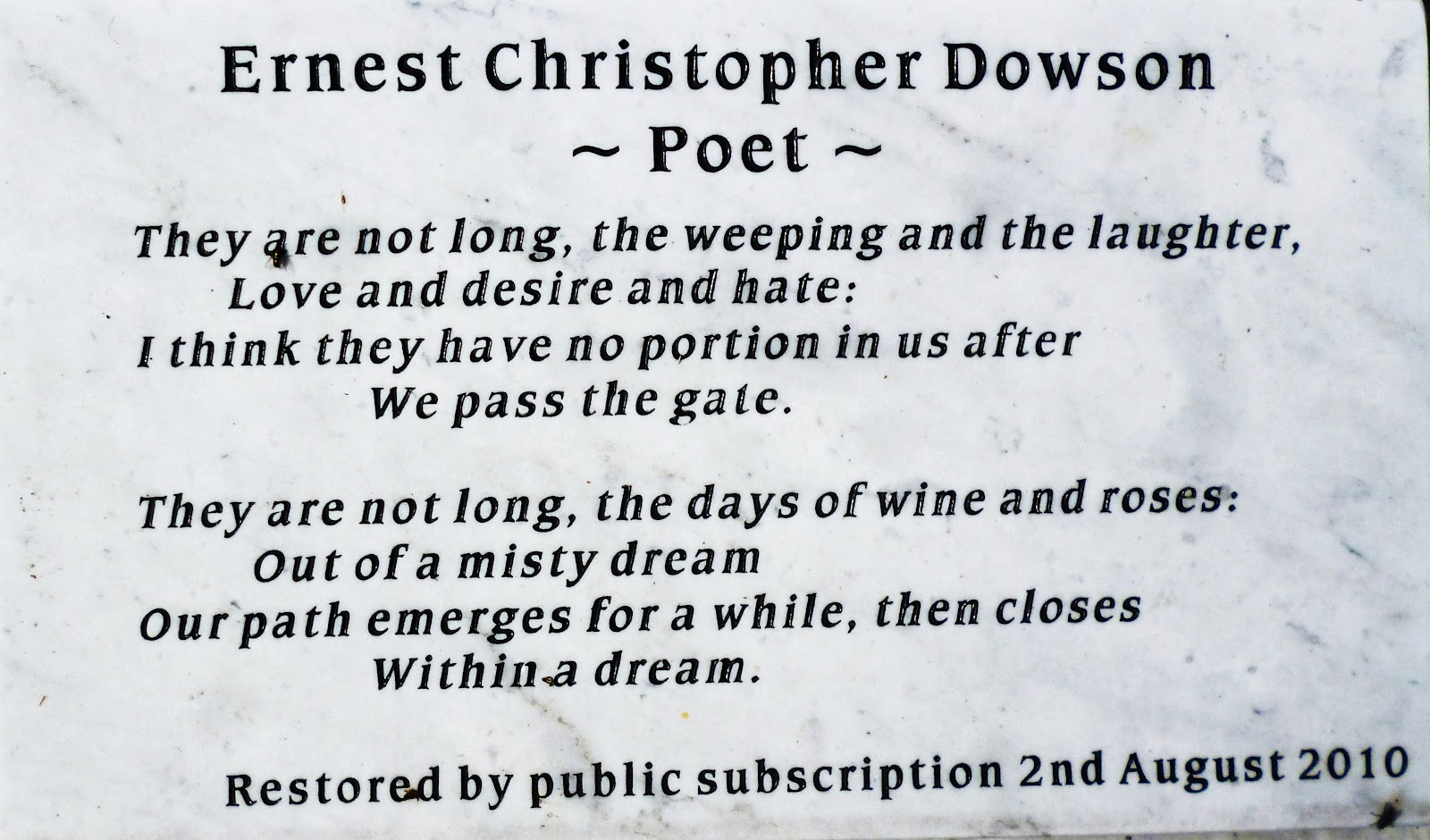
'Ernest Christopher Dowson
~ Poet ~
 
They are not long, the weeping and the laughter,
     Love and desire and hate:
I think they have no portion in us
     After we pass the gate.
 
They are not long, the days of wine and roses:
     Out of the misty dream
Our path emerges for a while, then closes
     Within a dream.*
 
     Restored by public subscription 2nd August 2010'
 
This is where I lacerated my legs on brambles: many parts of this cemetery are overgrown, and it's often difficult to find what you're looking for. The grave of the Cuban anarchist Fernando Tarrida del Mármol is apparently only a few yards from Dowson's grave, but in spite of having a photo of the grave with a number of other graves nearby, no amount of searching did any good. It was the same story with Welsh poet David Jones's grave, and after two weeks my legs still bear the scars.
 
 
In the end I decided to take a few shots of the most frequently mentioned grave here, which doesn't have a literary connection but is interesting: the story of Jane Maria Clouson's fate is given below.
 
 'To the Memory of
 
JANE MARIA CLOUSON,
A MOTHERLESS GIRL
WHO WAS MURDERED IN
KIDBROOKE LANE, ELTHAM,
ON THE NIGHT OF TUESDAY
THE 25TH OF APRIL 1871.
SHE WAS TAKEN TO GUY'S HOSPITAL
WHERE SHE DIED ON SUNDAY
APRIL 30TH 1871,
AGED 17 YEARS.
 
SHE WAS AGREEABLE IN MANNER,
AMIABLE AND AFFECTIONATE IN
DISPOSITION.
 
HER LAST WORDS WERE: "OH! LET ME DIE."
 
MAY GOD'S GREAT PITY TOUCH HIS HEART AND LEAD
MY MURDERER TO CONFESS HIS DREADFUL DEED,
THAT WHEN THE SECRETS OF ALL HEARTS ARE KNOWN,
GUILT AND REPENTANCE ALIKE MAY BE SHOWN.
 
THIS MONUMENT WAS ERECTED
BY PUBLIC SUBSCRIPTION.'
 
This was generally known as 'the Greenwich murder'. Clouson was beaten to death by hammer blows, and Edmund Pook, the son of her employer and with whom she was said to have been having a relationship, was tried for her murder but acquitted.
 
*'Vitae summa brevis spem nos vetat incohare longam', published in The Poems and Prose of Ernest Dowson (1900), and the title taken from Horace.

John Milton in St Giles without Cripplegate Church: London #23

St Giles without Cripplegate, within the Barbican complex, London.
 
 
John Milton was buried here in 1674. The statue is by Horace Montford.
 
'JOHN MILTON
Author of Paradise Lost
Born Decr. 1608.
Died Novr. 1674.
 
His Father JOHN MILTON,
Died March 1646.
They were both interred in this church.
SAMUEL WHITBREAD posuit 1793.'
 
Under this is an allusion to Paradise Lost: a flaming sword with a snake wrapped around it, an apple in its mouth.
 
Another bust of Milton, this time looking older and frailer.
 
 
The west window of the tower, showing in detail the Milton coat of arms.
 
There is also a bust of Daniel Defoe, who died in the parish in 1731.
 
John Bunyan, who attended the church, is also remembered.
 
'JOHN SPEED
1552–1629
Citizen and Merchant Taylor,
historian and map-maker
who was buried in this Church.
 
This monument, which was
badly damaged in 1940, was
restored by the Worshipful
Company of Merchant Taylors
in 1971.'
 
Below is a link to a related post I made earlier.

–––––––––––––––––––––––––––––––––––
John Milton's Cottage in Chalfont St Giles, Buckinghamshire

11 September 2012

Dr Johnson's House: London #22


'DR. SAMUEL
JOHNSON
AUTHOR
––––––––
LIVED HERE.
––––––––
B. 1709.
D. 1784.'
 
17 Gough Square, near Fleet Street, was Johnson's home from 1748 to 1759, and was where he wrote A Dictionary of the English Language.
 
The view from the stairs on the ground floor.
 
The parlour on the ground floor.
 
Francis Barber (c. 1735–1801), Johnson's servant (later assistant) from 1752 until Johnson's death. He was the main beneficiary of Johnson's will, and following his wishes, on his death went to live in Lichfield, Staffordshire, which was Johnson's birthplace.
 
Johnson's letter case, onto which a sketch of him and an example of his handwriting were later attached.
 
A 20th century souvenir brass door knocker with Lichfield Cathedral at the top, and beneath is a representation of Boswell first meeting Johnson in Tom Davies's bookshop in 1763. On lifting the knocker, a representation of Johnson's cat Hodge appears.
 
A Royal Doulton spirit flask originally produced in 1909 to commemorate the bi-centenary of Johnson's birth. Copies of it were once sold in the pub Ye Olde Cheshire Cheese.
 
On the landing up the first flight of stairs is what is perhaps the most well-known feature of the house: Sparrow's 19th century stained glass portrait of Johnson, with Lichfield Cathedral to our left and Johnson's The Vanity of Human Wishes above.
 
Johnson had several bluestocking friends – a term said by Boswell to stem from the legware of writer Benjamin Stillfleet, who was much admired by these proto-feminists.  For more than 30 years Anna Williams was a friend of Johnson's, and the room on the right of the landing is named after her. This was probably her room: she was to stay with Johnson and his wife Elizabeth (or Tetty) while recovering from a cararact operation, although Tetty died before, the operation failed, and she still stayed in the house; but her temper was appalling. The painting is by Frances, the sister of Sir Joshua Reynolds.
 
The painting of the classicist Elizabeth Carter (1717–1806), who wrote many hours in a day and took snuff to keep herself awake. She became a friend of Johnson through the Gentleman's Magazine. Carter's friend Elizabeth Montagu paid for the painting by Katharine Read.
 
A jasperware Wedgwood brooch of Elizabeth Montagu.
 
Johnson married the widow Tetty, who was twenty years his senior, in 1935. She died before the publication of the Dictionary.
 
A whatnot, or portable stand for diplaying small ornaments, which belonged to Elizabeth Carter.
 
At the top of the next floor is a brick from the Great Wall of China: Johnson was fascinated by the wall. This was a donation to the museum.
 
To the right of the stairs, the Withdrawing Room: it was used by women after meals, and also for entertaining friends. There are many portraits around the room of people associated with Johnson.
 
The Reverend Hugh Blair argued with Johnson over the genuineness of the Ossian poems: Blair thought they were, Johnson thought otherwise.
 
Pasquale Paoli was a Corsican freedom fighter supported by Boswell and introduced to Johnson's circle when exiled in Britain.
 
The Reverend Samuel Parr was a great admirer of Johnson's and published a book of his aphorisms shortly after his death.
 
This comes from the Cock Tavern in Fleet Street, where it was known as Dr Johnson's dining chair, and was presented to the Johnson Club by co-founder T. Fisher Unwin. His widow remembered him by putting the plaque on it in 1939.
 
The room to the left of the stairs, now called the Will Room for obvious reasons, was a bedroom in Johnson's day, possibly used by the unqualified and poor physician 'Dr' Robert Levitt who had attended medical lectures in Paris. In London his patients were the poor who often paid him with cheap alcohol, meaning he returned drunk. And I photographed myself again,
 
A painting of Johnson, Boswell and Flora MacDonald by an unknown artist. Johnson and Boswell met MacDonald, noted for the part she played in helping Bonnie Prince Charlie to escape, in the Hebrides.
 
On the top floor is the Garret, where Johnson worked on his Dictionary. He originally thought that he could complete it in three years, but it in fact took him nine – a huge achievement for what is a major, groundbreaking work. As well as the expected Dictionary facsimiles, there are some interesting items in the Garret: above, for instance, is a pot lid modelled on an E. M. Ward painting depicting Johnson waiting for his patron Lord Chesterfield.
 
In World War II the house allowed the Auxiliary Fire Service (later to be the National Fire Service) to use it as a social centre. As a gesture of their appreciation, the National Fire Service presented this.
In the basement (once the kitchen area) is this bust of Johnson.
 
Dr Johnson's House is now a partner of the National Trust, which of course is not an organization noted for its sense of humour. However, in the lavatories there's an nice touch: synonyms of the word 'lavatory' (apparently) taken from Johnson's Dictionary.
 
 
Across the square from Dr Johnson's House sits a his pet cat Hodge.
 
And there oysters at his feet: Johnson used to feed Hodge a seafood that may be quite an expensive delicacy now, but was then cheap.
 
And nearby is Ye Olde Cheshire Cheese, which Johnson inevitably used to drink in.
 
Below are links to two other posts I've made on Johnson.
 
–––––––––––––––––––––––––––––––––––
Dr Samuel Johnson (1709-84) and Lichfield, Staffordshire

Dr Johnson, The Strand: London #31