26 October 2011

H. P. Lovecraft and Other Writers in College HIll, Providence, Rhode Island: Literary New England #14


'SAMUEL MUMFORD
HOUSE
1823-28
Moved from College St. 1959'
This house, now at 65 Prospect Street, was Lovecraft's last home, and was moved to make room for the Art List Building. He described this as Robert Blake's home in 'The Haunter of the Dark'.

 The Lovecraft monument, Prospect Street.

'Howard Phillips Lovecraft
(1890 – 1937)
U.S. Author

I never can be tied to raw new things,
For I first saw the light in an old town.
Where form my window huddled roofs sloped down
To a quaint harbour rich with visionings.

Streets with carved doorways where the sunset beams
Flooded old fanlights and small window-panes,
And Georgian steeples topped with gilded vanes –
These are the sights that shaped my childhood dreams.

Dedicated on the centennial of his birth
August 20, 1990
by
The City of Providence
Brown University
and
Friends of H.P. Lovecraft'

'Built for
HENRY SPRAGUE
                         1902'

100 Prospect Street is the address Lovecraft uses as 'Ward House' in 'The Case of Charles Ward Dexter'.

88 Benefit Street is the former home of the poet Sarah Helen Whitman.

The Stephen Harris House on 135 Benefit Street is the model for Lovecraft’s 'The Shunned House', which he called the Babbitt House.

144 Benefit Street has been mentioned as a possible model for Dr. Elihu Whipple's house in 'The Shunned House'.

But it's now called The Old Court, which offers bed and breakfast.

161 Benefit Street is to the left of the photo, and was the home of Lillian D. and Franklin C. Clark, Lovecraft's aunt and uncle.

Lovecraft greatly disliked the Colonial Apartments at 175–185 Benefit Street, which had replaced the countryside.

The funerals of both Lovecraft and his aunt Lillian took place here, at the former Knowles Funeral Home on 187 Benefit Street.

The Providence Athenæum at 251 Benefit Street was a favorite of Lovecraft's, and where Poe courted Sarah Helen Whitman.

Both Lovecraft and Edgar Allan Poe were fascinated by the graveyard of the Cathedral of St John on North Main Street.

Lovecraft often went to the small park in Congdon Street, where a huge statue of Roger Williams (1603–83), the founder of Providence and the author of A Key to the Language of America (1943), overlooks the city.

Williams was originally from Cowley, Middlesex, England, with a great interest in Native American languages.

22 October 2011

Some Writers of Provincetown, Cape Cod, Massachusetts: Literary New England #13

Provincetown harbor, Cape Cod, formed the backcloth to a number of writers' lives.
Commercial Street looks out onto the harbor, and has been the home of a number of writers. This is number 466, the former home of Mary Heaton Vorse.

'MARY HEATON VORSE
1882–1966
AUTHOR
WAR CORRESPONDENT
LABOR JOURNALIST
LIVED HERE'

Vorse lived here from 1908–66, the year of her death. She was involved with the famous Provincetown Players. In this post, I frequently paraphrase from the brochure 'Provincetown Historic Walking Tour', published in 2010 by the Provincetown Historical Commission and funded by the Provincetown Tourism Fund.

I've already mentioned Vorse in this blog in relation to her novel Strike(1930) – concerning the 1929 Loray Mill strike in Gastonia, North Carolina – although the brochure understandably only mentions her Time and the Town: A Provincetown Chronicle (1942), which states that she 'imbues her characters [...] with proletarian nobility'. Her house was owned by Captain Kibbe Cook.

File:Vorse-mary-heaton-1915.jpg
The above photo of Vorse is in the public domain: a 1919 passport photo.

 564 Commercial Street, the former home of Susan Glaspell:

'SUSAN
GLASPELL
1882–1948
NOVELIST
PLAYWRIGHT
LIVED HERE'

571 Commercial Street, the former home of John Dos Passos.

 'JOHN
DOS PASSOS
1896–1960
NOVELIST
LIVED HERE'

577 Commercial Street, Francis' Flats.

 'EUGENE
O'NEILL
1888–1953
DRAMATIST
LIVED HERE'

Quite by chance, I stumbled across this plaque:

'IN HOMAGE TO
EUGENE GLADSTONE O'NEILL
FOR HIS CONTRIBUTION TO
AMERICAN DRAMA
WRITTEN AT THIS SITE IN
THE YEAR OF OUR LORD
NINETEEN HUNDRED AND SEVENTEEN
WERE THE PLAYS:

"ILE"
"THE MOON OF THE CARIBEES"
"THE LONG VOYAGE HOME"
"IN THE ZONE"'

The above plaque stands on an exterior wall by the entrance to Atlantic House.
627 is the final house of literary interest on Commercial Street.

Now the Norman Mailer Center, the writer lived here from 1990 to his death in 2007. The Norman Mailer Writers Colony aims to honor Mailer's contribution to literature, and encourage future writers.

Finally, and moving away from Commercial Street, 27a Bradford Street was a barn that editor and bookseller Frank Shay turned into the Barnstormers' Theater (now a private residence) to maintain the spirit here of the Provincetown Players after their removal to New York, and writers linked to it are O'Neill, Vorse, and Harry Kemp.

Unfortunately, we were unable to locate the graves of Mailer, Vorse, and Hutch Hapgood in Provincetown Cemetery, nor Susan Glaspell's in Snow Cemetery, Truro, but hadn't really the time to spend on seeking out omissions too much. Nevertheless, many thanks to Provincetown Tourism Office for helping Penny so much.
 
Below is a link to a post I made on Mary Heaton Vorse's Strike!:
 
–––––––––––––––––––––––––––––––––––

20 October 2011

William Lloyd Garrison in Bennington, Vermont: Literary New England #12

'FIFTY FEET WEST OF THIS SPOT
WILLIAM LLOYD GARRISON
EDITED
THE JOURNAL OF THE TIMES
OCTOBER 3, 1828 – MARCH 27, 1829[.]
HITHER CAME
BENJAMIN LUNDY DECEMBER 6, 1828
TO ENLIST HIM IN THE CAUSE OF THE SLAVE.
GARRISON DEPARTED HENCE
TO LIFT UP IN BALTIMORE
THE BANNER
OF IMMEDIATE EMANCIPATION'

A detail of the representation of the printing press.

Toward the end of the afternoon we went for a coffee, and saw this mockingbird in the parking lot. The only excuse I have for publishing it here is that I really like it, and that it reminds me of Harper Lee, who reminds me of a number of things.

19 October 2011

William Edward Burghardt (or W. E. B.) Du Bois in Great Barrington, Massachusetts: Literary New England #10

'I WAS BORN BY A GOLDEN RIVER IN THE SHADOW OF TWO GREAT HILLS. FIVE YEARS AFTER THE EMANCIPATION PROCLAMATION.'
BIRTHSITE OF W.E.B. DUBOIS (1868-1963)
PREMIER ARCHITECT OF THE AMERICAN CIVIL RIGHTS MOVEMENT

ERECTED BY THE GREAT BARRINGTON HISTORICAL SOCIETY
1994'

Du Bois's mother, Mary Sylvina Burghardt, had married Alfred Du Bois in 1867 and they rented a small property near this site on Church Street. After some trouble from Mary's family, though, Alfred left to make his own way. In Darkwater, W.E.B. Du Bois remembered its clapboards, its five rooms, and the delicious strawberries at the back. It was demolished in 1897.

William went to meetings at the Town Hall on the corner of Main and Castle streets to gather news for the Freeman (which was later called the Globe), a newspaper from New York with a predominant African American circulation.

The ailing Mary moved to other rented accommodation in Church Street, at the rear of the Congregational Church on Main Street, which she joined. When she died in 1885, William moved in with his aunt on Main Street for a short time before going to Fisk University. This is one of three congregations that helped him financially.

Clinton African Methodist Episcopal Zion Church in Elm Court is the oldest black church building in Berkshire County. William returned to give a talk there in 1894. The following year, he became the first African American to earn a PhD from Harvard University. 

'W.E.B. DU BOIS
RIVER GARDEN

"The Housatonic River flows gently
as the first life stream of our town".
                               W.E.B. Du Bois, 1961'.

Robert Frost in South Shaftsbury and Bennington, Vermont: Literary New England #11

'ROBERT FROST STONE HOUSE MUSEUM
a literary landmark
So. Shaftsbury, Vermont

Founded by Carole J. Thompson and Dr. Peter J. Stanlis
September 29, 2002

With special thanks to our major donors [etc.]'

The front of the house Robert Frost lived in from 1920 to 1929.

The back of the house.

And back and side elevation.

The present museum is divided into three galleries, the first being the Robert Frost Room, which contains details of Frost's biography and several other features. The above bust of Frost is in bronze and was made by Leo Cherne in 1962. It is on loan from Elinor Frost Wilber.

A note about the sofa reads that this was originally in Robert Frost's town house in Cambridge, MA and passed through a few family hands until Frost's great-grandson Douglas Wilber gave it to the Stone House in 2008.

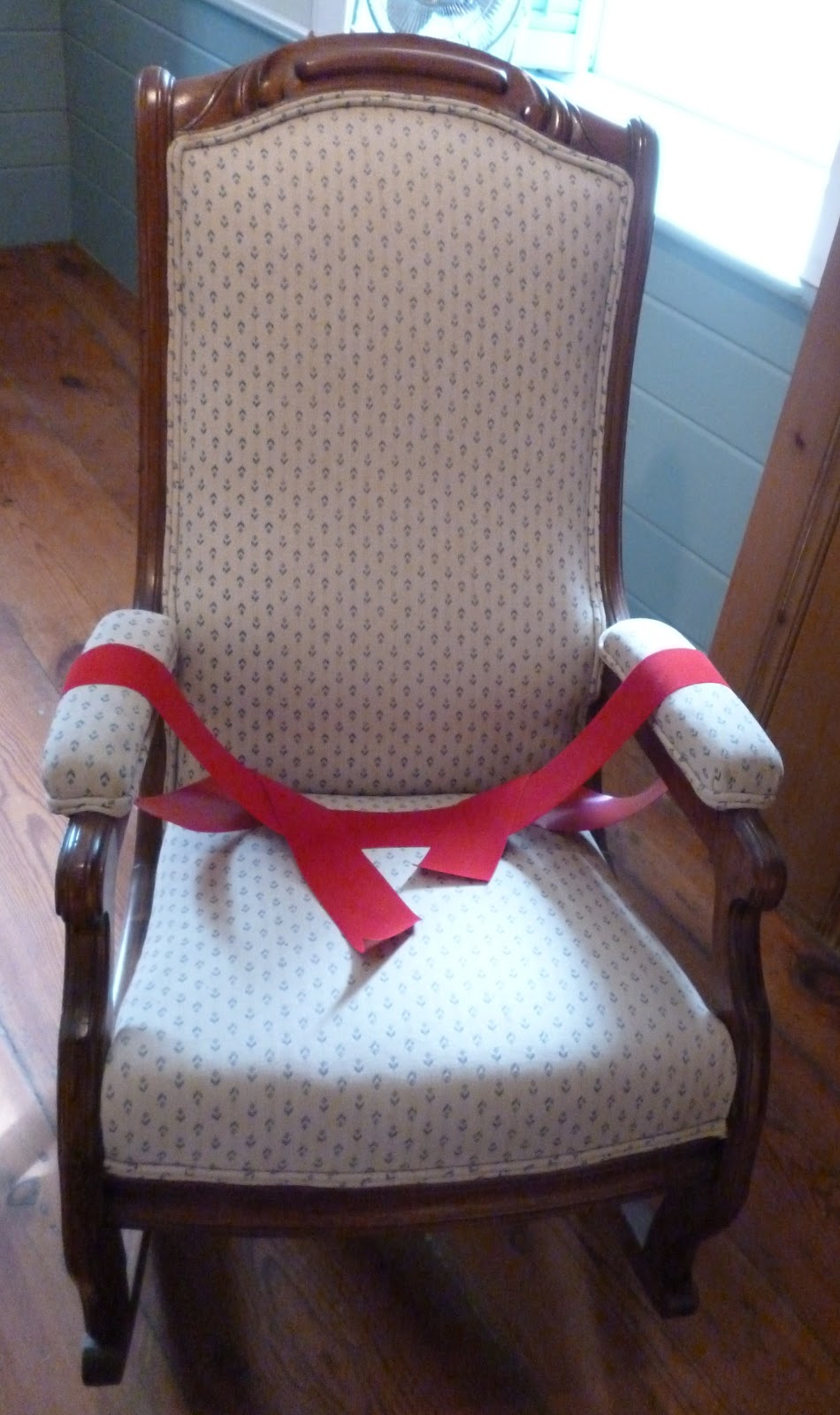
This was Frost's wife Elinor's rocking chair.

The central hall is dedicated to J. J. Lankes, a woodcut artist with whom Frost originally collaborated on a poem, leading to a long working relationship and lifelong friendship.

A few examples of Lankes's work for Frost.

Finally, I found the 'Stopping by Woods' room the most interesting. Frost wrote his famous 'Stopping by Woods on a Snowy Evening' in 1922 in this room while working on the title poem of his book New Hampshire.

The museum handout states that Frost said he wrote the poem 'pretty much at one stroke', although this manuscript replica, with all the poet's emendations, shows that Frost was exaggerating a little.

The entire room, as its title suggests, is dedicated to this poem, and along with details of Frost's iambic verse and his rhyming structure, there are details of Edward Connery Lathem's editing of Frost's punctuation.

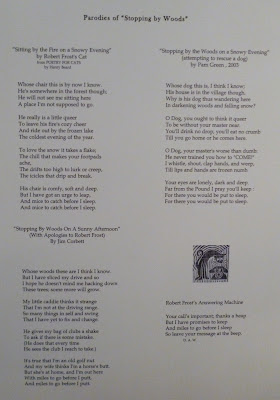
On a far less serious note, there are also examples of parodies of the well known poem.

And a Christmas card of the poem designed by Frost's grand-daughter Robin Fraser Hudnut for her aunt Jeanne Fraser Blackford.

In the center of the room, Frost's original chest of drawers that was in this room.

Still in Vermont, although a few miles down the road in Bennington, is the town cemetery with the Frost family grave.

'ROBERT LEE FROST
MAR. 26, 1874 – JAN. 29, 1963
"I HAD A LOVER'S QUARREL WITH THE WORLD."'

Elinor died a number of years before him:

'ELINOR MIRIAM WHITE
OCT. 25, 1873 – MAR. 20, 1938
"TOGETHER WING TO WING AND OAR TO OAR."'

And their children.