20 May 2010


15 May 2010
Robert Altman's Popeye (1980) Film Set, Sweethaven, Anchor Bay, Malta
Libellés :
Altman (Robert),
Anchor Bay (Malta),
Malta,
Movies,
Popeye,
Sweethaven

 The village Sweethaven in Anchor Bay created for Robert Altman's film Popeye has been preserved and turned into a museum. Critically, Popeye was seen as Altman's Heaven's Gate, and the director never made another big budget film of the like, although it was extremely popular with the general public.
 Two interior views of the General Store.
 The Post Office.
 The Barber Shop.
 Inside the café-bar, Tipsy & Sons Winery.
 The Sweethaven logo of the wine on sale there.
 And the tranquil Anchor Bay, which the village looks out onto.
13 May 2010
Achille Mizzi, Malta
Libellés :
Malta,
Maltese Literature,
Mizzi (Achille)
 There are a number of poems by and reviews of Achille Mizzi's work here both in English and Maltese.
12 May 2010
John Askham and Wellingborough, Northamptonshire
Libellés :
Askham (John),
Northamptonshire,
Wellingborough
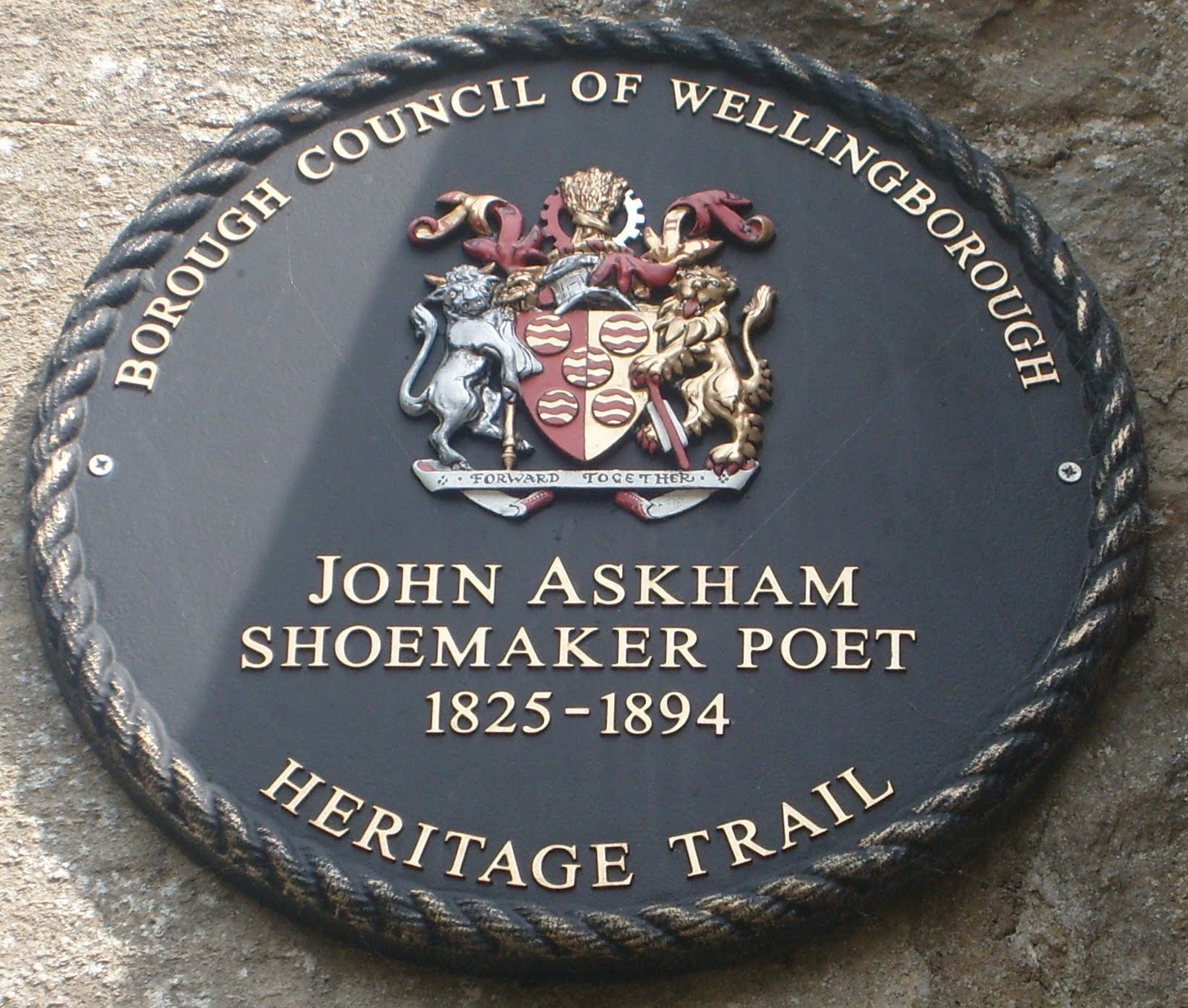 This plaque, on one of the two chapels in London Road cemetery, remembers one of the many forgotten working-class, autodidactic writers, John Askham (1825-94), the 'shoemaker poet' from Wellingborough, Northamptonshire. Askham's father, who had an amputated leg and suffered great pain through it, was a shoemaker, which is how his son learned the craft. John had very little education, and began working in his father's shoemaker's shop at the age of nine. By 25, he had started to write poetry, and ten years after that he began supplementing his shoemaking earnings by contributing to various newspapers and journals.
 Askham's life was riddled by tragedy, such as the early death of his first wife, and the death of his daughter by his second wife at the age of eight, and this is reflected in some of his poems:
Work While it is Day
"Work while it is yet day, for the night cometh on when no man can work."
Work while the day is long,
While the right arm is strong,
While the life-blood is young,
Night cometh on.
Work while the sun is high,
In the bright smiling sky;
Swiftly life's minutes fly:
Night cometh on.
Strive with thy heart and soul;
Press to the distant goal;
Waste not the hours that roll:
Night cometh on.
Life is a season lent;
Moments are treasures sent;
See that they're wisely spent:
Night cometh on.
What thy hand finds to do,
That, with thy might, pursue,
With a brave heart and true:
Night cometh on.
What though we toil in pain,
'Twill not be all in vain;
Haste then the good to gain:
Night cometh on.
What though grief rack the breast?
Doth there not come a rest?
Let us then do our best:
Night cometh on.
H. E. Bates and Rushden, Northamptonshire
Libellés :
Bates (H.E.),
Northamptonshire,
Rushden

 The novelist and short story writer Herbert Earnest Bates, who wrote as H. E. Bates, was born almost 105 years ago, on 16 May 1905, at 51 Grove Road, Rushden. His father A. E. Bates was director of Knight and Laurence Ltd, a shoe factory that stood very close to this house. At the age of six he moved to his grandfather's house in nearby Essex Road, and went to Newton Road School.
After Kettering Grammar School, and when shoemaking was a major industry in Rushden, he found a job in a leather warehouse, and drew heavily on his experience of the town when he wrote his autobiography, The Vanished World.
 Rushden Hall, parts of which date from the 14th century, was used as the model for the building in Bates's book Love for Lydia: he had visited it as a reporter for the local newspaper.
Ġużè Ellul Mercer, Dingli, Malta
Libellés :
Dingli,
Malta,
Maltese Literature,
Mercer (Ġużè Ellul)
 This wonderfully expressive statue in Dingli, Malta, is a representation of Ġużè Ellul Mercer (1897-1961), who was born in Msida, and who, among many other things, was a playwright, poet, novelist and Labour politician. The written work he is perhaps best known for is the novel Leli ta' Ħaż-Żgħir (1949) (Shadows of the Truth, trans. 2003 by Godwin Ellul). It is thought to be the first psychological novel in the Maltese language.
Mercer was buried in unconsecrated ground because of his politics - in the largest cemetery in Malta, the Addolorata, which is between Luqa airport and Paola. He was in fact buried in what is called the misbla, or rubbish dump, in a very simple grave. The Msida Maltese Labour Party later paid for a marble tomb.


11 May 2010
Rużar Briffa, Valletta, Malta
Libellés :
Briffa (Rużar),
Malta,
Maltese Literature,
Valletta
 One of the works of the romantic poet Rużar Briffa (1906-63) is called 'Fil-Barrakka ta' Fuq' ('At Upper Barrakka') and it is appropriate that there should be a plaque commemorating him in the Upper Barrakka Gardens in Valletta.
As a medical student - later a specialist in dermatology and venereology - he was friends with fellow student and future novelist Ġużè Bonnici, and they used to discuss literature together. Briffa admired Keats, Dante and D'Annuncio.
His wife Louisette said that he dreamed of 'beautifying' patients, and this idea is reflected in some of his work: he was known as 'The Poet of Beauty'. Louisette donated her husband's manuscripts to the University of Malta, which has copied some examples to a CD-ROM, and here are several images of the manuscripts. Also, there's a 5 minute 29 seconds documentary in Maltese on Briffa.
Giovanni Pietro Agius de Soldanis, Victoria, Gozo, Malta
Libellés :
De Soldanis (Giovanni Pietro Agius),
Gozo,
Malta,
Maltese Literature,
Victoria
.jpg) Also known as Gian Piet, Giovanni Pietro Agius de Soldanis (1712-70) was born in Victoria (then called Rabat), Gozo, and was a writer and a historian. His bronze statue stands in Villa Rundle gardens, Victoria, and remembers an author probably best known for two books: one about Gozo: Gozo antico e moderno, sacro e profano; and one about the development of the Maltese language: Della lingua punica presentemente usata da' Maltesi ovvero Nuovi Documenti, li quali possono servire di lume all'antica lingua etrusca (1750).
Also known as Gian Piet, Giovanni Pietro Agius de Soldanis (1712-70) was born in Victoria (then called Rabat), Gozo, and was a writer and a historian. His bronze statue stands in Villa Rundle gardens, Victoria, and remembers an author probably best known for two books: one about Gozo: Gozo antico e moderno, sacro e profano; and one about the development of the Maltese language: Della lingua punica presentemente usata da' Maltesi ovvero Nuovi Documenti, li quali possono servire di lume all'antica lingua etrusca (1750).
Ninu Cremona, Victoria, Gozo, Malta
Libellés :
Cremona (Ninu),
Gozo,
Malta,
Maltese Literature,
Victoria

 The statue of Ninu Cremona (1880-1972) outside the Ninu Cremona Lyceum, Fortunato Mizzi Street, Gozo.
Cremona was also known as Anthony Cremona and Is-Sur Nin and was born in Victoria, Gozo. Orphaned at an early age, he spent three years with an uncle in Tunis, later returning to the Jesuits' College on Gozo, then to the Seminary in Floriana, Malta, where he met Dun Karm (see below). He worked as a government clerk, then as a sanitary officer.
The statue of Ninu Cremona (1880-1972) outside the Ninu Cremona Lyceum, Fortunato Mizzi Street, Gozo.
Cremona was also known as Anthony Cremona and Is-Sur Nin and was born in Victoria, Gozo. Orphaned at an early age, he spent three years with an uncle in Tunis, later returning to the Jesuits' College on Gozo, then to the Seminary in Floriana, Malta, where he met Dun Karm (see below). He worked as a government clerk, then as a sanitary officer.In 1928 he was employed by the government with responsibility for translations and publications.
He was partly responsible for establishing the Għaqda tal-Kittieba tal-Malti (The Maltese Writers Society), later called Akkademja tal-Malti (The Maltese Academy), and was Vice-President and editor of Il-Malti, the organ of the Writers Society. More importantly, he helped to concretize Maltese orthography.
He wrote many books, but is most noted for his play Il-Fidwa tal-Bdiewa (The Farmers’ Liberation).
Roger Scicluna, Gozo, Malta
Libellés :
Gozo,
Malta,
Maltese Literature,
Scicluna (Roger)
 Roger Scicluna was a 20th century romantic poet who is very little known, and his almost total absence from the internet is a strong indication of this. However, like Pisani, he was a Gozitan who spent most of his life on the island. The very unusual thing, though, is that he chose to write in English as opposed to Maltese, probably as a result of extensive reading in his father's large English library.
After working as an accountant, Scicluna became an English teacher at the Archbishop's Seminary.
He published two poetry books - A Book of Verse (1937), and Fifty Sonnets (1938), and was strongly influenced by Wordsworth's nature poetry, which he adapted to a Gozitan setting. Other influences were Keats, Leopardi, and Edward Young. The images below are of places in Gozo that Scicluna names three of his poems after:
 'Sonnet to Xlendi Bay'.
 'Dawn on Rambla Bay in Gozo'.
 'Sonnet to Marsalforn Bay'. This photo was taken from Xagħra.
4 May 2010
H. D. (Hilda Doolittle) at Mecklenburgh Square, Bloomsbury: Literary London #23
Libellés :
Bloomsbury,
H.D. (Hilda Dolittle),
London

 44 Mecklenburgh Square. 'H. D. (HILDA DOOLITTLE) POET AND WRITER LIVED HERE 1917-1918'.
D. H. Lawrence and his wife Frieda stayed here in November 1917 after being forced away from Cornwell.
Lionel Britton and the Foundling Hospital, Coram's Fields, Guilford Street, Bloomsbury: Literary London #22
Libellés :
Bloomsbury,
Britton (Lionel),
London
Ed Glinert, in A Literary Guide to London (2000), mentions that Dickens publicized the work of the Foundling Hospital that once stood on Guilford Street in Household Words, and goes on to say that Harriet Beadle in Little Dorrit (1857) is known as 'Tattycoram' partly after an old nickname she had, partly after the place in which she was brought up.
When Lionel Britton - or rather, his protagonist Arthur Phelps - passed this way, it was still a hospital:
'Half-way down Guilford Street is the Foundling Hospital. That is for the love children. Thrown away because they were too expensive to keep, or because they were not proper, or because they came through lack of knowledge and were inconvenient. The bourgeoisie, whose social organisation has made it possible for the child and the mother to be together, built the stone walls and took it in. Do for cannon-fodder...'
Hunger and Love (1931), p. 412.


'THESE GROUNDS
THE SITE OF THE FOUNDLING HOSPITAL
established in 1739 by Captain Thomas Corem were offered for sale as building land in 1926, when owing to changing social conditions, the old Hospital was sold and demolished.
After eight years of anxiety as to its fate, the site was eventually preserved for the use and welfare of the children of Central London by the generosity and vision of Harold, Viscount Rothermere, by the efforts of the Foundling Site Appeal Council, by the co-operation of the Governors of the Foundling Hospital and of the Education Committee of the London County Council, and by the enthusiasm of many thousands of donors, large and small, who contributed their money or their toil to the saving of these nine acres, henceforth to be known as CORAM'S FIELDS'.
So the land has now been turned into a park. Coram's Fields looked interesting to me, but I wasn't allowed to enter as I wasn't accompanied by a child. The mad side of political correctness?
When Lionel Britton - or rather, his protagonist Arthur Phelps - passed this way, it was still a hospital:
'Half-way down Guilford Street is the Foundling Hospital. That is for the love children. Thrown away because they were too expensive to keep, or because they were not proper, or because they came through lack of knowledge and were inconvenient. The bourgeoisie, whose social organisation has made it possible for the child and the mother to be together, built the stone walls and took it in. Do for cannon-fodder...'
Hunger and Love (1931), p. 412.

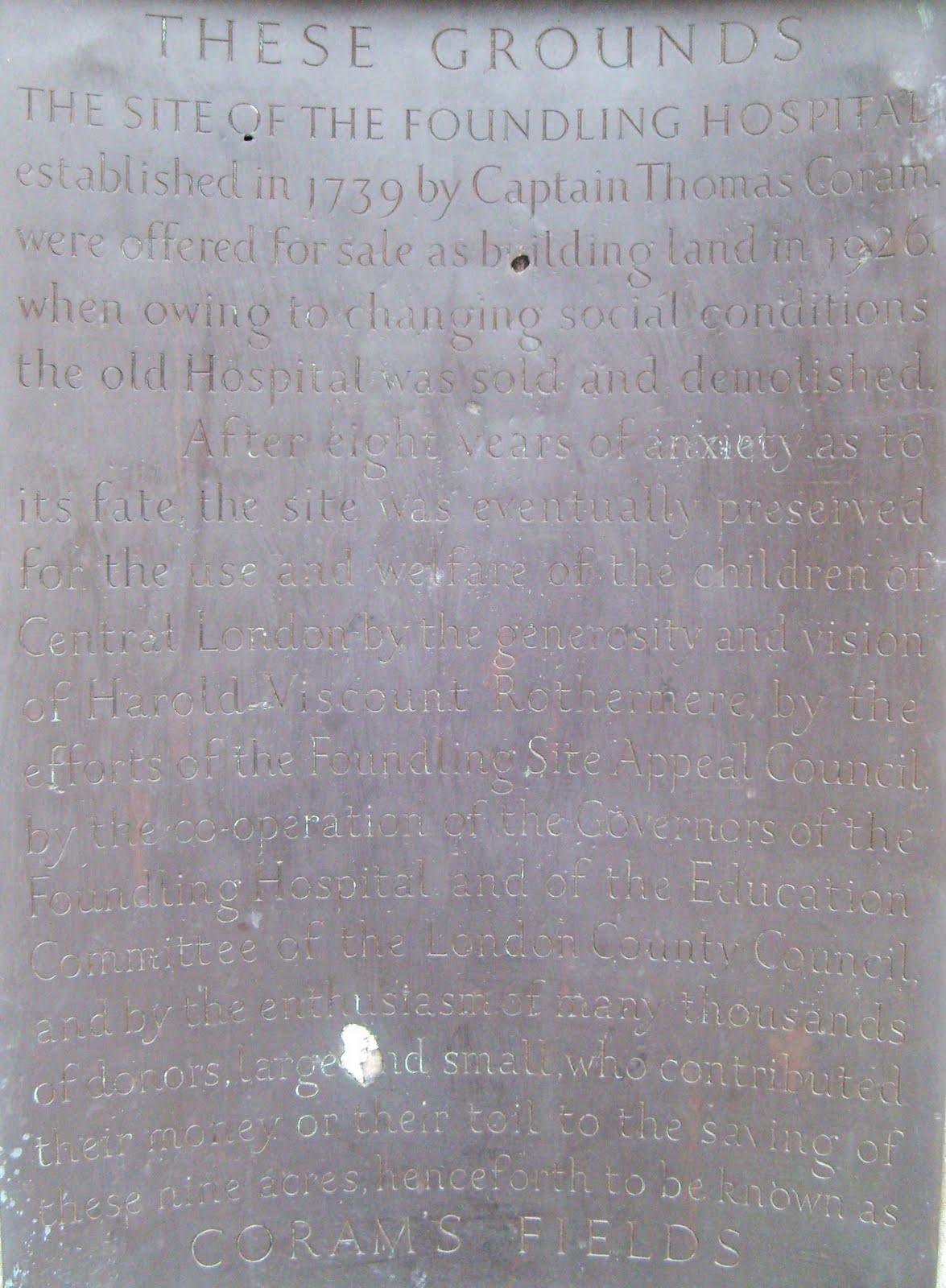
THE SITE OF THE FOUNDLING HOSPITAL
established in 1739 by Captain Thomas Corem were offered for sale as building land in 1926, when owing to changing social conditions, the old Hospital was sold and demolished.
After eight years of anxiety as to its fate, the site was eventually preserved for the use and welfare of the children of Central London by the generosity and vision of Harold, Viscount Rothermere, by the efforts of the Foundling Site Appeal Council, by the co-operation of the Governors of the Foundling Hospital and of the Education Committee of the London County Council, and by the enthusiasm of many thousands of donors, large and small, who contributed their money or their toil to the saving of these nine acres, henceforth to be known as CORAM'S FIELDS'.
So the land has now been turned into a park. Coram's Fields looked interesting to me, but I wasn't allowed to enter as I wasn't accompanied by a child. The mad side of political correctness?
Sydney Smith, Charles Dickens, Vera Brittain, and Winifred Holtby at Doughty Street, Bloomsbury: Literary London #21
Libellés :
Bloomsbury,
Brittan (Vera),
Dickens (Charles),
Doughty Street,
Holtby (Winifred),
London,
Smith (Sydney)
The impressive Doughty Street had security gates at each end in Charles Dickens's day: it was a very short distance from the slums of Saffron Hill, where Dickens had set Fagin's hovel in Oliver Twist.
 14 Doughty Street. 'Sydney Smith 1771-1845 Author and Wit Lived Here'.
 48 Doughty Street. 'Charles Dickens 1812-1870 Novelist Lived Here'. Dickens lived here from 1837 to 1839, when he was completing Pickwick Papers (1837), Oliver Twist (1839), most of Nicholas Nickleby (1839), and the start of Barnaby Rudge. He had married Catherine a short time before living here.
 52 Doughty Street. Unfortunately, the whole house has scaffolding over it, and does not take a pretty photo, although the blue plaque is readable:
'Vera
Brittain
1893-1970
Winifred
Holtby
1898-1935
Writers and Reformers
lived here'.
ADDENDUM: In August 2013 I returned to the street and took pictures of a house clear of scaffolding:


Benjamin Disraeli at Theobald's Road: Literary London #20
Libellés :
Bloomsbury,
Disraeli (Benjamin),
London

 22 Theobald's Road. 'BENJAMIN DISRAELI Earl of Beaconsfield born here 1904'.
Dante Gabriel Rossetti, William Morris, and Edward Burne-Jones at Red Lion Square, Bloomsbury: Literary London: #19
Libellés :
Bloomsbury,
Burne-Jones (Edward),
London,
Morris (William),
Rossetti (Dante Gabriel)
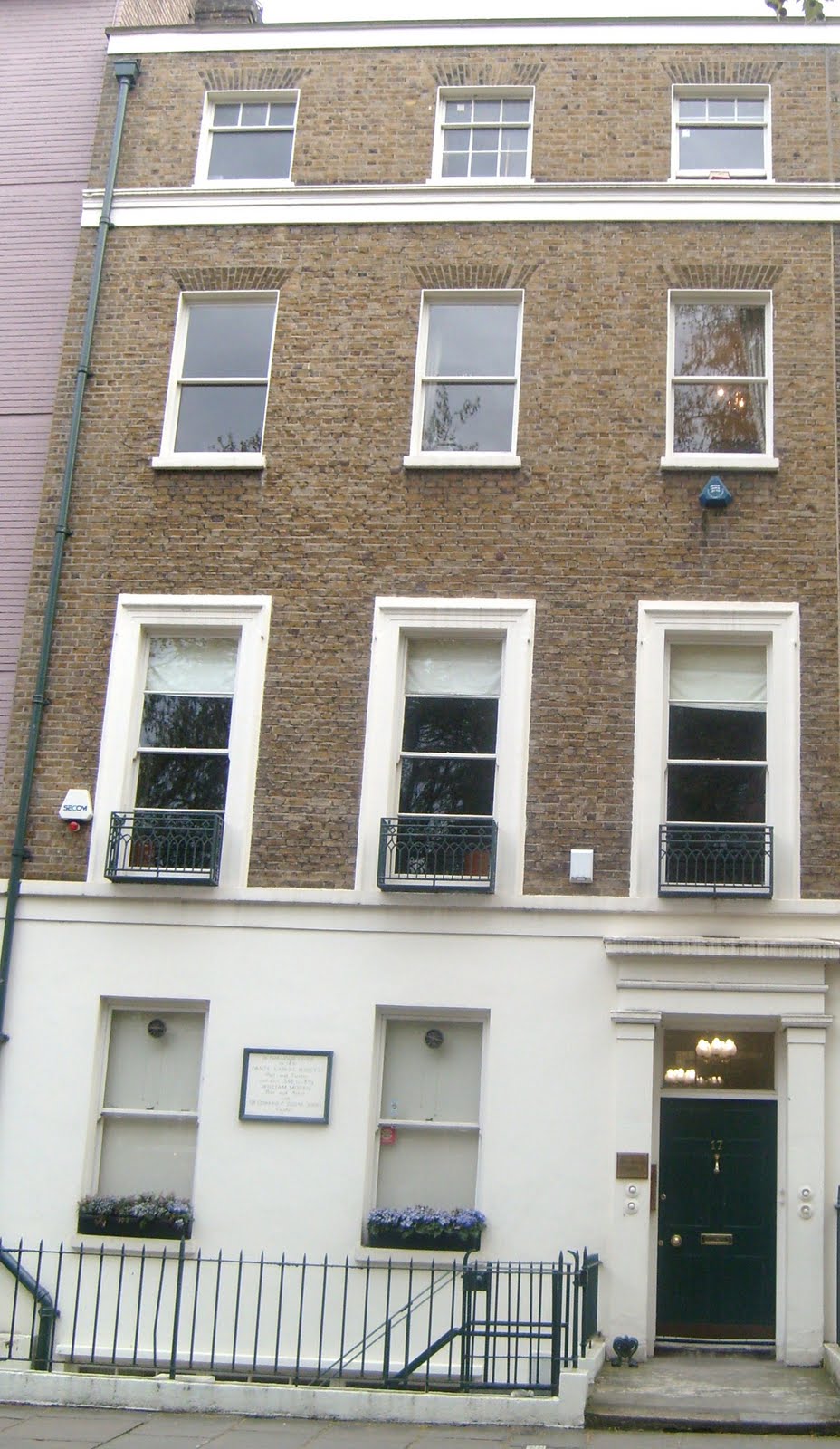
 17 Red Lion Square. 'In this house in 1951 lived Dante Gabriel Rossetti Poet and Painter and from 1856 to 1859 William Morris Poet and Artist and Sir Edward C. Burne-Jones Painter'.
When Morris moved in there was no furniture, so he and Burne-Jones made furniture after the medieval fashion that was later to become his hallmark style.
Isaac D'Israeli and Benjamin Disraeli at Bloomsbury Square, Bloomsbury: Literary London #18
Libellés :
Bloomsbury,
D'Israeli (Isaac),
Disraeli (Benjamin),
London

 6 Bloomsbury Square. The young future prime minister and novelist Benjamin Disraeli (1804-81) lived here from 1817-24, although it is his father Isaac D'Israeli who is commemorated in the stone plaque here:
'ISAAC D'ISRAELI. AUTHOR LIVED HERE. BORN 1766 | DIED 1848' Isaac wrote The Curiosities of Literature here.
T.S.Eliot, Faber & Faber, and Russell Square, Bloomsbury: Literary London #17
Libellés :
Bloomsbury,
Eliot (T.S.),
London
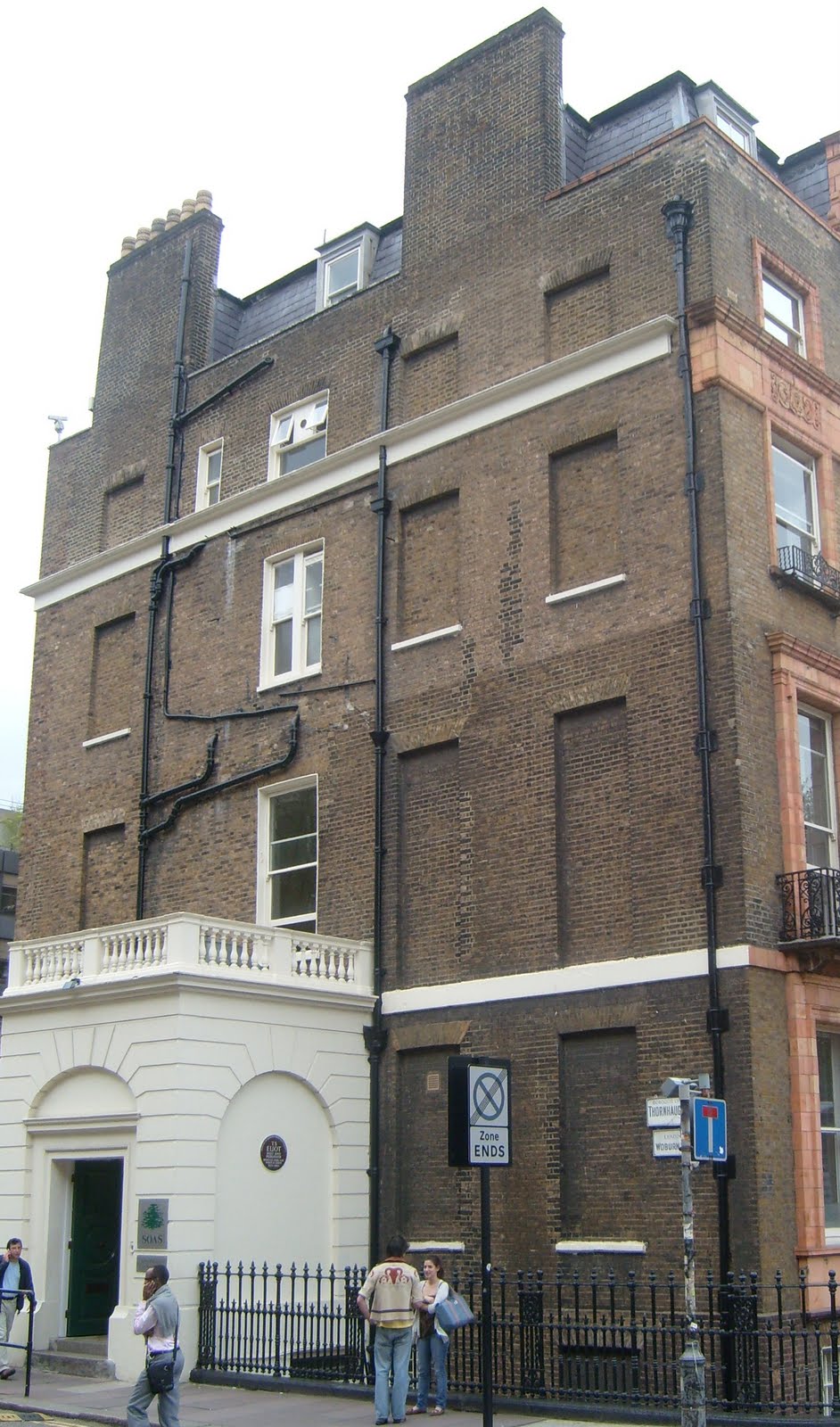
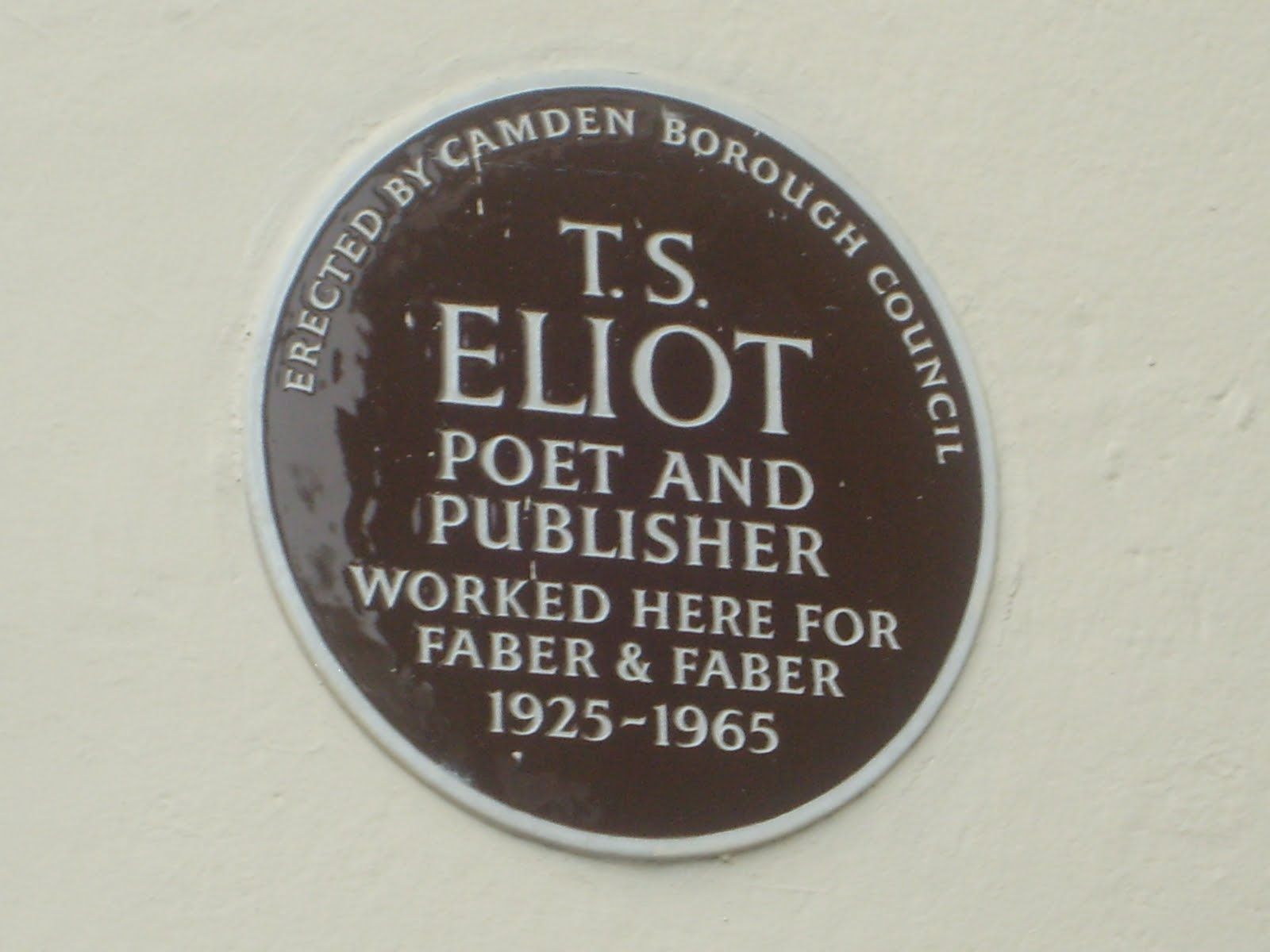 25 Russell Square. 'T.S. ELIOT POET AND PUBLISHER WORKED HERE FOR FABER & FABER 1925-1965'
T. S. Eliot published a great deal of poetry during his long time with Faber & Faber, some of the most noted poets being W. H. Auden, Stephen Spender, Louis MacNeice, Ezra Pound, and Marianne Moore.
Eliot also, along with other publishers, rejected George Orwell's Animal farm.
Mahatma Gandhi, Fredda Brilliant, and Tavistock Square, Bloomsbury: Literary London #16
Libellés :
Bloomsbury,
Brilliant (Fredda),
Gandhi (Mahatma),
London

 On several occasions, this blog has mentioned the sculptor Fredda Brilliant - the wife of Lionel Britton's friend Herbert Marshall - and sometimes in relation to her being the sculptor of Britton's bust, which recently appeared on an online auction site. But this is the work that Brilliant (known as 'Freddie' by Britton) is most remembered for: the statue of Mahatma Gandhi in Tavistock Square.
3 May 2010
Weedon Grossmith, Anthony Hope, Elizabeth Jesser Reid, and Ram Mohun Roy at Bedford Square, Bloomsbury: Literary London #15
 1 Bedford Square. Weedon Grossmith lived at this address from 1902 to 1919, some years after the publication of The Diary of a Nobody (1892).
 41 Bedford Square. This was the address of Anthony Hope Hawkins (Anthony Hope) from 1903 to 1917. His best known work is The Prisoner of Zenda (1894).
 48 Bedford Square. 'BEDFORD COLLEGE FOR WOMEN UNIVERSITY OF LONDON FOUNDED HERE 1849 BY ELIZABETH JESSER REID'.
 49 Bedford Square. 'Ram Mohun Roy 1772-1833 Indian Scholar and Reformer lived here'.
 52 Bedford Square. Between 1877 and 1881 Robert Bridges lived here with his mother as a physician. He would later become poet laureate, and perhaps is best known now for publishing Gerard Manley Hopkins's work.
Subscribe to:
Posts (Atom)


 Posts
All Comments
Posts
All Comments