8 September 2021

Jean-Pol Betton in Azé (71), Saône-et-Loire (71)

Jean-Pol Betton (1944-2005) was a painter, sculptor and ceramicist but he doesn't even have a Wikipédia page dedicated to him. His atelier was in Azé, where he is buried. There isn't much information to be found on what seems like a fascinating artist whose work encompassed the Rabelaisian and the grotesque ham acting of La commedia dell'arte. A representation of his head appears on the very odd grave. Around two sides of the grave are the clear thought that his belief is that he has no need for that which is necessary, only that which is superfluous: perhaps an irony, but I hope not: uselessless has the greatest of uses!


Another example of Betton's sculptures on his grave.

Roman theatre in Autun (71), Saône-et-Loire (71)

The Roman theatre in Autun was built in the second half of the first century AD and perhaps had the capacity for 14,000 spectactors (although this number depends on the narrator). It is said to be the largest of its kind and is still used for various tourist spectacles.

Lavoir and Boîte à lire in Couhard (71), Saône-et-Loire (71)

The lavoir in Couard was restored by volunteer inhabitants of this hamlet of Autun, and also has a beautiful new Boîte à lire.

6 September 2021

La Pyramide de Couhard in Couhard (71), Saône-et-Loire (71)

La Pierre de Couhard, or La Pyramide de Couhard, is in tiny Couhard just outside Autun. This is a funerary monument dating from the first century, although it is unknown who is concerned here or if it's a mausoleum or a cenotaph: the absence of found funerary remains suggests the latter. The orifice in the centre is the result of an excavation in 1640, and later attempts in the nineteenth century to discover more proved fruitless. From here you can see for many miles around, and not just Autun: Saulieu, for instance, is clearly visible.


5 September 2021

Dovecote in Buxy (71), Saône-et-Loire (71)

Hameau du pigeonnier is a street with a dovecote in the centre, but unlike, say, the dovecote in Laives this is not open to visitors.

Humour in Buxy (71), Saône-et-Loire (71)

Translated, I'd render this 'HERE ON 17 APRIL 1891 ABSOLUTELY NOTHING HAPPENED'.

Lavoir in Cortiambles (71), Saône-et-Loire (71)

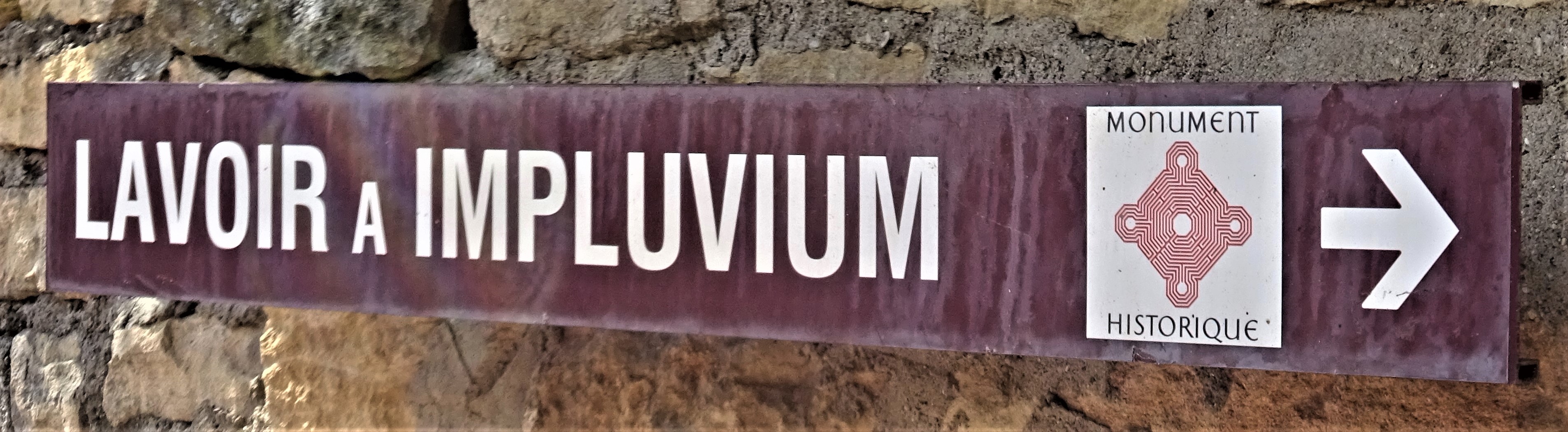
The lavoir at Cortiambles, a hamlet in the commune of Givry, has a roof designed to catch rain water in the basin. It was built between 1829 and 1830, on the site of an earlier lavoir, by François Berthelot following plans by Zolla, an architect from Chalon-sur-Saône. It is built of rubble stone, is half-moon shaped, and is a monument historique.

3 September 2021

Étienne-Jules Marey in Beaune (21), Côte-d'Or (21)

Étienne-Jules Marey (1830-1904) was a doctor, physiologist and inventor who was born in Beaune and died in Paris. This monument to him in the town of his birth is very impressive, with Marey seated and a series of moving horses at the side of him. He was one of the first people to methodically study 'la machine animal', photographically recording different movements of both animals and humans: chronophotographie, as Marey termed it. Among his many other creations, he also developed the sphigmograph (the precursor to the sphigmomanometer), making a portable version.


2 September 2021

Boîte à lire in Lacroste (71), Saône-et-Loire (71)

This is probably one of the smallest Boîtes à lire I've seen, but then Lacroste only has a population of over 700. All the same, there was no room for any more books here, and I relieved it of Jean Giono's Les Récits de la demi-brigade. We just love Lacroste.

Gabriel Jeanton in Lacroste (71), Saône-et-Loire (71)

The Jeanton tomb in Lacroste is a family one and I could see no mention of Gabriel Jeanton on it. However, a plaque at the side of it reveals a number of things about Lacroste's most famous son. He was born in Lacroste and lived in the family house, now 5 Rue Gabriel Jeanton. He left for Paris, where he obtained a doctorate in Law in 1906. He directed the Tribune Civil in Mâcon for eighteen years, and was curator of the Musée Greuze in Tournus. He wrote a large number of works on the area around Mâcon and Tournus.


5 Rue Gabriel Jeanton.


La Fontaine à Chagrin in Lacroste (or Préty) (71), Saône-et-Loire (71)

La Fontaine à Chagrin on the road between Lacroste (usually pronounced without the 'ste') and Préty is a legend concerning a vouivre (a wivern, or winged dragon) which used to drink at the fountain. It had a diamond on its forehead which it used to take off while drinking. But a man from Lacroste, called Chagrin, had a large container covered in very sharp nails and hid in it while waiting for the creature to go to the fountain. When the creature was drinking Chagrin crept to the diamond and covered it, along with himself, in the container. Having drunk, the wyvern sought the diamond and killed itself on the nails while trying to retrieve it. The fountain is said to cure eye diseases, although the water itself is said to be detrimental to the health of people. (This account is the one given by local historian Gabriel Jeanton (1881-1943) in L’ancienne paroisse de Préty en Mâconnaisin, although there are other stories which slightly differ.)


1 September 2021

Honoré d'Urfé in Saint-Étienne-le-Molard (42), Loire (42)

Le Forez is an area in France which is largely in the Loire département, and is essentially rural. The Château de la Bâtie d'Urfé is in Forez in Saint-Étienne-le-Molard, where Honoré d'Urfé (1567-1625) lived for a time and where the area was the source of inspiration for what is his masterpiece, the first roman-fleuve: L'Astrée.

L'Astrée is a homage to his childhood home and surroundings and was published between 1607 and 1627, being a partly autobiographical pastoral love story of Astrée and Céladon (in turn rendered homage to by Éric Rohmer's film version of part of it): the director could hardly have even summed up a book which stretches to 5399 pages with 293 characters in twelve books. The book was read throughout Europe in the seventeenth and eighteenth centuries. (And was in fact finished posthumously by the author's secretary Balthazar Baro.)

The novel, obviously known by academics, is still obscurely 'remembered' in the French word for green glazed porcelain: céladon, or 'celadon' in English. Unfortunately, because of a lack of time, we were unable to appreciate the château and its surroundings to anything like the extent it merits.


30 August 2021

Gabriel Vicaire in Amberieu-en-Bugey (01), Ain (01)

Gabriel Vicaire (1848-1900) was a poet who was born in Belfort and who died in Paris. Some of his works were co-written with Henri Beauclair under the collective pseudonym Adoré Floupette. Many places in France are named after him, and the monument of him below is by Jean-Antoine Injalbert in Luxembourg, Paris, which I took a whole ten years ago. He's buried here because his father was born in Bugey, as were his paternal ancestors, and on his mother's side his ancestors came from Bresse.


Antoine de Saint-Exupéry in Château-Gaillard (01), Ain (01)

In the middle of a traffic island near Château-Gaillard just at the junction with the A42 autoroute stands this representation of Antoine de Saint-Exupéry's Le Petit Prince, one of the most loved books in France as well as many other countries. The disc (made from local Villebois calcareous stone) shows Saint-Exupéry in flight, with Le Petit Prince and the fox in bronze on top of it. It is the work of Stéphane Paret from St-Rambert-en-Bugey.


28 August 2021

Ted Nomad in Pont-de-Vaux (01), Ain (01)

In 2016 street artist Ted Nomad decorated the streets of Pont-de-Vaux with murals from photos of the people, not at the time having met them. These are representations of some of them.


27 August 2021

Boîte à lire in Ars-sur-Formans (01), Ain (01)

I just love Boîtes à lire, and even if I can't find anything that pleases me – for the record in the three weeks I've been here I've given back far more books than I've taken – these mini-libraries are super. I don't think they'd work in England for many reasons, but then France is a different universe. This is in Ars-sur-Formans (Ain). 

Jean-Marie Vianney in Ars-sur-Formans (01), Ain (01)

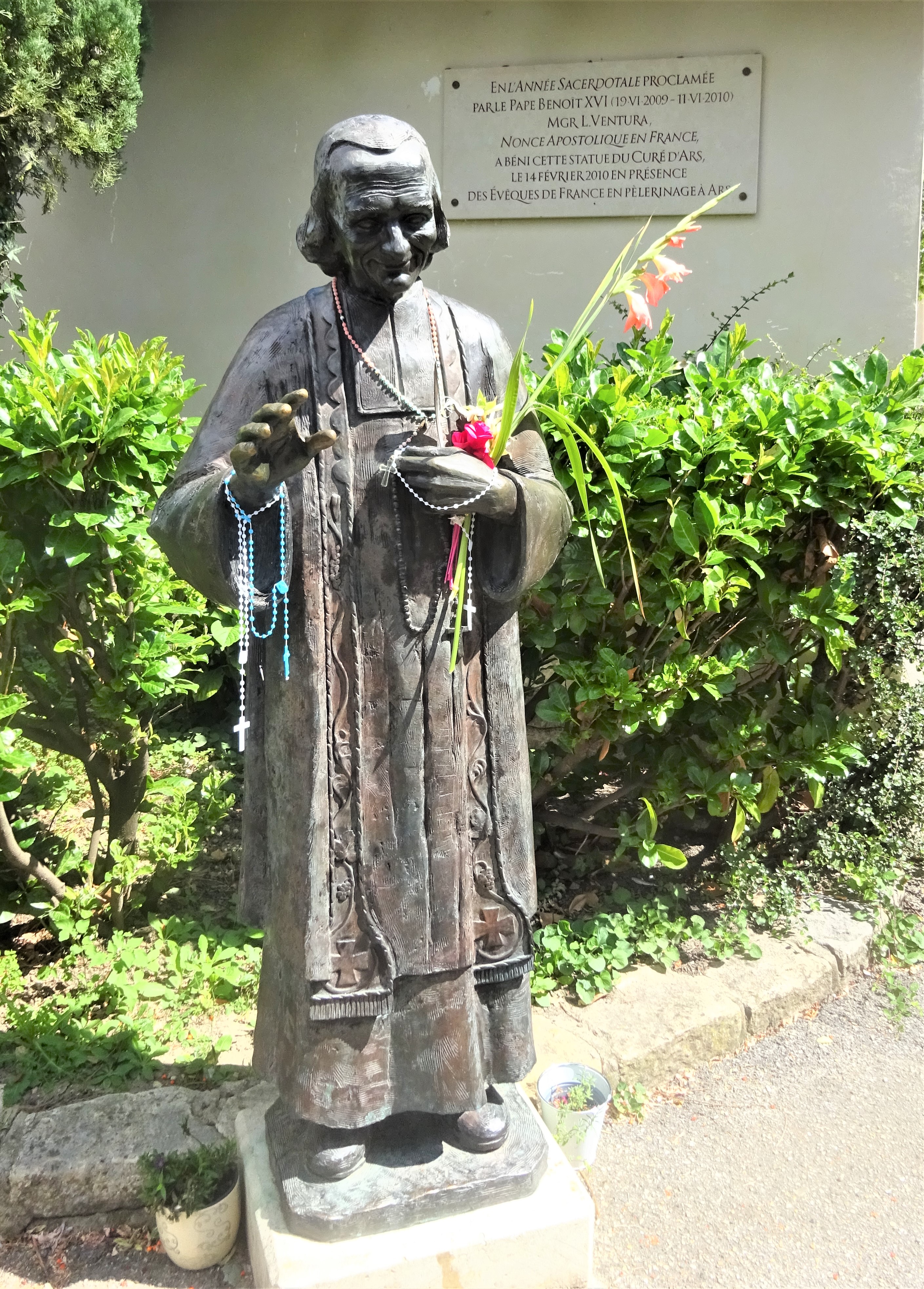
Jean-Marie Vianney (1786-1859), also known as 'Le Curé d'Ars', was a Catholic priest venerated by the Church. He was the curé in Ars for forty-one years. He earned great respect for his austerity: he ate little, spent many hours at prayer, and gave away what he had. Ars became a place of pilgrimage, as it indeed is today.

The statue of Vianney next to his presbytery.


The presbytery.

A view of the spiral staircase leading down to the huge crypt.

La Basilique d'Ars was built from 1862, and this shot was taken from a field close to the Monument de la Rencontre.

Le Monument de la Rencontre, where, the story goes, Vianney met the young shepherd boy Antoine Givre in 1818 and asked him the way to Ars. The monument reveals that the boy died a few days after Vianney, in 1859.

There is a grave which includes the name of an Antoine Givre, although the dates don't tally. However, there is a grave of Cathérine Lassagne, who was the daughter of agricultural workers. Vianney chose her (along with Benoîte Lardet) to teach the children of the village: he was dissatisfied with the contemporary education in the village. The girls were educated by sisters some short distance away, and returned to teach children at La Maison de Providence, which later became an orphanage.

26 August 2021

Marie-Joseph Bonnat, Pont-de-Vaux (01), Ain (01)

I made a post on Marie-Joseph Bonnat a few weeks ago, but here is the only photo I've ever seen of his grave in Pont-de-Vaux.


'MARIE JOSEPH

BONNAT

NÉ À GRIÈGES LE 25 MAI 1844

DÉCÉDÉ À TAQUAH

(AFRIQUE OCCIDENTALE)

LE 8 JUILLET 1881

PRIEZ POUR LUI'

The engraving of the ship is a fitting tribute to this explorer.