8 March 2020

Musée de la Luna Rossa (revisited), Caen, Calvados (14)

Last September I took a few shots of the Musée de la Luna Rossa, although because it's only open at limited times (on Sundays from 1 April) I had to aim my camera high and hope for the best. Unfortunately there was very little to see because of the abundant foliage. It isn't open at the moment either, but because of the time of year I was able to get better pictures:


And a magnificent cockerel kept turning up, obviously interested in what I was doing.

Art brut (Outsider Art) and associated:
––––––––––––––––––––––––––––––––––––
Rémy Callot, Carvin (Nord)
Carine Fol (ed.): L'Art brut en question | Outsider Art in Question
Kevin Duffy, Ashton-in-Makerfield
The Art Brut of Léopold Truc, Cabrières d'Avignon (34)
Le Musée Extraordinaire de Georges Mazoyer, Ansouis (34)
Le Facteur Cheval's Palais Idéal, Hauterives (26)
The Little Chapel, Guernsey
Museum of Appalachia, Norris, Clinton, Tennessee
Ed Leedskalnin in Homestead, Florida
La Fabuloserie, Dicy, Yonne (89)
Street Art City, Lurcy-Lévis, Allier (03)
The Outsider Art of Jean Linard, Neuvy-deux-Clochers (18)
Jean Bertholle, La Fabuloserie, Yonne (89)
Jean-Pierre Schetz, La Fabuloserie, Yonne (89)
Jules Damloup, La Fabuloserie, Yonne (89)
Camille Vidal, La Fabuloserie, Yonne (89)
Pascal Verbena, La Fabuloserie, Yonne (89)
The Art of Theodore Major
Edward Gorey's Yarmouth Port, Cape Cod, MA
Marcel Vinsard in Pontcharra, Isère (38)
Vincent Capt: Écrivainer : La langue morcelée de Samuel Daiber
The Amazing World of Danielle Jacqui, Roquevaire (13)
Alphonse Gurlie, Maisonneuve (07)
Univers du poète ferrailleur, Lizio, Morbihan
Les Rochers sculptés de L'Abbé Fouré, Rothéneuf, Saint-Malo
Robert Tatin in Cossé-le-Vivien, Mayenne
René Raoul's Jardin de pierre in Pléhédel, Côtes d'Armor
La Demeure du Chaos, Saint-Romain-au-Mont-d'Or, Rhône (69)
Emmanuel Arredondo in Varennes Vauzelles, Nièvre (58)
Musée de la Luna Rossa (revisited), Caen, Calvados (14)
La Fontaine de Château-Chinon, Nièvre (58)

7 March 2020

Joep Van Lieshout's La Caravane in Caen, Calvados (14)

La Caravane, by Dutch sculptor Joep Van Lieshout, caused some negative reactions on its installation in La Place Saint-Sauveur in Caen. It cost 204,000 euros (two thirds financed by the town) and some people found it not to their taste, although this of course is art, and as Van Lieshout noted: 'The worse thing would be indifference.' Quite. Emotion in time of crisis is the representation, the Great War, D Day. Mayor Philippe Duron saw the scultures as a comment from the people in front of the huge statue of Louis XIV, touchable sculptures, far removed from the aristocratic representation.


6 March 2020

Un singe en hiver, Villerville, Calvados (14)

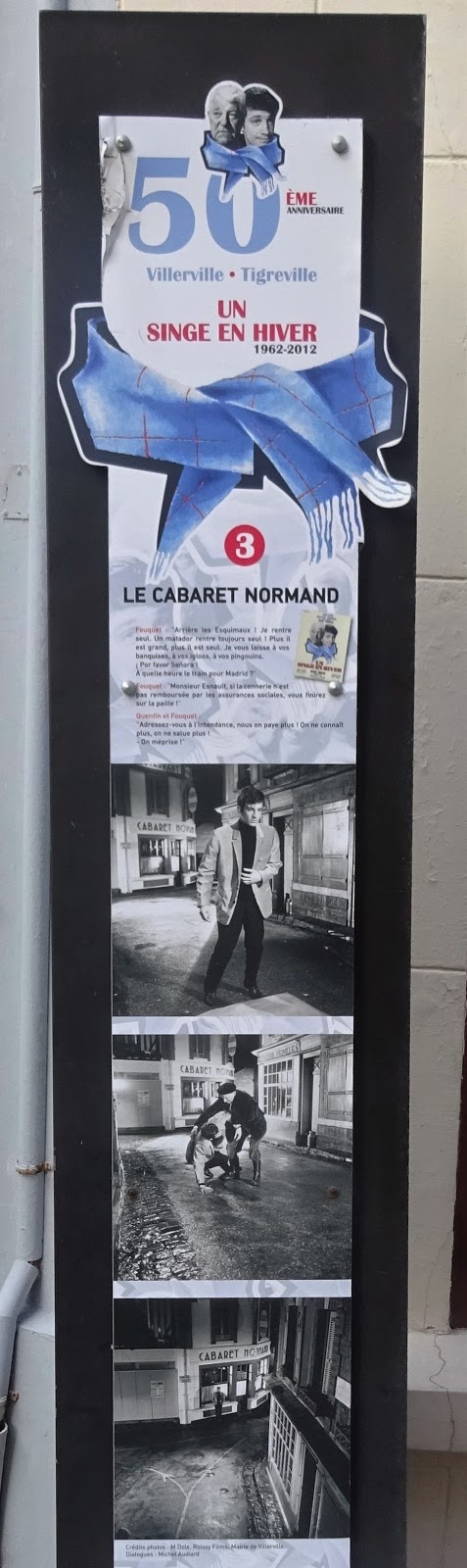
As Sainte-Sévère-sur-Indre is in many ways synonymous with Jacques Tati's film Jour de Fête, or Bergues is with Dany Boon's Bienvenue chez les Ch'tis, so Villerville is with Henri Verneuil's Un singe en hiver. The unforgettable (and only) pairing of Jean-Paul Belmondo with Jean Gabin is electric, and even today (a cold one) there were people here looking for the obvious spots where the film took place, made easier by posts bearing photos of the film and quotations from the screenplay by Michel Audiard. This is such an enormous cult movie that a huge number of people remember the whole script by heart.

Just as you enter Villerville, this movie still greets you.

Obviously the 'bull-fighting' scenes by Belmondo, echoing the games played with cars by Antoine Blondin on the Boulevard Saint-Germain, are more of less impossible to pinpoint geographically.


The scene on the steps of the Gendarmerie Nationale.


The (at the moment closed) Cabaret Normand, where Belmondo famously got pissed on Picon beer, danced a flamenco (with a real flamenco dancer posing as his legs), told the customers to get to their igloos, etc, and was thrown onto the street. This bar is obviously the main point of interest.


Well, your husband may still be obsessed with China, but with me it's Spain.

Boîte à lire, Villerville, Calvados (14)

This is quite an original Boîte à lire in Villerville, which we replenished with several French books but didn't take any: the books here were mainly translations of Agatha Christie. No comment.

Boîtes à lire:
––––––––––––––––––––––––––––––––––––
Boîte à Lire, Dicy, Nièvre
Boîte à lire, Maisons-Laffitte, Yvelines
Boîte à lire, Sorigny, Indre-et-Loire
Boîte à Lire, Jonzac, Charente-Maritime
Boîte à lire, La Roque-d'Anthéron, Bouches-du-Rhône
Boîte à Lire, Épineuil-le-Fleuriel, Cher
Boîte à lire, Marseille, Bouches-du-Rhône
Boîte à lire, East Markham, UK
Boîte à lire, La Folie Couvrechef, Caen, Calvados
Boîte à lire, Bergues, Nord
Boîte à lire, Le Havre, Seine-Maritime
Boîte à lire, Villerville, Calvados
Boîte à lire, Saint-Servan, Saint-Malo, Ille-et-Vilaine
Boîte à lire in Caen, Calvados
Boîte à Lire, Noyant d'Allier, Allier
Boîte à lire, Dampierre-en-Burly, Loiret
Boîte à lire, Illiers-Combray, Eure-et-Loir
Boîte à lire, Chartres, Eure-et-Loir
Boîte à lire, Saint-Romain-au-Mont-d'Or, Rhône

Le Statuaire des Moulières in Honfleur (14), Calvados

When the Porte de Rouen area of Honfleur was being renovated, the mayor, Michel Lamarre, wanted to pay homage to the women who for decades had worked in the estuary and other places collecting mussels to feed their families, often at risk of their lives. They wore long pleated dresses and scarves around their heads to protect them from the wind or sun, or men's clothing. They used an étique, a knife with a round wooden handle and a blade the shape of an ivy leaf, sharpened on one side. They collected their food in ten-kilo jute containers, which they roughly stitched up and in turn loaded them into thirty-kilo sacks which they put in flat-bottomed boats. The last women mussel pickers had gone by the late 1970s. The sculpture is the work of Jean-Marc de Pas from Haute Normandie.

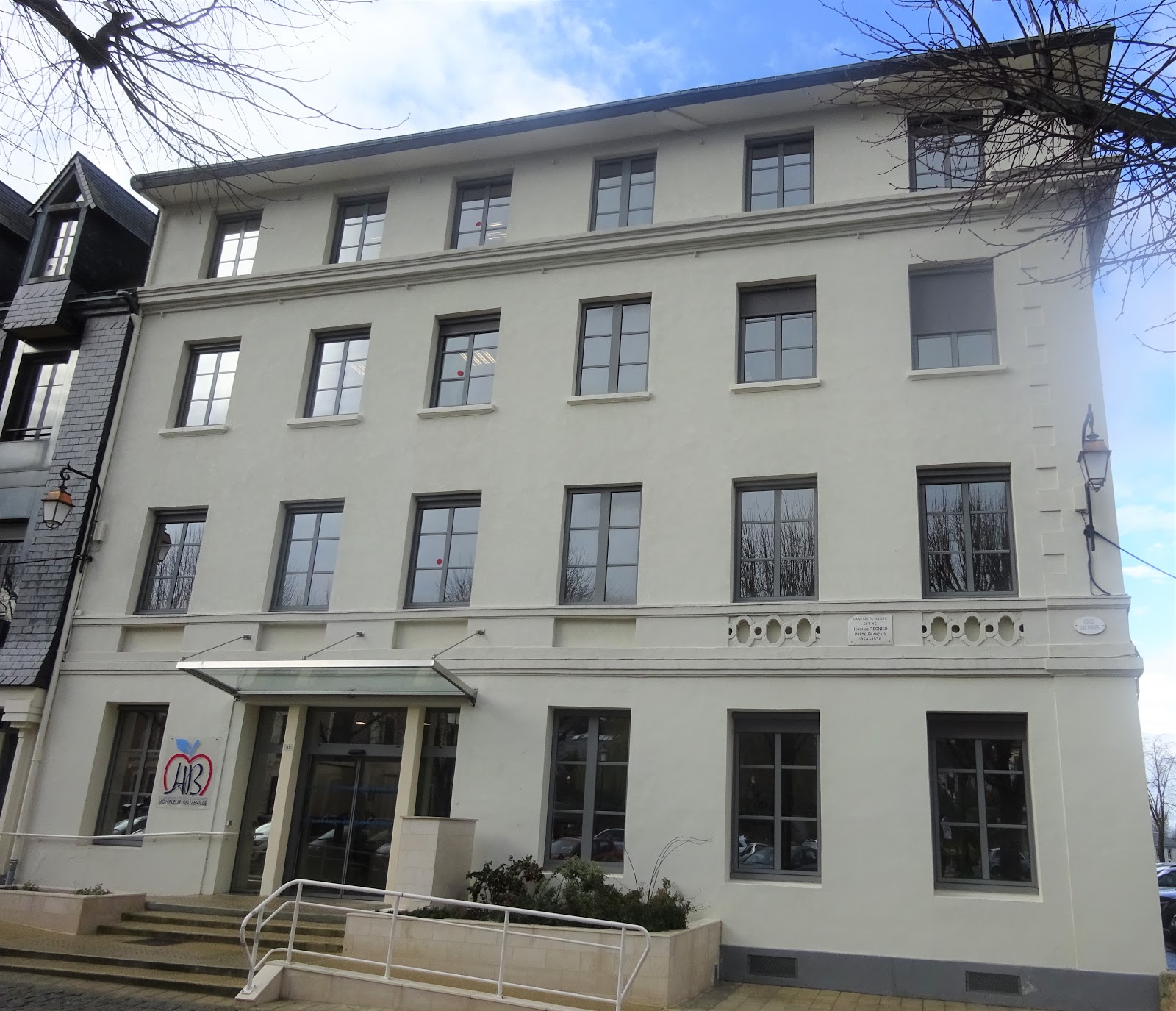
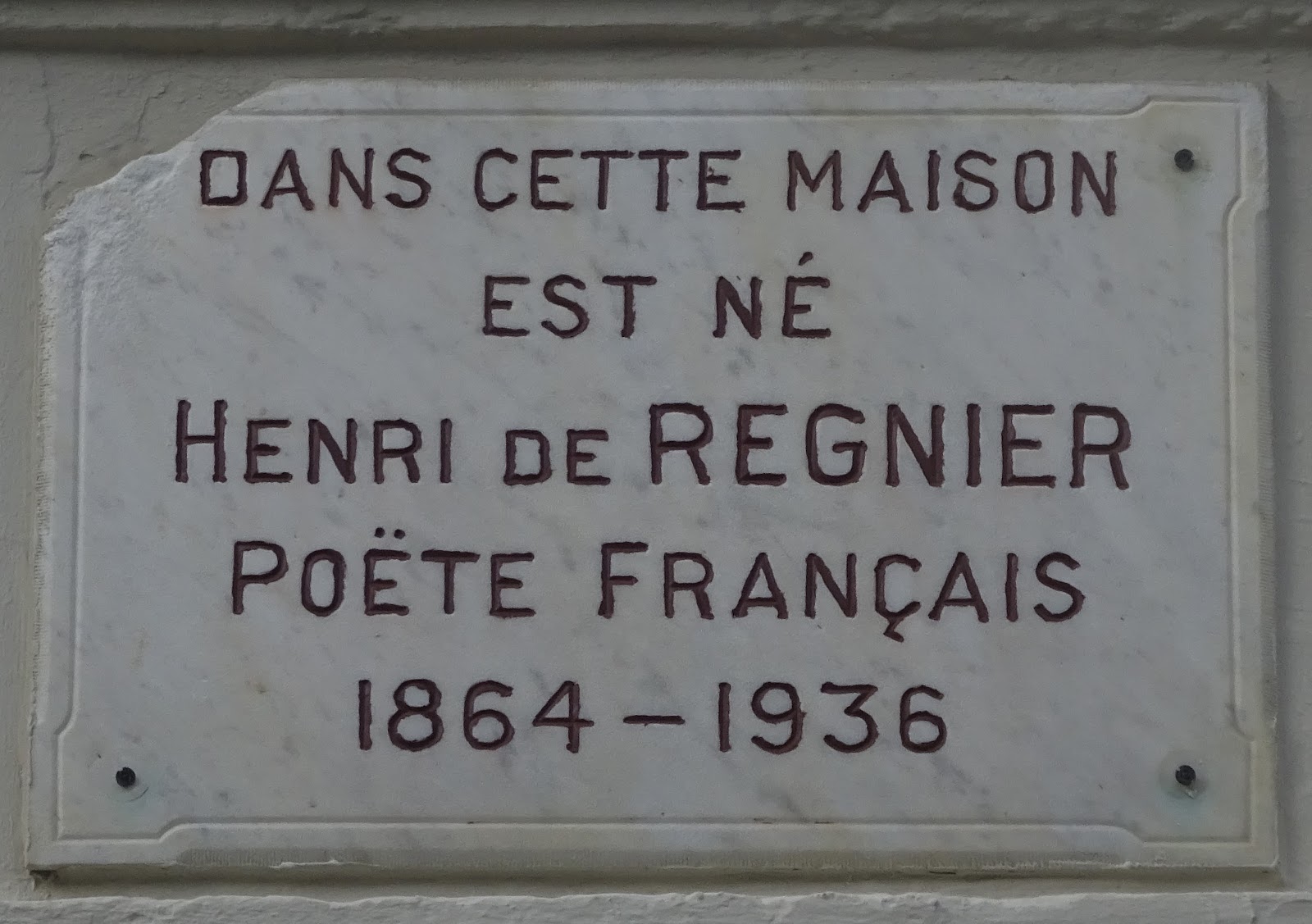
Henri de Régnier in Honfleur (14), Calvados


'DANS CETTE MAISON
EST NÉ
HENRI DE REGNIER
POËTE FRANÇAIS
1864-1936'

Lucie Delarue-Mardrus in Honfleur (14), Calvados

Lucie Delarue-Mardrus, portrait à la cigarette.jpg
The house where the novelist Lucie Delarue-Mardrus was born in Honfleur is now a hotel.


'LUCIE DELARUE-MARDRUS
POÈTE ET ROMANCIER
1874 - 1945'

She is buried in the cemetery in Honfleur about a mile up the road from her birthplace.

Erik Satie in Honfleur (14), Calvados

Open since 1998, the Maisons Satie are a homage to the musician and composer Erik Satie (1866-1925) who was born in Honfleur. He collaborated with Picasso, Picabia, Braque, Cocteau and René Clair and influenced such composers as Debussy, Ravel and Stravinsky. The museum is a liberally inspired view of the man and the visitor listens to his music on headphones as he or she drifts through the displays; the pear with wings represents his soul flying away. This is quite an experience.


4 March 2020

Léon Leclerc in Honfleur (14), Calvados


'DANS CETTE MAISON
EST NÉ
LÉON LE CLERC
ARTISTE PEINTRE
INSPIRATEUR DE VIEUX-HONFLEUR
QUI VÉCUT
POUR SERVIR SA CITÉ
1866 -1930'

In 1896 Leclerc followed Frédéric Mistral's initiative by creating a museum in Honfleur illustrating the popular arts and traditions, as well as the Société du Vieux Honfleur. He also established the Ecole des Marins de la Baie de Seine, which is today the Association La Chaloupe. He died in Honfleur.

La Baie de Somme and frogs

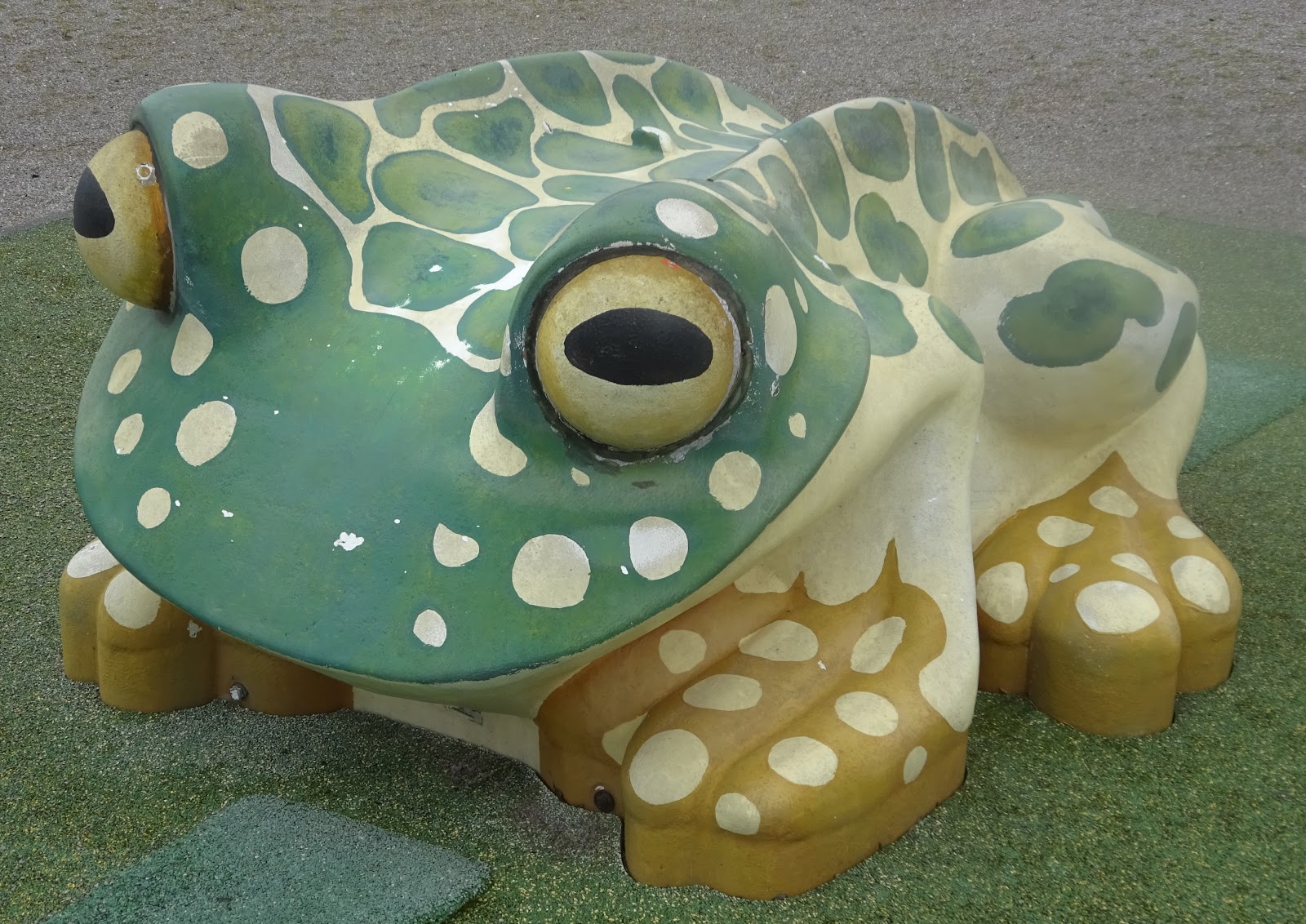
I've visited La Baie de Somme motorway aire on a number of occasions to drink a coffee and relax for half an hour and buy a newspaper, etc. although in the summer it fills rapidly with English tourists and is a less than pleasant place to stop off at. However, we visited today on the way to Honfleur and, although English tourists were still there, they were far outnumbered by the French people there. I took advantage of the moment to photograph the porcelain frogs in the outside children's area. Unfortunately the belvedere with the commanding view was closed until 1 April.


2 March 2020

Alexandre Jardin: Bille en tête (1986)

This is Alexandre Jardin's first novel, written when he was just twenty years old. And it starts brilliantly with a potentially glorious group of characters. The 'hero' is sixteen-year-old Virgile, whose mother he related to but died when he was eight, leaving him with his father, the awful domineering Raoul, and his brother Philippe, who takes after his father rather than his mother. Only his grandmother Arquebuse really loves him, and helps him to get out of scrapes.

Virgile's father has sent him well away from Paris, where he risks getting into difficulties, such as learning about life, so he's sent to boring Evreux, where with luck he can do no wrong. But Virgile seeks sex, fame and money, which he knows he can't find in Evreux, so he escapes with his friend Claude: they board a train to Paris, first class, with no money, and when an employee collars Virgile, asking him for his ticket and his business, Virgile says the prime minister wants to see him. Obviously Virgile and Claude are due to spend a night in the cells, although Arquebuse settles the cops' nonsense and frees them.

Virgile is expelled from the boarding school in Evreux, partly for the foiled escape, partly because he tells the head of the school that he left because he stood no chance of being Molière of Mozart if he remained in the school. And so his father dumps him in another boarding school in Evreux, from which he of course absconds, although the book just starts to fall apart here.

I don't mind not believing things (aren't all books, fiction or 'non-fiction', all lies anyway?), I don't mind literary fantasy, literary dreams (even wet), but our excessively clumsy virgin Virgile meets the sophisticated, rich, (badly) married thirty-five-year-old Clara and sparks fly with the semen, this is lust at first sight, she meets him outside the school gates in her chauffeur-driven Rolls-Royce (and the chauffeur will become Claude's gay lover), and, er, who cares: Alexandre Jardin has just destroyed his first novel, which started so well.

28 February 2020

Juan Buñuel's Au rendez-vous de la mort joyeuse | Expulsion of the Devil (1972)

Au rendez-vous de la mort joyeuse is the second film by Jean Buñuel, Luis Buñuel's son, who also co-scripted the screenplay. It wouldn't be an exaggeration to call it a cult film, and it is a highly accomplished poltergeist movie. Marc (Jean-Marc Bory) and Françoise (Françoise Fabian) move into a long-deserted and isolated manor house with their young son and older daughter Sophie (Yasmine Dahm), who is pubescent. And her pubescence is the essential problem here, especially when anything relating to sex matters is concerned: snails mating, her parents indicating their love for one another, etc.

Sophie seems externally to be unaware of the problems she is causing, although they are great. Glasses sway about on a table, the table hurls itself through the window, a moving fridge nearly traps a man, to the extent that a television company offers Marc a considerable sum of money to make an anonymous documentary on the house while the family stays elsehere. And that is where the real destruction begins, with Sophie secretly returning to watch the camera crew. Beretti (Gérard Depardieu) plunges his hand into boiling water, Péron (Jean-Pierre Darras) is visited by Sophie in the night and ends up covered in dirt, the crew's car and van are burned, and Beretti kills the visiting père d'Aval and his young troupe of girls stifle Beretti as he tries to drive the girls from the grounds of the house. It is as though most people within Sophie's circle are bewitched or in some way affected by her. A very strange and fascinating film.

Octave Mirbeau: Le Journal d'une femme de chambre | The Diary of a Chambermaid (1900)

Octave Mirbeau's Le Journal d'une femme de chambre (1900) is perhaps well known not directly as a result of the author's book, but via Buñuel's 1964 cinematic adaptation of it, although the film is only loosely based on the book. Mirbeau's Le Journal d'une femme de chambre – a wonderful sprawling, digressive work of 400 pages – contains many memories of the maid writer Célestine, of a large number of other families she has worked for, and the details of their avarice, the sexual assaults she has undergone, the insults, the denials, the slavery, the fact that she has no one to complain to because – automatically, she is a powerless entity in a world where the rich always win. This isn't the place to argue about how much or how little the situation has changed today, but it's interesting to reflect that Célestine, as she realises, in a sense stands in a kind of mid-position between the rich and the poor because she has direct experience of both poverty and wealth.

Buñuel's film is more linear than Mirbeau's book, which might at first appear a little odd, but then both Buñuel and Mirbeau are anarchists. Nevertheless, we can very easily tweak out a general story from this book: Célestine, a maid, arrives at the house of the Lanlaire family, one which owes much of its wealth to ill-gotten gains, and she discovers a horrendous world. Her mistress dominates the family, especially her husband (who makes pathetically sexually frustrated overtures to Célestine), and only very reluctantly parts with any money. The place is engulfed in misery.

But the gardener Joseph, who has been with the family for fifteen years and is highly respected by his employer, will wield a very heavy influence on Célestine. An anti-Dréfusard, in other words an anti-Semite, Joseph is an odious individual who is not only cruel to animals but may well have raped a young girl and killed her. Célestine is well aware of this, as well as Joseph's theft of the Lanlaire silver, but all the same goes on to join Joseph in his thriving café in Cherbourg.

Mirbeau criticises religion, the bourgeoisie, the class system, the nature of work itself, politics in even its most narrow sense, and comes up with a hugely powerful weapon against general right-wing enslavement of the vast majority of the population. This book is a deadly political weapon.

27 February 2020

Jean-Luc Godard's Alphaville, une étrange aventure de Lemmy Caution | Alphaville: A Strange Adventure of Lemmy Caution (1965)

Alphaville  is the only science fiction film that Jean-Luc Godard made, and yet it's both more and less than a sci-fi movie. It is also something of a noirish detective story filmed in 1960s Paris, although there are hints of German silent cinema with bits of Brian Aldiss's sci-fi novel Non-Stop and Richard Matheson's novel I Am Legend; the subtitle refers to Peter Cheyney's Lemmy Caution books, whose film adaptations Eddy Constantine had previously starred in. Here though, Caution calls himself Ivan Johnson who writes for Figaro-Pravda (one of Godard's jokes) when he enters the dystopian world of Alphaville, which is run by a dictatorial computer called Alpha 60, whose purpose is to create a place where emotion doesn't exist, and is constantly changing Alphaville's dictionary, reducing it to exclude any words which express emotion: obvious shades of Orwell's Newspeak.

Caution is a detective who aims to kill Professor von Braun (Howard Vernon), the creator of the computer and who used to be Leonard Nosferatu (another of Godard's jokes), and also to destroy the computer itself. In a world where sex is reduced to a natural function with no emotional feelings involved, and where any members of Alphaville who register emotions are interrogated and killed if found to be 'illogical', Caution meets Braun's daughter Natacha (Anna Karina) and falls in love with her, although she doesn't understand the meaning of the word.

As in all conventional films (although this is of course far removed from conventional), Caution achieves his aims and retreats from the wrecked Alphaville with Natacha, whose last hesitant words are 'Je vous aime'. Yes, it's a love story too.

24 February 2020

Jean-Claude Guiguet's Les Belles Manières | Fine Manners (1978)

Jean-Claude Guiguet is a new name to me, and this is the first of only four films he ever made: he had difficulties raising money for them. This is an austere, almost Bressonian, work of significance, and I regret that Guiguet is a very little known name, and that his films are so hard to find – in fact this seems to be the only one freely available.

Yonng Camille (Emmanuel Lemoine) comes to Paris for the first time to work with the divorced bourgeois Hélène Courtray (Hélène Surgère), helping out with household tasks and caring in so far as he can for her son Pierre (Hervé Duhamel), about the same age but just living in his room as he has done for two entire years, never venturing out.

When Hélène leaves for a day and night he talks briefly with Pierre, who makes it clear that he's dependent on him and in a sense seems to see Camille as a kind of saviour. Camille finds the emotions too complicated. He has watched Hélène masterfully play the piano, and in her absence tries it out, only to emit a few repetitive notes. He sets fire to the bedsheets hanging to dry, and is next found in prison for arson. Hélène wants to free him, but that night he is homosexually attacked by one of the inmates in the same cell, and is found to have hanged himself by the wardens the next morning.

These are the bones of the story, although for Guiguet problems are invisible, and he compares his film to Chabrol's Marxist Cérémonie. The comparisons with this film are evident: the working-class, partly literate Camille moves into a middle-class home and it surrounded by the trappings of that existence: classical music, books, a world of learning.

On one of his quite rare walks in Paris, Camille bumps into his sister Domino (Martine Simonet), who having earned very little as a punch card operator now makes a living as a prostitute in Montmartre.  And on leaving, Camille gets beaten up by yobs.

Hélène is sugar-sweet and just as poisonous. Is it really so surprising to learn that Camille has without doubt been harbouring frustrations which could explode at any time? Rhetorical question. Brilliant film.

23 February 2020

Jacque Audiard's De rouille et d'os | Rust and Bone (2012)

Jacques Audiard's film is an adaptation of a collection of the Canadian writer Carig Davison's short stories entitled Rust and Bone. It stars the penniless Ali (Matthias Schoenaerts) who takes his young son Sam from Belgium to the south of France to his sister Anna (Corinne Masiero), who puts him up and Ali finds a job as a bouncer in a night club. It's there that Ali interrupts an altercation between Stéphanie (Marion Cotillard) and a man, drives her home in her car as she's in no state to drive, and just leaves his phone number just in case.

Months later he's surprised that she contacts him, and in fact it's a matter of some desperation: she was a killer whale tamer but has had an accident in which she's left in a wheelchair with stumps for legs and is suicidal. Ali gives her hope, takes her to the sea where she develops a new enthusiasm for life. Ali becomes a security officer, begins a casual sexual relationship with Stéphanie while he makes money on the side by illegal boxing, which worries Stéphanie as she's developing a serious interest in him.

The crunch comes in a night club in which Ali disappears with a girl for a one-night stand, leaving Stéphanie to go through the motions of being chatted up by an oafish guy who obviously (unllike Ali) doesn't accept her handicap, doesn't accept her as a sexual being.

In the end Ali and Stéphanie both make it as a couple, although both have saved each other: Ali has turned her back into a woman, and Stéphanie has saved a man in danger of drowning (as Sam nearly did physically) in his own existential nothingness. (The OP? (opé?) messages greatly humanise the story, showing (as if it were needed) the potential modern importance of the mobile phone to cinema, which has in some ways destroyed the old-fashioned plots.)