Hall and Roberts's William Aitken: The Writings of a Nineteenth Century Working Man is dedicated to an unfairly forgotten man of Greater Manchester. Aitken (1812– or 1814–69) was born in Dunbar, Scotland, although his family moved to Ashton-under-Lyne when he was a child. He began work in a cotton mill at the age of twelve and was largely self-taught. He opened a school in Ashton in 1833, where he and his wife Mary taught mainly working-class children. He had a strong sense of justice and spent much effort on the Chartist cause and fighting for the ten-hour working day.
29 April 2014
Robert G. Hall and Stephen Roberts (eds): William Aitken: The Writings of a Nineteenth Century working Man (1996)
27 April 2014
Samuel Johnson (1691–1773) at Gawsworth, Cheshire
Libellés :
Cheshire,
Gawsworth,
Johnson (Samuel 'Maggoty')
At the entrance to Maggoty Wood, Gawsworth, Cheshire is this sign:
'MAGGOTY WOOD
The grave at the top of the wood is
that of Samuel (Maggoty) Johnson
(1691–1773), dancing master and
jester at Gawsworth Hall.
The epitaph on the grave was
provided at his death
(and probably written by him).
the lines alongside were added
about 1851 as a corrective to the
impious tone of the epitaph.'
that of Samuel (Maggoty) Johnson
(1691–1773), dancing master and
jester at Gawsworth Hall.
The epitaph on the grave was
provided at his death
(and probably written by him).
the lines alongside were added
about 1851 as a corrective to the
impious tone of the epitaph.'
* 'The Bottle Conjuror' was Montagu's famous hoax, in which a man was due to perform at the Haymarket Theatre by squeezing himself into a quart wine bottle. He didn't appear and the disappointed audience trashed the theatre interior.
Samuel Johson's well preserved grave.
'MAGGOTY WOOD
Original Inscription, 1773
Under this Stone Reʃt the Remainsof Mr SAMUEL JOHNSON
Afterwards ennobled with the grand Title of
LORD FLAME
Who after having been in this Life different from other Men
By the Eccentricities of his Genius
Choʃe to retain the fame Character after his Death
And was, at his own Deʃire, buried here May 5th
A.D. MDCCLXXIII aged 82.
"Stay, thou whom chance directs or eaʃe perʃuades,
To ʃeek the Quiet of theʃe Sylvan ʃhades,
Here, undiʃturbed and hid from Vulgar Eye
A Wit, Muʃician, Poet, Player, lies
A Dancing maʃter to in Grace he ʃhone,
And all the arts of Opera were his own
In comedy well ʃkilled he drew Lord Flame,
Acted the Part and gained himʃelf the Name,
Averʃe to Strife how oft he’d gravely ʃay,
Theʃe peaceful Groves ʃhould ʃhade his breathleʃs Clay
That, when he roʃe again, laid here alone,
No friend and he ʃhould quarrel for a Bone
Thinking that were ʃome old goʃsip nigh,
She poʃsibly might take his Leg or Thigh.'
The 'corrective' stone.
'MAGGOTY WOOD
To see the spot where this poor jester lies,
A thoughtless Jester even in his death,
Uttering his jibes beyond his latest breath,
O stranger pause a moment, pause and say,:
"Tomorrow should thou quit thy house of clay,
Where wilt thou be my soul? in paradise?
Or where the rich man lifted up his eyes".
Immortal spirit wouldst thou then be blest,
Waiting thy perfect bliss on Abraham's breast,
Boast not of silly art or wit or fame,
Be thou ambitious of a Christian's name,
Seek not thy body's rest in peaceful grove,
Pray that thy soul may rest in Jesus' love,
O speak not lightly of that dreadful day,
When all must rise in joy or dismay.
When spirits pure in body glorified,
With Christ in heavenly mansions shall abide,
While wicked souls shall hear the Judges boom,
"Go thee accursed into endless gloom",
Look at that stone and this, and ponder well,
Then choose twixt Life and Death,
Twixt heaven and hell.'
26 April 2014
Samuel Laycock in Stalybridge, Tameside
The above title is slightly misleading because the photos were taken in the Portland Basin Museum, Ashton-under-Lyne, and this of course is a representation of a nineteenth-century print shop. But what really interests me is the copy of the old poster hanging up in the middle of the picture:
'SAMUEL LAYCOCK
LANCASHIRE POET
TO HONOUR THE MEMORY AND RECORD
THE CONNECTION OF SAMUEL LAYCOCK
WITH THE TOWN OF STALYBRIDGE THE FOLLOWING
PROGRAMME HAS BEEN ARRANGED AS A
LAYCOCK CELEBRATION
IN WHICH THE GENERAL PUBLIC OF STALYBRIDGE
ARE INVITED TO TAKE PART'
LANCASHIRE POET
TO HONOUR THE MEMORY AND RECORD
THE CONNECTION OF SAMUEL LAYCOCK
WITH THE TOWN OF STALYBRIDGE THE FOLLOWING
PROGRAMME HAS BEEN ARRANGED AS A
LAYCOCK CELEBRATION
IN WHICH THE GENERAL PUBLIC OF STALYBRIDGE
ARE INVITED TO TAKE PART'
The specific details of the event are brought to the fore:
'Saturday next, Sep. 23
3.0 Reception at the Free Library.
3-30 Unveiling of Portrait of Samuel Laycock in the Free Library.
Unveiling Ceremony by Mrs. Bowness of Blackpool, Daughter of the Poet.
4-0 Unveiling of Bronze Tablet outside the Mechanics' Institution.
Unveiling Ceremony by Mrs. ? Schofield, Thronton-le-Flyde, ?, Daughter of the Poet.
6.0 PUBLIC ENTERTAINMENT and Laycock Celebration, at the
Mechanics' Institution.
Splendid Programme by Dialect Entertainers, including Lancashire Sketches, Recitals,
and Songs of Laycock and Waugh. Programme by Lancashire Authors' Association.
NO CHARGE FOR ADMISSION TO ENTERTAINMENT COLLECTION FOR EXPENSES
Geo. Whittaker and Sons, Printers, 50 Market Street, Stalybridge Tel. 794'
My Samuel Laycock posts:
–––––––––––––––––––––––––––––––––––
Samuel Laycock: Layton Cemetery, Blackpool
Samuel Laycock in Stalybridge
25 April 2014
Samuel Hill in Stalybridge, Tameside
'SAMUEL HILL
POET, LOCAL HISTORIAN,
LOVER OF THE LANCASHIRE DIALECT.
BORN IN KING STREET, STALYBRIDGE, 1864.
LIVED IN THIS HOUSE FOR MANY YEARS
AND HERE DIED, 24TH DECEMBER, 1909.
COMMEMORATION OF STALYBRIDGE CENTENARY
5TH MARCH 1957'
Samuel Hill's Bygone Stalybridge: Traditional, Historical, Biographical (1907) – a book which the author sold from his home at 78 Hamilton Street, Stalybridge – states that among other books he wrote were: Old Lancashire Songs and their Singers (1899), Lancashire Poets and their Poems (1900), Foirewood, or Splinters an' Shavin's fro' a Carpenter's Bench (1902), Little Spadger's Dog, and other Sketches (1906), and Local Poets of the Past [date not given].
The book includes a chapter titled 'Local Literary Men', which contains information on several writers linked to Stalybridge: John Jones, Thomas Kenworthy, George Smith, Joseph Rayner Stephens, William Chadwick, and Samuel Laycock.
24 April 2014
Donkey Stones in Ashton-under-Lyne
This building is on Lower Wharf Road close to the B6170 on the outskirts of Ashton-under-Lyne, Tameside, and has an interesting history.
'ELI WHALLEY
DONKEY STONE MANUFACTURERS
The firm of Eli Whalley, the last mass producer of donkey stones
in the country, closed early in 1979 and was based here
at Donkey Stone Wharf.
in the country, closed early in 1979 and was based here
at Donkey Stone Wharf.
Donkey stones are scouring stones, named after the trade-mark
of one of the earliest firms, Reads of Manchester,
and were cream, brown and white.
of one of the earliest firms, Reads of Manchester,
and were cream, brown and white.
Originally used to put a non-slip surface on greasy
stone staircases in the mills of Lancashire and Yorkshire and later
by proud housewives, who made stoning the front door step
a form of decoration and competition.
stone staircases in the mills of Lancashire and Yorkshire and later
by proud housewives, who made stoning the front door step
a form of decoration and competition.
Eli Whalley's trade-mark, the "lion-brand", impressed
on the stones was taken from a photograph of
a live specimen in Belle Vue Zoo.'
on the stones was taken from a photograph of
a live specimen in Belle Vue Zoo.'
Carole Martinez: Du domaine des Murmures | The Castle of Whispers (2011)
Libellés :
French Literature,
Martinez (Carole)
Carole Martinez's second novel, Du domaine des murmures (translated as The Castle of Whispers) is set in the twelfth century but throughout it begs to be viewed from a twenty-first century perspective. This is in effect a long feminist tract with a strong criticism of a male-dominated world, along with criticisms of religious superstition and hypocrisy.
21 April 2014
Joseph Brotherton in Salford
Libellés :
Brotherton (Joseph),
Greater Manchester,
Salford
'Joseph Brotherton
1783–1857
"My riches consist not in
the extent of my possessions but
in the fewness of my wants."'
The statue, appropriately, is on the Salford side of the River Irwell. Directly opposite it on the Manchester side is its former site in Albert Bridge Gardens. Originally it was in Peel Park in Salford, by was taken down in the 1950s to make way for a college, then bought by the owner of Gawthorn Hall in Cheshire in the late 1960s and then bought back by Manchester City Council. Perhaps the Brotherton statue has now found a permanent home.
–––––––––––––––––––––––––––––––––––
Joseph Brotherton in Weaste Cemetery
John Byrom in Manchester
Libellés :
Byrom (John),
Carroll (Lewis),
Manchester (UK)
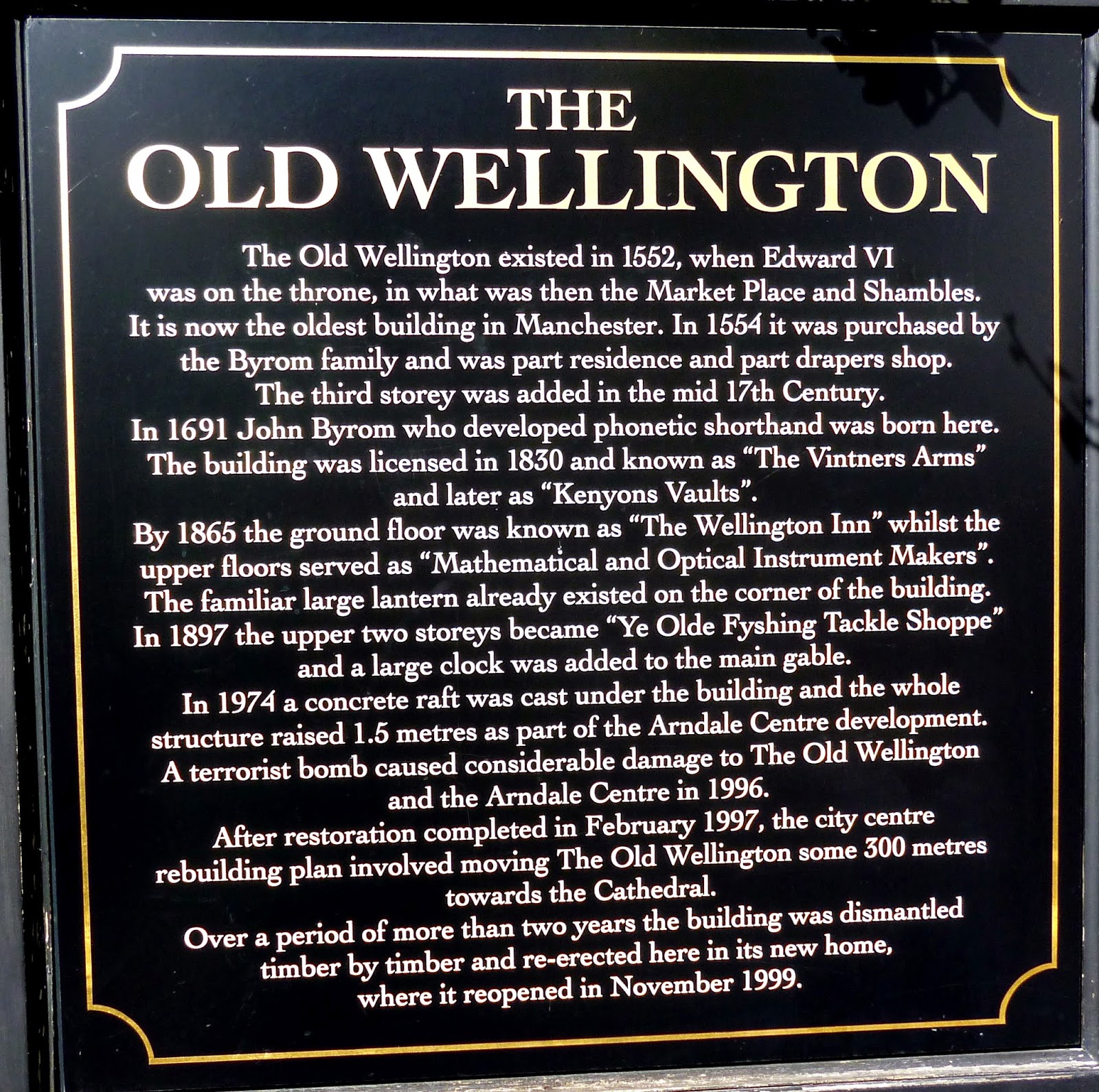
'THE
OLD WELLINGTON
The Old Wellington existed in 1552, when Edward VI was on the throne, in what was then the Market Place and Shambles. It is now the oldest building in Manchester. In 1554 it was purchased by the Byrom family and was part residence and part drapers shop.
The third storey was added in the mid 17th century.
In 1691 John Byrom who developed phonetic shorthand was born here.
The building was licensed in 1830 and known as 'The Vintners Arms'
and later as 'Kenyons Vaults'.
By 1865 the ground floor was known as 'the Wellingont Inn' whilst the upper floors served as 'Mathematical and Optical Maker'.
The familiar large lantern already existed on the corner of the building.
In 1897 the upper two storeys became 'Ye Olde Fyshing Tackle Shoppe' and a large clock was added to the main gable.
In 1974 a concrete raft was cast under the building and the whole structure raised 1.5 metres as part of the Arndale Centre development.
A terrorist bomb caused considerable damage to The Old Wellington and the Arndale Centre in 1996.
After restoration completed in February 1997, the city centre rebuilding plan involved moving The Old Wellington some 300 metres towards the Cathedral.
Over a period of more than two years the building was dismantled timber by timber and re-erected in its new home, where it reopened in November 1999.'
Byrom died in 1763, spending his later years in Stockport.
Charlotte Brontë in Manchester
Libellés :
Brontë (Charlotte),
Manchester (UK)
'CHARLOTTE
BRONTË
(1816–1855)
In 1846 The Revd. Patrick Brontë
came to Manchester for a cataract
operation accompanied by his daughter
Charlotte. They took lodgings at
59 Boundary Street West
(formerly known as 83 Mount Pleasant).
It was here that Charlotte began to
write her first successful novel
Jane Eyre.'
This plaque is on the Salutation pub in Higher Chatham Street in the Oxford Road area of central Manchester, although the pub would certainly not have existed at the time that Brontë stayed there.
My other Brontë posts:
–––––––––––––––––––––––––––––––––––
Haworth and the Brontës
Anne and Charlotte Brontë and Thackeray in Cornhill
20 April 2014
Hélène Grémillon: Le Confident (2010)
Libellés :
French Literature,
Grémillon (Hélène)
Le Confident (translated as The Confidant) is Hélène Grémillon's first novel and took her four years to finish. It concerns love and hate, lies and truth(s), fertility and (assumed) infertility, change and constancy, suicide and survival, desire and jealousy, all largely set against a backcloth of the lead up to – and then the reality of – the Second World War.
I used the word 'largely' in the sentence above because the novel begins in 1975 but has very long flashbacks to the war years. This is done in what could be called an epistolary format, although the letters are frequently so long that this doesn't read at all like a conventional epistolary novel.
Le Confident is thickly plotted with four voices, although two of these are in effect ventriloquized by one of those four. Camille lives in 1975 and her voice has a non-serif typeface, whereas while Louis physically exists in the same year he is particularly mentally preoccupied with the years between 1939 and 1943 and his voice is indicated by a serif typeface. Louis – in the same typeface – repeats two long sections using what he remembers of the words of his dead lover Annie. Finally – also in the same typeface – there is the long uninterrupted voice of Camille's dead mother as repeated through Louis again.
Camille's sections are short and mainly appear in the earlier parts of the novel, although they bookend the other voices.
Camille's mother has just died and among the letters of condolence is a long narrative written (he just mentions in passing) by someone called Louis. Louis continues to send passages of his story to Camille, who initially thinks he must be doing so in error. Eventually, though, she comes to realise that Louis is in fact writing about her mother's life, of someone she didn't even know was her mother. And that Camille's biological mother Annie became pregnant by the husband of 'Madame M.' (actually Elisabeth), her 'adopted' mother.
None of the story here would have been possible without Annie and Louis's love for each other, but that's, er, another story. This is a complex novel and it is one hell of a read.
18 April 2014
Tatiana de Rosnay: Spirales (2004)
Libellés :
French Literature,
Rosnay (Tatiana de)
A short way into Tatiana de Rosnay's Spirales I began to think of Ian McEwan's Saturday: the smelly underclass meets the well-heeled middle class and then things rapidly spiral downhill for the main character. I was appreciating this more than any McEwan, although by the end I was thinking of Amélie Nothomb's Tuer le Père, which was the book that put me off reading any more of Nothomb's books as I felt – well – cheated, short-changed.
15 April 2014
Shakespeare in Glossop, Derbyshire
Above of course is the very familiar figure of Hamlet reminiscing about Yorick, the king's jester, while staring at his skull. This statue niche is on the present Partington Players Theatre in Henry Street in Glossop.
The odd thing, though, is that the building began life not as a theatre but as the Glossop Liberal Club, Sir Edward Partington having laid the foundation stone in 1914 (although it wasn't completed until 1917).
14 April 2014
Delphine de Vigan: Rien ne s'oppose à la nuit (2011)
Libellés :
French Literature,
Vigan (Delphine de)
Delphine de Vigan's Rien ne s'oppose à la nuit (translated into English as Nothing Holds Back the Night) takes its title from the line 'Plus rien ne s'oppose à la nuit' in the late rock singer Alain Bashung's song 'Osez Joséphine', which was written by Bashung and Jean Fauque, and Vigan describes it as having 'a dark and daring beauty' that accompanied her throughout the time she was occupied in writing this book.
This is Vigan's 'livre de ma mère', essentially concerning her mother but necessarily also her mother's family and of course herself. The information is largely culled from people's memories, obviously including her own, and incorporates film, tapes, her mother's autobiographical writings, etc. Inevitably there must be some guesswork in the reconstruction, such as the fictionalization of dialogue.
The narrator calls her mother by her forename Lucile and describes her grandparents' household with its eventual total of nine children, although there were never nine at the same time.
Lucile's parents George and Liane and the rest of the family suffered three early losses: Antonin, who fell down a well at the age of eight; the adopted Jean-Marc, who was abused by his natural mother and died in bed from auto-erotic asphyxiation at fourteen; and Milo, who killed himself at twenty-eight and may have been involved in a suicide pact with two friends.
Lucile suffered from bipolar disorder, her daughter being used to trying to detect when a crisis would occur, when her mother would be re-admitted to a psychiatric hospital. The narrator mentions in passing that she too was briefly admitted to hospital for anorexia, which Vigan describes in Jours sans faim* (2001), translated as Days without Hunger and originally published under the pseudonym Lou Delvig.
It's quite possible that Lucile's life was traumatised by her father raping her at the age of sixteen, which is what she claimed, and the narrator finds two other women – one of them being another daughter – who were rather alarmed by George's behaviour towards them in their youth. But on the other hand Lucile's repeated written descriptions of the supposed rape don't exactly tally.
The narrator sometimes interrupts the narrative to describe how she went about finding her information and/or what difficulties she had in writing the book, and in passing she mentions Christine Angot's L'Inceste (for obvious reasons) and Lionel Duroy's Le Chagrin (as if fearing negative reactions within her own family – although certainly not from her sister Manon). Neither Marie Cardinal's Les Mots pour le dire nor Valérie Valère's Le Pavillon des enfants fous is mentioned, although there are similarities.
Towards the end of the book (and Lucile's life) the narrator says the doctor made the situation clear:
'either he put Lucile back in a chemical straitjacket, in which case she wouldn't have been able to work; or he gave her a chance to lead a normal life, and we had to accept that she expressed some irrational or suspicious ideas [...] "Like many people who aren't considered to be ill."'
She had the chance, but tragically it didn't last long.
At four hundred pages this book never flags, and it's even more riveting than the two earlier novels. I'm not too sure how she'll follow it up, but then Vigan's first directed film – À coup sûr – was released at the beginning of the year.
*The word 'faim' is pronounced the same as 'fin', and it's difficult not to see an intentional play on words.
Clip of 'Osez Joséphine', plus links to my earlier posts:
–––––––––––––––––––––––––––––––––––
Alain Bashung: Osez Joséphine
Delphine de Vigan: No et Moi
Delphine de Vigan: Les Heures souterraines
This is Vigan's 'livre de ma mère', essentially concerning her mother but necessarily also her mother's family and of course herself. The information is largely culled from people's memories, obviously including her own, and incorporates film, tapes, her mother's autobiographical writings, etc. Inevitably there must be some guesswork in the reconstruction, such as the fictionalization of dialogue.
The narrator calls her mother by her forename Lucile and describes her grandparents' household with its eventual total of nine children, although there were never nine at the same time.
Lucile's parents George and Liane and the rest of the family suffered three early losses: Antonin, who fell down a well at the age of eight; the adopted Jean-Marc, who was abused by his natural mother and died in bed from auto-erotic asphyxiation at fourteen; and Milo, who killed himself at twenty-eight and may have been involved in a suicide pact with two friends.
Lucile suffered from bipolar disorder, her daughter being used to trying to detect when a crisis would occur, when her mother would be re-admitted to a psychiatric hospital. The narrator mentions in passing that she too was briefly admitted to hospital for anorexia, which Vigan describes in Jours sans faim* (2001), translated as Days without Hunger and originally published under the pseudonym Lou Delvig.
It's quite possible that Lucile's life was traumatised by her father raping her at the age of sixteen, which is what she claimed, and the narrator finds two other women – one of them being another daughter – who were rather alarmed by George's behaviour towards them in their youth. But on the other hand Lucile's repeated written descriptions of the supposed rape don't exactly tally.
The narrator sometimes interrupts the narrative to describe how she went about finding her information and/or what difficulties she had in writing the book, and in passing she mentions Christine Angot's L'Inceste (for obvious reasons) and Lionel Duroy's Le Chagrin (as if fearing negative reactions within her own family – although certainly not from her sister Manon). Neither Marie Cardinal's Les Mots pour le dire nor Valérie Valère's Le Pavillon des enfants fous is mentioned, although there are similarities.
Towards the end of the book (and Lucile's life) the narrator says the doctor made the situation clear:
'either he put Lucile back in a chemical straitjacket, in which case she wouldn't have been able to work; or he gave her a chance to lead a normal life, and we had to accept that she expressed some irrational or suspicious ideas [...] "Like many people who aren't considered to be ill."'
She had the chance, but tragically it didn't last long.
At four hundred pages this book never flags, and it's even more riveting than the two earlier novels. I'm not too sure how she'll follow it up, but then Vigan's first directed film – À coup sûr – was released at the beginning of the year.
*The word 'faim' is pronounced the same as 'fin', and it's difficult not to see an intentional play on words.
Clip of 'Osez Joséphine', plus links to my earlier posts:
–––––––––––––––––––––––––––––––––––
Alain Bashung: Osez Joséphine
Delphine de Vigan: No et Moi
Delphine de Vigan: Jours sans faim
Delphine de Vigan: Les jolis garçons
13 April 2014
James Taylor in Royton, Oldham
Libellés :
Greater Manchester,
Oldham,
Royton,
Taylor (James)
'IN MEMORY OF
JAMES TAYLOR
"THE ROYTON POET"
WHO DIED 18TH SEPTEMBER 1863,
IN THE 70THYEAR OF HIS AGE.
AND OF MARY HIS WIFE,
WHO DIED 12TH MAY 1873,
IN THE 73RD YEAR OF HER AGE.'
According to a webpage written by a member of Royton Local History Society, James Taylor was born on the currently named Middleton Road near its junction with High Street. Beginning work as a handloom weaver, he moved on to a steam-driven cotton mill where he continued until he was sixty, when he began making shoe blacking and selling it from a shop near MIddleton Road.
He had no formal early education, his mother apparently fearing that he would turn into an irreligious radical, which he in fact did for a time before returning to the Christian fold.
Before the end of the 1820s he was writing poetry for magazines using the pseudonym 'poor poet'. He is most remembered for the poem 'On My Native Village' and shortly after his death a book – Miscellaneous Poems – was published by private suscription.
Taylor's grave was one of those moved from St John's graveyard in 1969, and is now in Royton Cemetery.
12 April 2014
Ian Curtis in Macclesfield, Cheshire
Libellés :
Cheshire,
Curtis (Ian),
Joy Division,
Macclesfield
I finally got round to visiting Macclesfield again: I made a post in 2009 explaining that while on the way to Atlanta (via Manchester airport) we were unable to find the kerbstone of Ian Curtis (1956–80) of the band Joy Division, although we made it to the important places in Elizabeth Gaskell's Knutsford.
Above is a photo of 77 Barton Street, Macclesfield, where Curtis lived and where he hanged himself in the back kitchen.
'IAN CURTIS
18-5-80
LOVE WILL
TEAR US APART'
The kerbstone memorial, which has perhaps become Macclesfield's most important feature and is certainly visited by many people from all over the world. Today was a rather miserable Saturday and no one else was there at the time of our visit:
But there was strong evidence that many people had visited in the recent past, leaving all kinds of tributes, including an old tee-shirt bearing the album cover from Unknown Pleasures (1979), which was recorded at Strawberry Studios, Stockport (featured in this blog earlier this year).
Elsewhere on this blog are photos of the graves of Martin Hannett, Rob Gretton and Tony Wilson in Southern Cemetery, Chorlton-cum-Hardy. Below I show photos of tributes above the kerbstone which attracted my attention.
My other Curtis-related posts:
–––––––––––––––––––––––––––––––––––
Mick Middles and Lindsay Reade: Torn Apart
Anton Corbijn's Control
9 April 2014
Tanguy Viel: Paris-Brest (2009)
Libellés :
Brest,
Brittany,
French Literature,
Viel (Tanguy)
Louis is seventeen and lives in a tiny apartment in Brest downstairs from his grandmother, who lives in a huge apartment and has been left eighteen million euros after the death of Albert, whose companion she was for three years. The young man's parents are in 'exile' in Palavas-les-Flots in Languedoc-Roussillon: Louis's father was vice-chair of Brest football team until fourteen million euros were found to have 'disappeared', and his father is continually insulted in the town for being responsible. After his daily dinner with his grandmother at the Cercle Marin – where Louis hates the right-wing old sailors and where his grandmother met Albert – his friend le fils Kermeur comes up to his apartment to join him and they drink wine.
Several years later – after Louis's parents have quietly returned to Brittany but not Brest, and have the ageing grandmother living with them – Louis returns from Paris for a few days over Christmas, although he cuts the visit short.
From the beginning it's clear that Louis doesn't like his parents, and his mother comes across as insufferable: she has always hated le fils Kermeur as a bad influence on Louis, and when she was in Palavas-les-Flots she used to ring her son every evening to check that he wasn't up to mischief. But he was.
We learn more about le fils Kermeur, of how he recruited Louis as a child into the petty theft of chocolate bars from a supermarket, and later how he encouraged Louis to burgle his grandmother's apartment. Shortly after the theft Louis left for Paris, where he rented a place in Paris overlooking Luxembourg. There, he fulfilled his ambition to be a writer.
Louis's 'family novel' is completed but must never see the light of day until his grandmother's death. It contains a great deal of information about Louis's family, and although it's fictionalised (with names and some facts changed) it to a certain extent falls in the relatively recent sub-genre of 'autofiction'. But this is not the book we're reading – which begins with a brief history of Brest – as the 'family novel' begins with grandmother's death.
Other things are different. In Paris-Brest they escape from the burglary with impunity, although in Louis's family book his mother finds le fils Kermeur out and is responsible for his imprisonment. When he gets out he seeks revenge and the whole of Louis's book leads up to le fils Kermeur cornering his mother in order to kill her. Obviously the reader now expects that this last part of Louis's book will come true and le fils Kermeur will in fact kill her in Paris-Brest.
But this is not to be and there's just a little bonfire of Louis's book. It's futile though, as he's caressing a memory stick in his pocket and will soon be back in Paris and out of his family's life for ever.
Interestingly, Tanguy Viel not only shares the same publisher as Laurent Mauvignier but is also a friend of his.
Links to my other Viel posts:
–––––––––––––––––––––––––––––––––––
Tanguy Viel: Insoupçonnable
Tanguy Viel: L'Absolue perfection du crime
Tanguy Viel: La Disparition de Jim Sullivan
8 April 2014
Olivier Adam: Les Lisières (2012)
Libellés :
Adam (Olivier),
French Literature
Lisières means fringes or edges, and in Les Lisières relates to a large number of things. Paul Steiner grew up in V., a town in Essonne on the fringes of Paris, although with his wife Sarah he moved to Brittany, to a town in Finistère, on the fringe of France.
My other posts on Olivier Adam:
––––––––––––––––––––––––––––––––––––
Olivier Adam: Je vais bien, ne t'en fais pas
Olivier Adam: Des vents contraires
Olivier Adam: Le Cœur régulier
Olivier Adam: Falaises
Olivier Adam: À l'abri de rien
Ian Cross: The God Boy (1957)
Libellés :
Cross (Ian),
New Zealand literature
Ian Cross's New Zealand classic The God Boy reads at first like a young adult novel, until you realise that this is interstitial literature narrated by a thirteen-year-old boy recalling his previous life, in particular the disturbing events which occurred when he was eleven: the truth is often between the lines, part of which others hide from him, part of which he hides in self-deception.
Annick Pérez: Je cherche Goldie (2002)
Libellés :
French Literature,
Pérez (Annick)
Tia – mysterious, young and beautiful – is allergic to reality. She ran away from the death of her sister Monique, from the doctor, from the funeral. She is now running towards Goldie, a mysterious man who has written a succès de scandale concerning the Shoah that has made him the enemy of many, and who now travels incognito. Tia doesn't really want to find him, though, as it would be horrifying to find the person she's looking for.
J. G. Ballard: Miracles of Life: Shanghai to Shepperton: An Autobiography (2008)
Libellés :
Ballard (J. G.),
London,
Shanghai,
Shepperton
Written quite a short time before his death from prostate cancer, J. G. Ballard's autobiography is relatively short, often amusing, and remarkably gentle on almost everyone, even – rather scarily for a republican such as Ballard – the Queen of England.
Véronique Olmi: Cet étè-là (2010)
Libellés :
Coutainville,
French Literature,
Olmi (Véronique)
There's a paragraph on pages 101 to 102 in Véronique Olmi's Cet étè-là when fifty-five-year-old Denis talks about his mother, who at times 'loses her head', and Denis asks himself 'why should words always exactly express our thoughts?'. He sees his mother as 'deconstruct[ing] the world and its logic', and they both find themselves laughing stupidly at something others tend to cry over. I found this a fascinating moment, although I have to say that it's the only moment in the book when I thought that Olmi was beginning to speak to me, to break out of the rather conventional content of the novel and begin to say something of real interest. There are certainly a number of moments of interesting psychological insights in the book, although I felt that this paragraph was never surpassed.
Right from the first paragraph we know that there's something wrong – at least from Denis's wife Delphine's point of view – with their marriage: as with 14 July holiday weekends for the last sixteen years, the couple have invited friends to join them at their holiday home in Coutainville on the Cotentin peninsula in the north-west, and Delphine thinks the more people there the better, as they put more distance between herself and Denis.
We know virtually from the beginning that Delphine is leaving Denis for good, and there are problems in the relationships of the other two adult couples. Lola is thirty-eight and regularly comes with a new boyfriend – this time it's with the twenty-six-year-old Samuel, who unsurprisingly comes across as somewhat immature to her: Lola can already see the end. And there are Nicolas and Marie, who are more Delphine and Denis's age, and have been married for many years, although for three years Nicolas has been keeping a secret from her: his breakdown was caused by the fact that he was most probably responsible for the suicide of a female teacher colleague who was having an illicit relationship with a male pupil.
The three couples are of varying financial circumstances, although they're all middle class, but with different reactions to the strange Caliban-type figure Dimitri, a surprisingly shy twenty-year-old who befriends Denis and Delphine's daughter Jeanne (aged sixteen). He's a young man of few – but very unsettling – words who will affect all the characters: Delphine is frightened for Jeanne's (sexual) safety, Nicolas fears that he's the brother of his dead colleague come to seek revenge, Lola is reminded of the child she had at sixteen whom she was forced to send away, etc. The major statement he makes is to say that the pine tree near Denis and Delphine's house is dying: the tree is the main thing that distinguishes the couple from the others, where people congregate, and is an important symbol of their little community.
Towards the end – after the traditional firework display in the village – there's the high drama of Jeanne going missing with Dimitri*, and then, well, nothing much at all: the end of the book is something of a damp squib.
*I forgot to mention that Jeanne doesn't seem to be interested in her smartphone too much. What? She's sixteen! Now that really is stretching credibility to its limits to make way for the plot.
–––––––––––––––––––––––––––––––––––
Véronique Olmi: Le premier amour
2 April 2014
Yann Moix: Partouz (2004)
Libellés :
French Literature,
Moix (Yann)
For the first time in a long time, I was unable to finish a book: that is indicative of the level of boredom to which I felt subjected by Yann Moix's Partouz.
Subscribe to:
Posts (Atom)
.jpg)
.jpg)
.jpg)

.jpg)
.jpg)
.jpg)

.jpg)
.jpg)
.jpg)
.jpg)